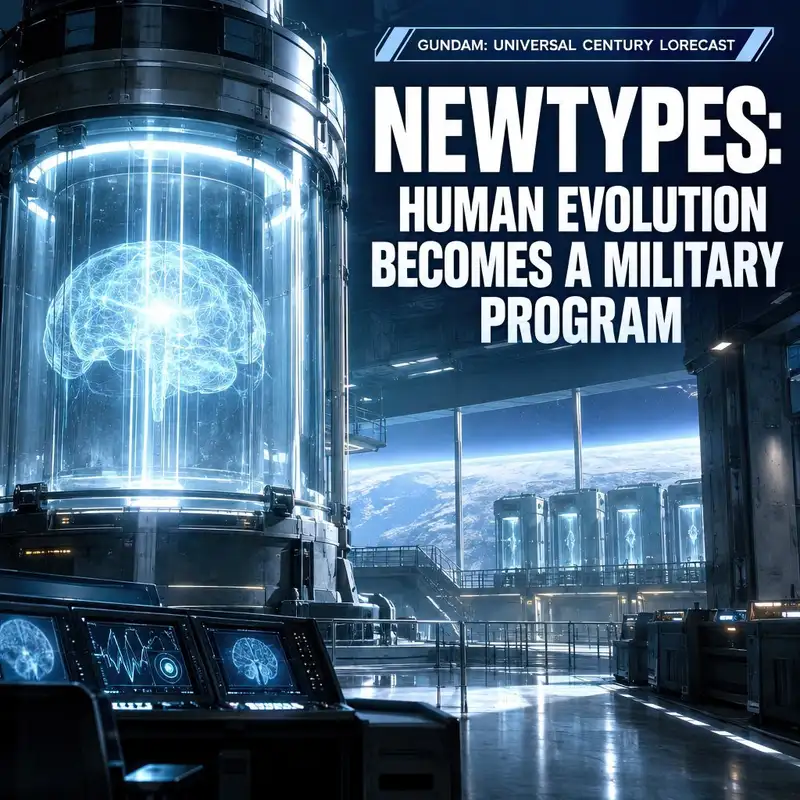
Newtypes: Human Evolution Becomes a Military Program
In Universal Century eighty-seven, the Psyco Gundam comes down on Hong Kong not as a miracle of engineering, but as a diagnosis of a political order. Inside it is Four Murasame, a young woman remade by a Federation Newtype research program into a Cyber Newtype pilot. The machine is immense, heavily armed, and built around psycommu technology that turns exceptional perception into firepower. But the military value of the system depends on what has been done to the person operating it. Four’s memories are disrupted. Her identity has been made conditional. Her usefulness is measured by whether she can be directed, stabilized, and returned to combat.
That is where the military history of Newtypes becomes difficult to separate from the moral history of the Universal Century. The word began as a hopeful political idea. It came to describe people who appeared capable of unusual awareness, perception, and connection. Then armies, laboratories, security services, and arms manufacturers began asking a different question. Not what such people might mean for humanity, but how their abilities could be identified, controlled, reproduced, and aimed at an enemy.
The result was not a clean technological revolution. It was a long series of improvised institutions. Some sought to study rare human potential. Some tried to manufacture it. Some built specialized weapons around it. Some used it to support political myths. Again and again, the Earth Sphere’s governments proved better at turning extraordinary people into military assets than at building the society that might have made the original Newtype ideal meaningful.
To understand why Four Murasame exists, we have to return to the older political meaning of the word Newtype. Before it became a research category, a pilot classification, or a label attached to expensive hardware, it was associated with the thought of Zeon Zum Deikun. Deikun’s ideas emerged from a world in which humanity had moved into space without resolving the political inequalities it had carried there from Earth.
That was a political philosophy, not a laboratory manual. Deikun did not provide a standard list of Newtype abilities. He did not establish a reliable test for identifying them. He did not leave behind a military doctrine explaining how a Newtype squadron should fight, how many such pilots a fleet required, or how a government could mass-produce expanded human awareness. The idea was aspirational. It connected the experience of living in space with a claim that Spacenoids might become something more politically capable than the institutions ruling them allowed.
War accelerated that process. During the One Year War, the idea of Newtypes encountered a military environment that made exceptional perception operationally valuable. Minovsky particle warfare disrupted long-range detection, communications, and targeting. Fleets could not always rely on the kind of distant sensing and centralized control that a conventional industrial military preferred. Combat moved closer. Identification became harder. Local initiative mattered more. Pilots and commanders often had to make decisions with incomplete information and little time to verify what they believed they were seeing.
That environment did not make normal military systems irrelevant. Fleets still required ships, fuel, ammunition, technicians, trained crews, repair facilities, and secure routes. Mobile suits still depended on carriers, hangars, recovery operations, and maintenance. Infantry, armor, artillery, and fixed defenses still mattered on Earth. But Minovsky conditions raised the value of a pilot who could process confusing information quickly, anticipate danger, maintain spatial awareness, or coordinate with a machine beyond ordinary controls.
Zeon research institutions saw an opportunity. The Flanagan Institute and related programs sought to convert rare human capacity into military advantage. Their work was not simply an effort to understand consciousness. It was an answer to a battlefield problem. If long-range systems had become unreliable, then a pilot capable of superior local awareness might restore an advantage that technology alone could no longer guarantee.
Psycommu systems were central to that effort. In broad terms, psycommu provided a way for a compatible pilot to control weapons and systems through a specialized mental interface rather than through ordinary mechanical controls alone. That made possible remote weapons such as bits, which could attack from multiple directions and complicate an enemy’s ability to understand where the threat was coming from. It also increased the burden on the pilot. The system did not remove the need for training, concentration, maintenance, power, or tactical judgment. It made the human operator more deeply embedded in the weapon system.
The military attraction was obvious. A compatible pilot could influence a wider volume of space than a conventional mobile suit pilot. A remote weapon system could threaten an opponent from outside the narrow geometry of a frontal exchange. Under Minovsky interference, when warning and coordination were already degraded, an all-direction attack could be profoundly disorienting. But the attraction came with a basic institutional problem. Compatible people were rare. The machines were specialized. The training was difficult. And the strategic value of a system dependent on a small number of exceptional individuals was uncertain.
Lalah Sune is the clearest example of how quickly a person could become the center of that contradiction. In the One Year War, she appears simultaneously as an individual with unusual sensitivity, as a pilot, as a subject of Newtype interest, and as a strategic asset in a conflict much larger than her own choices. Her role should not be reduced to the effect she has on Amuro Ray and Char Aznable. That relationship is important, but it can obscure the larger military history around her.
Lalah’s deployment in the Elmeth demonstrated what psycommu weapons could do when paired with an exceptionally capable pilot. The machine’s bits allowed attacks from shifting and difficult-to-predict directions. Against opponents without comparable awareness, this changed the immediate tactical problem. A conventional pilot could not simply face the enemy, evade, and return fire. The danger existed around the mobile suit, not just in front of it. The Elmeth turned perception, machine interface, and weapon geometry into a single combat system.
That did not mean Zeon had discovered a war-winning formula. The Elmeth’s performance depended on a rare pilot and a highly specialized machine. It did not solve Zeon’s strategic shortages, its political fractures, its increasingly desperate defensive position, or the broader imbalance between the Principality and the Federation’s capacity for mobilization. A remarkable weapon can transform a local engagement. It cannot automatically create a sustainable force structure.
The human cost was more serious still. Lalah was not a component whose value could be measured by the number of enemy machines she threatened. She was a vulnerable person drawn into the machinery of war and treated by powerful men and institutions as someone whose exceptional qualities might decide matters beyond her control. The One Year War repeatedly made young people into soldiers. Newtype research gave the process a more refined vocabulary, but it did not make it less exploitative.
Amuro Ray reveals the other side of the problem. If Lalah demonstrated the military potential of a specialized Newtype weapon system, Amuro demonstrated how difficult it was for an institution to reproduce exceptional performance when it emerged outside a controlled program. His growing awareness develops through combat, repeated exposure to danger, adaptation to the Gundam, contact with Lalah, and the brutal education of survival. The animated record does not present him as the finished product of a laboratory pipeline.
Amuro’s effectiveness was never just a matter of individual perception. He had access to a high-performance prototype in the Gundam. He fought alongside the White Base crew, which carried him, supplied him, repaired his machine, and survived enough battles to develop hard-earned cohesion. He benefited from the learning accumulated through repeated combat. He also operated within a wider Federation war effort that was gradually mobilizing industrial capacity, fielding new machines, and recovering from the shock of Zeon’s early offensive.
By Universal Century eighty-seven, major institutions had stopped waiting for rare talent to emerge on its own. The question was no longer only whether Newtypes existed. It was whether a state could manufacture a usable version of them. That question led directly to the kind of program that produced Four Murasame.
Murasame Labs was a Federation Newtype research facility operating during the Gryps Conflict. Its work belonged to a larger security environment in which the Titans sought to preserve order through surveillance, repression, and military force. The Titans presented themselves as guardians against instability and Zeon resurgence. In practice, their methods expanded the very resentments and resistance they claimed to suppress. Newtype research inside that system was not detached science. It was part of a coercive apparatus.
Four was a Cyber Newtype, meaning that her combat potential had been artificially induced or enhanced through modification and conditioning. The exact methods should not be reduced to a tidy technical recipe. The series makes clear enough that the process involves manipulation, trauma, disrupted memory, and institutional control. Her past is not merely background for a tragic pilot. It is evidence of what the program requires. The military seeks a controllable asset, and it treats identity as an obstacle to be removed or rearranged.
Cyber Newtype programs were an answer to a replacement problem. Natural Newtypes were scarce, unpredictable, and politically difficult to manage. They could not be ordered into existence on a production schedule. They could not be guaranteed to respond to conditioning in the desired way. An institution that wanted Newtype combat power without dependence on rare individuals therefore had an incentive to force the process. It could select vulnerable subjects, alter them, equip them with specialized machines, and hope that technology would stabilize what coercion had damaged.
The Psyco Gundam represents that logic in mechanical form. It is not just a powerful mobile armor. It is a massive psycommu weapon system built around one human subject. The design assumes that a person with artificially enhanced sensitivity can become the central processor for overwhelming firepower. This is an old military temptation in futuristic form. When an institution cannot create a reliable doctrine around a difficult human capability, it may build a larger and more elaborate weapon around the individual who has it.
That choice brings advantages. A machine like the Psyco Gundam can concentrate destructive power and exploit a Cyber Newtype pilot’s specialized responsiveness. It can terrify a city, disrupt enemy formations, and force an opponent to respond to a threat that ordinary units may struggle to handle. But it also creates a fragile command asset. The system depends on one pilot’s condition, one specialized machine’s maintenance, and a chain of control that may collapse under emotional stress, conflicting orders, or battlefield confusion.
Technical sophistication did not make the Titans strategically wise. A security state can produce advanced weapons while steadily destroying its own legitimacy. The Titans’ Newtype research did not resolve colonial resentment, Federation corruption, or the political crisis that followed the One Year War. It added another layer of abuse to an already failing system. The organization could classify its programs, deploy its machines, and impose temporary control through force. It could not make coercion into consent.
Four’s combat value therefore becomes inseparable from the question of command. What happens when a pilot senses danger, intention, or emotional connection in ways the formal chain of command cannot verify? What happens when the people directing her understand her as a weapon platform rather than as a person capable of making her own judgments? The answer is not simply instability. It is institutional failure. A system built on damaged identity cannot expect reliable loyalty, clear judgment, or humane outcomes.
Kamille Bidan offers a contrast, though not a simple one. Kamille’s Newtype sensitivity develops through conflict, loss, and relationships rather than through a dedicated enhancement program. He is not the creation of Murasame Labs. His abilities do not arrive as a predictable military product. They emerge unevenly, often painfully, in a war that places extraordinary burdens on young people.
The Anti-Earth Union Group, or A E U G, should not be romanticized as an organization outside the military use of human potential. It fights the Titans with mobile suits, warships, covert movement, and advanced technology. It also recognizes Kamille’s value as a pilot. The difference is not that one side uses Newtype-capable people and the other does not. The difference is that Four’s program attempts to manufacture combat performance by subordinating the person to the machine and the command structure.
Kamille’s connection with Four exposes the moral weakness of that approach. Her memories and emotions are not defects in a weapons platform. They are the substance of her personhood. The program’s failure lies in believing that a soldier can be made more controllable by severing that person from history, family, memory, and choice. In the short term, coercion may produce compliance. In the long term, it produces damage that no amount of technical sophistication can fully contain.
The Zeta period also requires care in discussing technology. Psycommu and bio-sensor systems both concern the relationship between human perception and machine response, but they are not interchangeable. Psycommu systems are associated with direct mental control and remote weapon use by compatible pilots. The bio-sensor, as presented in this period, is another form of advanced pilot-machine responsiveness. It should not be treated as a universal substitute for psycommu, nor should every unusual response from a mobile suit be assigned the same technical explanation.
The important point is institutional rather than terminological. By the Gryps Conflict, the arms race had moved beyond the question of whether certain people possessed unusual sensitivity. Competing organizations were building machines designed to exploit that sensitivity. The pilot was becoming part of the guidance system, the sensor suite, the targeting process, and the political symbolism of the weapon.
The end of the Gryps Conflict did not end that competition. It scattered personnel, machines, research experience, and political ambitions across a fractured Earth Sphere. In Universal Century eighty-eight, Gundam ZZ shows Newtype-capable pilots becoming central to Neo Zeon’s military culture, leadership image, and internal struggles for authority. The idea had moved well beyond its earlier philosophical origins. Newtype status was now associated with prestige, succession, elite warfare, and the claim to lead others through an age of crisis.
Haman Karn’s Qubeley is a clear example of a mature Newtype-use mobile suit. Developed on Axis and equipped with funnels, it allows a compatible pilot to extend attacks beyond the ordinary forward arc of a mobile suit engagement. This gave Haman formidable tactical reach. It also reinforced her political image. She was not merely a commander issuing orders from a distant headquarters. Her personal combat capability became part of the authority she projected.
But a machine like the Qubeley did not make fleets, ground forces, logistics, or ordinary pilots irrelevant. Neo Zeon still needed transports, bases, resupply, political control over colonies, and cooperation from populations that did not necessarily share its ambitions. A leader’s personal power can create fear and loyalty. It cannot by itself solve the problem of governing territory or sustaining war.
The pressure to manufacture exceptional pilots also continued. The various enhanced individuals used by Neo Zeon demonstrate that the Federation had not held a monopoly on exploitation. Different factions reached similar conclusions because they faced similar military incentives. Natural Newtypes were scarce. Their abilities could not be scheduled. Their independence could be inconvenient. Cyber Newtype programs promised a controlled answer, even when that promise repeatedly produced instability, trauma, and waste.
By Universal Century ninety-three, Char’s Rebellion brought this military competition together with a more advanced form of human-machine integration. Char’s Neo Zeon employed Quess Paraya and Gyunei Guss as valuable Newtype assets. Both possessed agency, fears, ambitions, and personal histories. Yet both were also treated by the war around them as pieces in a larger political and military design.
Quess is especially revealing because she is young, volatile, and searching for meaning in a world of powerful adults and collapsing institutions. Char recognizes her potential, but recognition does not equal care. A commander who sees a young person’s value primarily through the lens of military usefulness is repeating the logic that had shaped Newtype warfare since the One Year War. The rhetoric may be more sophisticated. The machine may be more advanced. The human relationship remains dangerously unequal.
Gyunei, meanwhile, represents a different kind of pressure. He is a Cyber Newtype, a combat asset whose position is shaped by artificial enhancement, rivalry, and the need to prove usefulness within Char’s force. His presence shows that even an organization claiming revolutionary purpose still sought controllable, deployable forms of exceptional human ability. Political grievance and military exploitation continued to coexist.
On the other side, Amuro Ray operated the Nu Gundam, a dedicated Newtype-use mobile suit developed with his involvement. Its fin funnels gave it the capacity for remote, all-direction attacks, while its partial psycho-frame construction represented a further integration of psycommu functions into the machine itself. The Nu Gundam was not simply a better Gundam. It was a design shaped around the problem of allowing a Newtype pilot to process, direct, and survive combat at a level beyond ordinary mobile suit systems.
Psycho-frame requires careful treatment. It is not merely a stronger form of armor, and it is not identical to every earlier psycommu system. It is a material and interface technology in which psycommu-function computer elements are incorporated at a microscopic level within the machine’s structure. The practical military promise is clear enough. The system could potentially make the connection between pilot and machine more immediate, more responsive, and more pervasive.
But the full properties of psycho-frame remain unresolved even within later records. It cannot be reduced to a routine upgrade that any army can install, maintain, and deploy across an entire fleet. The material is specialized. Its effects depend on circumstances that institutions do not fully understand. Its most famous outcome, the Axis Shock, demonstrates precisely why caution is necessary.
At the end of Char’s Rebellion, the attempt to divert Axis produces an event that exceeds ordinary tactical explanation. The film shows an extraordinary convergence of human intent, psycho-frame technology, and Newtype resonance. The immediate result is real within the record. Axis is pushed away from its catastrophic course. But the mechanism is not converted into a settled scientific formula. No commander emerges from the event with a reliable doctrine for reproducing it on demand.
The Axis Shock did not validate Char’s political strategy. His plan depended on mass death and coercive environmental politics, on treating catastrophe as a means of forcing history forward. Whatever the extraordinary event revealed about human connection or psycho-frame resonance, it did not transform that strategy into wisdom. Exceptional technology could not compensate for a catastrophic political choice.
The aftermath of Char’s Rebellion left the Earth Sphere with a different problem. It was no longer enough to ask how psycho-frame might be used. The question became who could control the meaning of its existence. If the technology suggested that human consciousness could affect machines and events in ways conventional institutions could not explain, then it threatened systems built on secrecy, hierarchy, and monopoly over force.
Gundam Unicorn, set in Universal Century ninety-six, places this problem in explicitly political terms. The Universal Century Charter contains language recognizing the existence and rights of Newtypes. That matters because it moves the question beyond laboratories and cockpits. If Newtypes have rights, then they cannot be treated merely as classified military resources, elite pilots, research subjects, or symbols for political movements.
Yet recognition on paper does not automatically change the distribution of power. The political order of the Earth Sphere remains shaped by concealment, entrenched authority, and fear of destabilization. Those who benefit from the existing system have reasons to suppress information that might challenge their legitimacy. The struggle around Laplace’s Box is therefore not just a dispute over historical documents. It is a dispute over whether the political promise associated with Newtypes will remain symbolic or become a basis for real institutional change.
The Unicorn Gundam and its opposing psycho-frame systems demonstrate the continuing military attraction of this technology. Full psycho-frame mobile suits are capable of effects that exceed ordinary human understanding. They can become focal points for resonance, perception, and destructive potential on a scale that alarms every institution near them. But the fact that such machines exist does not mean their capabilities are fully understood, standardized, or safely controllable.
The temptation is to interpret psycho-frame as the final solution to the old Newtype problem. If earlier psycommu systems depended on rare pilots and complicated interfaces, perhaps psycho-frame could finally place extraordinary responsiveness inside the machine itself. But the events of Unicorn point in the opposite direction. The more deeply institutions attempt to integrate human consciousness with weapons technology, the more they encounter effects that cannot be reduced to procurement schedules or command procedures.
Anaheim Electronics is important in this history, but it should not be imagined as an all-powerful hidden sovereign. The company is a major industrial actor with access to advanced manufacturing, military customers, technical expertise, and political influence. It builds and supplies systems for competing sides because conflict creates demand and governments need industrial capacity. That makes Anaheim strategically significant. It does not mean every political decision in the Earth Sphere originates in a corporate boardroom.
The more revealing pattern is the relationship between industry and uncertainty. A company can manufacture a component, assemble a mobile suit, maintain a production line, or support a research program. It cannot guarantee that a rare human response will occur in the field. It cannot mass-produce trust between people who have spent generations divided by war, colonial inequality, and political fear. The industrial system can build increasingly intimate interfaces between person and machine. It cannot manufacture the political conditions that would make those interfaces unnecessary as weapons.
By Universal Century ninety-seven, Gundam Narrative shows the containment state in action. The Phenex becomes the focus of competing efforts by Federation authorities, the Republic of Zeon, remaining Sleeves forces, Luio and Company, and researchers with different interests in possession, study, suppression, and exploitation. The struggle is not simply over a mobile suit. It is over a legacy that threatens to escape conventional military categories.
The Phenex is tied to psycho-frame phenomena that remain difficult to explain. The film does not provide a final metaphysical theory of Newtypes, consciousness, or the apparent persistence of human presence beyond ordinary limits. Instead, it shows institutions operating under uncertainty. Some want to secure the phenomenon before rivals can use it. Some want to hide it. Some want to study it. Some see it as a source of power, proof, or profit.
This is a familiar intelligence problem. When an institution encounters a capability it does not fully understand, it often responds by classifying it, compartmentalizing knowledge, and trying to establish exclusive control. That can reduce an immediate risk. It can also preserve the conditions for the next crisis. Secrecy protects programs. It protects reputations. It protects political arrangements that might not survive open scrutiny. But it also encourages duplication, rivalry, and the belief that safety lies in possessing a greater secret than the other side.
Narrative therefore does not show the final mastery of Newtype technology. It shows the opposite. Decades after the Flanagan Institute, Murasame Labs, the Psyco Gundam, the Qubeley, the Nu Gundam, and the Axis Shock, the Earth Sphere is still trying to turn extraordinary human potential into something manageable. The methods have changed. The institutions have changed. The underlying reflex has not.
For that reason, the military history of Newtypes is not a story of humanity transcending conflict. It is the story of institutions repeatedly recognizing extraordinary human potential and then attempting to own it. Zeon Zum Deikun’s original political vision associated life in space with the possibility of greater awareness and understanding. The wars that followed found a more immediate use for that possibility. In Minovsky-era combat, perception could become a tactical advantage. Psycommu could direct remote weapons. A rare pilot could alter the outcome of an engagement.
Those military effects were real. Newtype-capable pilots could demonstrate unusual spatial awareness, heightened responsiveness, empathy, communication, or compatibility with advanced interfaces. But these qualities did not form one fixed package. They did not make their possessors morally superior. They did not guarantee sound command judgment. They did not replace fleets, logistics, maintenance, training, or political legitimacy.
The tactical value was clear enough. Better awareness and faster response could change a duel, protect a ship, break an ambush, or make a remote weapon system devastatingly effective. The operational value was much harder to sustain. Newtype-use machines required specialized components, skilled technicians, compatible pilots, and commanders willing to trust information they could not always verify. A force built around rare talent faced immediate problems of replacement, command, recovery, and control.
The strategic value was more limited still. No Newtype program solved the Earth Sphere’s underlying conflicts. Zeon’s exploitation of Newtype language did not make dictatorship or aggressive war legitimate. The Federation’s research programs did not cure its political complacency or colonial inequality. The Titans’ technical sophistication did not preserve public trust. Neo Zeon’s elite warfare did not create durable governance. Char’s psycho-frame age did not make mass-casualty politics acceptable. Later containment efforts did not erase the institutions that had repeatedly weaponized human difference.
The moral cost fell most heavily on people who were young, displaced, traumatized, isolated, or politically vulnerable. Lalah, Four, Quess, Gyunei, and many others were not simply evidence in an argument about weapons development. Their lives reveal what happens when military institutions regard memory, grief, sensitivity, and identity as variables to be adjusted for performance. Cyber Newtype programs were not failures because their subjects lacked enough power. They were failures because they treated human beings as defective components in search of a more reliable weapons system.
Psycommu, bio-sensor systems, psycho-frame, and other technologies each represented an attempt to make exceptional human capacity repeatable. They produced remarkable machines. They also produced secrecy, coercion, unstable command relationships, and an escalating belief that political problems could be solved by building a more intimate connection between a person and a weapon.
The original hope behind the Newtype idea was that life in space might expand humanity’s capacity to understand one another. The military program reversed that promise. It treated understanding as a targeting advantage, empathy as a control interface, and human growth as a resource to be captured by the state. The Universal Century repeatedly mistook the ability to weaponize extraordinary people for the ability to build a society worthy of them.