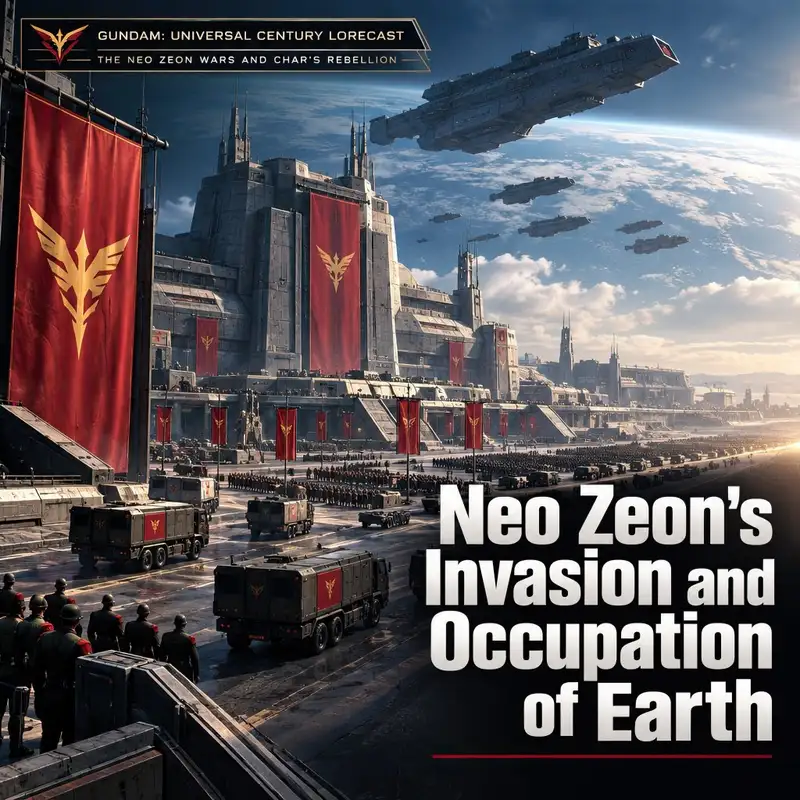
Neo Zeon’s Invasion and Occupation of Earth
Over Dublin, the problem was no longer how to win a battle. It was how many people could be moved before a falling colony turned a living city into a weapon. The Earth Federation’s political leadership had gathered there. Civilians still filled its streets, hospitals, transport routes, and shelters. Karaba’s Audhumla was not simply carrying mobile suits into another engagement. It was serving as an emergency command post, transport, and evacuation vessel while the Argama and the Gundam Team tried to buy time against Neo Zeon forces. Above them, Haman Karn’s government was using a colony drop to make a political argument in the most brutal form possible. Neo Zeon did not need to occupy every country, city, and transport network on Earth to dominate the moment. It needed to prove that the Federation could not protect its own political center, and that refusing Neo Zeon’s demands could carry an unbearable civilian cost.
That is the central fact of Neo Zeon’s invasion of Earth during the First Neo Zeon War. Haman Karn’s forces achieved real military and political leverage, but they did not conquer the planet in the conventional sense. Their occupation was selective. It depended on a few key points of control, a concentrated expeditionary force, cooperation from local armed groups, remnants of older Zeon formations, and a Federation leadership too exhausted to respond with confidence. This was coercion backed by occupation, not an orderly replacement of one planetary government by another. The distinction matters. A state can be forced into concessions without being destroyed. A capital can be seized without the population being governed. And terror can compel obedience for a time without creating the institutions, legitimacy, or administrative reach required for durable rule.
Neo Zeon’s opportunity came from the wreckage of the Gryps Conflict. The Earth Federation had survived its struggle with the Titans, but survival was not the same as recovery. Its political authority had been damaged by the existence and conduct of the Titans. Its military institutions had fought each other. Its public credibility had been weakened by repression, internal violence, and the revelation that the Federation’s own security apparatus could become a threat to the people it claimed to defend. The anti-Titans coalition had also paid heavily for victory. The Anti-Earth Union Group, or AEUG, had lost experienced personnel, ships, and combat power. The Argama was damaged. Several of its most important pilots were dead, absent, or no longer capable of sustained operations. Kamille Bidan, whose abilities had mattered greatly in the final phase of the Gryps Conflict, was incapacitated.
The Earth Federation Forces did not disappear. Local garrisons, bases, ships, and regular units remained. But the Federation did not emerge from Gryps as a unified military instrument ready to conduct a fresh planetary campaign. Its civilian leadership, military commands, and surviving anti-Titans allies were not operating from a position of common confidence or clear political purpose. That gap between formal power and usable power was what Haman Karn exploited. Neo Zeon did not have to defeat an intact Federation at full readiness. It had to move before the Federation rebuilt political cohesion, before the AEUG recovered, and before the temporary alliances formed against the Titans could turn into a coherent defense of Earth.
Axis had become Neo Zeon under Haman’s leadership, with Mineva Lao Zabi serving as the dynastic figure at the center of its claim to legitimacy. Haman was Mineva’s regent, but she was also the practical leader of the movement, directing its military and political strategy. Her aim was larger than preserving an asteroid refuge or reviving the memory of the old Principality of Zeon. She sought to establish Neo Zeon as the decisive power in the Earth Sphere. That required recognition, territory, and the ability to compel the Federation to act on Neo Zeon’s terms.
Yet Neo Zeon’s strength should not be overstated. It had an organized military core inherited from Axis, capable officers, warships, mobile suits, and the political momentum created by the Federation’s crisis. It was not an unlimited force capable of stationing reliable garrisons across an entire planet. Earth was too large, too populated, and too institutionally complex for that. Its surface contained major cities, agricultural zones, transport networks, local authorities, military installations, industrial centers, and communities with different relationships to the Federation and to Zeon’s past. A smaller force could dominate selected points, especially when its opponent hesitated. It could not simply paint a new color over Earth and call that government.
Haman’s strategic advantage was concentration. A force does not need to be numerically superior everywhere if its enemy is dispersed, politically divided, and reluctant to escalate. Neo Zeon could choose where to make itself visible. It could put its best units and most intimidating weapons at points whose political value exceeded their physical size. It could exploit the memory of the One Year War, the fear of renewed mass destruction, and the Federation’s desire to avoid another conflict on that scale. But concentration also had a cost. It meant that Neo Zeon’s authority depended heavily on the credibility of its threats and on the ability of its commanders to keep local allies, former Zeon soldiers, and newly occupied populations under control.
In August of Universal Century eighty-eight, Neo Zeon converted opportunity into physical presence through a major descent operation to Earth. The Argama and Judau Ashta’s Gundam Team attempted to interfere as the Neo Zeon fleet began atmospheric entry. The operation mattered because descent from orbit is not merely a dramatic change of scenery. It requires ships capable of reaching the planet, timing the entry, deploying forces, preserving equipment, and then connecting those forces to bases, supply routes, repair facilities, and local political support. Mobile suits can provide sharp tactical power during entry and after landing. They do not eliminate the need for transport, maintenance, communications, medical support, or a place to refuel, rearm, and recover damaged machines.
Neo Zeon succeeded in getting forces down despite AEUG resistance. That was a meaningful operational success. It gave Haman a terrestrial foothold and allowed her government to turn orbital power into direct political pressure on the surface. But the television record does not establish a complete map of Neo Zeon control, nor does it show a conventional conquest of every region of Earth. It shows a major landing, subsequent operations in Africa, the seizure of politically important locations, and the exploitation of a weak opponent. The important point is not that Neo Zeon somehow controlled every square kilometer. The important point is that it did not need to. Its strategy was built around the selective control of decisive places and the public demonstration that Federation protection could fail.
Once Neo Zeon forces were on Earth, their problem changed. Entry had been difficult, but entry was only the beginning. The larger challenge was extending influence without enough manpower to administer the planet directly. Here, Neo Zeon benefited from networks that had survived from earlier wars and from local groups pursuing their own agendas. Former Zeon soldiers remained active in some regions. Units associated with Desert Rommel and the Blue Corps carried their own histories, loyalties, equipment, and reasons for continuing to fight. These were not simply identical extensions of Haman’s command. Some retained old military identities. Some saw Neo Zeon as a chance to preserve status or regain influence. Some were trying to survive in a political environment where the old war had never really ended for them.
Neo Zeon also worked with regional movements such as the African Liberation Front. These relationships gave Haman’s forces access to local knowledge, armed manpower, bases, guides, and political entry points. That kind of partnership can multiply the reach of an expeditionary army. A small outside force may secure airfields, roads, ports, towns, or communication routes more effectively when local fighters know the terrain and understand the political fractures of the region. But partnership is not the same as obedience. Local movements have local aims. Their grievances may be real, but they are not necessarily identical to the objectives of the outside power supplying them.
Gadeb Yasin’s faction illustrates the danger. He presents his struggle in terms of African independence, but his willingness to target a town populated by people he regards as foreign occupiers reveals how liberation rhetoric can become a cover for collective violence. Neo Zeon officer August Gidan uses that faction for Neo Zeon’s purposes, but he does not erase its independent motives. This is a recurring problem in occupation warfare. A stronger patron can arm and encourage local allies because they are useful. It may later discover that those allies have their own enemies, their own score-settling, and their own ideas about which civilians count as legitimate targets. Such arrangements can expand influence quickly. They rarely produce disciplined and coherent governance.
For Haman Karn, the most valuable targets were not necessarily the largest or most heavily defended places. They were the places that represented authority. Dakar mattered because it was the Earth Federation’s political capital. To take Dakar, or to force its leaders to yield under military pressure, was to demonstrate that the Federation could not secure the center of its own government. The symbolic effect extended far beyond the streets physically occupied by Neo Zeon units. Every local authority, Federation officer, civilian official, and political movement would have to reassess what Federation power actually meant if its capital could be threatened or taken by an enemy expeditionary force.
Haman personally led the descent to Earth and used military intimidation to take Dakar. The television account emphasizes the result and its political impact more clearly than it provides a detailed record of a conventional urban assault. There is no reason to invent an exact order of battle or a street-by-street campaign that the series does not establish. What is clear is that Neo Zeon placed the Federation under pressure at its political center and made that pressure effective. Dakar was not important because it held every Federation military asset. It was important because it held the visible machinery of civilian authority.
Tactically, Dakar demonstrated that Neo Zeon could place forces where the Federation did not expect or could not immediately stop them. At the operational scale, it disrupted decision-making and forced the Federation to address an immediate crisis while still recovering from the Titans. At the strategic scale, it made a much larger government appear vulnerable to a smaller challenger. Politically, it created leverage. Governments do not make decisions only according to the number of tanks, ships, or mobile suits available on paper. They make decisions according to what they believe they can protect, what risks they can accept, and what their public will tolerate. Haman understood that a threatened capital could alter all three.
The Federation government responded not with an immediate, unified counteroffensive, but with accommodation. It accepted major concessions, including the transfer of Side Three to Neo Zeon. The exact constitutional procedures, internal votes, and bureaucratic negotiations are not fully detailed in the television series. The outcome, however, is clear enough. A weakened Federation leadership chose to buy time or avoid a wider war by conceding the former Zeon homeland. That decision should not be described as proof that every Federation official supported Neo Zeon, or that all Federation military personnel had surrendered. It was a political decision made under pressure, by a government attempting to contain a crisis it did not feel prepared to fight on conventional terms.
There was a certain logic to the concession. The Federation had just endured a civil conflict. Its leaders had seen what internal militarization could do. They faced a force with credible military capability, a powerful political symbol in Mineva, and a leadership willing to exploit the fear of mass war. Giving up Side Three may have seemed less dangerous than beginning another general conflict across the Earth Sphere. But an accommodation that prevents immediate fighting can still carry severe strategic costs. It told Neo Zeon that coercion worked. It told local actors that Federation promises might be negotiable under pressure. And it damaged the Federation’s legitimacy among those who expected the government to defend its territory and citizens.
The concession also changed the incentives of Neo Zeon itself. If military intimidation could produce recognition and territory, then the temptation was to continue escalating pressure. This is the strategic trap of appeasement under direct coercion. A concession may delay conflict, but it can also persuade the coercing power that its threats are producing results. That does not mean every compromise is cowardice. Governments sometimes compromise because the alternative is worse. But a government that cannot make its concessions look temporary, controlled, and politically defensible risks appearing unable to act at all. Haman’s government had learned that the Federation could be compelled. Dublin would show how far Neo Zeon was willing to go to preserve that advantage.
The colony drop on Dublin in late October was not simply another strike against a military objective. It was a political weapon aimed at an entire population and at the leadership that claimed to govern it. Haman’s purpose was to demonstrate Neo Zeon’s power and force compliance from the people of Earth and their government. In that sense, Dublin was coercive theater on a catastrophic scale. The target was not an isolated fortress or a fleet anchorage. It was a city full of civilians, infrastructure, institutions, and people trying to live through a war that had already repeatedly treated Earth as a prize to be fought over.
This must be distinguished from Operation British and from every other use of colonies or asteroids as strategic weapons. The Universal Century contains several different mass-casualty operations, each with its own context and purpose. Dublin was Neo Zeon’s act in this war, at this moment, intended to prove that the Federation’s concessions had not ended Neo Zeon’s ability to impose its will. Its logic was brutally simple. Neo Zeon lacked the manpower to police every community. Terror could do some of that work for it. If the Federation could not stop a colony from falling on a political city, then no official promise of security would sound convincing.
The military calculation was inseparable from the moral reality. A colony drop is not merely a large projectile. It is an act that converts an immense piece of human infrastructure into an instrument of destruction. Whatever its condition before it was used, the effect on Dublin was measured in homes, hospitals, families, transport systems, and the physical fabric of a city. Neo Zeon’s leadership could describe this as demonstration or compulsion. The people beneath it experienced it as mass violence. The act widened the gap between any claim that Neo Zeon represented liberation and the conduct of a regime prepared to punish civilians in order to secure political compliance.
That did not make the operation strategically meaningless. Terror can produce real short-term effects. It can paralyze decision-makers, disrupt administration, create refugee flows, force military units into rescue duties, and persuade frightened local leaders to reconsider resistance. But terror is poor material for building a state. It may compel a signature, a withdrawal, or a public statement. It does not automatically create tax collectors, engineers, schools, reliable courts, food distribution, loyal security services, or trusted local governments. It does not solve the problem of administering communities that have seen what happens when they are treated as a message to someone else.
The resistance around Dublin reveals what opposition looked like when no intact conventional army was ready to intervene. The AEUG’s surviving forces were not capable of replacing the Earth Federation’s entire defense establishment. The Argama and the Gundam Team were a mobile intervention force, not a planetary field army. They could strike, pursue, defend, and disrupt. They could not deploy enough troops to secure every evacuation route, intercept every threat, or hold every city under attack. Karaba was equally important, but in a different way. It provided terrestrial networks, local contacts, transport capacity, and an organizational bridge between armed resistance and the people trying to survive on the ground.
The Audhumla represented that broader role. It was a carrier and a command platform, but it was also an evacuation asset. Its value did not lie only in how many mobile suits it could launch. It could move people, coordinate rescue, support resistance operations, and provide a point of connection between Karaba’s local presence and the AEUG’s mobile combat capability. In a crisis like Dublin, transport and command were as important as firepower. A machine can defend an evacuation corridor for a few minutes. A ship can move civilians out of the danger zone, relay information, carry medical personnel and supplies, and keep a scattered rescue effort from becoming a series of isolated acts of desperation.
Neo Zeon forces under Rakan Dakaran contested those efforts. The Gundam Team fought to protect the evacuation operation and to interfere with the enemy’s ability to complete its mission. These tactical engagements mattered, but they should not be mistaken for the whole event. The central mission was civilian survival. The resistance could save people, disrupt Neo Zeon formations, and demonstrate that Haman’s forces were not operating without opposition. It could not prevent the colony from striking Dublin. That is one of the harsh realities of humanitarian operations in war. A rescue mission can be worthwhile even when it cannot avert the catastrophe that made rescue necessary.
Hayato Kobayashi’s death belongs in that operational context. He was not simply another veteran removed from the story, nor was his loss merely an emotional punctuation mark. His death came during an effort to protect Judau and sustain the wider evacuation mission. Karaba lost an experienced leader at the moment when experienced people were already scarce. The cost was personal, but it was also institutional. Resistance movements and improvised coalitions depend heavily on individuals who understand both military action and local networks. When those people are killed, the loss affects command, trust, and continuity as much as it affects morale.
The Dublin operation produced different outcomes at different levels. Tactically, the AEUG and Karaba could fight back and save some civilians. At the mission level, they could reduce the human cost but not prevent the impact. Operationally, the Audhumla and Karaba remained important because they preserved a mobile Earth-based capacity to resist and evacuate. Strategically, however, Neo Zeon achieved its immediate demonstration of power. It showed that a limited force with access to a strategic weapon could impose a crisis on a far larger government. Politically, the atrocity exposed the nature of Haman’s coercive strategy. It made compliance more likely in the immediate aftermath, but it also made Neo Zeon harder to regard as a legitimate alternative to Federation rule.
Judau, Ple, and the incapacitated Kamille experience extraordinary Newtype-related perceptions during this period, but those experiences should not be mistaken for a substitute command network. They matter to the human drama and to the way particular individuals understand danger. They do not provide a fleet headquarters with a dependable map, a civilian evacuation system with secure communications, or an army with a replacement structure. One of the recurring errors of the Universal Century is the belief that exceptional people can compensate indefinitely for broken institutions. They cannot. They can sometimes save lives in a moment. They cannot make a coercive occupation into a functioning government.
Neo Zeon’s difficulty was structural. It had enough power to seize Dakar, influence African operations, demand concessions, and make a city an example. It did not have the demonstrated capacity to govern Earth as a stable political community. Control of a capital did not equal control of transport networks, food systems, industrial production, local administrations, military bases, and public loyalty across the planet. Neo Zeon’s troops and mobile suits still required ships, maintenance, ammunition, replacement personnel, communications, medical support, and secure places to operate. The more widely Haman spread her available forces, the more she would depend on local intermediaries whose loyalty could not be assumed.
The local allies who extended Neo Zeon’s reach also limited its control. Former Zeon formations had their own traditions and resentments. Regional liberation movements had their own political programs. Titans remnants brought their own baggage and ambitions. Field commanders could interpret political orders through the narrow demands of the moment. An occupation based on fear requires disciplined command, because every undisciplined act of violence can create more resistance than it suppresses. Yet Haman’s coalition was not a single professional bureaucracy with a shared long-term vision. It was a wartime assembly of forces linked by opportunity, coercion, ideology, personal loyalty, and the expectation that Neo Zeon might prevail.
This did not make Haman an incompetent strategist. On the contrary, her Earth campaign showed a clear understanding of political pressure. She recognized that the Federation’s apparent strength concealed exhaustion and indecision. She recognized that Dakar’s symbolic importance could magnify a limited military success. She recognized that local armed networks could extend Neo Zeon influence without requiring an impossible number of occupation troops. And she recognized that a mass-casualty threat could force opponents to make choices they would otherwise reject. The problem was that these methods created leverage without solving the political problem behind the war.
The Federation was weak, but it was not empty. Its institutions were discredited and divided, but they remained rooted in Earth’s population, infrastructure, and political life. Neo Zeon could force the government to concede Side Three. It could not automatically persuade every Federation official, Earth resident, colony citizen, or local commander that Neo Zeon deserved to replace the Federation. The difference between making a government sign an agreement and making millions of people accept a new political order is the difference between coercion and legitimacy. Haman’s campaign was effective at the first task. Dublin made the second task far more difficult.
The political cost of terror also extended inside Neo Zeon. A government that depends on escalation must keep proving that its threats are credible. That creates pressure for larger demonstrations, harsher punishments, and more dramatic victories. It can reward commanders who deliver immediate results while undermining the discipline needed for long-term administration. It can also make internal divisions more dangerous. Neo Zeon’s later fractures would destroy much of its strength, but the essential point here is simpler. Haman’s authority rested on a coalition whose military successes had not produced a stable political settlement. A movement built around fear can look formidable until the moment fear no longer produces obedience.
Dublin therefore was both the height of Neo Zeon’s coercive power and evidence of its governing failure. The colony drop demonstrated that the Federation could not protect a city under immediate threat. It forced the surviving anti-Neo-Zeon forces into rescue, evacuation, and damage limitation. It placed civilians at the center of the war’s political struggle. But it did not give Neo Zeon a durable administrative system for Earth. It did not reconcile the goals of its local partners. It did not transform intimidation into consent. And it did not erase the reality that Earth was too large, too fragmented, and too deeply structured for a limited expeditionary force to rule simply by holding a few symbols of power.
Neo Zeon seized political control in key parts of Earth because it arrived at the precise moment when the Federation and the AEUG were least capable of coordinated resistance. It concentrated force where political symbolism mattered most, exploited surviving military networks and local grievances, and proved willing to impose civilian costs that its opponents struggled to match or prevent. Dakar showed that the Federation could be pressured at its center. The Side Three concession showed that pressure could produce political results. Dublin showed the appalling price of continuing that method.
But Neo Zeon’s occupation could not become durable planetary rule because occupation is not governance. Its control rested on a narrow expeditionary presence, conditional allies, frightened concessions, and violence that destroyed the legitimacy it claimed to seek. The Federation had been weakened, not replaced. Earth had been intimidated, not administered. Haman Karn’s campaign demonstrated that a government can be forced to yield without being truly defeated, and that the destruction of Dublin was the price of confusing compliance with authority.