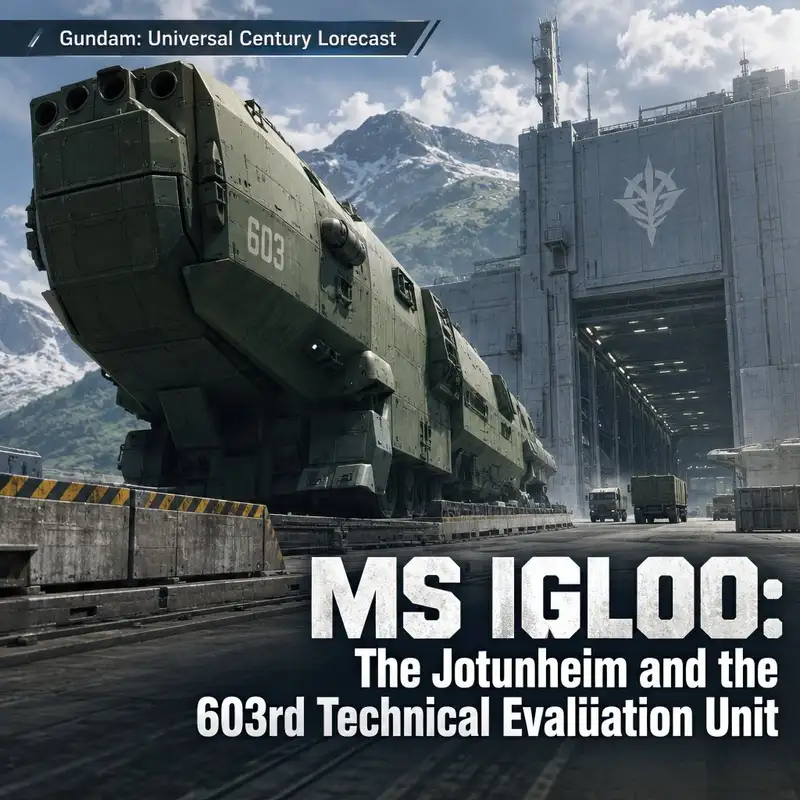
MS IGLOO: The Jotunheim and the 603rd Technical Evaluation Unit
At A Baoa Qu, the 603rd Technical Evaluation Unit was no longer standing at a safe distance from the weapons it judged. The Big Rang moved through a fortress battle already coming apart, not simply as a heavy mobile armor, but as a forward support platform. Damaged mobile suits and mobile pods needed ammunition, repairs, and some prospect of returning to the fight. The Big Rang tried to provide that prospect under fire.
That mission reveals the strange final condition of the Jotunheim and its crew. A technical evaluation unit exists to observe, measure, compare, and report. It needs controlled procedures, experienced operators, spare parts, recovery plans, and enough time to determine whether a system can be made reliable. At A Baoa Qu, Zeon had little of any of that left. Oliver May, an engineering officer whose work was to assess combat machines, was drawn into direct combat. The boundary between evaluator and operator had disappeared because the war had consumed the people who normally occupied those roles.
The Big Rang was not the beginning of the 603rd’s problem. It was the final expression of a pattern that began much earlier. Across the One Year War, the Jotunheim carried weapons meant to answer real military problems. Some were powerful. Some were ingenious. Some revealed genuine alternatives to the dominant mobile-suit doctrine. But again and again, testing became combat, combat became emergency improvisation, and the lives needed to produce useful data became part of the cost of trying to save a declining war effort.
The Jotunheim was not a conventional warship built to seek fleet engagements. It was a former civilian cargo vessel pressed into military service as a test-support ship. That origin mattered. A cargo ship is built around movement, storage, endurance, and the practical business of getting people and material from one place to another. The military gave the Jotunheim a different mission, but it did not erase the ship’s underlying function. It became a mobile laboratory, transport, recovery vessel, workshop, observation post, and temporary home for people working at the edge of Zeon’s weapons-development system.
The 603rd Technical Evaluation Unit used that mobility to bring prototypes into the environments where they might actually be employed. Its task was not merely to decide whether a weapon could fire or move under ideal conditions. It had to determine whether a system could survive operational use. Could it reach the target? Could a trained operator use it under pressure? Could it be repaired after damage? Could it be recovered? Could the results justify production, training, supply, and doctrine? Those questions are less glamorous than a successful attack, but they are what separate an experimental machine from a military capability.
The unit’s internal structure reflected that distinction. Captain Martin Prochnow commanded the Jotunheim itself and bore responsibility for the ship and crew. Oliver May served as a technical officer and evaluator. Test pilots and temporary specialists operated the systems under examination. Monique Cadillac represented a supervisory presence tied to higher authority. Albert Schacht connected the unit to Zeon’s wider technical bureaucracy and its stream of assigned projects. Their responsibilities overlapped, but they were not identical. A captain had to think about survival and withdrawal. A technical officer had to think about evidence. Supervisors had to think about orders and institutional expectations. The test pilot had to make the machine work in the moment when all those pressures met.
That division of labor was sensible in theory. It was also fragile. A prototype cannot be evaluated in a vacuum, especially during wartime. The Jotunheim had to carry specialized personnel, tools, replacement components, communications equipment, observation capacity, and enough support infrastructure to launch, recover, and inspect unfamiliar machinery. In a Minovsky-era conflict, where long-range detection and communications could be degraded, local judgment mattered even more. A ship supporting an experimental weapon could not assume that distant headquarters would see the same situation, understand the same threat, or send help in time.
The Jotunheim therefore represented a serious attempt to make experimentation operationally relevant. It was not merely a floating warehouse for eccentric machines. But Zeon’s broader military condition repeatedly turned this rational arrangement against itself. The more urgent the battlefield became, the less room there was for controlled evaluation. The 603rd was sent to determine whether systems worked, then found itself using those systems because no other force was available to fill the gap.
Its first major test came at Loum, one of the opening shocks of the One Year War. The 603rd was assigned to evaluate the Jormungand, a long-range plasma cannon intended to strike enemy warships at distance. The military problem behind it was understandable. Space warfare had become harder to manage through conventional long-range methods. Minovsky particle conditions complicated detection, targeting, and communications. A weapon able to deliver destructive force across a substantial engagement distance promised to restore some measure of stand-off power.
The Jormungand was not meaningless because mobile suits existed. A large plasma cannon could still damage ships and threaten formations. Fleet combat had not vanished. Warships still carried troops, supplies, command staffs, fuel, ammunition, and industrial capacity from one theater to another. Destroying or disabling one remained consequential. But the Battle of Loum demonstrated that Zeon’s more important innovation was moving in a different direction.
Mobile suits offered flexibility that a highly specialized long-range weapon could not easily match. They could maneuver in the confused conditions created by Minovsky particles. They could close with enemy vessels, inspect targets visually, exploit blind approaches, change objectives, and fight at ranges where centralized command had less control. A cannon could be formidable within the conditions for which it had been designed. A mobile suit was a broader system. It combined mobility, weapons, pilot judgment, and the ability to function in uncertain local conditions.
That did not make mobile suits perfect. They required carriers, launch facilities, maintenance, trained pilots, propellant, weapons, and recovery support. They created their own logistical burden. But at Loum, their operational value was unmistakable. The Jormungand’s test took place just as the entire logic of space combat was changing around it. A weapon might prove capable of inflicting damage, yet still become less relevant before the evaluation cycle had finished.
That was the first lesson of the 603rd’s war. Technical performance and military importance are not the same thing. A machine can work as designed and still be overtaken by a different doctrine. A system can be impressive in a trial and still offer too little flexibility for the campaign that follows. Loum was not only a battlefield victory for Zeon. It was an institutional warning. The side that had introduced the mobile suit now had to decide what to do with all the other systems developed under older assumptions.
Zeon did not stop experimenting. If anything, early victories encouraged further search for decisive systems. That was understandable. A state that had gained military advantage through technological surprise had every reason to believe another breakthrough might preserve that advantage. But the same belief created a trap. Every new project could be treated as the possible answer to the next operational problem. Every prototype could be rushed toward combat before the organization had established doctrine, training, maintenance procedures, or a realistic production path.
Wartime testing does require realism. A vehicle tested only on a range may fail when its crew is fatigued, communications are uncertain, the terrain is unfamiliar, and the enemy is actively trying to kill it. Field trials can reveal faults that no laboratory will detect. Yet there is a difference between evaluating a system under realistic pressure and using an unfinished system to fill a crisis in the line. Once that distinction collapses, the test itself becomes distorted. The machine is judged amid circumstances it may never have been designed to endure. The crew is ordered into missions that may exceed their preparation. And the people collecting the evidence are too busy trying to survive to collect it well.
The Hildolfr demonstrated this problem on Earth. During Zeon’s ground campaign, the 603rd was sent to evaluate the YMT-05 Hildolfr in the Arizona theater. The Hildolfr was a transformable mobile tank, and it should not be understood as a mobile suit that had somehow taken a wrong turn. It represented a different answer to the question of armored warfare. Rather than relying on a humanoid machine’s versatility, it emphasized heavy firepower, armored mobility, and the ability to make use of ground terrain.
That distinction mattered because mobile suits did not erase the military value of armored vehicles. Ground combat imposed different demands from space operations. Roads, hard ground, elevation, open desert, cover, buildings, bridges, and supply routes all shaped what a machine could do. A vehicle designed around powerful guns and armor might remain useful if it could be deployed, maintained, supplied, and protected within a combined-arms formation. It could support infantry, hold a defensive line, or exploit terrain in ways that a more flexible mobile suit might not.
The Hildolfr’s evaluation took place as local conditions deteriorated. The test environment became an active battlefield, and the question changed. It was no longer only whether the machine’s concept was sound. It became whether the vehicle and its crew could survive an immediate tactical emergency. In such moments, a powerful test vehicle can appear to settle the argument by performing well against the enemy in front of it. But a local action cannot answer all the questions that procurement must answer.
Could Zeon build enough Hildolfrs? Could it train sufficient crews? Could field units maintain them? Could they be recovered when damaged? Could they work effectively with infantry, artillery, engineers, and ordinary armored formations? Could the army establish a doctrine that used their strengths without exposing their limitations? The screen record does not provide a complete answer, and it should not be forced to. The Hildolfr showed that mobile-tank concepts retained tactical potential. It did not prove that mobile tanks were superior to mobile suits or that they could have transformed Zeon’s position on Earth.
The human cost mattered as much as the design argument. Test personnel were not abstract inputs in a technical process. They were skilled people operating unfamiliar equipment under battlefield pressure. Losing them meant more than losing a single machine. It meant losing accumulated knowledge about how the machine behaved, what its weaknesses were, and how it could be improved. A state in a long war can sometimes replace hardware faster than it can replace the people who understand it.
If the Hildolfr showed that alternative armored concepts remained viable, the Zudah showed the danger of trying to revive a troubled design through confidence, spectacle, and institutional pressure. The EMS-10 Zudah was associated with an earlier design lineage whose reputation had been badly damaged. Its evaluation was therefore not simply about introducing another mobile suit. It was also about rehabilitating a record. The machine had to prove that the past could be overcome and that a controversial program deserved renewed confidence.
The central issue was not speed by itself. High performance is useful only if the system can survive the performance it is asked to deliver. A machine pushed beyond safe operating margins may look exceptional during a demonstration. It may outrun a competitor, impress observers, or fit a narrative of technical redemption. But engineering does not become less real because the political need for success has become more urgent. Structural limits, reliability problems, pilot safety, and maintenance demands do not negotiate.
The Zudah’s story also involved information. Any attempt to recover prestige through a public or operational demonstration depended on what the enemy knew. If Federation intelligence already understood the history behind the design, then the hoped-for effect of surprise was weakened from the start. A weapon program can have propaganda value, but propaganda is not a substitute for security. An opponent who recognizes the system’s limitations can prepare for it, exploit them, or simply refuse to be impressed.
This is where technical evaluation becomes politically vulnerable. The evaluator’s job is to preserve bad news. A test report should identify faults before they become battlefield losses. It should distinguish a promising concept from a deployable weapon. But a bureaucracy under pressure may hear caution as disloyalty, delay as defeatism, and failure as embarrassment. The risk is not that every official ignores engineering. The risk is subtler. Institutions may create incentives that reward the appearance of success before the conditions for real success exist.
The Zudah could not solve that problem through performance alone. Its fate demonstrated that tactical spectacle cannot erase a known reliability issue. Nor can institutional reputation be recovered merely by placing a dangerous system in front of an audience. Zeon’s technical services contained capable engineers and serious evaluators. The 603rd itself is evidence of that. But talent operating inside a pressured procurement system cannot always prevent the system from demanding the wrong answer.
As the war progressed, the strategic environment around the Jotunheim changed. Early in the conflict, Zeon could still search for new advantages from a position of initiative. Later, Federation counteroffensives narrowed the room in which prototypes could be tested and refined. Secure areas became scarcer. Losses reduced the supply of experienced personnel. Projects that might once have remained experimental were sent toward operational missions because the regular force no longer had enough reserves to absorb every emergency.
For the Jotunheim, this was especially significant. Its civilian origins had made it a useful support platform. It could move equipment, specialists, and technical infrastructure to where they were needed. But a support ship works best when it has distance from the front, reliable routes, and the option to withdraw. As Zeon’s position deteriorated, the Jotunheim was drawn closer to the decisive battles. The ship’s ability to preserve its crew increasingly conflicted with the demand to use every available asset.
The Ze’Gok mission near Jaburo showed what that pressure looked like. By the late war, Federation vessels were ascending from Jaburo, moving forces outward from one of the Federation’s critical military centers. The 603rd was ordered to evaluate the Ze’Gok, a specialized mobile-diver system, in an attack against ships using that launch corridor. This was not a forgiving environment for an experimental operation. The boundary between atmosphere and orbit imposes its own harsh discipline. Timing matters. Approach routes matter. Recovery matters. A force that misses its opportunity may not receive another.
The Ze’Gok’s mission was therefore both technical and operational. Its system was meant for a narrow but demanding role. It had to reach a target moving through the transition between Earth and space, attack under difficult conditions, and give its operators some possibility of survival afterward. That kind of specialization can be valuable when the target set is clear and the opportunity is brief. But it also makes the weapon dependent on precise intelligence and favorable circumstances.
A successful strike against individual vessels could impose real losses. It could disrupt movement, force escorts to alter procedures, or create temporary hesitation. Yet it could not by itself reverse the Federation’s growing strategic mobility. Jaburo’s significance lay not in one ship or one launch, but in the Federation’s broader ability to generate, support, and move military power. A specialized attack system could exploit a vulnerable moment. It could not erase the industrial and organizational structure producing those launches.
The Ze’Gok mission reveals a recurring late-war problem for Zeon. Advanced systems were increasingly tied to narrow opportunities. Their operators had to act at exactly the right moment, against targets that might not appear again, with little margin for failure and limited prospects for recovery. Such systems could be tactically dangerous. They were not necessarily operationally sustainable. The Jotunheim could support an experiment, but it could not create a secure strategic environment in which repeated use, refinement, and mass adoption became possible.
The next emergency concerned not a better elite machine, but a machine that could be crewed at all. In the lunar fighting late in the war, the 603rd encountered the MP-02A Oggo mobile pod alongside more advanced machines such as the Gelgoog. That pairing tells us much about Zeon’s condition. The Gelgoog represented a high-performance mobile suit requiring skilled pilots, maintenance, support, and a military system able to use its capabilities. The Oggo represented an emergency answer to a different problem: how to place combat power in the hands of a force running short of trained people and time.
The Oggo should not be dismissed merely because it was simpler than a full mobile suit. Simplification can be a legitimate wartime choice. A simpler machine may require fewer specialized components. It may be easier to assemble, faster to train on, or more practical for a force that cannot replace its losses through the normal pipeline. In a crisis, that can matter. A machine available now may be more useful than a superior machine that exists only in a factory plan or requires a pilot who has not yet been trained.
But emergency simplification is not the same as efficiency. A force may build a simpler combat system because it has chosen an elegant doctrine. Or it may build one because its existing doctrine has consumed more skilled personnel and resources than it can replace. The Oggo belonged to the second category. It was evidence of a military trying to sustain combat capacity while its manpower system eroded.
That erosion affected more than pilots. It affected mechanics, officers, instructors, medical staff, recovery crews, and the experienced noncommissioned personnel who turn raw recruits into functioning units. A combat machine can be simplified. The process of teaching people how to survive, communicate, identify friendly forces, respond to damage, and make decisions under pressure cannot be simplified to the same degree. Shorter training may produce a body in a cockpit. It does not necessarily produce a durable combat capability.
The contrast with the Gelgoog was not a contest over which machine was stronger. It was a picture of incompatible demands. Zeon still needed high-performance systems to challenge Federation forces in serious engagements. At the same time, it needed equipment that could be fielded by people with less experience and supported under worsening conditions. The presence of both systems reflected not abundance, but strain. One answer demanded skilled human capital that was increasingly scarce. The other accepted reduced capability because the supply of that capital had already been damaged.
At A Baoa Qu, the 603rd’s final major project addressed an even more basic question. Not how to strike harder. Not how to move faster. Not how to find another pilot. The Big Rang addressed the problem of keeping damaged combat systems in the fight. It was built around a Bigro-derived mobile armor system and attached to a support unit capable of rearming and conducting emergency repairs on mobile suits and mobile pods near the battle.
That makes the Big Rang one of the most revealing machines in the Jotunheim’s record. Military power is often described in terms of weapons, armor, speed, and pilots. Those matter. But combat power also depends on sustainment. A mobile suit with an empty weapon, damaged control system, exhausted consumables, or failing components is no longer an effective weapon system. If it must withdraw all the way to a fixed depot, it may be absent when the battle is decided. If it cannot withdraw safely, it may simply be lost.
The Big Rang attempted to push repair and resupply forward. In a fortress defense under intense pressure, that was a rational idea. Fixed facilities can be isolated, destroyed, or overwhelmed. Damaged machines may not be able to reach them. A mobile logistics node could meet units closer to the fight, restore some of their capability, and send them back into action. In tactical terms, that could extend the endurance of a sector and preserve assets that would otherwise be written off.
This is why the Big Rang should not be treated as merely another oversized combat machine. Its offensive capacity mattered, but its central contribution was logistical. It tried to convert support into mobility. That is a serious military concept. A force that can repair and rearm under pressure can remain dangerous longer than an opponent expects. It can reduce the time between sorties, preserve experienced pilots, and make better use of machines already available.
But logistics cannot be separated from security and command. A forward support platform is valuable only if it can survive long enough to do its work. It needs protection, information, access to the units it is meant to support, technical staff, replacement materials, and some assurance that the battle will not simply overrun it. The Big Rang was large, complex, and conspicuous. It was operating inside a defensive system that had already lost much of its strategic depth.
The machine could prolong local resistance. It could repair a damaged suit, replenish a mobile pod, and make a tactical difference. It could not create a reserve force where none existed. It could not restore lost crews, reopen secure supply routes, or rebuild a coherent command structure in the middle of a collapsing fortress battle. The Federation assault on A Baoa Qu was shaped by factors far beyond one support platform. The Big Rang’s value was real, but it had limits that no amount of courage could remove.
Those limits became personal in Oliver May’s role. May had spent the war observing weapons, assessing their performance, and recording the evidence that technical institutions need to make decisions. At A Baoa Qu, he was forced into a combat role despite his limited experience as a pilot. This was not simply a dramatic reversal. It showed what had happened to the distinction between testing and fighting.
An evaluator is useful because the evaluator can stand apart from immediate enthusiasm, fear, and political need. The evaluator can say that a machine succeeded only under narrow circumstances, that a loss revealed a design fault rather than pilot failure, or that a system cannot be responsibly fielded yet. But when the evaluator is placed in the cockpit, the distance required for that role is gone. The report becomes secondary to survival. The person who should be interpreting the battle becomes another participant in it.
Captain Prochnow faced a related dilemma from the command side. His responsibility was not abstract. The Jotunheim carried people whose work depended on continuity, training, and trust. A captain must preserve the ship not out of sentimentality, but because a ship and crew are a functioning military system. They cannot be replaced by a line on an equipment ledger. Yet military orders can demand commitments that expose the ship and crew to risks beyond their original mission.
Monique Cadillac’s supervisory role adds another layer to that tension. The 603rd, the Jotunheim’s command, the technical bureaucracy, and higher political authority did not share identical responsibilities. One office could assign a project. Another could direct a mission. Another could operate the machine. Another had to live with the immediate danger. Such divided authority is common in large military institutions. It becomes dangerous when everyone has authority over part of the decision but no one retains full responsibility for the human cost.
The 603rd’s record should therefore not be read as a parade of strange machines or failed inventions. Its machines each reveal a different institutional problem. The Jormungand showed doctrinal displacement, when a weapon could remain dangerous yet be eclipsed by a more flexible system. The Hildolfr showed that alternative approaches to land warfare could retain value without becoming a complete answer to the war. The Zudah showed the cost of allowing prestige and political desire to press against engineering judgment.
The Ze’Gok showed how specialized systems become tied to narrow, high-risk opportunities when a military loses time and strategic freedom. The Oggo showed manpower decline translated into machinery, with simplified systems filling gaps that a healthy training and replacement structure should have addressed. The Big Rang showed that sustainment itself can become a combat mission when a force is too damaged to withdraw, repair, and return through ordinary means.
Taken together, these projects do not prove that Zeon lacked technical imagination. Quite the opposite. The Jotunheim’s missions show a military-industrial system capable of producing unusual and sometimes sophisticated responses to difficult problems. Zeon could identify the need for stand-off fire, armored ground mobility, high-performance maneuver, specialized interception, emergency simplification, and forward repair. Its engineers and test personnel understood that war was not solved by one type of machine.
But recognizing problems is not the same as possessing the institutional capacity to solve them. A weapon must be produced, supplied, operated, recovered, repaired, and integrated into a larger force. It must survive more than one demonstration. It must be usable by people other than a small group of specialists. It must fit the strategy of the war being fought, not merely the hopes of the organization developing it.
By the end of the One Year War, Zeon’s problem was not a shortage of individual technical ideas. It was a shortage of time, trained personnel, secure operational space, industrial resilience, and strategic margin. The state had begun the war with technological surprise and striking operational successes. It ended it asking experimental systems, technical officers, support crews, and emergency recruits to compensate for losses that no prototype could reverse.
The Jotunheim functioned as a mobile laboratory, carrier, recovery platform, observation post, and technical support ship. The 603rd functioned as an evaluator of experimental weapons. Yet the war repeatedly transformed both. The ship became more exposed to frontline danger. The evaluators became combatants. The prototypes became emergency assets before their true military value could be established. The test process was asked to provide answers faster than the war allowed.
Several of the systems demonstrated tactical value. Some inflicted damage. Some offered mobility. Some extended the endurance of forces already under pressure. The Big Rang, in particular, made clear that repair and resupply can matter as much as firepower in a defensive battle. But tactical utility did not become operational recovery. Specialized weapons lacked the numbers, doctrine, training base, recovery systems, and secure conditions required to change the wider campaign.
The final record is also human. Test pilots, technicians, inexperienced recruits, and crews were not incidental to the machines. They were the machinery of evaluation and combat. When Zeon’s institutions began treating them as resources to be spent alongside prototypes, the technical mission lost the separation it needed to remain honest. Courage could keep a machine moving for a few more minutes. It could not repair the political and military system that had placed those people there.
The Jotunheim and the 603rd were meant to tell Zeon whether its experimental weapons could become useful tools of war. By A Baoa Qu, their record had delivered a harsher answer: a prototype can win a moment, and a support system can keep a damaged force alive a little longer, but neither can rescue a military whose strategy, industry, manpower, and political leadership have already exhausted the war’s remaining margin for error.