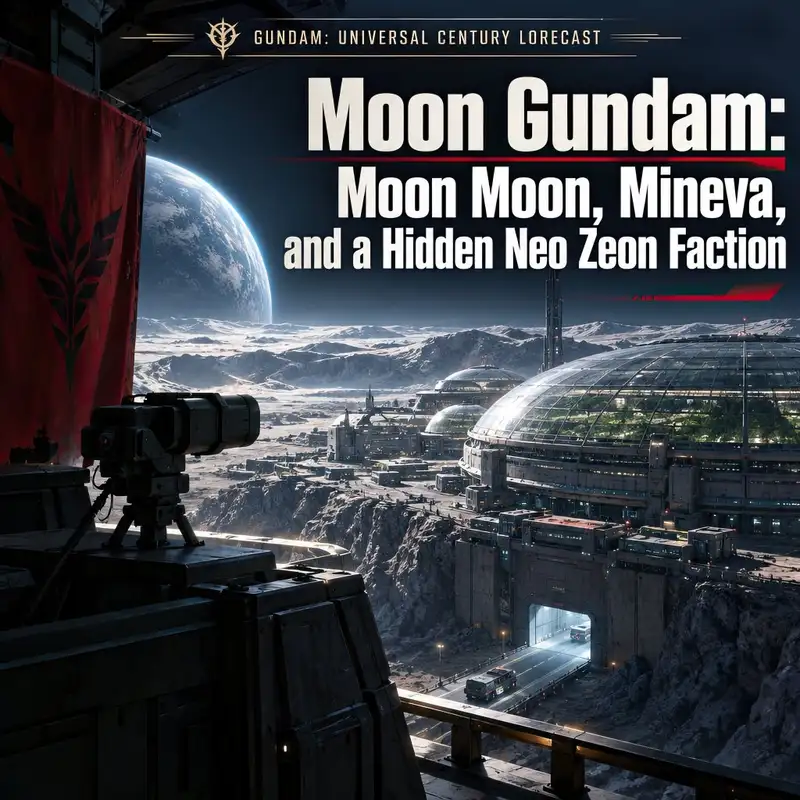
Moon Gundam: Moon Moon, Mineva, and a Hidden Neo Zeon Faction [Manga]
The wreckage arrived before any army announced itself. A damaged Psycho Gundam Mark Four G-Doors had fought Londo Bell somewhere beyond Moon Moon’s immediate horizon. Its defeat did not end with the machine. The head section and eight pieces of specialized equipment known as Psycho Plates drifted into the colony’s vicinity, carrying debris from a former Titans-linked research program into a community that had attempted to live apart from modern military life.
For Moon Moon, that was not simply salvage falling from the sky. A colony is inhabited infrastructure. Damage to its interior can mean blocked transit routes, ruptured systems, panic among residents, and the sudden discovery that there is no practical distinction between a military emergency and a civil emergency. Moon Moon had neither the communications network nor the institutional readiness to absorb a mobile-suit conflict safely. Its isolation had preserved it from many pressures of the wider Earth Sphere. It had not made it independent of them.
That distinction matters throughout Moon Gundam. Moon Moon appears protected because it is distant, self-contained, and culturally resistant to the machine civilization around it. But distance is not sovereignty. A community without reliable information, outside representation, or credible defenses may be left alone for years. It may also be unable to shape events when an outside power finally arrives. Moon Moon’s peace depended less on secure autonomy than on remaining below the attention of governments, fleets, remnant forces, and military researchers.
The society that receives this wreckage is already divided. Moon Moon’s dominant culture is the Light Tribe, a community that rejects ordinary machine civilization and maintains a quasi-pastoral order under the leadership of Sarasa Moon. The point is not that the Light Tribe simply lacks technology. Its relationship with technology is political and moral. Certain knowledge, practices, and forms of social authority are treated as acceptable, while others are restricted, taboo, or held at a distance.
Sarasa Moon represents the recognized order of the colony. Rinato Licht commands the Warrior Corps, the local force responsible for protecting that order. Yet the Warrior Corps is not a modern army designed to resist naval interception, mobile-suit raids, occupation, or covert extraction operations. It is a local institution built for local threats. It has authority inside Moon Moon, but authority is not the same as capacity. When the colony becomes the scene of a three-sided military crisis, its defenders are forced to operate against opponents who possess advanced machines, outside intelligence, and objectives that do not begin or end with Moon Moon itself.
Jutta Qasim stands uneasily within this setting. He belongs to the Light Tribe’s world, but he also wants to see the world beyond it. That desire is more than youthful restlessness. It marks a tension at the heart of Moon Moon. A society that survives by limiting contact with the wider Earth Sphere may ask its people to accept a narrow horizon. Jutta’s curiosity becomes politically important because he is among the residents most prepared to encounter the outside world, even if he is not prepared for the violence with which it arrives.
There is also Arzt, an underground and marginalized population led by Raymel. Moon Gundam does not allow this internal division to be dismissed as a simple conflict between respectable citizens and criminals. Arzt exists beneath the colony’s official order, associated with taboo practices and excluded from the dominant social structure. The details of its history matter less here than the political fact of its existence. Moon Moon’s apparent unity rests on a division that has already pushed part of its population out of sight.
That division becomes critical once war reaches the colony. External actors do not enter a socially blank space. They enter a community with grievances, restricted knowledge, competing authorities, and people accustomed to living under different rules. Moon Moon’s internal conflict does not cause the larger military crisis. But it shapes how the colony experiences that crisis, who can organize resistance, who can move through hidden spaces, and who is most vulnerable when outside forces begin imposing their own priorities.
This is where the manga’s setting becomes more than a nostalgic return to a location associated with Mobile Suit Gundam ZZ. Moon Gundam uses Moon Moon as its own historical space. It expands and reinterprets the colony rather than treating the earlier television appearance as a complete record. The important question is not whether the two versions can be fitted into one seamless account. The important question is what this manga does with the idea of an isolated colony. It turns isolation into a condition of political fragility.
The term Neo Zeon therefore requires care. It can describe a political heritage, an armed network, a restorationist claim, or a label attached to groups that share personnel and equipment without sharing a single chain of command. Moon Gundam is especially clear on this point. The postwar landscape is not divided neatly between the Earth Federation on one side and a unified Neo Zeon on the other. Instead, it is filled with overlapping organizations that possess different objectives, different loyalties, and different ideas about what Zeon should mean after defeat.
Some surviving forces operate openly when they can. Others rely on concealment, privateer-like methods, disguised transports, hidden supply relationships, and the ability to move military personnel and equipment through spaces that appear civilian. This is not evidence that every freighter in the Earth Sphere is secretly a warship. It is evidence that a defeated movement can retain a military afterlife when personnel, matériel, and political ambition remain available.
The manga’s hidden Zabi-aligned faction makes this visible. Ryuuse Clangel and the Schlange Corps are not presented as the whole of Neo Zeon. Their connection to a Zabi faction tells us something more specific. The old dynastic legacy remains politically useful. It can organize loyalty, provide symbols, and justify operations. But the very existence of a distinct faction demonstrates that Zeon’s inheritance is contested. There is no single surviving authority whose orders settle the matter.
That uncertainty gives Mineva Lao Zabi extraordinary importance. Mineva is not merely a young passenger being moved from one ship to another. She is a descendant of the Zabi family, and that lineage makes her a political asset to people who want to claim continuity with Zeon’s former ruling structure. Her presence allows different actors to frame their own ambitions as guardianship, restoration, rescue, or protection.
But symbolic legitimacy must not be confused with actual authority. Mineva’s name can be used to make political claims. That does not mean she commands the factions acting in her name. It does not mean she approves of their actions. It does not mean a group that possesses her has solved the question of what Zeon should become. Dynastic symbolism can strengthen a faction’s public narrative, but it can also turn the person at its center into an object of custody, surveillance, and coercion.
In this respect, Mineva’s situation is inseparable from the history of the Universal Century. Political institutions repeatedly convert individuals into symbols. Young pilots become proof of a weapon system’s promise. Newtypes become evidence for ideological claims. Children of famous families become containers for political legitimacy. The person beneath the symbol still has a life, knowledge, fears, and agency. Yet the institutions around them often find the symbol more useful than the person.
Mineva’s movement through this conflict is therefore a problem of custody. Who controls her physical safety? Who speaks on her behalf? Who gains access to her name? Who can claim that their operations are undertaken for her protection? Each answer creates consequences. A rescue can become an abduction. Protective custody can become political detention. A transport mission can become a struggle over succession.
The ship carrying Mineva is the Atalant Three, commanded by Lise Jenaro. It is disguised as a cargo vessel, but it is not an ordinary civilian freighter. Its concealed military role, specialized crew, and embarked commander-grade mobile suits reveal the kind of capability that can survive within a postwar remnant network. The Atalant Three is a transport, but it is also a covert military instrument. It can move a politically valuable passenger while retaining the means to defend, evade, or fight.
Londo Bell enters this situation through the Ra-Gills, commanded by Lauro Bacheek. The Federation force is pursuing the disguised Atalant Three near Moon Moon. On paper, this resembles an interception. In practice, it is an intelligence problem made more dangerous by the Minovsky-era environment. A suspicious vessel may be carrying contraband, personnel, weapons, refugees, or a political figure. Its intentions may be uncertain. Its escort may be hidden. The difference between surveillance, interception, seizure, and open combat can disappear quickly.
Londo Bell’s interest is understandable. A disguised transport with an armed capability in the unstable aftermath of Neo Zeon’s defeat is not a routine civilian concern. The Federation has reason to seek information and control. Yet military logic does not remove political risk. If the person aboard is Mineva Lao Zabi, then an interception is no longer only about stopping a covert ship. It becomes a struggle over a symbol of Zeon’s future.
The Ra-Gills must make decisions without perfect information. Minovsky conditions complicate long-range detection and communications, though they do not render every sensor or signal useless. The crews involved must still identify a target, assess threats, maintain formation, and decide how much force is acceptable near an inhabited colony. Their commanders are not acting on a clear battlefield with empty space around them. Moon Moon is close by, filled with civilians and infrastructure that cannot be treated as expendable.
The Atalant Three has its own dilemma. Its mission depends on concealment, yet it carries a passenger whose presence makes concealment politically impossible once discovered. It must protect Mineva, but the methods used to protect her can make her more valuable to hostile or competing forces. A covert transport can avoid a patrol. It cannot easily avoid the consequences of a battle that reveals its cargo.
Moon Moon has the simplest objective and the least capacity to enforce it. The colony wants to survive. Its people do not need to resolve Zeon’s succession crisis, recover research equipment, or establish Federation custody over a political figure. They need outside forces to stop bringing their conflict into inhabited space. But that is not an objective they can impose on the larger powers around them. The colony becomes the terrain on which other people pursue their goals.
The situation becomes still more dangerous when Ryuuse Clangel and the Schlange Corps enter the struggle. Their flagship, the Gwasha, represents a separate Zabi-aligned Neo Zeon faction. The Schlange Corps does not merely reinforce the Atalant Three in a clean conflict between Federation and Zeon. Its intervention exposes a contest within the surviving Zeon world. Mineva is valuable not only because the Federation has found her, but because different anti-Federation forces want to determine who possesses her and what her presence will mean.
The Schlange Corps turns an already unstable interception into open conflict around Moon Moon. Tactically, this is disastrous for the colony. Mobile suits are powerful weapons in an enclosed inhabited environment, but their presence does not make them precise instruments of policing. Every exchange of fire raises the risk of infrastructure damage, blocked access routes, fires, pressure hazards, and civilian panic. Even when combatants attempt restraint, their objectives require movement through a place built for civilian life rather than mechanized warfare.
Moon Moon’s Warrior Corps is forced into a role for which its society has not prepared it. Local defenders must respond to armed outsiders, identify threats, protect residents, and preserve social order at the same time. The problem is not merely one of courage. A modern military operation requires communications, intelligence, logistics, medical support, maintenance, and a command structure capable of coordinating under pressure. Moon Moon has a local security institution, but not the depth of a state military or a naval task force.
The colony’s internal divisions now become militarily relevant. The Light Tribe’s recognized authority cannot simply command universal trust. Arzt’s underground networks and knowledge of marginalized spaces become part of the colony’s ability to survive. This does not make Arzt a conventional army or transform every internal grievance into a liberation movement. It shows that an occupation or raid rarely encounters a unified civilian population. Existing social fractures shape who can hide, who can organize, who can communicate, and who is exposed first.
The political purpose of the battle remains Mineva. The mobile suits, warships, and advanced systems are instruments in a contest over her custody. This is why the crisis cannot be understood as Federation versus Zeon. Londo Bell is not simply defending Moon Moon. The Atalant Three is not simply one unified Neo Zeon force. The Schlange Corps is not simply a rescue party. Each actor has a different relationship to Mineva, and each believes that physical control of her can produce a political advantage.
That logic reaches its sharpest point when Ubald Molina, the Ra-Gills mobile-suit commander, abducts Mineva and takes her aboard the Federation ship. This is a deliberate act, not an accidental evacuation from a battlefield. In tactical terms, it gives Londo Bell possession of the person every other faction is trying to protect, move, or claim. In political terms, it places the Federation force at the center of a succession struggle it may not fully understand.
From Ubald’s perspective, seizing Mineva may appear sensible. A politically important figure aboard an armed Neo Zeon transport is an intelligence opportunity and a security concern. Leaving her in the hands of a remnant faction could allow that faction to consolidate influence. Yet possession does not equal resolution. The Ra-Gills now holds a person whose identity can mobilize rival forces, complicate negotiations, and turn a local patrol action into a larger crisis.
It would be a mistake to treat this as proof that the entire Earth Federation has adopted one coherent plan for Mineva. Moon Gundam instead shows how institutional ambiguity works. Londo Bell is a Federation force, but it is not the whole Federation. Its commanders operate under pressures that may not match the calculations of civilian officials, intelligence services, or other military commands. A local act can be politically consequential without being the product of a grand centralized conspiracy.
For Mineva herself, the crisis demonstrates the cruelty of symbolic politics. She is treated as an asset by people who insist that her heritage matters. Their concern may include genuine loyalty or fear for her safety. But their actions also reduce her freedom. A dynasty survives in political memory not only through ceremonies and proclamations, but through the physical control of the people who embody its claim.
While custody of Mineva drives the political struggle, the wreckage on Moon Moon creates another kind of contest. The damaged Varguil is an advanced Neo Zeon Newtype-use mobile suit. Its original pilot, Agos Lagart, is an enhanced human whose ability to operate the machine is tied to specialized training and intervention. When Agos is incapacitated, the question is not simply who can climb into the cockpit. The machine’s systems are not designed for ordinary interchangeability.
Jutta enters this situation under conditions that no responsible procurement system would describe as a controlled deployment. He is a young man from an isolated colony, caught between external military forces and the social limits of his own home. He has not emerged from a standard military training pipeline. He does not represent a mass-produced pilot program. His encounter with the Varguil and the Psycho Plates is the result of crisis, damage, proximity, and the sudden discovery that his brainwave activity can produce a response from equipment built for highly specialized use.
The Psycho Plates respond to Jutta’s heightened activity, and the damaged components of the G-Doors become joined with the Varguil’s body. The resulting machine is called the Moon Gundam. Its creation has the visual force of a heroic transformation, but historically it is closer to an improvised convergence of separate military systems. Former Titans-linked research, Neo Zeon technology, damaged equipment, an enhanced pilot’s disabled machine, and a colony youth’s emerging capabilities are forced together by circumstances.
Jutta’s performance must be understood with the same caution. The manga establishes that the Psycho Plates respond to him and that he demonstrates unusual potential. It does not require us to treat him as a conventional natural Newtype identical in ability, development, or historical role to Amuro Ray. The evidence is observed response under extreme conditions, mediated through equipment designed to interact with heightened brainwave activity. That is significant. It is not a complete scientific theory of Jutta’s mind.
Agos Lagart’s presence makes that danger more visible. He is not merely the displaced pilot whose absence creates room for Jutta. He represents a different path to Newtype-use combat, one shaped by enhancement and institutional intervention. The gap between Agos and Jutta is important. Enhanced people, natural Newtypes, and individuals whose potential emerges in a particular technological context should not be collapsed into one category. The military may want comparable results. Human experience does not become comparable simply because a machine requires a certain kind of pilot.
The Psycho Plates themselves should be treated with restraint. Their connection to brainwave response, control assistance, and all-range operations makes them important. They represent specialized equipment intended to extend a pilot’s ability to manage weapons and engagement space. In the right conditions, that can change the geometry of combat. A mobile suit that can direct remote weapons or respond through an advanced interface poses a different problem from a conventional machine.
The G-Doors also carries the legacy of former Titans-linked research. The Varguil carries a Neo Zeon context. It may be tempting to arrange these elements into a single, seamless secret history of advanced Newtype weapons. The manga does not require that simplification. Military research often leaves scattered artifacts, personnel, incomplete data, and rival programs behind it. A later faction can acquire equipment without acquiring full mastery over the institution that created it.
The same caution applies to the relationship between Psycho Plates and later technologies. The Plates can be understood as part of an evolving field of Newtype-use development, and they are described in developmental terms connected to later ideas. But they should not be treated as fully developed psycho-frame technology, nor as an explanation for every later extraordinary event. Similar ambitions do not prove identical systems. The Universal Century’s research institutions repeatedly pursue methods for linking human perception and machine control. Their results remain uneven, ethically compromised, and often poorly understood.
What matters at Moon Moon is not simply which side has the stronger machine. The larger question is who can control people, territory, and political meaning. The Moon Gundam gives Jutta a role in events that would otherwise overwhelm him. It does not free Moon Moon from outside pressure. It may even deepen that pressure by making the colony and its inhabitants more valuable to competing forces.
As the crisis continues, Ryuuse’s forces impose control over Moon Moon, and residents are driven underground into organized resistance. This is where the difference between battlefield success and occupation becomes clear. Mobile-suit superiority may seize key routes, intimidate a population, and suppress immediate opposition. It does not by itself establish durable control. Occupation requires information, movement control, local intermediaries, supplies, discipline, and some answer to the question of why civilians should accept the occupier’s authority.
A faction can claim to be acting in Mineva’s name or for Zeon’s restoration. That claim means little to a resident whose home has been damaged, whose family has been displaced, or whose access to food, medicine, and safe transit has been disrupted. Political legitimacy cannot be created merely by carrying a famous name into a colony. It must survive the daily experience of governance. In Moon Moon’s case, outside forces arrive with weapons and objectives. They do not arrive with a credible settlement for the people living there.
The Light Tribe and Arzt divisions are now militarized by pressure from above. The colony’s old hierarchy becomes a security problem, while its marginalized population becomes part of the resistance landscape. This does not mean every Arzt resident shares one military objective, or that the Light Tribe’s leaders cease to matter. It means that occupation activates divisions that were already present. A society that has concealed inequality during peacetime may discover that the excluded possess knowledge and networks essential to survival during war.
The occupation also reveals the limits of remnant warfare. Ryuuse’s faction can project force, but force alone cannot solve the problem of governing a colony. Its resources are finite. Its presence depends on ships, mobile suits, crews, maintenance, ammunition, and the ability to keep hostile forces from isolating it. The more energy it spends controlling Moon Moon, the more it reveals that its mission is not a simple rescue operation. It is a political struggle over a place, a symbol, and a future claim to authority.
Londo Bell faces a different version of the same problem. It may be able to seize Mineva, but it must then decide what political responsibility follows. The Ra-Gills cannot treat her as a piece of captured equipment. Her identity creates obligations and dangers that exceed ordinary prisoner handling. The Federation’s capacity to impose order is also limited by uncertainty. It must distinguish among armed remnants, local residents, covert networks, and people whose loyalty may be shaped by fear rather than ideology.
Moon Moon’s tragedy is that all of these actors can describe their conduct in defensive terms. Londo Bell can speak of security. The Atalant Three can speak of protection. The Schlange Corps can speak of restoration. Moon Moon’s local defenders can speak of preserving their way of life. Arzt can speak of survival beneath an unjust order. None of those claims eliminates the damage inflicted on civilians when armed organizations pursue incompatible objectives inside a colony.
The conflict eventually expands beyond Moon Moon. The Ra-Gills attempts atmospheric descent while carrying Jutta and Mineva. The Atalant Three pursues it. This shift from colony space toward Earth changes the scale of the struggle. Movement through the Earth Sphere is never merely a change of scenery. Descent, pursuit, fuel, timing, reentry, and the ability to maintain contact all shape what forces can do. A ship carrying politically valuable people and advanced technology is not simply traveling. It is moving the center of the crisis.
The later Antarctic phase broadens the cast of actors. Char, Nanai Miguel, Londo Bell, the Luio Company, and a Newtype unit become part of a conflict that has outgrown Moon Moon’s immediate confines. Their involvement confirms that the colony crisis is connected to wider struggles over Federation authority, Zeon’s inheritance, corporate interests, military research, and the unresolved relationship between Newtype potential and political power.
But the expansion of the story should not erase Moon Moon from its center. The colony is not merely an opening location before the more famous figures arrive. It is the place where the underlying conflict becomes visible. Moon Moon shows what happens when a supposedly peripheral community is pulled into the orbit of larger institutions. Its people are not peripheral to the consequences. They are the ones whose society is broken open while outside actors pursue national, dynastic, and technological objectives.
The manga remains ongoing, and its later published material continues to move the struggle into broader theaters. That unfinished status is important. Moon Gundam has not reached a final resolution that can be treated as the settled endpoint of this branch. What the released material establishes, however, is already clear enough. The Moon Moon incident is not an isolated diversion between larger wars. It is a demonstration that the years between the First Neo Zeon War and Char’s Rebellion remain politically unstable.
The postwar Earth Sphere contains formal governments, active military forces, covert transport networks, private interests, research legacies, displaced populations, and surviving ideological movements. These systems intersect in places where no one has prepared for them. A colony that believes it has escaped history discovers that history has only been delayed. A defeated faction discovers that military survival does not produce political unity. A Federation force discovers that seizing a symbolic figure can create more problems than it solves.
At the operational scale, the incident reveals the persistence of covert military capability after formal defeat. The Atalant Three’s disguised role, the Schlange Corps’ intervention, and the movement of advanced equipment demonstrate that remnants can retain meaningful combat power without fielding a conventional state fleet. They can exploit uncertainty, commercial cover, and dispersed networks. Yet those methods also reveal weakness. Fragmented forces must compete for symbols, matériel, and territory because they lack a universally accepted authority.
In political terms, Mineva is the central figure because she is not allowed to remain only a person. Her lineage gives others a language of restoration. It permits factions to claim continuity with Zeon’s past. But her presence does not answer whether Zeon’s future should be dynastic, authoritarian, democratic, revolutionary, or something else entirely. A symbol can unite supporters temporarily. It cannot substitute for institutions capable of governing without coercion.
Institutionally, Moon Gundam is a story of partial authority. Londo Bell acts through local command decisions that may have consequences beyond its original mission. Neo Zeon-linked groups act through overlapping claims and incomplete chains of command. Moon Moon’s own leaders possess local legitimacy but lack the means to control outside military power. Each institution is real. None is fully capable of resolving the crisis it helps create.
At the human level, Jutta’s transformation is not simply the rise of a new pilot. It is the moment when a young man’s desire to see beyond his closed world becomes entangled with weapons research, factional conflict, and other people’s political ambitions. His unusual response to the Psycho Plates gives him agency, but it also makes him useful. In the Universal Century, usefulness is often the first step toward exploitation.
Moon Moon’s tragedy is not simply that a hidden war reached an innocent colony. It is that no colony can remain innocent of an Earth Sphere whose political order remains unresolved. Mineva exposes the struggle over Zeon’s inheritance, Jutta exposes the military exploitation of human potential, and the Zabi-aligned faction exposes Neo Zeon as a contested legacy rather than a single surviving army.