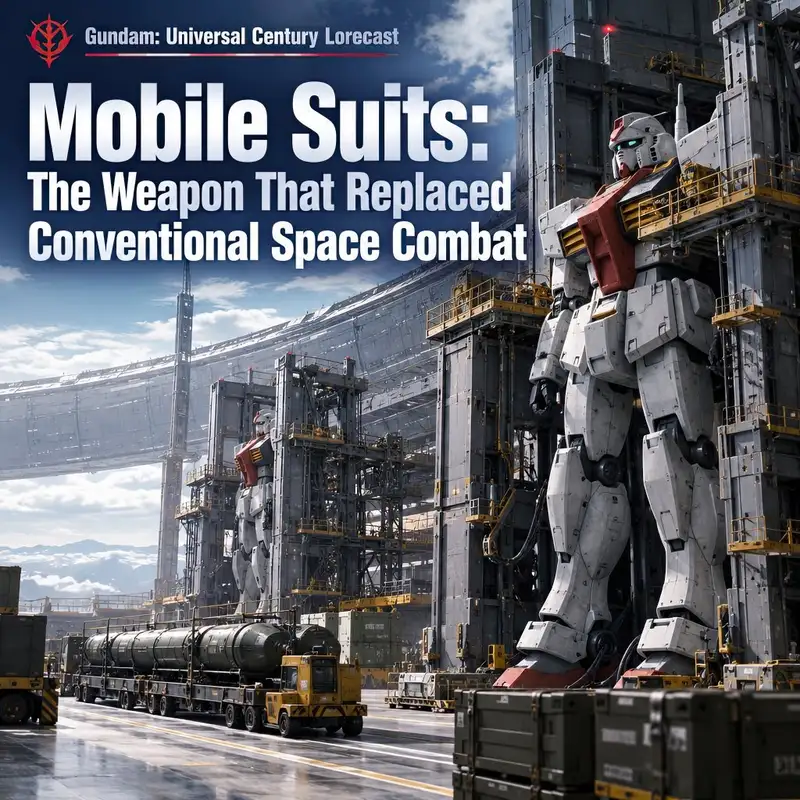
Mobile Suits: The Weapon That Replaced Conventional Space Combat
A Federation warship crew could still see its own guns, its missile racks, its radar displays, and the familiar geometry of a fleet formation. What it could no longer see with confidence was the enemy. Under Minovsky particle interference, the information system that made long-range space combat manageable began to break apart. Contacts became uncertain. Communications became less reliable. Guided weapons could no longer be trusted to solve every engagement before opposing crews came close enough to identify one another by sight. Into that gap came Zeon mobile suits, small enough to maneuver around a warship, armed enough to threaten it, and independent enough to attack from directions a traditional fleet had difficulty covering. The revolution was not that a humanoid machine somehow defeated a ship by virtue of having arms and legs. The revolution was that a battlefield built around distant detection and centralized fire control had become a battlefield of proximity, uncertainty, and local initiative.
Before the One Year War, the Earth Federation possessed the advantages expected of a larger interplanetary state. It had strategic depth, access to major industrial centers, a broad population base, established military institutions, and a space force organized around warships, missiles, sensors, and command networks. Those arrangements made military sense. A large warship could carry heavy weapons, endurance supplies, command personnel, and the systems needed to coordinate operations across enormous distances. Missiles and long-range guns allowed a fleet to threaten an opponent without exposing every crewman to close combat. Radar-linked detection and computerized fire control promised to turn distance into an advantage. A government with more ships and more industry generally preferred a kind of war in which mass, coordination, and reach could be converted into decisive force.
That older fleet bargain depended on information. A ship did not need to see every hostile vessel with the naked eye if its sensors could detect movement at range, identify the contact, calculate a firing solution, and guide weapons toward it. Commanders could manage formations because they could communicate with subordinate ships and maintain a reasonably coherent picture of the battle. Missiles mattered because they could be directed toward targets before those targets entered close weapons range. The Federation’s conventional space doctrine did not become foolish overnight. It was built for a combat environment in which large organizations could see far, communicate reliably, and concentrate firepower before an enemy could close.
Minovsky particles did not create the political failures that led to war, and they did not render every electronic system useless. They did, however, undermine the confidence on which that earlier style of fleet warfare depended. In practical terms, the particles degraded radar and disrupted portions of the electromagnetic environment that supported long-range detection, communications, and guided weapons. The exact effect varied with conditions, equipment, and particle density. Optical observation still mattered. Local sensors still mattered. Some communications remained possible. Missiles did not vanish from the battlefield. But commanders could no longer assume that a distant contact would remain tracked, identified, and vulnerable all the way to impact.
That distinction is important. Minovsky conditions did not blind fleets completely. They made fleets uncertain. Uncertainty can be more damaging than blindness because it complicates every decision. A commander may know that hostile forces are nearby without knowing their exact position, numbers, intentions, or approach route. A ship may receive orders but not enough detail to coordinate precisely with every escort. A missile may still be launched, but its target may maneuver beyond the quality of information needed for reliable guidance. A suspicious contact may be an enemy, a friendly unit, a civilian craft, debris, or an object moving on a different vector than expected. In a colony region or a crowded transport corridor, the cost of getting that judgment wrong could be severe.
The result was a return to shorter engagement distances. Not a return to naval warfare from old Earth oceans, because space has no horizon in the familiar sense and combat remains three-dimensional, but a return to a more immediate problem. Someone had to get close enough to find the enemy, identify the enemy, maneuver against the enemy, and strike before the enemy did the same. That favored crews and machines able to operate away from the protective hull of a capital ship. It favored reconnaissance, visual confirmation, local judgment, rapid changes in direction, and weapons that could be brought to bear at close and medium range. The side that could place armed pilots inside that degraded information environment had found a way to challenge a stronger fleet.
For the Principality of Zeon, this was more than an interesting technical possibility. Zeon faced a strategic imbalance. The Earth Federation had the larger population, broader industrial base, and deeper pool of conventional resources. Zeon could not assume that a prolonged contest conducted on Federation terms would favor the smaller state. It needed a way to turn the Federation’s size into less of an immediate advantage. Mobile suits offered that possibility. They promised to let smaller units threaten larger ships, to make close-range maneuver more important than raw hull size, and to create tactical dilemmas that a fleet designed around long-range control would struggle to solve.
The mobile suit was therefore an institutional answer to an institutional problem. Its development required more than a useful reactor, a weapon, or an inspired designer. It required research programs, industrial production, pilots willing and able to operate a new kind of combat machine, technicians who could maintain it, transports and warships that could carry it, and commanders prepared to employ it in formations that did not resemble older fleet doctrine. Zeon’s military and industrial establishments had to learn how to launch mobile suits, recover damaged ones, arm them, supply them, direct them under interference, and replace crews who did not return. The famous machines of the One Year War can make this look like a contest of individual designs. In reality, the first side to make mobile suits useful had to create a new military ecosystem around them.
The mobile weapon’s ancestry in worker and industrial machinery helps explain part of its appeal, but it should not be mistaken for a complete development history. A machine built to manipulate equipment in hazardous environments is not automatically a war-winning weapon. What mattered was the adaptation of mobility, powered manipulation, protected crew space, propulsion, sensors, and weapons into a single platform. Zeon did not gain an advantage because it discovered that a machine could have hands. It gained an advantage because those hands, thrusters, sensors, and weapons could be used together in the kind of close, confused space combat that Minovsky conditions encouraged.
The humanoid shape was useful, but not mystical. In zero gravity, a mobile suit could use its limbs to stabilize itself, hold tools, carry weapons, push against structures, manipulate damaged equipment, and change orientation without requiring an entirely separate vehicle for every task. Its articulated form gave it flexibility around warships, fortifications, debris, docks, and colony structures. It could approach from above, below, or behind in relation to a ship’s frame of reference. It could use cover, exploit blind zones, and attack from vectors that older gun arrangements were not always designed to meet. None of that proves that a humanoid form was ideal for every combat mission. Mobile armors, fighters, missiles, fixed defenses, and warships all retained roles that a humanoid machine could not perform as efficiently. But the mobile suit combined several useful functions in one deployable package.
Its mobility also changed the relationship between the attacker and the capital ship. A warship carries powerful weapons, but those weapons are mounted on a large hull with firing arcs, structural limits, crew compartments, vulnerable systems, and a finite ability to turn toward threats. A mobile suit could separate the combat unit from the transport and command unit. The pilot could leave the ship, scout ahead, screen the formation, pursue a contact, strike at exposed sections of an enemy hull, or return for resupply and repair. The ship no longer had to be the only object capable of searching, fighting, and surviving in the immediate battlespace. That was a major change in tactical geometry.
The mobile suit did not become independent simply because it could fly under its own power. It carried limited propellant, limited ammunition, limited endurance, and a single pilot subject to fatigue, injury, confusion, and fear. Its sensors could be obstructed. Its weapons could malfunction or run dry. Its reaction controls and thrusters could be damaged. A pilot who lost orientation, lost communications, or lost the route back to a carrier faced a danger that no heroic reputation could solve. Mobile suits were powerful because they extended a fleet’s reach into close combat. They were vulnerable because they remained dependent on the fleet, base, or depot that armed and sustained them.
The opening phases of the One Year War demonstrated the effect with brutal clarity. Zeon’s mobile-suit arm entered a war for which Federation conventional forces were not fully prepared. Federation ships were not suddenly incapable of fighting. Their guns still mattered, their armor still mattered, and their crews still mattered. But they faced an enemy whose tactical methods exploited the weaknesses created by degraded long-range information. When a ship designed to fight at distance had to identify and engage fast-moving attackers at close range, it could become vulnerable in ways its earlier doctrine had not adequately addressed. Mobile suits could approach along multiple vectors, force defensive fire into awkward arcs, and threaten systems that mattered far more than a ship’s overall size suggested.
The Battle of Loum became the clearest early demonstration of that transformation. It was not a controlled weapons trial, and it should not be treated as one. The battle involved larger political and operational objectives, extensive violence against military and civilian targets, and a degree of destruction that cannot be reduced to a clean comparison between one weapon system and another. But Loum showed that Zeon’s mobile suits could reshape fleet combat. Federation forces confronted maneuverable attackers in a tactical environment where the confidence of traditional long-range systems had been reduced. Zeon’s early battlefield success was not merely a matter of one side having better pilots or more aggressive commanders. It reflected a shift in the relationship between information, maneuver, and firepower.
The effect was psychological as well as operational. A capital ship had long represented concentrated military power. It carried heavy weapons, protected crews, and embodied the reach of a state. Mobile suits challenged that image by proving that a smaller combat machine could threaten a much larger vessel when the larger vessel could not maintain distance and information superiority. The fear was not that every mobile suit could destroy every warship. The fear was that a fleet could no longer assume its size and guns guaranteed control of the engagement. Once that assumption fails, formations change, escorts change, ship design changes, and the entire command structure begins adapting.
Loum did not prove that Zeon had solved the problem of war. It proved that the Federation could not continue fighting as if mobile suits did not exist. Zeon achieved surprise and gained early military advantage, but tactical shock is not the same as durable strategic victory. A smaller power can use a new weapon to disrupt a larger opponent’s assumptions. It still has to sustain that weapon, replace losses, protect supply routes, govern territory, and make political choices that do not turn military success into strategic overreach. The One Year War would show repeatedly that the ability to win a close engagement did not automatically create the ability to win a long war.
That advantage did not make warships obsolete. It made them change jobs. A warship remained the platform that moved mobile suits between theaters. It carried fuel, propellant, ammunition, spare parts, food, water, medical facilities, maintenance spaces, command staff, navigation systems, and damage-control teams. It could provide long-range firepower, carry communications equipment, coordinate dispersed units, and serve as a place where damaged machines and injured pilots could return. In many cases, the mobile suit became the fleet’s forward fighting arm, while the ship became the system that enabled that arm to exist.
This was not a demotion into irrelevance. It was a reorganization of naval power. A fleet that could not launch, recover, repair, and resupply mobile suits was at a growing disadvantage. A carrier-like ship that carried mobile suits but lacked escorts, intelligence, ammunition, or competent damage control was also at a disadvantage. The ship and mobile suit became mutually dependent. The ship needed mobile suits to scout, screen, intercept attackers, and fight in close spaces around the formation. Mobile suits needed ships and bases for everything that turned a single sortie into sustained combat power.
Fleet doctrine had to adjust accordingly. Larger ships could no longer assume that their own weapons covered every threat. They needed mobile-suit patrols, local defenses, escorts, and formations designed to reduce vulnerability from multiple directions. Commanders had to plan for communications failures and provide subordinates with enough guidance to act when headquarters could not see the whole battle. Identification became more difficult. A ship’s crew might have only moments to decide whether an approaching contact was hostile, friendly, or civilian. The Minovsky battlefield placed a premium on discipline, prearranged procedures, and local initiative. It also increased the danger that local initiative could become confusion.
The tactical shift was especially severe for forces caught without a comparable mobile-suit arm. The Earth Federation did not begin the war with an operationally mature system that matched Zeon’s mobile-suit capability. Its response could not be limited to ordering a better machine from a factory. The Federation had to understand what kind of war it was now fighting. It needed machines that could survive against Zeon weapons, pilots who could operate them, ships that could support them, and a doctrine that connected close-range mobile combat to the Federation’s much larger industrial and military resources.
Operation V represented part of that response. The project that produced the RX-78 Gundam was not simply an effort to build a more impressive machine than Zeon’s Zaku. It addressed a cluster of battlefield problems. The Federation needed survivability in close combat, the ability to employ powerful beam weapons, a platform capable of operating in the new tactical environment, and a means to gather practical combat experience against an enemy that had already learned how to fight with mobile suits. The Gundam was important not because it existed outside the military system, but because it became part of the Federation’s attempt to build one.
A prototype has a special value in war. It can test ideas that a mass-production machine cannot yet embody. It can reveal weaknesses in enemy equipment. It can force opponents to reconsider their tactics. It can generate combat data, inspire confidence, and protect a formation at a critical moment. But a prototype is not an army. Its parts may be rare. Its maintenance demands may be high. Its pilot may be unusually capable. Its performance may not be easily reproduced. A machine that wins one engagement can still be strategically insignificant if its lessons cannot be turned into training, production, supply, and doctrine.
The RX-78 Gundam mattered because it became a source of learning as well as a combat asset. Its encounters with Zeon mobile suits demonstrated strengths and vulnerabilities on both sides. It gave Federation personnel direct experience in operating a high-performance mobile suit under combat conditions. It also showed that the Federation could contest Zeon’s technological advantage rather than merely absorb it. Yet the Gundam’s importance must be kept in proportion. It did not independently defeat the Principality of Zeon. It operated within a much larger war shaped by fleets, ground forces, industrial capacity, political decisions, and the eventual ability of the Federation to field mobile suits on a broader scale.
The White Base provides a useful case study in that relationship. It was not a typical Federation ship in every respect, and its experiences should not be treated as a universal model for the entire war. But it makes the support system visible. The Gundam did not appear in battle from nowhere. It required hangar space, launch procedures, ammunition, repairs, technicians, navigation, command decisions, intelligence, and a crew that could keep the ship alive long enough for the mobile suit to sortie again. The White Base’s own survival increasingly depended on the mobile suits it carried. The mobile suits, in turn, depended on the White Base as a moving base, workshop, supply ship, command center, and refuge.
That mutual dependence is easy to overlook because the mobile suit is the visible object in combat. The pilot launches, maneuvers, fires, and returns under damage. The audience sees the duel. But behind every sortie are mechanics checking systems, crew members preparing weapons, officers deciding routes and objectives, operators tracking uncertain contacts, medical personnel treating casualties, and engineers finding ways to keep damaged equipment operating. A mobile suit can make a warship more dangerous. It can also make the ship more vulnerable, because the carrier must now expose itself to launch and recovery cycles, protect its hangars, and remain close enough to support machines that cannot operate indefinitely alone.
Amuro Ray’s unusual ability contributed to the Gundam’s battlefield record, but it does not replace this institutional argument. A highly capable pilot can exploit the potential of a machine more effectively than an ordinary pilot. That may alter individual engagements. It may protect a ship at a decisive moment. It may even influence the morale and judgment of opposing commanders. Yet no military can plan its entire force structure around the assumption that every pilot will be exceptional. The Federation’s real strategic opportunity lay in learning from combat and connecting that learning to broader force generation.
Force generation is less glamorous than a prototype duel, but it determines wars. Machines must be built, crews trained, damaged equipment repaired, ammunition manufactured, propellant delivered, and losses replaced. Zeon entered the war with the advantage of early mobile-suit development and operational experience. That advantage was real. But it also created burdens. Mobile suits had to be maintained across multiple fronts. Pilots had to be trained and replaced. Specialized designs could create supply problems. A force spread across Earth, the colonies, and space installations could discover that technical superiority in one engagement was difficult to sustain across an entire war.
The Federation’s deeper industrial and demographic base gave it the ability to respond over time. That did not make victory automatic. Bureaucratic delay, initial surprise, local defeats, and the sheer disruption of war all limited what the Federation could do in the early stages. But once the Federation began converting experience into production, training, and reorganization, the strategic balance changed. A simpler machine that could be produced, maintained, and fielded in useful numbers might matter more to a campaign than a rare machine of superior individual performance. The decisive question was not simply which mobile suit was stronger. It was which military system could keep putting capable units into the field.
This was the point at which mobile suits became more than Zeon’s specialized advantage. They became the central tactical arm around which both sides organized close and medium-range combat. The Federation did not need every machine to equal the Gundam. It needed an operational mobile-suit force integrated into ships, bases, command structures, and supply networks. Zeon’s early innovation had changed the terms of war. Federation mobilization ensured that Zeon would not retain that advantage indefinitely. The contest became one of adaptation, production, replacement, and sustained operational reach.
The same logic applied outside open space. Mobile suits transformed ground combat, but they did not erase conventional forces. Mobile Suit Gundam MS IGLOO 2: The Gravity Front presents a Federation ground war in which tanks, anti-mobile-suit units, artillery-like fire support, and ordinary soldiers confront a battlefield increasingly shaped by mobile suits. That account belongs to its own animated perspective on the One Year War, but its broader point is sound. Conventional forces did not simply surrender when mobile suits appeared. They adapted. They sought ambush positions, developed anti-mobile-suit methods, used terrain, and relied on combined arms to survive against a weapon system that could not be everywhere at once.
A mobile suit on Earth faces constraints different from those of open space. Roads, bridges, forests, mountains, cities, weather, gravity, and fuel or propellant requirements shape what it can do. Infantry can observe terrain that a large machine cannot easily enter. Engineers can block routes, prepare defenses, and repair infrastructure. Artillery can threaten areas rather than individual targets. Tanks and armored vehicles can still carry weapons, protect crews, and operate as part of a larger formation. Aircraft and transports remain necessary for reconnaissance and movement. A mobile suit may dominate a particular encounter, but it does not automatically solve the problem of holding ground, feeding troops, guarding supply lines, or governing occupied territory.
Gundam: Requiem for Vengeance offers another, later animated illustration from the European front. Its Zeon mobile-suit units operate within a wider composite formation that includes conventional vehicles, logistics, medical personnel, bases, and exhausted soldiers. The series does not present mobile suits as independent armies wandering through a war without support. They are embedded in an operational system, and that system is under pressure. Machines require repair. Units require supplies. Wounded personnel require treatment. Commanders must decide where to commit scarce assets. Even a powerful mobile suit cannot compensate indefinitely for a deteriorating strategic position.
The same is true around colonies. A colony cylinder is not an empty arena built for spectacular combat. It is a pressure vessel, a habitat, a transportation system, an agricultural environment, and a political community. Fighting near it creates hazards far beyond the destruction of military equipment. Missiles, debris, beam weapons, damaged ships, and mobile suits moving at high speed can threaten civilian infrastructure. A commander cannot treat every close engagement as a clean tactical problem when homes, docks, life support, and civilian traffic lie nearby. Mobile suits made close combat more likely in these spaces. That made discipline and restraint more important, not less.
The political value of Zeon’s early mobile-suit advantage was therefore double-edged. It gave the Principality a means of challenging Federation power and demonstrating that the existing balance of force was not permanent. It strengthened Zeon’s coercive capacity and encouraged confidence in its ability to shape the war through military initiative. But technological surprise could not provide political legitimacy. It could not justify dictatorship, aggressive conquest, occupation, or mass violence against civilians. A weapon system can change the balance of an engagement. It cannot make a government capable of ruling a hostile population or make a destructive war serve the liberation it claims to represent.
Zeon’s early successes also encouraged the danger of overestimating what tactical superiority could accomplish. A smaller state can win remarkable victories if it disrupts the larger opponent’s assumptions. But if the larger opponent retains the industrial capacity to adapt, the smaller state must find a political settlement, preserve its resources, and avoid turning every success into a demand for more expansion. Mobile suits helped Zeon create an opening. They did not remove the Federation’s capacity to learn, reorganize, and mobilize. Nor did they remove the burden of maintaining far-flung forces under wartime conditions.
The Federation’s adaptation carried its own limits. Building an effective mobile-suit arm restored military balance, but it did not resolve the Earth Sphere’s deeper political crisis. Colonial inequality, weak representation, concentrated power, militarized responses to dissent, and the resentment created by war all survived the immediate technological transition. The Federation could learn to fight Zeon’s mobile suits without learning how to create a political order that did not repeatedly produce new rebellions and new security regimes. Military adaptation is not political reform. A government may become better at surviving a war while remaining incapable of resolving the conditions that made war possible.
For that reason, the title requires one careful qualification. Mobile suits replaced conventional space combat as the decisive tactical arm of the One Year War. They displaced the older expectation that large warships, long-range sensors, and guided weapons would dominate the immediate contest by themselves. Under Minovsky conditions, the decisive question often became who could maneuver, identify, and strike effectively at close range. Mobile suits answered that question better than the capital ship alone. They became the forward weapon of fleet combat, the screen, the scout, the interceptor, and the close-range attacker.
But they did not replace the fleet as a military system. Fleets still determined where forces could go. Ships and bases still determined whether mobile suits could launch, recover, repair, rearm, and return to battle. Logistics still determined endurance. Industry still determined replacement. Intelligence still determined whether commanders understood the battlefield before they entered it. Conventional weapons still defended bases, supported ground forces, threatened mobile suits, and carried out missions for which a humanoid combat machine was poorly suited. The mobile suit did not abolish those systems. It made them reorganize around a new tactical centerpiece.
The isolated warship at the beginning of this story was not defeated because it was old, large, or conventional. It was endangered because the battle had changed faster than its doctrine. Its sensors and missiles still existed, but the conditions that made them decisive had been weakened. Mobile suits became dominant because they could move through that uncertainty, bring pilots and weapons into visual combat, and attack from angles that centralized fleet fire control struggled to manage. They transformed the immediate fight. They did not transform the underlying requirements of war.
Tactically, mobile suits became the principal maneuver and close-combat weapon of the Minovsky battlefield. At the operational level, fleets became more dependent on carriers, escorts, bases, and mobile-suit support systems. At the strategic level, the ability to produce, train, repair, and replace mattered more than the brilliance of any single prototype. At the political and civilian level, the new form of warfare did not solve the Earth Sphere’s crisis. It brought close-range violence into the spaces where people lived, worked, traveled, and tried to survive.
Mobile suits changed who could fight effectively in space. They did not change the fact that every force still had to sustain its people, govern its territory, and live with the consequences of the war it chose to wage.