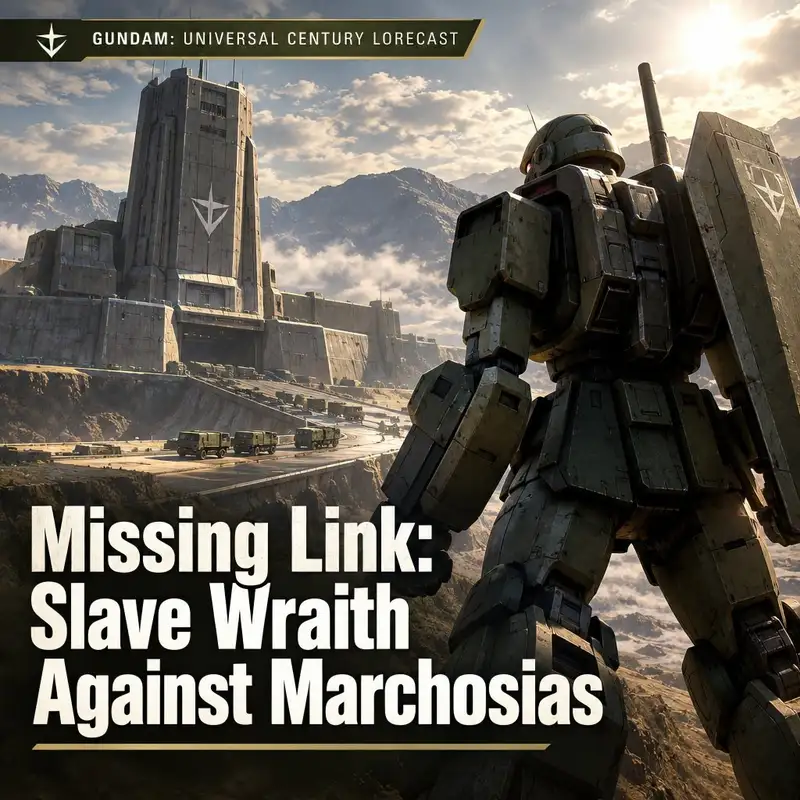
Missing Link: Slave Wraith Against Marchosias [Game]
California Base was no longer a prize. By the time Slave Wraith and Marchosias met there, it was a shrinking exit. The Federation offensive was closing in on one of Zeon’s most important terrestrial installations. What mattered was not holding every hangar, runway, and warehouse. It was getting people, equipment, and knowledge off Earth before the base became another recovered position on a Federation map. The High-Low Vehicles preparing for launch were therefore more than transports. They were the last available route from a collapsing ground war back to the space war.
That created an unusual encounter. Slave Wraith was a Federation unit, at least on paper. Marchosias was a Zeon formation. Under ordinary circumstances, they had every reason to engage one another. Instead, Slave Wraith had already broken from the authority that had used it, and its personnel were disguising themselves as a Zeon special unit in order to survive. Marchosias recognized that something was wrong. Its commander, Doug Schneid, had a choice. He could destroy an enemy formation, preserve formal loyalty, and perhaps gain little from the act. Or he could help defend the launch vehicles and preserve the lives of soldiers who had become more reliable in the field than the institutions supposedly commanding them.
This was not reconciliation between the Earth Federation and Zeon. It was not a declaration that the two governments were morally equivalent, politically identical, or suddenly united by a higher cause. Zeon’s invasion and occupation of Earth remained an aggressive war conducted by a dictatorship. The Federation remained the state fighting to reclaim its territory. But at California Base, the immediate military problem was no longer ideological theory. It was whether a few trained personnel could protect a launch route before the battle closed around them.
The decision makes more sense once we understand what these two formations were. Neither Slave Wraith nor Marchosias fit comfortably inside an ordinary chain of command. Each was a workaround. Each was built to extract military usefulness from people, equipment, and missions that conventional institutions could not easily manage in public. And each had learned, through combat, that being useful to a government was not the same thing as being protected by it.
Slave Wraith was formally the Earth Federation’s Twentieth Mechanized Composite Unit. It was commanded by First Lieutenant Travis Kirkland, known by the code name Fixer. Publicly, it could be described as an experimental mobile-suit formation. That description was not entirely false. Its equipment and missions were unusual. But it concealed the more important fact. Slave Wraith was used for operations requiring deniability, discretion, and a willingness to send politically inconvenient people into danger.
Its personnel included soldiers burdened by convictions, compromised records, or other circumstances that made them useful and expendable at the same time. Fred Reber, Marvin Herriot, Edward Lee, and Doris Brand were not interchangeable pieces of a penal battalion. The unit was not a standard punishment formation sent forward simply because nobody expected it to return. It was a specialized organization combining irregular personnel, experimental equipment, and covert authority. That combination gave it flexibility. It also meant that its members lived under a constant question: were they soldiers with a future, or assets to be used until the sponsor behind the program no longer needed them?
The authority behind that structure was Grave, a hidden Federation power center connected to Slave Wraith’s missions and to the Pale Rider project. The game does not justify treating Grave as the entire Earth Federation government, or as proof that every Federation commander understood these operations. Compartmentalization was the point. A classified program could function precisely because responsibility was divided, information was restricted, and ordinary units did not see the full picture. Such arrangements can protect sensitive research. They can also make it difficult for soldiers to know who is responsible when orders become unlawful, self-serving, or simply impossible to understand.
Marchosias was built around a different problem. It was a Zeon competition formation associated with Kycilia Zabi’s sphere of influence. It collected talented pilots who did not move easily through the regular elite track. Some had ability without the right connections, status, reputation, or institutional fit. Zeon did not simply discard them. Instead, it placed them in a competitive environment where advancement could be earned through combat performance. The prize was the possibility of selection for the planned Chimera Corps.
That arrangement was neither ordinary training nor simple meritocracy. It was a military contest shaped by political sponsorship. Marchosias gave Zeon access to capable personnel who might otherwise have remained underused or excluded. It also gave its sponsors a way to identify aggressive, adaptable survivors under wartime pressure. But competition changes behavior. It rewards initiative, individual results, and visible courage. It can also reward recklessness, personal rivalry, and the habit of treating fellow soldiers as obstacles in a race for recognition.
Marchosias entered the war at the beginning of its own formation process. During Operation British, its candidates received combat assignments involving the colony on its descent trajectory and engagements with Federation forces attempting to interfere. This was not yet a mature special-force organization with a settled doctrine and reliable cohesion. It was a proving ground under the worst possible conditions, created during an operation that had already turned a civilian habitat into an instrument of mass destruction.
The importance of that beginning should not be overlooked. Operation British was not merely a large military maneuver. It was an atrocity on a planetary scale. The colony’s use as a weapon exposed the logic of the One Year War at its most extreme. Strategic ambition, ideological rhetoric, and military desperation were all willing to treat inhabited infrastructure as expendable. Marchosias operated within that war, but its existence did not make it responsible for the decision to carry out Operation British. It did, however, show how early Zeon was willing to place ambitious and politically useful personnel inside operations whose strategic purpose far exceeded their knowledge or control.
After Zeon’s Earth offensive began, Marchosias took part in the second Earth Drop Operation and the seizure of California Base. The unit’s campaign moved from space operations into ground warfare, where the practical demands were different. A mobile suit needed maintenance in gravity. Ammunition, spare parts, transport, recovery, and terrain knowledge mattered. A pilot who had performed well in space could not assume that deserts, roads, forests, factories, and fortified bases would reward the same instincts. The war had become a struggle over infrastructure as much as over terrain.
Doug Schneid emerged as Marchosias’s commander and instructor. His customized Efreet reflected his experience and the formation’s reliance on specialized individual capability. The Efreet was not evidence that Zeon could equip every ground force with rare, high-performance machines. It was evidence that Marchosias had unusual sponsorship and that Schneid was valuable enough to receive an exceptional tool. In a small, politically favored unit, a commander’s machine could become both a combat asset and a symbol of authority.
Vincent Gleissner began as a subordinate in Schneid’s platoon. He was ambitious, capable, and shaped by the formation’s competitive culture. He also received a high-mobility ground Zaku suited to the kind of mobile operations Marchosias was expected to conduct. Again, the machine matters less as a set of specifications than as an institutional signal. Vincent had been identified as someone worth investing in. But investment was conditional. In Marchosias, performance created opportunity. It did not create security.
Marchosias learned that lesson on Earth. As the Federation recovered from its early defeats and began fielding stronger resistance, the conditions that favored Zeon’s initial offensive changed. Zeon could still exploit experienced pilots, local initiative, and specialized equipment. But the Federation’s larger industrial base, expanding mobile-suit program, and recovering capacity to coordinate ground operations steadily reduced the advantage of early surprise. Exceptional units were useful at the edge of a campaign. They could not by themselves reverse a strategic balance turning against their side.
The unit encountered increasingly capable Federation forces, including the Gundam Pixy. That encounter is easy to misread as a contest between famous machines. It was more useful as a demonstration of how close-combat specialization changes a ground fight. A machine designed for rapid, close-range action can turn restricted terrain, concealment, and short warning times into advantages. That does not make it invincible. It makes the fight more dependent on reconnaissance, local knowledge, reaction time, and whether supporting forces can identify a threat before it reaches engagement range.
For Marchosias, repeated encounters with capable Federation mobile suits made the war personal. Pilots remember the machine that killed a friend, forced a withdrawal, or exposed a weakness in their own doctrine. That memory can sharpen combat performance. It can also trap a unit inside a cycle of revenge, where the desire to settle a score begins to compete with the actual mission. Schneid’s formation had been designed to reward individual distinction. A close-range enemy like the Pixy offered precisely the kind of encounter that could make personal ambition feel like military necessity.
Slave Wraith faced a different kind of insecurity. Marchosias had been told that success could earn advancement. Slave Wraith had been made useful through secrecy and deniability. That distinction affected its command climate. A competitive unit worries that its members may fail one another in pursuit of recognition. A covert unit worries that its own sponsor may decide that silence is more valuable than survival.
Kirkland had to command under those conditions. His role was not merely to direct mobile suits in combat. He had to hold together people whose relationship with the Federation was already damaged or conditional. The members of Slave Wraith needed to believe that their commander’s orders served a mission rather than another concealed agenda. That is difficult in any special operation. It becomes harder when the unit’s external authority is deliberately obscured.
Slave Wraith’s mobile suit was derived from the Ground Gundam line but heavily modified for its particular role. The game presents it as a specialized platform emphasizing protection, sensors, communications, and mission equipment. That profile made sense for a formation operating independently and often under uncertain direction. A unit conducting sensitive work needs to see more, communicate when it can, survive long enough to withdraw, and adapt its equipment to the mission. But specialization brings a burden. Modified systems require technical support, spare parts, trained mechanics, and supply channels that may not exist outside the unit’s protected network.
The value of such a machine was not that it could defeat every opponent. Its value was that it supported a particular mission style. It could help a small formation operate where ordinary units might lack the equipment, information, or authorization to act. But it also tied Slave Wraith more closely to the classified structure that sustained it. A regular battalion might draw replacements and parts through visible channels. A deniable unit depends on the continued favor of people who cannot always be named in an order.
Grave’s authority over Slave Wraith should therefore be understood as a narrow, hidden control structure, not as a claim about all Federation policy. The Earth Federation was a vast state with many commands, agencies, officers, and competing interests. Most conventional Federation soldiers did not need to know why Slave Wraith operated differently. That ignorance was part of the design. But when a hidden program treats its own field personnel as disposable, the damage reaches beyond the classified file. It destroys trust at the point where soldiers need it most.
Slave Wraith and Marchosias crossed paths inside campaigns neither controlled. Their missions touched the larger war at Odessa and Jaburo, but neither unit decided the strategy of those campaigns. That was another feature of their status. Special formations are often given narrow tasks within large operations. They sabotage a facility, delay an advance, test an enemy response, protect a route, or hunt a particular target. They may be central to a local turning point while remaining peripheral to the political decisions that determine whether the campaign should happen at all.
Around Odessa, Slave Wraith’s sabotage of defensive infrastructure and Marchosias’s harassment and delaying actions reflected that pattern. The wider campaign concerned Zeon’s ability to retain its position on Earth. For the Federation, it was part of the long process of recovering territory, restoring movement across the planet, and breaking the occupation’s operational framework. For the special units involved, the immediate mission was smaller and sharper. Destroy this installation. Slow that force. Deny the enemy a route. Escape before the larger front shifts again.
Jaburo made the pressure even clearer. The Federation’s underground headquarters was not simply a fortified location on a map. It represented command, production, transportation, repair, and political continuity. An attack on Jaburo had to contend with difficult access routes, layered defenses, limited intelligence, and severe time pressure. Zeon could not treat the operation as a normal assault on an isolated base. The target was embedded in the Federation’s larger capacity to continue the war.
Marchosias entered this operation with reinforcements that included Albert Bell and Annerose Rosenheim. The presence of young replacements underlined the formation’s changing condition. The unit was still expected to perform specialized tasks, but it was carrying the consequences of prior attrition. Slave Wraith, meanwhile, operated according to its own concealed agenda. When the two formations encountered each other, the visible situation appeared straightforward. Federation against Zeon. The actual situation was more complicated. Both were acting on incomplete information, under authorities whose purposes were only partly visible to the people fighting.
Then the Pale Rider entered the battle.
The Pale Rider was a Federation prototype associated with the RX eighty line and equipped with the HADES combat-enhancement system. It was not a standard Federation machine and should not be treated as evidence that the Federation had broadly solved the problem of creating such systems. It was expensive, experimental, and bound to a classified research structure. In military history, a prototype can matter enormously without becoming an ordinary capability. A machine may demonstrate what a laboratory can achieve while revealing nothing about whether an army can build, train, maintain, and control it at scale.
HADES is presented in the game as related to the earlier EXAM concept, but not as simply identical to it. That distinction matters. Universal Century military research repeatedly tries to convert exceptional human perception, reaction, or combat potential into a weapon system. Different programs borrow ideas, reuse terminology, or pursue similar objectives. That does not mean they share one settled scientific model. The game gradually reveals the Pale Rider’s connection to a pilot and a program operating behind the immediate battlefield. It does not provide a final explanation for every technical, medical, or psychological question that later materials might raise.
The operational fact at Jaburo was simpler and more alarming. The Pale Rider attacked Marchosias and Slave Wraith alike. A Federation machine was treating Federation personnel as hostile. For Slave Wraith, this was not merely a surprise encounter with a new weapon. It was evidence that the chain of command above it was willing to place a classified project ahead of the safety of the soldiers it supposedly controlled.
The Pale Rider therefore created a third threat. It was Federation-built, but it was not functioning as ordinary Federation battlefield support. It was connected to the same hidden world of authority that had shaped Slave Wraith’s existence. Marchosias could see the immediate result even if it could not understand the program behind it. The enemy formation was being attacked by its own side. That observation did not create trust by itself. It did create a shared understanding that formal uniforms were no longer a reliable guide to who posed the most immediate danger.
The episode’s central paradox now returns to California Base. By then, Slave Wraith’s relationship with its own command had broken down beyond repair. The unit was no longer moving as a normal Federation formation with a secure route back to friendly lines. It was trying to escape the machinery that had used it. Its disguise as a Zeon special unit was a survival measure. It was not ideological conversion. The personnel of Slave Wraith had not suddenly accepted Zeon’s war aims or forgotten the occupation and destruction unleashed by the Principality. They were attempting to remain alive in a situation where their nominal government had become the more immediate threat.
For Marchosias, California Base was both familiar ground and a sign of strategic defeat. The formation had helped take the base during Zeon’s early Earth campaign. Now it was part of the withdrawal. The base’s military value had changed. It was no longer merely a supply and operations hub supporting conquest. It had become a launch node for retreat. Zeon personnel, specialized equipment, and whatever records or knowledge could be preserved needed access to the High-Low Vehicles before Federation forces recaptured the installation.
Launch capacity is one of the least glamorous and most decisive forms of military power. A force on Earth cannot simply decide to return to space. It needs vehicles, fuel, preparation, secure approaches, technical crews, timing, and a launch site that remains intact long enough to use. The High-Low Vehicle was therefore an operational center of gravity for the people at California Base. Protecting it meant preserving the ability to move selected survivors out of a lost theater. Losing it meant that trained specialists and scarce equipment might be trapped, captured, or destroyed.
Schneid’s decision to cooperate with Slave Wraith should be understood in that context. Marchosias recognized the disguised Federation unit. He did not need to mistake it for Zeon in order to see the larger situation. His formation had already experienced rivalry, losses, reorganization, a classified Federation prototype, and the erosion of the simple assumptions that defined its early war. The immediate threat was the Federation offensive bearing down on the base. The immediate objective was getting people to the launch vehicles. Slave Wraith could contribute to that defense. Destroying it would have consumed time, ammunition, and trained pilots without solving the problem in front of Marchosias.
Slave Wraith had its own reasons to accept. The unit needed an exit from Earth. It needed access to launch capacity that the Federation was unlikely to provide. It also had reason to believe that the Zeon formation across from it understood something about being used by a patron and left to carry the consequences. Marchosias was still a Zeon unit. It was not suddenly innocent, nor was its cooperation an absolution for the state it served. But the soldiers present could distinguish between the larger political war and the immediate obligation to survive a battle created by institutions that had already treated them as expendable.
The combined defense of the two High-Low Vehicles was therefore a limited tactical partnership. The game’s supporting account includes a decoy-launch element, with one vehicle drawing destruction while the actual escape relies on Marchosias equipment. That should be treated as a game-specific expedient, not as a general model for launch operations. What matters is the logic behind it. Deception can create a small window when the defender lacks the strength to hold every route. A decoy cannot reverse strategic defeat, but it can force an attacker to spend time and firepower on the wrong target.
The human cost should remain visible even in a story focused on mobile suits. A base is not empty terrain. It contains mechanics, transport crews, communications personnel, guards, medical staff, laborers, and people whose work makes every launch possible. Its surrounding infrastructure affects local communities, supply routes, and the civilians caught between occupation and liberation. When a base becomes a withdrawal point, the people with access to a launch vehicle may escape. Many others do not have that option. The war’s operational necessities were never distributed equally.
For Marchosias, the transition from Earth to space imposed another change in military conditions. Ground operations had depended on roads, bases, terrain, and the ability to maneuver through gravity. Space defense required different equipment, different maintenance arrangements, different navigation habits, and renewed dependence on ships, fortresses, and dock facilities. A mobile suit in space can be agile, but it still needs propellant, repair, recovery, ammunition, and a place to return to after combat. The unit was no longer improvising around ground routes. It was entering a war defined by fortress garrisons and fleet movements.
Marchosias reached Solomon, but it was not restored to the stability of a normal garrison formation. By this stage of the war, Zeon was concentrating scarce personnel and unusual equipment wherever it might delay the Federation advance. The formation received advanced or experimental assets, but scarcity should not be confused with strength. Rare machines can provide a local advantage. They can also complicate maintenance, training, and replacement. A battered unit with special equipment may look impressive in a roster while remaining fragile in practice.
Vincent’s role changed as the original competitive structure broke down. Attrition has a way of stripping away the systems that looked important during a unit’s creation. Promotion contests, platoon rivalries, and promises of future advancement lose force when the organization is trying simply to keep enough experienced people alive to function. Vincent became increasingly important as a leader not because the competition had worked perfectly, but because the war had forced the survivors to become something more cohesive than the formation’s original design allowed.
At A Baoa Qu, the lesson reached its most severe form. The fortress was one of Zeon’s final defensive positions, but it was also a place where military order was breaking under the pressure of defeat. Forces were fighting, withdrawing, evacuating, and receiving contradictory information at the same time. The battle was not just about holding a fortress. It was about whether any coherent Zeon military structure could survive the collapse of the war around it.
Marchosias entered that environment as a more unified formation than it had been on Earth, but unity could not erase the larger strategic reality. Vincent operated a high-mobility Gelgoog. Annerose used a psycommu test Zaku. These were scarce, specialized assets, not representative equipment for a force recovering its strength. Their presence showed that Zeon was still willing to place unusual technology in the hands of selected pilots even as the wider system was failing. Experimental equipment can be valuable in a final defense. It can also reveal how little margin remains for ordinary replacement and sustainment.
The Pale Rider returned during the battle against retreating Zeon forces. Once again, the machine appeared as a threat that did not fit neatly inside the normal categories of the war. Marchosias gained a temporary advantage and managed to restrain or disable it. That was an accomplishment at the tactical level. It demonstrated that a damaged but cohesive unit could still coordinate against an exceptional opponent. But it came at enormous cost. The formation was effectively destroyed or incapacitated in the process.
Then Vincent discovered the Pale Rider’s pilot, Chloe Croce, and found not an abstract weapons-system operator but a young girl. The revelation should not be treated as a simple technical answer to HADES, EXAM, Newtypes, or every other Universal Century program concerned with human enhancement. The game does not provide a single settled framework for those questions. What it does establish is more immediate. A classified combat project had turned a child into the human center of an experimental weapon system and sent that system into battle against soldiers who lacked the information to understand what they were facing.
Marchosias had begun as a formation that treated talented but excluded pilots as competitors for advancement. Slave Wraith had been built from people the Federation could use without fully trusting. The Pale Rider project represented an even harsher version of the same institutional logic. It treated human vulnerability as material for a weapons program. The differences among these systems matter. They were not identical programs, and they did not carry identical levels of coercion or responsibility. But they all reveal a wartime culture willing to solve political and organizational problems by placing exceptional burdens on people with limited power to refuse.
Vincent’s path from ambitious subordinate to responsible survivor stands against that culture. His development does not make him a symbol of moral perfection. He remains a soldier of Zeon, fighting in a war launched by a state whose leadership had committed vast crimes. But within Marchosias, he learned that survival could not be built on rivalry alone. By the end, responsibility meant carrying the memory of the unit, recognizing the people behind the enemy machine, and understanding the cost of the structures that had shaped them all.
The Federation used secrecy, deniability, and experimental authority to make Slave Wraith useful. Zeon used sponsorship, competition, and promised advancement to make Marchosias useful. The Pale Rider exposed the most dangerous consequence of such arrangements. When a state builds weapons programs around compartmentalization and human disposability, the people in the field may come to trust an enemy soldier more than the authority issuing their orders.
At California Base, formal allegiance became less important than launch access, battlefield competence, and the limited trust that soldiers could build under fire. That choice saved individuals. It preserved a fragment of combat power. It allowed Marchosias to fight again and gave Slave Wraith a chance to escape the system that had used it. But it could not save the states or institutions that had made such a choice necessary.