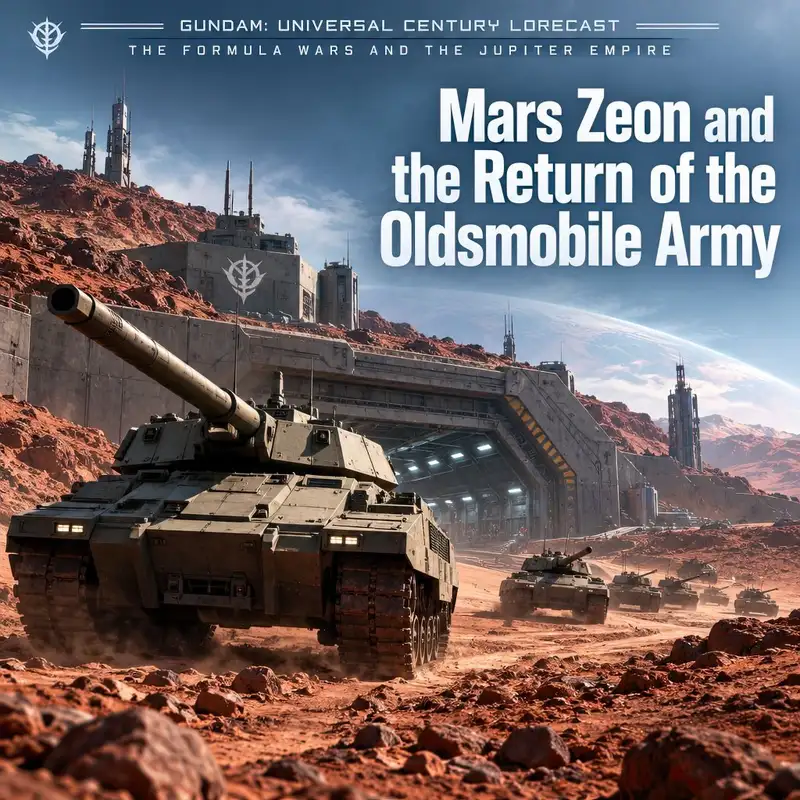
Mars Zeon and the Return of the Oldsmobile Army
The captured mobile suit should have been an embarrassment to Mars Zeon. The F90 Unit 2 was a Federation test article, built to explore the future of compact, flexible mobile-suit warfare. Instead, it reappeared in Martian service with enlarged sensors, extra verniers, and a body rebuilt for another purpose. Its new operators belonged to a force the Federation associated with antique Zeon silhouettes and old political symbols. That visual contrast produced a dangerously comforting assumption. If the machines looked old, perhaps the movement behind them was old as well. Perhaps it was a relic, isolated at the edge of the human sphere, waiting to be swept aside. The stolen F90 proved otherwise. Mars Zeon had penetrated a sensitive military program, carried advanced technology across interplanetary distance, and adapted it to a war on its own terms.
The name Oldsmobile Army captures the Federation’s problem better than it captures Mars Zeon’s identity. It was a Federation-associated nickname for forces whose mobile suits recalled older Zeon designs. It should not be mistaken for the name of a separate political movement, or for proof that every machine was literally a surviving artifact from the One Year War. The old silhouettes carried meaning. They could preserve technical familiarity, support unit identity, and invoke a past in which Zeon had briefly challenged Earth’s authority. But a Zaku-like outline could conceal newer systems, rebuilt engines, replacement parts, altered weapons, or a locally improvised maintenance culture. Military organizations often misjudge an enemy by reading appearance as capability. Mars Zeon benefited from that mistake. Its machines advertised continuity with the past while its methods revealed adaptation to the present.
Any expedition to Mars required more than mobile suits and confidence. It required transport able to sustain crews over a long route, spare parts for machines that could not simply be replaced from a nearby depot, medical support, fuel or propellant planning, ammunition, recovery capability, and a realistic plan for bringing damaged personnel and equipment home. The same distance that complicated Federation operations also protected a Martian armed movement from immediate pressure. Reinforcements would not arrive quickly. Intelligence could become stale while it was still being evaluated. A local force did not need to equal the Federation’s total industrial strength. It only needed enough security, engineering skill, political cohesion, and selective access to equipment to remain dangerous at the point where the Federation’s reach became thin.
Within that expeditionary problem, Def Stallion, the test pilot assigned to F90 Unit 1, belonged to the Federation’s experimental world. A test pilot’s skill is not identical to that of a line commander or a planetary occupation specialist. Test pilots must understand an unfamiliar machine’s limits, respond to technical failures, and provide useful feedback to engineers. They are valuable because they stand between design theory and operational reality. But when a prototype program is drawn into an active conflict, that same expertise can make a pilot difficult to replace. The Federation would eventually use Def in combat not because experimental personnel naturally make ideal expeditionary forces, but because the crisis made the F90 program itself part of the battlefield.
In Universal Century one hundred twenty, during testing in the Side Four region, Mars Zeon attacked and captured F90 Unit 2. The theft was a military success, but it was also an intelligence and security failure. An organization based around Mars had reached a sensitive Federation project, identified an opportunity, and removed a machine whose value lay partly in classified design information. The episode demonstrated that distance had not made Mars Zeon irrelevant. It had made the Federation’s understanding of Mars Zeon incomplete. The Federation knew enough to identify a hostile Zeon-derived force. It did not know enough to prevent that force from reaching a next-generation weapons program.
Bosch’s motives belong to the limits of the source record, and later material gives his role additional framing that should not be projected backward without care. What the original account establishes is enough. A Federation-trained officer crossed to Mars Zeon with access to a highly sensitive machine. That gave the Martian organization more than a captured asset. It gave them a pilot familiar with Federation procedures and a symbol that the Federation’s own system could produce defectors. In a conflict built around identity and political memory, that symbolism mattered. Mars Zeon could portray the captured machine as evidence that Federation authority was neither universal nor secure. The Federation, meanwhile, had to treat the theft as both a technical loss and a challenge to command reliability.
Mars Zeon did not preserve Unit 2 unchanged. Its modifications reveal a different operational logic from the original Formula Project. The captured machine’s mission-pack system was removed. Its sensors were enlarged. Additional verniers were installed, and its exterior was substantially rebuilt for Mars Zeon service. The result is often described as the Mars-type F90. It would be easy to call it an improved F90, but that misses the point. The redesign traded away the original machine’s modular flexibility. The Federation had wanted a platform that could change roles through interchangeable equipment. Mars Zeon wanted a more self-contained combat machine optimized for its own requirements. Those are different answers to different military problems.
The added verniers and enlarged sensors suggest that mobility and local awareness mattered to the Martian force. But the source record does not justify a precise technical comparison of acceleration, range, or sensor performance. What matters historically is the tradeoff. Mars Zeon accepted less adaptability in exchange for a configuration it could maintain and employ in a narrower operational setting. A remote force does not necessarily need a complete, balanced military-industrial base. It may be more effective to sustain a small number of specialized assets than to imitate every part of a major power’s force structure. The rebuilt Unit 2 represented selective modernization. Mars Zeon did not need to reproduce the Federation’s entire Formula Project. It needed to extract enough value from one captured machine to strengthen its own military position.
That adaptation also tells us something about logistics. Interchangeable mission packs are useful only if a force can manufacture, stock, transport, inspect, and repair them. The Federation’s concept assumed an institutional system behind the machine. Mars Zeon may have lacked the capacity, the supply chain, or the operational need to support that system. Removing it reduced flexibility, but it may also have simplified local maintenance and made the mobile suit less dependent on equipment that Mars Zeon could not reliably replace. The Mars-type F90 was not evidence that a distant remnant had suddenly become the Federation’s technological equal. It was evidence that the remnant understood what it could sustain.
The Federation’s response was to turn an experimental formation into an expeditionary instrument. The F90 test force was organized into the Thirteenth Autonomous Mobile Fleet and sent toward Mars. The mission was never as simple as recovering a stolen mobile suit. The Federation needed to neutralize sensitive technology, assess the scale of the Martian threat, retaliate for the attack, and suppress the organization that had carried out the theft. Those objectives overlapped, but they did not necessarily demand the same kind of force. A unit designed to test advanced equipment is not automatically prepared to conduct a long-range punitive campaign, investigate political loyalties, destroy hardened installations, protect civilians, and establish a durable postwar order.
Mars Zeon’s objectives should be stated with restraint. The available record supports a movement organized around survival, Zeon identity, Martian independence, and hostile action against the Earth Federation. It does not support the claim that every fighter understood the same political program, or that every civilian near Mars Zeon facilities was a willing participant. For the leadership, inherited Zeon imagery offered more than nostalgia. It supplied a ready-made language of separation from Earth, military sacrifice, and historical grievance. For personnel who had grown up far from the Earth Sphere’s centers of power, that language could provide belonging. A uniform and a mobile suit design can function as an institution when formal political representation is absent or distrusted.
The Olympus installation transformed this problem from a remote security concern into a strategic crisis. In the original F90 side-story record, the Olympus Cannon becomes the decisive threat of the First Oldsmobile War. The exact engineering details are not securely established, and the important point is not a speculative calculation of range or yield. The cannon mattered because it gave a Martian sanctuary the potential to impose unacceptable risk on Earth. A force that could not defeat the Federation in conventional fleet battle might still threaten the Federation politically by holding distant civilian populations at risk. That is the logic of strategic coercion. The weaker side seeks a weapon whose consequences exceed its ordinary battlefield strength.
For the Federation, the existence of such a weapon changed the mission. The issue was no longer simply whether Mars Zeon could retain a captured prototype or defeat a Federation task force in local combat. The issue was whether an armed organization outside routine Federation control could use Mars as a platform for a potential mass-casualty strike. That raised the pressure on commanders and narrowed the space for patient political action. It also created a familiar danger. Once a government believes an enemy holds a strategic weapon, every delay appears irresponsible, every compromise appears risky, and every civilian near the target can be treated as an obstacle to urgent action.
The civilians threatened by an Earth-directed strategic weapon were not abstractions. They were the people who would pay for a failure of deterrence or interception. But Martian civilians were not abstractions either. A cannon installation can be a military target. A Martian society living around military facilities remains a society. The Federation’s challenge was not merely to destroy the weapon. It was to do so without treating every descendant of a Zeon remnant as part of the weapon system. The record does not provide a full account of Martian population patterns, evacuation measures, or civilian casualties. That absence should make historians cautious, not complacent. Military records often preserve the destruction of installations more clearly than they preserve the lives disrupted around them.
Under the pressure created by Olympus, the confrontation between F90 Unit 1 and the rebuilt Unit 2 took on meaning beyond a duel between two pilots. Def Stallion’s Unit 1 represented the Federation’s future-oriented Formula Project. Bosch Weller’s Unit 2 represented the same technology captured, repurposed, and placed in service of Mars Zeon’s independence struggle. Their encounter was operationally important because it involved control of a sensitive test article and the knowledge embodied in it. Def ultimately defeated Unit 2 on Mars. That removed a capable weapon from the field and denied Mars Zeon further use of the captured machine. It did not, by itself, defeat the political organization that had acquired it.
Pilot-centered history is tempting because it provides clean narratives. One pilot remains loyal. Another defects. Two versions of the same machine meet in combat. The battle appears to settle the argument. But a mobile suit is not a political settlement, and a pilot’s defeat does not erase a support network. Unit 2 required technicians, parts, facilities, intelligence, command decisions, and a strategic purpose. Unit 1 required the same, delivered across interplanetary distance by an expeditionary force. The F90 confrontation mattered because it was embedded in those systems. If it is separated from them, the conflict becomes a story about personal skill. In reality, it was a story about whether the Federation or Mars Zeon could control the future of a military technology and the political meaning attached to it.
Def’s role also shows the burden placed on technical specialists when institutions fail to contain a crisis. He was a test pilot, not the architect of Federation policy toward Mars. Yet he became one of the people expected to resolve the immediate consequences of that policy. Bosch, similarly, should not be reduced to a simple villainous defector. His actions created a grave security breach and strengthened an armed movement threatening the Federation. But his defection also exposed a deeper institutional problem. A military can screen personnel, classify information, and protect hardware. It cannot eliminate political fracture merely by treating it as an administrative inconvenience. When loyalty becomes uncertain inside a sensitive program, command must ask why, not merely who.
The original F90 account places the Thirteenth Autonomous Mobile Fleet’s arrival at Mars in Universal Century one hundred twenty-one. It then describes an internal rebellion, the fleet’s destruction by the Olympus Cannon, and the eventual collapse of the Mars base. This sequence belongs to that particular side-story record and should not be flattened into a universal, perfectly documented account of late Universal Century history. Even within that record, however, the operational lesson is clear. The Federation expedition had reached Mars with an already complex mission. It encountered not only an entrenched hostile force and a strategic weapon, but internal command vulnerability. The very formation sent to suppress a distant threat proved vulnerable to fracture from within.
The destruction of a fleet by a strategic cannon is not simply a tactical setback. It demonstrates the danger of approaching a defended sanctuary with insufficient intelligence about its fixed defenses, command reliability, and firing capability. It also illustrates why a remote armed movement invests in a weapon like Olympus. Conventional mobile suits can harass, defend a local installation, and fight for tactical space. A strategic cannon can shape the enemy’s entire operational plan. It can force the Federation to consider approach routes, timing, fleet concentration, risk to transports, and the consequences of a failed first strike. A force that cannot match the Federation ship for ship may still make the Federation pay heavily for every attempt to close with it.
The eventual collapse of the Mars base therefore produced several different outcomes. Tactically, Mars Zeon’s major installations were defeated, and the captured F90 Unit 2 was neutralized. Operationally, the immediate Martian threat was reduced and the Federation denied Mars Zeon the use of its most dangerous strategic asset. Strategically, the Federation prevented the Olympus weapon from maintaining leverage over Earth. Those were genuine achievements. It would be dishonest to deny them merely because the campaign failed to resolve every political consequence. A government has an obligation to prevent an armed organization from placing civilian populations at strategic risk.
But victory also exposed institutional weaknesses that the Federation could not afford to ignore. Prototype security had failed. Political reliability inside the expedition had failed. A test formation had been forced into a combat role far beyond ordinary evaluation work. The Federation had discovered that a distant security problem could become a strategic crisis before its institutions fully understood the threat. And the campaign showed the limits of punitive expeditionary warfare. The Federation could destroy a base and defeat a captured prototype. It could not demonstrate legitimacy simply by doing so. It could not assume that military destruction had reconciled Mars to Federation rule, or that the descendants of old Zeon communities would now see the Federation as their political protector.
The civilian consequence is where the language of suppression becomes most revealing. A military organization can be dismantled through force. A population cannot be reduced to the organization operating in its vicinity. Mars Zeon’s leadership may have pursued armed independence and strategic coercion. Children, families, workers, and noncombatants did not choose the One Year War, and many did not choose the symbols inherited from it. Yet they lived in the political world those symbols had created. If the Federation treated every Martian connection to Zeon memory as evidence of insurgency, it would make the next generation more likely to understand Federation power as occupation rather than representation. That is not an argument against military action against a strategic weapon. It is an argument against imagining that military action is the whole policy.
The return of Oldsmobile forces in Universal Century one hundred twenty-two confirms that distinction. Here the source changes. Mobile Suit Gundam F91: Formula Senki 0122 is an interactive game record, and its campaign must be handled accordingly. The player’s exact victories, equipment choices, losses, and battlefield performance are not fixed history simply because the game allows them. What can be used as historical evidence is its established premise. The Federation again faces Oldsmobile forces, and the Thirteenth Anti-Earth Federation Suppression Squadron is assigned to transport the F90 and eliminate the organization. Its flagship, the Eibraham, carries out a mission that joins technology transfer to armed suppression.
That premise matters because it shows that the First Oldsmobile War did not produce a durable political settlement. The Federation is again moving the F90 in connection with an operation to remove Oldsmobile forces. The wording is stark. Suppression is a military objective, not a political program. It identifies an enemy organization and directs force against it. In some circumstances, that may be necessary. Armed groups capable of attacking Federation personnel or threatening civilians cannot be dealt with through slogans alone. But suppression is not the same as representation, reconstruction, negotiation, or the creation of institutions that give distant communities a meaningful stake in the larger political order.
The Formula Senki record also describes the Federation force as already weakened by repeated fighting before the main campaign. That detail is important because it strips away the image of a clean and overwhelming purge. Long-range operations wear down ships, crews, machines, and command staffs. A unit that enters a campaign after prior combat carries damage, fatigue, maintenance debt, and reduced margin for error. The Eibraham and its squadron were not operating in a laboratory environment. They were carrying a sensitive mobile suit through a difficult security mission against an adversary that had already demonstrated its ability to endure beyond a first defeat.
Bergh Scred is the Federation pilot associated with the game’s campaign, which unfolds across twelve scenarios against Oldsmobile forces. His role belongs to that game’s fixed narrative frame. The player’s route through those scenarios does not establish a single detailed historical record of every engagement. We should not pretend that a selected mission pack, a perfect score, or the survival of a particular unit in a playthrough was part of one settled chronology. Yet the game’s structure still communicates a larger historical point. The Federation is fighting not a single isolated encounter, but a continuing series of operations against a persistent enemy organization. The problem has endured long enough to require repeated armed action and the redeployment of valuable technology.
The second campaign also reveals a bureaucratic habit common to overstretched powers. A difficult political frontier is classified as a recurrent security threat. A special formation is dispatched. It fights hard, suffers attrition, and reports the enemy suppressed. Then the underlying conditions remain, because the operation was designed to remove hostile capability rather than address the environment in which hostility continued to matter. This does not mean every Federation officer was indifferent to Martian civilians, or that every Mars Zeon fighter represented legitimate political opposition. It means that the Federation’s institutional vocabulary was too narrow. It had a doctrine for punitive action. It had fewer visible tools for treating Mars as a community whose political alienation required more than another operation order.
The later manga Mobile Suit Gundam F90 Cluster returns to the First Oldsmobile War from a different source position. It is not a seamless replacement for the older F90 account, and its newer details should not be used to erase the limits or sequence of that earlier record. What it does provide is a broader view of the Martian human terrain. Its central figure, Ivar Dana, is described as a third-generation descendant of Zeon remnants living on Mars. That generational position changes the question. Ivar is not simply a surviving veteran trying to relive the One Year War. He belongs to a population born into the consequences of a conflict that had already become inherited history.
That distinction is crucial. The Federation could look at Zeon symbolism and see a defeated ideology refusing to die. A Martian descendant could look at the same symbolism and see family history, political exclusion, local identity, or the only vocabulary available for opposing distant authority. Those meanings do not erase the crimes committed under Zeon rule, and they do not justify Mars Zeon’s use of force. But they help explain why the symbols retained power. A child born on Mars did not choose the Zabi dictatorship, the One Year War, or the Federation’s long failure to build a convincing political relationship with the periphery. Yet that child could still inherit the fear, pride, grief, and suspicion produced by those events.
F90 Cluster brings noncombatants more directly into view, including Ivar’s efforts to protect children and others caught in the conflict. That emphasis does not turn the First Oldsmobile War into a simple morality tale in which one side is innocent and the other cruel. It does something more valuable. It reminds us that military categories are often too blunt for the societies they enter. The Federation may identify an Oldsmobile assault. Mars Zeon may identify a struggle for survival. Civilians identify pressure loss, evacuation, hunger, separation, damaged infrastructure, and the danger of being assigned an allegiance by armed people who have never asked for one.
The newer manga therefore reframes Mars from a hostile base into a political community under military pressure. Its characters have inherited a conflict without necessarily inheriting responsibility for its beginning. That is especially important in a setting where institutions repeatedly convert young people into soldiers, symbols, test subjects, and heirs to grievances they did not create. The question is not whether later generations should be held accountable for old Zeon crimes. They should not. The question is whether a political order can distinguish inherited identity from active participation in armed violence. If it cannot, it will treat every descendant as a suspect and every act of civilian protection as an obstacle to security.
That does not absolve Mars Zeon’s armed leadership. An organization that steals military technology, builds strategic coercive capability, and threatens the Earth Federation accepts responsibility for the consequences of those choices. Nor does it absolve the Federation. A government that allows distant populations to remain politically marginal, then approaches them primarily through punitive fleets, accepts responsibility for the conditions that make inherited rebellion durable. The two responsibilities are not identical. They should not be collapsed into moral equivalence. But neither can be ignored if the aim is to understand why conflict returns after a military victory.
Mars Zeon remained dangerous because it was not preserved in amber. It adapted. It used old Zeon identity as political capital, local engineering as a practical resource, Federation technology as an opportunity, and Martian distance as a sanctuary. The rebuilt F90 Unit 2 embodied that adaptation. The Olympus Cannon gave it strategic leverage. Bosch Weller’s defection revealed that the Federation’s vulnerabilities included people and institutions, not merely hardware. The return of Oldsmobile forces in Universal Century one hundred twenty-two showed that a destroyed base was not the same as a resolved conflict.
The Federation could defeat a prototype, collapse an installation, and send another suppression squadron toward Mars. What it could not accomplish through force alone was the harder task: explaining why another generation on Mars still found protection, meaning, or political purpose in the symbols of an old war.