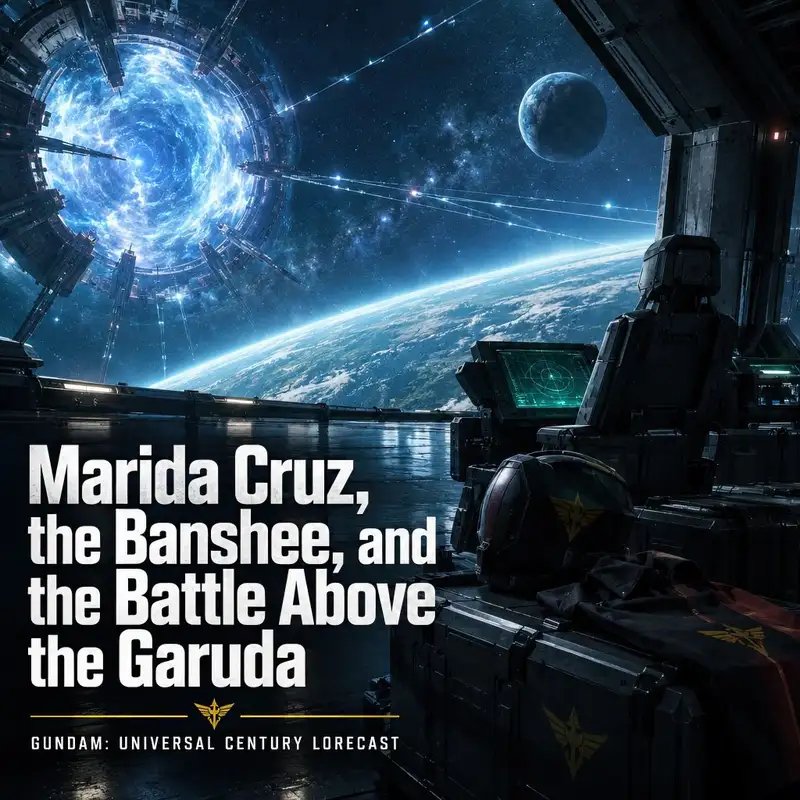
Marida Cruz, the Banshee, and the Battle Above the Garuda
Mineva Lao Zabi is held aboard a Federation aircraft large enough to carry mobile suits, command staff, guards, and the machinery of a political crisis. Outside its hull, high above the Earth, Banagher Links is intercepted by the Banshee, the second of the RX-zero units. The pilot speaks with the imposed name Ple Twelve. Banagher hears something else. He hears Marida Cruz, the woman who had flown the Kshatriya for the Sleeves and who belonged, in every sense that matters, to the people trying to rescue her.
That is the real conflict above the Garuda. It is not simply one black mobile suit against one white one. The issue is whether a machine’s performance, an institution’s authority, and a human being’s will can be treated as the same thing. Martha Vist Carbine and Alberto Vist possess the aircraft, the prisoner, the Banshee, and access to Federation power. Yet they cannot truly control the people whose choices give those assets meaning. Mineva refuses to become leverage. Banagher refuses to treat Marida as an enemy machine. And the Garencieres crew refuses to abandon either of them.
The Garuda was built for a world in which airspace still mattered. Universal Century warfare is often remembered through colony battles, lunar installations, and mobile suits maneuvering around asteroids. But Earth remains a vast and difficult theater. It has oceans, weather, mountains, cities, occupied territory, launch sites, and an atmosphere that punishes any force designed mainly for space. A mobile suit can be formidable under gravity, but it still needs transport, maintenance, fuel or propellant, technicians, secure launch points, and a way home.
The Garuda was meant to provide that infrastructure from the sky. Official material identifies it as a three-hundred-seventeen-meter heavy airlifter developed under the Garuda Initiative. The plan called for several such aircraft to divide responsibility for Earth’s air-defense zones and support mobile-suit deployment. Most of those planned machines were lost over time. The original Garuda survived through repeated upgrades until it became something more than a transport. It was a flying fortress, a mobile hangar, a command platform, and an armed symbol of Federation reach over its own planet.
That combination made it useful, but it also made it vulnerable. A giant aircraft concentrates too much in one place. Its hangars, launch systems, crew spaces, maintenance facilities, communications equipment, fuel, and high-value passengers are all tied to one airframe. A warship can sometimes absorb damage and maneuver into open space. A transport aircraft in atmosphere must preserve lift, control, and structural integrity. It cannot casually exchange fire around its own engines or send defenders through every section of the hull without regard for the people inside.
By the time of the Garuda confrontation, the aircraft is carrying more than military cargo. Mineva is aboard because Martha Vist Carbine intends to use her as leverage. The immediate subject is Laplace’s Box, the political secret sought by several governments, factions, and private interests. But the operational problem is Banagher Links. The Unicorn Gundam’s La-plus System has revealed coordinates connected to the Box, and neither possession of the machine nor custody of its pilot automatically grants access to that information.
Banagher has become a political problem because the Unicorn responds to him in ways the people trying to control it cannot fully command. Mineva is a political problem because she is not merely Audrey Burne, the name she used while moving through Federation society. She is Mineva Lao Zabi, heir to the Zabi family and a potential public figure in the long shadow cast by Zeon, Neo Zeon, and Char’s Rebellion. Her presence can legitimize a movement, embarrass a government, complicate negotiations, and expose the gap between public policy and private power.
Martha understands that danger. She does not need to believe that Mineva can overthrow the Federation by herself. It is enough that Mineva can become a focal point for dissent, memory, and alternative political claims. Ronan Marcenas and other figures within the Federation establishment have their own reasons to fear what the Box could reveal. Alberto Vist, operating in Martha’s orbit, is tasked with turning that larger political crisis into a manageable security operation. Capture the pilot. Secure the princess. Control the machine. Prevent the information from moving.
It is a familiar institutional instinct. When authority lacks confidence in its own legitimacy, it often tries to compensate with custody. It places people under guard, classifies documents, partitions information, and assumes that a controlled room will produce a controlled outcome. The Garuda is the physical expression of that assumption. It is large enough to carry prisoners, guards, mobile suits, and political representatives through the sky. But no airframe, however imposing, can force Banagher to reveal what he does not wish to reveal. Nor can it make Mineva accept the role assigned to her.
The Banshee exists because the people around the UC Project do not trust persuasion, ordinary military power, or political negotiation to solve the problem. It is the second RX-zero Unicorn unit, a sister machine to Banagher’s Unicorn Gundam. It is not a standard Federation mobile suit, and it should not be mistaken for evidence that the Earth Federation Forces could routinely field psycho-frame-equipped anti-Newtype weapons. The Banshee is an exceptional system, built around rare technology, specialized support, restricted knowledge, and a small pool of pilots capable of operating it.
Its development reflects the military logic of the late Universal Century. Newtypes and psycommu systems had repeatedly disrupted conventional assumptions about detection, reaction time, remote weapons, and pilot-machine interaction. The answer pursued by the UC Project was not merely to study Newtypes. It was to build machines capable of identifying, confronting, and destroying the threat they represented. The Banshee’s Newtype Destroyer system, usually called NT-D, turns that logic into hardware. It is a system designed around the fear that human perception might exceed institutional control.
The Banshee is also described as a more complete RX-zero unit tested under gravity. That matters because the Garuda battle takes place in the atmosphere, where mobility is constrained by different problems than those found in open space. A machine cannot simply drift away from trouble. It must account for weight, air resistance, flight systems, momentum, altitude, and the danger of falling onto the very platform it is supposed to protect. The Banshee’s specialized Armed Armor equipment gives it options beyond the basic weapons carried by an ordinary line mobile suit. But more capability also means more maintenance, more complexity, and more dependence on a tightly controlled support system.
That is the contradiction at the heart of advanced weapons programs. The Banshee looks like a solution because it is fast, powerful, and built to confront the same class of machine as the Unicorn. Yet it is not strategically useful in the abstract. It requires psycho-frame technology that cannot simply be issued across an entire fleet. It requires trained technicians. It requires secure facilities. It requires political protection. Most of all, it requires a pilot whose Newtype capacity can make the system function at the level its designers intended.
The institution behind the Banshee finds that pilot in Marida Cruz. That fact is the machine’s greatest strength and its greatest indictment. Marida is not an anonymous test subject discovered in a laboratory. She is a young woman with a name, a past, and relationships forged aboard the Garencieres. She is the Sleeves pilot who operated the Kshatriya, and she is someone Zinnerman and his crew know as Marida. They know her abilities, but they also know her as a person who has survived exploitation that no military record can make clean or impersonal.
Above the Garuda, that person is forced into the designation Ple Twelve. The change in name is not cosmetic. It announces that the people directing the Banshee are attempting to strip away the identity Marida built after earlier abuse. The OVA does not present this as a simple switch being flipped inside a machine. Marida’s behavior emerges from conditioning, trauma, imposed commands, and the Banshee’s psycho-frame response. The exact relationship between those elements is not explained as settled science. What is clear is that her combat capability is being commandeered.
The distinction matters. Marida is not voluntarily serving Martha Vist Carbine. She is not transformed into a conventional loyal officer who has weighed the mission and accepted its purpose. But neither is she rendered into a mindless mechanism with no remaining self. Her skill remains real. Her reactions remain real. Her fear, anger, and fractured memories remain real. The cruelty lies in the effort to turn all of those human qualities into inputs for a weapons system. Alberto and Martha do not merely deploy an asset. They try to make damage itself dependable.
The Universal Century repeatedly turns exceptional people into military resources. Newtype potential becomes a research category. Trauma becomes a pilot-management problem. Memory becomes something to suppress, stimulate, or redirect. The language of security helps make this appear orderly. A program receives a designation. A pilot receives a number. A machine receives a mission. But the administrative vocabulary does not remove the violence. It merely gives that violence a filing system.
Marida’s condition also exposes the weakness of the word control. Alberto can issue commands. The Banshee can respond to the presence of another psycho-frame machine. The people around the project can isolate Marida from those who know her. None of that creates a stable human instrument. It creates a dangerous concentration of coercion. A pilot whose identity has been damaged may still fight with tremendous ability, but a system built on that damage is not secure in the deeper sense. It is only forcing its contradiction into the cockpit.
For Banagher, this changes the nature of the encounter immediately. In a conventional engagement, a hostile mobile suit is an obstacle to be defeated, disabled, or destroyed according to the mission. The Banshee is all three, but it is also Marida. Banagher has seen enough to understand that the person facing him is not acting freely. That knowledge imposes a tactical cost. He cannot simply regard the enemy machine as expendable. He must protect Mineva, survive the Banshee, and somehow preserve the possibility that Marida can be reached.
The Garencieres crew reaches the same conclusion from a different direction. Their captain, Suberoa Zinnerman, has no reason to view the Garuda as an ordinary target. His objective is not to destroy the aircraft. Destroying it would risk Mineva, Banagher, Marida, and everyone aboard. It would also turn a recovery operation into a mass-casualty event with no guarantee of achieving its purpose. Zinnerman’s mission is extraction. Recover Mineva. Recover Banagher if possible. Recover Marida if possible. Then escape before the larger forces around the Laplace Incident can close in.
That is a difficult mission even before the Banshee appears. The Garencieres is a disguised Sleeves freighter, capable of atmospheric entry and able to carry a limited mobile-suit complement. It is useful precisely because it does not announce itself as a major warship. But disguise does not create mass, armor, or unlimited endurance. A small transport operating against a fortified airlifter and its escorts cannot win by brute force. It must exploit surprise, confusion, and the defenders’ need to protect their own aircraft.
The rescue force faces a layered problem. The Garuda has defending mobile suits, including Anksha units, and it has the advantages of altitude, preparation, and internal security. The Banshee adds a mobile suit capable of contesting the Unicorn directly. The attackers must worry about the safety of hostages, the aircraft’s stability, the possibility of a crash, and the fact that their own people are scattered across the battlespace. There is no clean line between the military target and the political target. The same hull contains both.
The Garencieres therefore does not seek a grand battle. It seeks enough disruption to create access. The external mobile-suit fight fixes defenders’ attention. Pressure against the aircraft forces the Garuda crew to respond to multiple threats at once. While the defenders focus on launches, interceptions, damaged sections, and the security of their passengers, Zinnerman can move toward Mineva. This is the logic of a boarding operation. The objective is not annihilation. It is to create a temporary gap in an enemy’s control system and pass through it before that gap closes.
The battle above the Garuda is shaped by gravity as much as by ideology. High-altitude mobile-suit combat is not open-space combat moved to a blue background. The aircraft must remain airborne. Its defenders must avoid damaging critical structures. Launch and recovery areas become choke points. Firing arcs are limited by the presence of friendly machines, engines, hull surfaces, and prisoners. A mobile suit that misses may not merely lose a shot. It may puncture a hangar, damage a flight surface, or send debris into an area where civilians and crew cannot easily escape.
The Garuda’s size gives it capacity, but capacity brings concentration. It carries the personnel required to operate mobile suits, maintain communications, direct security, and sustain a long-range air mission. It also carries the people Martha believes she can use to determine the future of Laplace’s Box. That makes it too important to abandon and too valuable to risk. A fortress that cannot be risked is not invulnerable. It is constrained. Its commander must preserve the aircraft, the prisoners, and the mission at the same time.
The Anksha defenders illustrate that the Garuda is not defenseless. They provide the kind of atmospheric mobile-suit response a high-altitude carrier needs. But defense is more complicated than launching machines toward an attacker. The defenders must identify which threat matters most. Is the priority the Garencieres itself? The Sleeves mobile suits outside? The boarding party moving inside? Banagher and the Unicorn? Mineva’s custody? The Banshee’s operations? Every answer leaves another vulnerability exposed.
This is where compartmentalized authority becomes a military weakness. Martha, Alberto, the Garuda crew, Federation personnel, Londo Bell, the Sleeves, and the rescuers do not all share the same mission or the same information. Some know Mineva’s real identity. Some learn it only during the crisis. Some care primarily about the Box. Some are concerned with the Unicorn. Some are trying to preserve an aircraft and avoid a political disaster. Marida alone is denied the most basic information of all, the ability to stand securely within her own identity.
Bright Noa and Londo Bell sit uneasily within that fractured chain of command. Bright is not the architect of the UC Project, and he does not command every political authority involved in the operation. His position is constrained by superiors, classified objectives, and the larger machinery of the Federation state. But he recognizes what is happening. The Unicorn and its pilot are not being handled solely as military assets. They are being contained because their existence threatens people who have invested power in keeping certain truths buried.
The Ra Cailum, Londo Bell’s flagship, is itself present on Earth for testing connected to Minovsky craft technology. That does not make Bright master of the situation. It places him near a crisis in which military command is being bent around political fear. His concern is significant precisely because it is limited. A senior officer can see that an operation is becoming dangerous, unlawful in spirit, or strategically foolish. Seeing it does not always grant the authority to stop it. The Federation has won wars before while allowing its internal command system to become increasingly distorted by secrecy and patronage.
Riddhe Marcenas is caught in a related conflict. As a Londo Bell ensign and ReZEL pilot, he approaches events through military duty. Yet he is also the heir to the Marcenas family, one of the political families entwined with the Federation order. When he learns that Audrey Burne is Mineva Lao Zabi, the crisis becomes personal in a way he did not choose. Mineva is no longer simply a civilian he wants to protect. She is connected to the history his own family has helped manage, conceal, and defend.
The point is not that Riddhe controls the operation. He does not. Nor is he simply a passive witness. His reaction demonstrates how quickly the supposed boundaries between public duty, family interest, and private feeling collapse around Mineva. The Garuda is carrying a prisoner, but it is also carrying the unresolved history of the Earth Sphere. Every person who learns more about Mineva must decide whether she is a threat to be contained, a political symbol to be exploited, or a person with the right to choose her own role.
Outside the aircraft, Banagher confronts the Banshee under conditions that offer little time for philosophical reflection. Marida is dangerous. The machine is dangerous. The Banshee’s NT-D activation intensifies the threat, exposing its psycho-frame and driving the RX-zero system into a far more aggressive operational state. Banagher cannot solve that problem through a speech alone. He must maneuver, defend, and find enough space to keep the Banshee from closing off every route of escape.
Yet the Unicorn’s response is not merely a technical countermeasure. The two machines react through psycho-frame systems, Newtype perception, and the emotional pressure carried by their pilots. The OVA shows a confrontation in which machine behavior, pilot experience, and psychological trauma cannot be cleanly separated. It does not provide a laboratory explanation that would allow a later commander to reproduce the event by issuing the same equipment to another unit. The circumstances are extraordinary, and the people involved are not interchangeable components.
That uncertainty is important. The Banshee is intended to destroy or suppress Newtype threats. The Unicorn responds in a way that allows Banagher to confront it and create space for the rescue. But neither result proves that psycho-frame technology has solved the operational problem of Newtypes. If anything, the battle demonstrates how little the institutions using these machines understand the forces they are trying to weaponize. They can build the hardware. They can create procedures. They cannot reliably predict what will happen when memory, fear, empathy, and psycho-frame resonance collide.
Banagher’s restraint is therefore neither sentimental nor cost-free. It exposes him to risk. A pilot who refuses to destroy an enemy mobile suit may lose the initiative, endanger friendly forces, or allow an opponent another attack. But Banagher’s judgment is based on operational reality as he understands it. Marida is not an enemy in the ordinary sense. Killing her would remove a threat, but it would also complete the work Alberto and Martha have begun. It would accept their definition of her as a weapon that can only be neutralized through destruction.
Zinnerman’s mission similarly depends on rejecting that definition. Marida is part of the rescue objective because she is one of his people. The Garencieres crew does not have the luxury of treating her recovery as a secondary humanitarian concern. Her capture by the Vist side is militarily significant, politically significant, and personally significant. The people controlling the Banshee have gained not only an advanced mobile suit but also a pilot who understands the Sleeves, Banagher, and the emotional bonds that might interfere with their plans.
The internal and external battles reinforce each other. Outside, mobile suits draw attention and force the Garuda’s defenders to respond. Inside, Zinnerman works toward Mineva. The attack becomes possible because the Garuda cannot give every task equal priority. It cannot preserve ideal flight safety, maintain airtight prisoner control, conduct a coordinated mobile-suit defense, and manage a politically sensitive detention operation without friction. A crisis does not need to destroy a system to defeat its immediate purpose. It only needs to force that system to choose what it cannot afford to lose.
The Garuda’s defenders are not incompetent because they face this dilemma. Their mission is structurally difficult. They are guarding people whose status is politically explosive. They are operating under orders shaped by people who may not share the practical concerns of the crew. They must prevent escape without causing a crash. They must repel a rescue force without killing hostages. They must respond to the Unicorn and the Banshee while also keeping the aircraft itself in the air. That is not a simple security mission. It is a stack of incompatible requirements.
The rescuers exploit those incompatibilities. They do not win through superior firepower. They win through purpose. Zinnerman knows what he must recover. Banagher knows whom he must protect. Mineva knows that remaining aboard means allowing herself to remain an object in someone else’s political calculation. Martha and Alberto possess greater resources, but their plan depends on reducing people to controllable roles. Once those people refuse those roles, the plan begins to fail.
Mineva’s escape is the decisive political event of the battle. Her departure from the Garuda is not merely a dramatic physical act. It is a refusal to remain cargo. She has been moved from hand to hand by institutions that believe her identity can be contained by transport, guards, and sealed compartments. By leaving the aircraft, she collapses the immediate leverage Martha hoped to exercise over Banagher and the Unicorn. A hostage is valuable only while physically and psychologically contained. Once Mineva is free, the balance of the operation changes.
Banagher catches her with the Unicorn. The act is risky because everything about the battle is risky. The aircraft is damaged and under pressure. The Banshee remains active. The rescuers are separated and exposed. But the recovery of Mineva demonstrates the essential difference between custody and control. The Vist side had the larger aircraft. It had armed guards. It had an advanced mobile suit. It had political influence at the highest levels. It still could not make Mineva accept captivity as her only possible future.
The disruption to the Garuda matters, though the surviving record does not support a precise damage assessment or casualty count. What matters is that the aircraft’s coercive mission has been compromised. It remains a major platform. It is not simply destroyed or erased from the conflict. But it has failed at the task Martha assigned to it. Mineva is gone. Banagher is no longer securely held. The Unicorn’s information cannot be extracted through simple custody. The effort to turn the Garuda into a flying prison has broken down under the weight of its own contradictions.
The outcome is not a clean victory for the Garencieres or the Sleeves. At the tactical level, the rescue force disrupts the Garuda’s operations, extracts Mineva, and prevents Banagher’s permanent capture. Those are substantial achievements. The aircraft’s defenders are forced into a reactive posture, and the Vist side loses its most immediate means of coercion. The rescue demonstrates that a smaller force with a focused objective can impose a decision on a larger platform when that platform must defend too many vulnerable functions at once.
At the mission level, however, the result is incomplete. Mineva escapes. Banagher survives. But Marida is not liberated. The Banshee and its pilot remain under the control of the people who have seized them. That failure matters more than a conventional battle report might suggest. A commander could list recovered personnel and damaged equipment, then call the operation a success. Zinnerman would have reason to resist that conclusion. A rescue mission built around responsibility to people cannot ignore the person left behind in the cockpit.
Not every Federation officer aboard shares Martha’s purposes. It means the system gives people like Martha room to act. The Earth Federation remains vast, divided, bureaucratic, and unevenly governed. Its institutions include professional soldiers, political families, security organs, elected and unelected authorities, corporations, and people simply trying to carry out their assigned duties. The danger lies in the way compartmentalization allows an extraordinary abuse to be presented as an ordinary security requirement. A prisoner becomes an asset. A hostage becomes a negotiation tool. A traumatized pilot becomes a weapons interface.
The industrial lesson is equally severe. The Banshee is an impressive machine, but it is not a scalable answer to the Earth Sphere’s political violence. Its psycho-frame, specialized systems, and pilot requirements make it rare by design. It can decide a local encounter. It can exert enormous pressure on a single pilot or a small group of mobile suits. But it cannot repair a damaged political order, restore trust between Earth and the colonies, or replace the institutions needed to govern without coercion.
The humanitarian lesson is the most painful. Marida remains trapped. Banagher has recognized her. Zinnerman has acted to recover her. The audience can see the person beneath the imposed designation. But recognition is not liberation. The people controlling the Banshee retain access to the machine and to the wounded human being inside it. They have learned that Marida’s trauma can be made operationally useful. That fact turns the battle’s apparent success into something unfinished.
The Garuda encounter is therefore not best understood as a duel between rival Gundams. The Banshee and Unicorn are important because they reveal the larger struggle in concentrated form. One machine is used to contain, classify, and destroy a perceived threat. The other becomes a vehicle for a pilot trying to protect people whom the system has marked as dangerous. Neither mobile suit is morally independent. Their meaning comes from the institutions directing them and the human choices made inside their cockpits.
The Banshee’s real function above the Garuda is institutional control. It is designed to confront Newtype capability, but it is deployed as part of a broader attempt to control Banagher, Mineva, and the future represented by Laplace’s Box. Its greatest danger is not that it is faster or more heavily armed than another machine. Its greatest danger is that powerful people believe they can make obedience from a wounded person by combining technology, confinement, and fear.
Banagher’s success is not that he proves the Unicorn stronger. He refuses the classification that would make Mineva a hostage and Marida a weapon. Mineva escapes because she refuses to remain political cargo. Zinnerman acts because responsibility to his crew means more than preserving a ship or winning a tactical exchange. The Garuda remains in the sky, and the Banshee remains in hostile hands, but the battle has exposed the poverty of a strategy that depends on breaking people in order to govern them.
Above the Garuda, the Vist side possesses an extraordinary weapon and nearly every material advantage. What it lacks is legitimacy. That is why Mineva can escape, why Banagher can resist, and why Marida’s captivity remains the battle’s unresolved fact. The machine can be maintained, armed, and launched again. The person inside it cannot be reduced to a component without revealing the moral failure of everyone who tries.