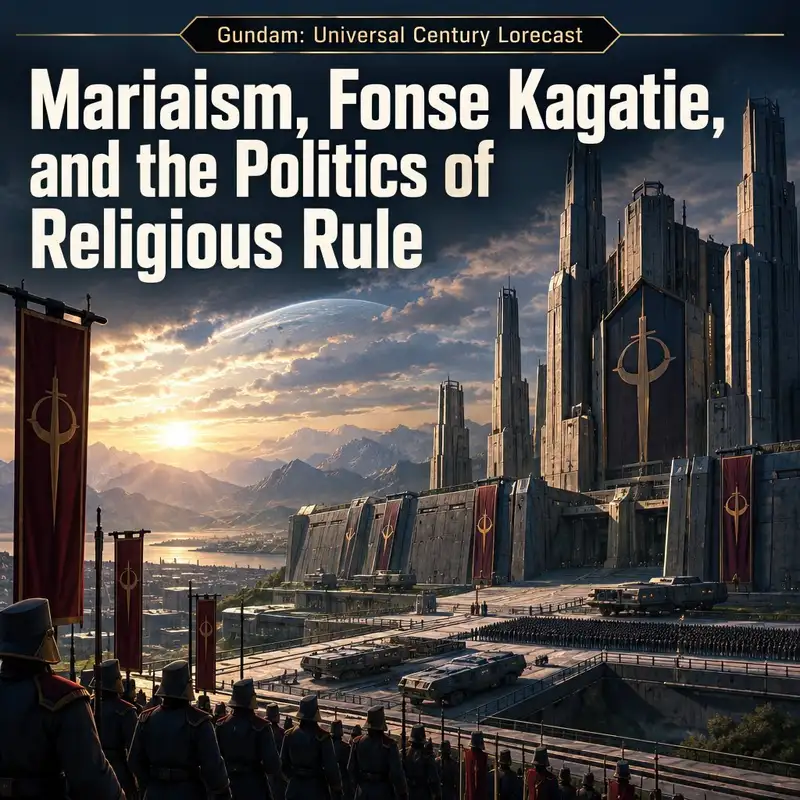
Mariaism, Fonse Kagatie, and the Politics of Religious Rule
A crowd gathers beneath the symbols of Zanscare rule, waiting for Queen Maria Pure Armonia. They have come for a ritual of healing. For some, her presence promises relief from illness, fear, poverty, and the accumulated fatigue of a society that has spent too long watching distant governments fail to protect ordinary people. Maria stands before them as a maternal figure, gentle where politics has been brutal, compassionate where military authority has been cold. The ceremony invites devotion because devotion is not always foolish. People under pressure often seek a person who appears to see their suffering and offer a language other than command, profit, or war.
Yet this public grace exists beside a very different kind of state action. Fonse Kagatie’s regime uses the atmosphere surrounding Maria’s ceremonies to prepare executions and intimidate its opponents. The contrast is not an accidental hypocrisy at the margins of Zanscare government. It is the structure of the regime. Maria offers sanctification. Kagatie supplies the machinery of obedience. One gives the state a moral face. The other ensures that those unconvinced by that face have few safe ways to object.
The television record leaves Maria’s apparent healing deliberately uncertain. The people around her experience something meaningful. They believe they have witnessed comfort, perhaps grace, perhaps a power beyond ordinary medicine. The series does not offer a detached scientific report that settles the matter. It does not need to. Politically, the important fact is that many people believe Maria represents care in a political order that has forgotten how to care for them. Kagatie understands that belief better than anyone around him. He does not need to prove that Maria is divine. He only needs her to be trusted.
That is the central problem of Mariaism and Zanscare rule. The question is not simply whether Maria is compassionate, or whether Kagatie is cruel. It is how a language of healing, maternal protection, and social peace becomes the public face of conquest, terror, and ultimately a plan to suppress human will itself. Zanscare does not rule through faith alone. It does not rule through military force alone. It binds the two together, giving one man control of fleets, prisons, party institutions, and strategic weapons while placing a woman above him as a sacred symbol whose authority is honored in ceremony and denied in practice.
Mariaism, as Victory Gundam presents it, is not a fully documented theology. The series does not provide a scripture, a systematic body of doctrine, or a detailed religious hierarchy that can be diagrammed like a military chain of command. Its meaning is conveyed through symbols and public conduct. Maria is associated with healing, care, mercy, feminine moral authority, and the hope that a society organized around maternal protection might escape the habits of militarized male rule. Her queenship is less important as a constitutional office than as an emotional and political image.
Official background material adds that Maria lived through severe hardship before becoming queen. She knew poverty. She survived conditions that required her to work at the margins of respectable society. Later, she developed a reputation as a healer and established a small clinic. Those details are not dramatized in full by the television series, but they help explain why Maria’s public identity could not be manufactured from nothing. Her appeal draws strength from a life that appears to have brought her close to suffering rather than insulating her from it.
That history matters because it prevents an easy dismissal of Mariaism as mere fraud. Maria is not simply an actress reading lines written by the Gachi Party. Her followers are not merely dupes. They are people seeking dignity, relief, and a political language that does not celebrate hardness as virtue. In a civilization accustomed to commanders who promise security through more weapons, Maria offers a different image. She represents the possibility that public authority might heal rather than merely punish.
The problem is that an ideal can be sincere and still become dangerous once it is attached to a state. Healing in a clinic is a relationship between persons. Healing as an ideology of government immediately raises harder questions. Who decides what counts as illness? Who determines when a population has been healed? What happens to people who reject the cure? And who controls the army standing behind the person called healer? Mariaism does not become imperial power merely because people believe in Maria. It becomes imperial power when a political organization captures the meaning of belief and directs it toward obedience.
That organization is built around Fonse Kagatie. Formally, Maria is queen. Symbolically, she stands above the state. In practical terms, Kagatie is the regime’s indispensable operator. He serves as chancellor, leads the Gachi Party, directs the political machinery surrounding the throne, and exercises effective control over the institutions that determine whether a government can actually act. He has access to military command, strategic planning, state repression, and the channels through which information reaches Maria herself. The queen is the source of legitimacy. The chancellor holds the levers.
This division is not a constitutional accident. It is an efficient design for authoritarian rule. Kagatie needs Maria because military power alone is expensive, unstable, and morally thin. Armies can seize a city, enforce a curfew, or destroy a resistance unit. They cannot easily create willing identification with the state. Terror may compel silence, but silence is not loyalty. A regime that wants recruits, administrators, informants, and civilians to accept sacrifice needs something more durable than fear. It needs a story about why its authority deserves to exist.
Maria provides that story. Her public compassion allows Zanscare to present its rule as a moral correction to the failures of the Federation and the violence of earlier Universal Century governments. Her femininity is politically useful because it gives the regime a contrast with the martial, patriarchal order it claims to reject. Her apparent distance from ordinary ambition makes her seem above the competition for offices and military commands. In effect, she turns state authority into something that can be experienced as care.
Kagatie, however, has no intention of surrendering practical power to that symbol. He controls access. He controls information. He controls the party apparatus that translates Mariaism into public policy. He controls the military force that expands Zanscare influence beyond Side Two. He controls the coercive institutions that decide who may speak, who may organize, and who may live under the protection of the state. Maria may be formally superior, but a sovereign who cannot command information, armed force, or administration is sovereign in a ceremonial sense only.
The series gives no complete private confession from Kagatie explaining every element of his ideology. It would be a mistake to pretend that his inner life is fully known. What the record does show is his political method. He understands that a sacred queen can unify followers more effectively than another party chairman or military dictator. He also understands that genuine independent authority in Maria’s hands would threaten his control. So he preserves her sanctity while limiting her power. He creates a state in which she may bless the people, but he decides what is done in her name.
That state rests on institutions, not on religious feeling alone. The Gachi Party supplies political direction. It shapes the regime’s public ideology, organizes loyalty, and mediates between the sacred image of the queen and the ordinary business of rule. BESPA, Zanscare’s military arm, provides the means to turn that political project into territorial power. Its forces conduct campaigns, occupy ground, move fleets, operate mobile suits, protect bases, and enforce the empire’s expanding authority. The party gives conquest a justification. BESPA gives it reach.
Still, the material foundation of Zanscare power is unmistakable. Its expansion into Europe does not occur because prayers alone persuade populations to accept a new order. It requires transport, command networks, mobile-suit formations, fleet support, pilots, mechanics, ammunition, spare parts, fuel or propellant, local bases, and the ability to sustain personnel far from their original political center. Occupation also requires intelligence, local enforcement, collaborators, administrators, and a method for identifying those who will resist. The sacred language of Mariaism does not replace these systems. It gives them moral cover.
BESPA’s military campaign therefore has two purposes. The first is conventional. It secures territory, defeats armed opposition, protects Zanscare routes and installations, and establishes the empire as a strategic force in the Earth Sphere. The second is political. It demonstrates that Maria’s promised order is backed by a government strong enough to impose itself where the Federation has become weak. Every successful operation strengthens the claim that Zanscare is not merely a movement of believers but a viable state.
Yet military success creates a problem for a regime built on healing symbolism. War exposes the distance between the language of protection and the reality of command. Soldiers must occupy communities. Commanders must decide whom to arrest. Supply officers must requisition food, transport, and labor. Intelligence services must distinguish actual threats from suspected ones, often badly. The more Zanscare expands, the more it needs coercion. The more it relies on coercion, the more Kagatie needs Maria’s image to reassure followers that coercion is being used for peace.
The guillotine becomes the clearest public expression of that contradiction. It is easy to treat the device as a piece of theatrical villainy, a visual shorthand for cruelty. But within the political system of Zanscare, its purpose is more specific. The guillotine is an institutional technology of fear. It makes punishment visible, standardized, and ceremonial. It tells every observer that the state has the authority to decide not only who is guilty, but whose body may be publicly destroyed to restore order.
Its political function is not limited to killing the condemned. A secret execution removes a person. A public execution reorganizes everyone watching. It separates the obedient from the accused. It teaches civilians that dissent is not merely disagreement but a form of contamination. It transforms fear into a civic ritual. Those who participate are invited to understand themselves as protected subjects. Those who hesitate are reminded that protection is conditional.
This is where the contrast with Maria’s public image becomes especially revealing. Mariaism promises care, mercy, and the moral authority of the mother. The guillotine represents centralized punishment, administered with the cold confidence of a state that has ceased to regard dissent as a political problem and begun to treat it as a bodily defect. One image tells people they will be healed. The other tells them what happens when the state decides they cannot be healed.
In retrospective production discussion, director Yoshiyuki Tomino connected Mariaism and the guillotine to a broader concern about societies searching for a unifying political center in an age of fragmentation. That is useful as production context, not as an in-universe explanation offered by Zanscare itself. The guillotine, in that interpretation, represents the danger of transferring personal responsibility to an absolute authority. Once citizens accept that a sacred leader or state institution will decide every moral question for them, punishment can be recast as compassion, and obedience can be mistaken for peace.
Kagatie’s final project takes that political logic beyond public execution. The guillotine still requires subjects who can see, fear, obey, and remember. It disciplines people through an example. Angel Halo seeks something more radical. It aims to make visible punishment unnecessary by altering the population that might resist. If the guillotine is a warning delivered to the body, Angel Halo is an attempt to govern consciousness itself.
Angel Halo is not simply a large weapon added to the final campaign because late Universal Century wars require a larger machine. It is the culmination of Kagatie’s system. Its construction depends on industrial and logistical capabilities that are easy to overlook amid the final battle. Components are brought from the Jupiter sphere through Kagatie’s connections and covertly moved into the Earth Sphere. Personnel such as Mutterma Zegan are involved in that movement. The project requires transport, secrecy, assembly, specialized technical work, military protection, and a political structure capable of concealing its full purpose from rivals and even from Maria.
That makes Angel Halo strategically different from an ordinary weapon of conquest. A fleet can bombard a target. A mobile-suit formation can seize an installation. An occupation force can establish checkpoints and patrol routes. All of those methods attempt to control a population while leaving at least some of that population capable of work, compliance, and resistance. Angel Halo seeks pacification by reducing the capacity for independent action itself. It does not merely defeat an enemy force. It threatens to dissolve the political subject.
Kagatie can describe this as peace because his definition of peace has become empty of consent. If conflict is treated as the product of human independence, then the simplest way to end conflict is to end independence. If disagreement is treated as illness, then political agency becomes a symptom to be suppressed. If resistance is treated as proof that people have failed to accept care, then coercion can be presented as treatment. This is the hidden logic connecting Maria’s healing symbolism to Angel Halo’s mass effect.
Maria eventually begins to understand the contradiction. The image built around her is peaceful. The empire acting under that image wages war. She is kept politically powerless and does not possess full knowledge of the invasion or of the institutions operating in her name. Kagatie’s control of information is part of his control of the state. A symbolic ruler can be managed by ensuring that she encounters only the version of reality that preserves her willingness to bless the system.
But Maria cannot be understood as entirely innocent or entirely passive. She accepts a political structure that elevates her without securing command over the party, the armed forces, or the coercive apparatus that claims to serve her. That failure matters. Good intentions are not a substitute for accountable authority. A ruler who accepts sacred status while leaving practical power in other hands risks becoming the moral shield for actions she cannot stop.
When Maria recognizes that Zanscare’s military conduct and Earth invasion are incompatible with the peaceful meaning attached to her name, she attempts to act. Her later choices show that she is not merely a decorative hostage in Kagatie’s court. She seeks to use Uso Ewin and others to restrain the ambitions that have grown around her. But she is trying to recover control of a system that was designed from the beginning to prevent her from having it.
Her position becomes even more dangerous when Tassilo Vago turns against Kagatie. Tassilo is not simply another ambitious officer appearing at the end of a collapsing war. He demonstrates a structural weakness in Zanscare’s model of rule. Authoritarian systems often centralize practical power while claiming legitimacy from a sacred or charismatic symbol. That arrangement works only as long as the person controlling the army, party, and security apparatus also controls the symbol. Once military leaders begin to compete, the sacred figure becomes a prize.
Tassilo possesses senior military authority, but he does not possess the same ideological position as Kagatie. He can command forces. He can challenge his superior. He can exploit disorder within the empire. What he cannot easily create for himself is Maria’s moral legitimacy. Her public role gives her value beyond any office she holds. To control Maria is to claim continuity with the order that Kagatie built. To obtain her blessing is to make military ambition appear lawful, even compassionate.
Maria’s refusal to validate Tassilo is therefore politically significant. She rejects being converted once again into an instrument for a man seeking power through force. Tassilo responds by killing her. The act is not merely personal violence. It reveals the final emptiness of the regime’s reverence. Maria is sacred only while she serves the needs of those who command fleets and guns. When she exercises independent moral judgment, her supposed sanctity offers no protection.
Her death creates a legitimacy crisis. Zanscare has built a political order around a living symbol of maternal care, but the institutions surrounding that symbol have consumed the person herself. Kagatie loses the queen whose image made his rule more than naked dictatorship. Tassilo shows that military authority cannot inherit sacred legitimacy merely by seizing the body attached to it. And the empire discovers that a state built around one sanctified individual has no stable answer when that individual refuses to authorize its violence.
Kagatie attempts to solve the problem by replacing Maria not as a person, but as a function. Angel Halo still requires a human center. Shakti Kareen is placed in that role. This decision reveals how completely the regime has reduced human beings to instruments. Shakti is not asked whether she wishes to become the focus of a weapon. Her relationship to Maria, her emotional sensitivity, and her significance to Uso make her valuable to the adults who want Angel Halo to continue functioning. She becomes another child absorbed into a war she did not create.
The contrast between Shakti and Uso is central to the final crisis. Uso is forced into military agency. Adults and institutions repeatedly rely on his ability to fight, improvise, and survive. He is treated as a pilot, a weapon, and a necessary answer to problems that should never have been left to a child. Shakti is pushed toward a different role. She becomes the contested spiritual and political center through which Angel Halo may define peace, obedience, or survival. Both children are used by systems that speak grandly about the future while denying the young meaningful control over their own lives.
Kagatie expects Shakti’s presence to preserve Angel Halo’s purpose. But the weapon’s effect changes through Shakti’s prayer and the extraordinary collective phenomenon within Angel Halo. The television narrative presents this as a unique event involving Shakti, the psychickers, the system, and the pressures of the final battle. It is not a routine doctrine that can be reproduced by placing any Newtype-sensitive person into similar equipment. It does not establish that empathy automatically overcomes violence, or that psycho-frame-related phenomena provide a reliable substitute for political institutions.
What it does demonstrate is the limit of Kagatie’s control. He has built an immense apparatus. He has moved components across interplanetary distances. He has hidden the project from rivals. He has assembled fleets, personnel, and a human mental network around it. Yet the more his weapon depends on living minds, the less completely it can be controlled like a machine. The people inside Angel Halo are not inert parts. Their consciousness, fear, hope, and intention matter. The political meaning of the weapon cannot be separated from the people forced to operate it.
Shakti’s intervention does not erase the horror of what Angel Halo was built to do. It redirects an extraordinary event away from Kagatie’s exterminatory purpose. That distinction is essential. The final effect is not proof that the weapon was secretly benign. It is proof that the weapon’s intended function has been disrupted by human agency that its designers believed they could command. Kagatie’s project fails precisely because it cannot fully eliminate the independent will of the people on whom it depends.
Outside Angel Halo, the war remains conventional in the harshest sense. The League Militaire and its supporting forces must still fight through defended space, enemy mobile suits, fleet formations, and the limits of their own ships and crews. No spiritual transformation makes the military problem disappear. Angel Halo must be reached. Its defenders must be engaged. The route to the objective must be opened before the weapon can be neutralized.
The final operation therefore works at several levels at once. At the tactical level, mobile suits and warships contest access to Angel Halo against Zanscare forces. Pilots must navigate a battlefield shaped by confusion, damage, incomplete communications, and the danger of fighting near a system whose effects threaten everyone involved. At the operational level, the assault depends on creating an opening through Zanscare’s fleet screen. A force cannot simply decide to attack a strategic installation. It needs a route, time, concentration, and enough surviving combat power to exploit the breach.
The Reinforce Junior’s final action against the Motorad fleet is part of that operational reality. The ship’s sacrifice is remembered because it is devastating, but its military meaning lies in mission enablement. By striking the enemy fleet, it helps open the way for the assault on Angel Halo. The crews aboard do not solve the entire battle alone, and they do not turn loss into something clean or glorious. They create an opportunity at terrible cost, allowing other forces to reach the objective before Kagatie’s plan can be carried through.
That is what fleet operations look like when stripped of ceremony. A ship, its crew, its engineers, its medical staff, its command team, and the personnel who maintained it are committed to a decision whose purpose is to alter the larger battle. Their destruction is not an abstract symbol. It is the loss of people and accumulated skill. But it also demonstrates that Angel Halo cannot be defeated by a single pilot’s courage detached from support. The final assault is sustained by crews, ships, resistance networks, and people whose names do not become the center of the legend.
At the strategic level, destroying or neutralizing Angel Halo prevents Kagatie from carrying out his plan for mass pacification and projected mass death on Earth. That is an immense victory. It stops a weapon designed to turn civilian humanity into a manageable population stripped of ordinary agency. It prevents Zanscare’s most radical attempt to transform the political order of the Earth Sphere through force applied directly to consciousness.
At the institutional level, Kagatie is already losing before the structure collapses. Maria is gone. Tassilo’s revolt has exposed the instability of the command system. The military hierarchy has fractured. Angel Halo, which was meant to consolidate absolute rule, becomes the place where Kagatie’s authority proves most fragile. His final encounter with Maria’s empty throne or residual image should not be treated as a problem the series definitively solves through a single metaphysical explanation. What is clear is that Kagatie confronts the absence of the symbol he tried to possess.
He fires at that absence. The gesture is revealing. He has spent the war converting Maria’s image into political power, but he cannot command what Maria meant to the people who believed in her, or what she finally chose to reject. In the collapse of Angel Halo, Kagatie dies amid the ruins of the system he built. His end is not simply the death of a villain whose weapon malfunctioned. It is the failure of a ruler who believed that compassion could be separated from consent and then used as an instrument of domination.
Zanscare fails because it tries to solve social conflict by abolishing human responsibility. Mariaism’s original appeal rests on the desire for care, healing, and protection in a wounded society. Those are not false ideals. They become politically dangerous when Kagatie isolates them from accountable power. He makes Maria the source of moral legitimacy while preventing her from controlling the institutions that act in her name. He turns the Gachi Party into the interpreter of compassion, BESPA into its armed executor, the guillotine into its visible discipline, and Angel Halo into its final, totalizing cure.
The guillotine and Angel Halo are the same political argument at different scales. One destroys the dissenter before a crowd. The other seeks to remove the capacity for dissent from an entire population. Both promise order by ending the subject’s ability to resist. Neither can create the peace Maria’s followers hoped for, because peace without agency is only obedience, and obedience enforced through fear or mental incapacity is not social reconciliation.
The destruction of Angel Halo ends an immediate catastrophe. It does not restore the Earth Federation’s legitimacy. It does not repair the political fragmentation, war fatigue, and distrust that made Zanscare’s promise plausible in the first place. The League Militaire can defeat Kagatie’s weapon. It cannot, by military action alone, rebuild a civilization worthy of the people it has saved.