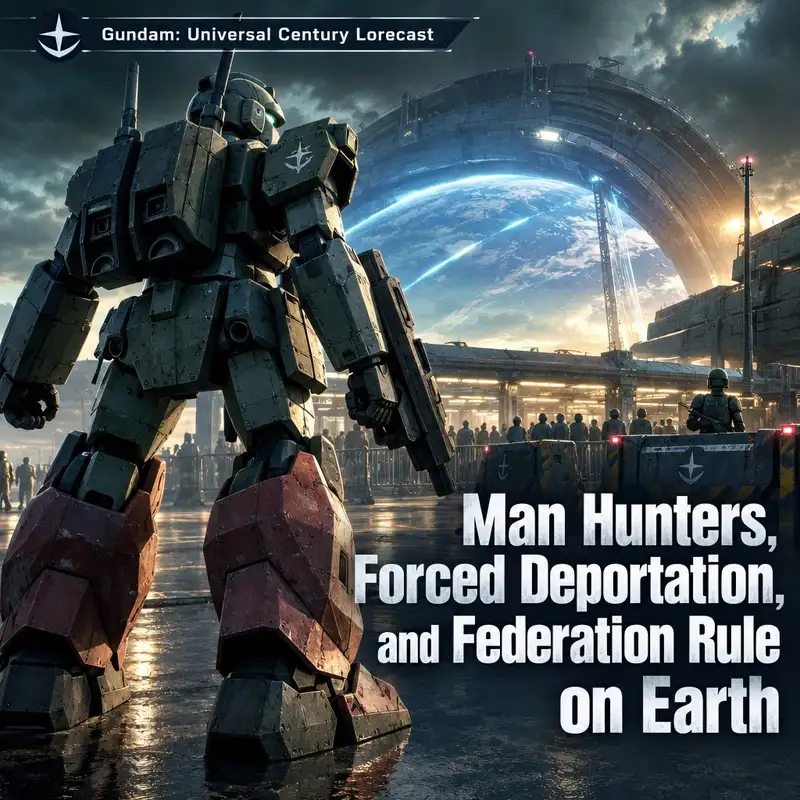
Man Hunters, Forced Deportation, and Federation Rule on Earth
A Man Hunter mobile suit does not need to win a battle against another mobile suit to do its job. In a crowded Earth city, its value begins with scale. A machine built for war stands over pedestrians, traffic, shops, apartment blocks, and people trying not to be noticed. Its presence announces that the state can reach down into ordinary life with armored feet, a cockpit crew, and a weapon designed for human targets. The Man Hunter Jegan Ground Type-A is a converted ground-use Jegan. Its anti-mobile-suit beam armament has been removed, and it carries a twelve-point-seven-millimeter anti-personnel machine gun. Its altered appearance, including its deliberately conspicuous paint treatment, is part of the mission. This is not a frontline adaptation for a difficult battlefield. It is a visible instrument of intimidation. The machine tells civilians that residency law is backed by force capable of crushing resistance before resistance can become organized.
The distinction matters because the Man Hunters are not simply another Federation military unit. Their mobile suits do not represent a new doctrine for defeating enemy armor, seizing territory, or defending Earth from an external invasion. They represent the militarization of internal administration. The question is no longer only who can enter a restricted area, obtain a permit, or remain in a particular city. It becomes who can be classified as removable, who has the authority to make that classification, and what happens when the people enforcing it arrive in armored machines. In Universal Century one hundred five, Federation power on Earth rests increasingly on that kind of decision. A government that claims it must protect the planet has also built an apparatus that decides which human beings are permitted to remain upon it.
The environmental argument itself is not absurd. Earth has endured centuries of pressure from population, industrial development, war, ecological damage, and the political failure to distribute humanity’s resources fairly across the Earth Sphere. Moving large populations into space was never only an engineering project. It was also presented as a way to reduce pressure on Earth and preserve a habitable world. By Universal Century one hundred five, the principle that Earth requires protection has acquired great political force. The problem is how that principle is administered.
In practice, residence on Earth has become a privilege concentrated among government-authorized people and socially privileged classes. Earth is no longer treated as a common political home for all humanity. It is treated as a scarce and protected possession, managed by those already powerful enough to remain. The Federation’s ruling system can speak the language of environmental preservation while creating a hierarchy of access. A person’s right to live on Earth depends not merely on family, work, or community, but on official status and the discretion of institutions far removed from daily life.
That arrangement changes the meaning of ordinary existence. Residency determines whether a family can remain together, whether a worker can keep employment, whether a child can stay in school, whether a person can travel without fear, and whether an encounter with police becomes an administrative inconvenience or the beginning of forced removal. A government can call Earth a protected environment. But when protection is distributed through privilege, residence becomes political currency. Those allowed to remain have security. Those denied it live under conditional status. And those whose status can be challenged at any moment live under fear.
This is where the Man Hunters enter the story. Their stated purpose is to identify unauthorized residents on Earth and deport them to space. On paper, that sounds like a harsh immigration or residency enforcement system. The record established by the Hathaway films is worse than that. The Man Hunters abduct residents. They remove people who have residence rights. They impose forced labor on Spacenoids. The official category of illegal Earth resident does not contain the actual behavior of the institution. It gives that behavior an administrative vocabulary.
The central danger is not simply that the law is severe. Laws can be unjust while still defining recognizable boundaries. The deeper danger is discretionary power. Once a person with legal residence rights can be seized and removed anyway, legal status becomes unstable. Once forced labor can accompany deportation, removal ceases to be a regulatory process and becomes coercive domination. Once armed police can operate with broad authority over movement, identity, and residence, the category of illegality can become less a fact than a pretext.
The Man Hunters operate under the Criminal Police Organization, led by Handley Yoxon. That chain of command matters. The cabinet and the broader Federation political system shape the policy. The Criminal Police Organization controls or employs the force enforcing it. Individual Man Hunter personnel conduct operations on the ground. Regular Federation military officers may cooperate, object, remain detached, or become drawn into a security structure they do not fully control. These layers should not be collapsed into one indistinguishable mass of guilt. Not every Federation soldier is a Man Hunter. Not every police official writes national policy. Not every civilian who benefits from Earth residency designed the system. But the system functions because each level can pass responsibility downward while retaining the benefits of coercion.
The Man Hunters therefore reveal a familiar weakness in declining states. Political leadership defines a problem in broad terms. A security institution receives authority to solve it. The institution expands its interpretation of that authority. Then the people most exposed to it discover that the difference between policy and abuse is difficult to enforce when the same organization controls classification, detention, transport, and armed force. The mobile suit outside the city is not merely equipment. It is the final visible expression of an administrative chain that begins in residency policy and ends in a person being taken away.
The Man Hunters did not become influential because they were better suited than the Earth Federation Forces to fight a conventional war. Their rise is tied to the weakening of conventional military authority after Char’s Rebellion. The conflict of Universal Century ninety-three ended without producing another immediate war on the same scale. That peace did not create a stronger, more accountable Federation. It encouraged retrenchment. The Earth Federation Forces declined in size, combat experience, and readiness. Units still possessed weapons and mobile suits, including the long-serving Jegan, but possession is not the same as capability.
A military force depends on training, maintenance, experienced personnel, coherent command relationships, logistics, and the ability to learn from real operations without treating every crisis as an exception. When those habits weaken, a state may still look armed. It may still have bases, uniforms, mobile suits, and officers. Yet its ability to respond intelligently to a serious threat declines. It becomes vulnerable to surprise, internal rivalry, and dependence on specialized organizations created for narrower missions.
That is the institutional opening through which armed policing expands. A government facing unrest, illegal settlement, political violence, and declining confidence in its own authority may find it easier to enlarge police powers than to rebuild a disciplined military or address the political causes of instability. Police organizations promise immediate visibility. They can raid, detain, patrol, and display force in public. Their missions can be framed as order, security, and law enforcement. But a force optimized to control civilians is not automatically capable of conducting combined-arms operations, defeating an organized insurgency, or resolving a legitimacy crisis.
The Man Hunter Jegan makes that problem plain. Its configuration is specialized for intimidation and anti-personnel enforcement. It is not an answer to Mafty’s advanced mobile suits. It is not a substitute for a field force able to maneuver, gather reliable intelligence, protect supply lines, coordinate aircraft and armor, or hold terrain without brutalizing the population. The Federation has not solved its security problem by arming the Man Hunters. It has shifted a political problem into the hands of an organization whose tools encourage coercive solutions.
The result is blurred responsibility. Where does ordinary policing end and military occupation begin? When an armed police force removes residents from their homes, what standard governs its conduct? Who investigates abuse when the same institution depends on fear to enforce policy? What happens when military commanders are asked to support internal operations they did not design but cannot ignore? A state can maintain formal distinctions between police and armed forces. In practice, those distinctions lose meaning if one side acquires military hardware and the other loses the readiness to provide a credible alternative.
The Oenbelli Army emerges from this environment. It is important to describe Oenbelli precisely. It is an independent anti-Federation force, centered on illegal Earth residents and broader networks of activists opposed to Federation rule. It is not Mafty’s First Army, despite its claim to be one. It is not directly subordinate to Hathaway Noa’s organization. That false identification is politically useful. It lends Oenbelli some of Mafty’s reputation and makes it easier for Federation authorities to treat disparate opposition as one enemy. But the distinction is essential. Anti-Federation movements do not become a unified command merely because they share grievances or operate in the same region.
Oenbelli’s existence demonstrates how coercive residency policy can create armed capacity. People who lack lawful security, political representation, or confidence in due process become vulnerable to recruitment by organizations offering protection, belonging, and revenge. That does not mean every person threatened with deportation becomes an insurgent, or that every illegal Earth resident supports violence. It means the government has weakened the ordinary barriers that keep political anger from becoming armed organization.
Insurgency is not produced by anger alone. Anger may supply motive, but armed movements require people, safe areas, communications, leadership, intelligence, weapons, food, transport, medical care, and access to supplies. Oenbelli has networks substantial enough to support a private army on a large scale. It seeks to establish a ground force and potentially an air arm. It gains access to diverted Federation supplies. That logistical detail is more important than any slogan. A movement becomes militarily significant when it can sustain personnel and equipment beyond a single demonstration or isolated attack.
The diversion of Federation materiel also reveals a larger institutional failure. Supplies do not simply appear in an insurgent camp by force of ideology. They move through corrupt channels, compromised officials, sympathetic intermediaries, poor security, or weak accountability. A government that restricts political participation while failing to control its own military resources creates a dangerous combination. It pushes people outside the legal order, then provides the tools through which that exclusion can become organized resistance.
Oenbelli is not therefore a simple liberation movement. It is an armed private force with its own ambitions, its own command structure, and its own claim to legitimacy. Its members may include people with real grievances against forced removal and political exclusion. That does not make its military program automatically accountable to the population in whose name it speaks. Armed groups often promise representation while concentrating decisions in small leadership circles. The Federation’s abuses help explain why Oenbelli can recruit. They do not settle what Oenbelli would build if it succeeded.
Colonel Kimberley Heyman’s campaign against Oenbelli exposes the Federation’s inability to understand that distinction. Based at Davao, Kimberley has already failed to capture or destroy Mafty. His authority is under pressure, and Kenneth Sleg is due to arrive and replace him. Under those circumstances, Kimberley seeks a decisive success against forces in the Oenbelli area. He treats the operation as an opportunity to restore his position, prove his usefulness, and demonstrate that he can still impose order in the South Pacific jurisdiction.
This is a familiar trap for commanders under political pressure. A force that has failed against a difficult enemy may search for a more accessible target. It may confuse visible aggression with strategic recovery. Kimberley can identify armed opponents. He can direct troops against them. He can claim that a successful operation against an anti-Federation force proves competence. But the underlying problem is not simply the presence of a target that can be destroyed. It is the political environment that produces armed resistance, the uncertain loyalties surrounding the conflict, and the government’s lack of legitimacy among the people it seeks to control.
Counterinsurgency and internal security operations cannot be reduced to target elimination. A commander may clear an area, capture suspects, destroy weapons, or disperse a force. None of that establishes durable control if the population sees the state as predatory, arbitrary, or incapable of distinguishing civilians from enemies. Sustainable security requires intelligence that people are willing to provide, discipline that prevents indiscriminate abuse, logistics that support forces without looting or coercion, and civilian administration credible enough to make law more than an armed threat.
Kimberley’s methods fail that test. He resorts to inhumane repression against Oenbelli. The immediate military details matter less than the political meaning. His campaign confirms the fears that make residents distrust Federation authority. It turns a security operation into evidence that the state will employ violence without restraint when its authority is challenged. That may intimidate some people in the short term. It may also broaden the pool of those prepared to aid resistance, conceal fighters, move supplies, or reject official narratives.
The campaign does not end in a clean restoration of Federation control. Kimberley’s forces are ultimately defeated by Mafty, and Kimberley himself is captured. But his defeat is not simply the story of an inferior commander losing to a more capable mobile-suit force. It is the failure of an approach that mistakes coercion for governance. He attempts to solve a political problem through destruction, even as his own conduct creates more evidence that the political system is intolerable.
The turning point comes when SPTV broadcasts recorded evidence of Kimberley’s atrocities. This is not merely a moment in which hidden cruelty becomes publicly embarrassing. It is an information-warfare event. Before the broadcast, the Federation’s security apparatus can frame its operation through official language: anti-terror measures, suppression of armed agitators, restoration of order, enforcement against illegal residents. Such language may be incomplete or dishonest, but it has power when the public cannot see what happens behind military cordons and police authority.
SPTV changes the information environment. Recorded evidence allows people outside Kimberley’s command structure to judge the operation for themselves. The violence is no longer confined to the private knowledge of victims, perpetrators, and a small number of witnesses. It becomes politically visible. That visibility strips Kimberley of plausible legitimacy and isolates his unit. The issue is no longer whether the government has the authority to respond to an armed force. Governments do have obligations to protect civilians and confront armed threats. The issue is whether the methods used can survive public scrutiny.
A coercive institution requires more than weapons and legal authorization. It requires discipline, credibility, and confidence that the record of its conduct will not destroy the legitimacy it claims to defend. The Federation’s problem is not that violence suddenly exists. Violence was already built into the Man Hunter system. The problem is that the public can now see how easily official categories become cover for abuse. A state that depends on secrecy to preserve the appearance of lawful rule is already admitting that its methods cannot withstand open judgment.
The broadcast also demonstrates the limits of command control. Senior officials may prefer ambiguity. They may wish to distance themselves from a subordinate’s excesses while retaining the benefits of his actions. But once the evidence becomes public, the distinction between individual misconduct and institutional responsibility becomes difficult to manage. Kimberley may bear direct responsibility for his decisions. Yet he operates within a political system that has normalized forced removal, armed policing, and the treatment of vulnerable residents as security problems. His atrocities are not the whole system. They are the system’s logic exposed under pressure.
Mafty can exploit that exposure. Hathaway’s organization understands that the Federation’s legitimacy is vulnerable. Its critique of Earth rule has force because the residency system is visibly unequal. Mafty argues that humanity should move into space to protect Earth’s environment and that the Federation’s political class has monopolized the planet while ruling without genuine legitimacy. In a society where privileged officials retain access to Earth while other people are deported, abducted, or forced into labor, that argument cannot be dismissed as empty rhetoric.
The environmental dimension of Mafty’s critique deserves to be taken seriously. Earth cannot absorb unlimited settlement, exploitation, and industrial strain without consequence. A society that treats the planet as an inexhaustible estate will eventually destroy the conditions that make life possible. The Federation’s failure lies not in recognizing ecological limits. It lies in turning those limits into a privilege system. It asks the less powerful to bear displacement while the already powerful retain protected access to Earth. Environmental preservation becomes a justification for hierarchy rather than a shared political responsibility.
But political intelligibility is not political legitimacy. Mafty’s methods are coercive. The organization assassinates Federation ministers who reject its demands. It uses armed operations, disguised transport vessels, advanced mobile suits, and the threat of violence to force political change. The Xi Gundam and Mafty’s other military assets make the movement dangerous to Federation security. They allow it to challenge conventional forces and create crises that governments cannot ignore. Yet no mobile suit, however advanced, can create accountable representation by itself.
Mafty identifies a genuine structural injustice. It does not solve the question of who has the authority to decide Earth’s future, how residents are represented, how environmental burdens are distributed, or how political change can be made accountable to the people affected by it. Assassinating ministers may disrupt a corrupt system. It also substitutes fear for public consent. Armed coercion may force a government to reconsider legislation. It cannot establish that the armed organization speaks for all Spacenoids, all Earth residents, or even all those harmed by Federation policy.
This is the recurring tragedy of the late Universal Century. The Federation’s political order becomes so detached that opposition acquires moral and political force. Yet the opposition most capable of threatening the state often relies on methods that reproduce the same contempt for accountable civilian politics. The state says order requires force. The insurgent says justice requires force. Between them stand the people whose residency, safety, and future are being decided without meaningful participation.
The Adelaide Conference brings these tensions into direct contact. The Federation cabinet gathers in Adelaide, Australia, for a central meeting of unusual importance, the first such conference in thirteen years. The proposed special Earth-return bill is not an incidental piece of bureaucracy. It is the legislative culmination of the residency system already enforced through the Man Hunters. The bill would prohibit residence on Earth except for those authorized by the government. It would formalize the idea that Earth is available only to a politically approved class.
The bill can be presented as an environmental measure. It can be defended as population management, ecological protection, or orderly administration. But its political effect is clear. It would reinforce privileged control over the planet and strengthen the institutions empowered to remove those excluded from it. The Man Hunters are not an unfortunate side effect of this system. They are one of the means through which the system becomes real. A law that restricts residence requires officials to interpret eligibility, police to enforce removal, transport to carry deportees away, and armed force to manage resistance.
Adelaide matters to Mafty because legislation is the target. An attack on the conference is not merely an attempt to destroy a symbolic building or eliminate political figures. It is an effort to force the defeat of a bill that would deepen the Federation’s exclusionary Earth policy. That makes the city both a political center and a military vulnerability. Security planners must protect officials, manage public movement, prevent infiltration, anticipate mobile-suit operations, and preserve enough public confidence that the conference does not become proof of governmental helplessness.
The Federation cannot defend Adelaide by placing more weapons around it and calling the problem solved. A conference of this kind requires coordination among military forces, police organizations, intelligence services, political leadership, and civilian authorities. It requires reliable information. It requires clear command authority. It requires an understanding that the security operation itself will be judged politically. If the government protects the bill through methods that resemble Man Hunter repression, it may preserve the meeting while further discrediting the policy being defended.
Kenneth Sleg arrives in this environment as Kimberley’s replacement. He takes command of the Davao-based force responsible for the South Pacific region and for operations against Mafty. Kenneth represents an attempt to restore conventional military competence to a situation that has been distorted by weak readiness, political rivalry, and police expansion. He improves the capability of his unit, known as the Kirke Unit, and gains access to Penelope, an advanced prototype developed by Anaheim Electronics.
Penelope is significant because it represents a different use of military power. It is a high-performance system intended for a demanding counter-Mafty mission. It belongs to a conventional military effort to regain operational capacity against an adversary with advanced mobile suits. Its value lies not only in its weapons or mobility, but in the training, maintenance, command, intelligence, and support structure required to use it effectively. A prototype can provide a sharp tactical edge. It can also impose a heavy burden on the organization trying to field it.
Kenneth’s challenge is therefore larger than defeating Mafty in combat. He must prepare for Adelaide while operating alongside institutions with different priorities. Handley Yoxon and the Criminal Police Organization are also involved in the security problem. Yoxon proposes measures that include deception against Mafty and the possible use of Bright Noa’s fleet in the Adelaide security plan. Those proposals reveal a government trying to assemble security from overlapping authorities. The police have domestic control and political influence. The military has mobile-suit and fleet capabilities. Other commanders bring their own experience, loyalties, and judgments.
Cooperation does not erase rivalry. Kenneth and Yoxon do not approach the crisis from the same institutional position. Kenneth is concerned with the operational problem of locating and defeating a capable armed enemy. Yoxon represents a police organization accustomed to managing internal threats through surveillance, control, and political authority. Each may need the other. Each may also fear being blamed if the operation fails, sidelined if it succeeds, or exposed if the other institution’s methods become politically damaging.
This fragmentation is one of the Federation’s deepest weaknesses. It has formidable technology. It can call on experienced figures. It can deploy ships, mobile suits, intelligence assets, and police powers. Yet those tools are distributed among institutions that do not fully trust one another and do not necessarily share the same definition of success. One organization may seek the destruction of Mafty’s force. Another may seek control of information. Political leaders may seek the passage of the bill. Police may seek expanded authority. Military officers may seek a clean operational victory. These goals overlap, but they are not identical.
Anaheim Electronics is part of this story as an industrial enabler. The corporation can provide sophisticated military technology to a Federation force confronting a serious threat. That does not establish that Anaheim controls Federation policy, orchestrates every conflict, or possesses a single unified political agenda. Corporations matter because they provide expertise, production capacity, technical knowledge, and access to systems that governments cannot always create quickly on their own. But the decision to build an exclusionary residency regime belongs to political institutions. The decision to use armed police against civilians belongs to commanders and officials. Corporate involvement does not remove responsibility from the state.
The contrast between Penelope and the Man Hunter Jegan clarifies the nature of the crisis. Both are products of a Federation security system. Both place advanced machinery in service of state power. Yet they embody different purposes. Penelope is part of an attempt to rebuild the ability to fight an organized armed opponent. Its mission belongs to the realm of military operations, however politically compromised that mission may become. The Man Hunter Jegan is a coercive policing conversion. Its purpose is not to contest Mafty on equal terms. Its purpose is to make vulnerable civilians feel the weight of the state before they ever become combatants.
The Federation’s weakness, then, is not simply a shortage of firepower. More capable machines can improve tactical defense. Better-trained units can make a security operation more competent. A restored fleet can complicate Mafty’s planning. None of these measures can repair arbitrary residency policy, forced deportation, police abuse, or elite political exclusion. Technology can protect a conference. It cannot make an unjust bill legitimate. It can defeat an armed force in a particular engagement. It cannot persuade people that a government treating them as removable has earned their loyalty.
At the tactical level, the Federation can contest Mafty. It possesses personnel, mobile suits, ships, and increasingly capable commanders. At the operational level, coordination remains difficult because authority is fragmented and information is contested. At the political level, the Earth-return bill and the Man Hunter system generate the resistance they are meant to suppress. At the institutional level, police militarization corrodes accountability by making domestic coercion appear routine. At the civilian level, residents pay the immediate price. They are the people stopped in streets, forced from homes, separated from communities, and made to understand that their place on Earth depends on someone else’s permission.
That is what Federation rule on Earth has become by Universal Century one hundred five. It is not simply tyranny in a simple uniform, nor is it a government without real environmental concerns or real security threats. Earth does require protection. Mafty and other armed movements are genuine threats. Oenbelli’s militarization does not become harmless because its members have grievances. Yet the Federation has chosen to answer its deepest political problem through exclusion. It preserves the planet by restricting citizenship in practice, then relies on armed institutions to enforce the resulting hierarchy.
The Man Hunters become powerful because conventional military authority has weakened and civilian administration has delegated political problems to coercive enforcement. They are not the cause of the system by themselves. They are its instrument. Their authority grows where law becomes conditional, where residents become categories, and where the state finds it easier to deport, intimidate, and classify than to govern fairly.
Oenbelli and Mafty emerge from conditions the Federation helped create. That fact explains their appeal without vindicating their methods. An armed private army cannot substitute for representation. Assassination cannot create accountable government. Advanced mobile suits cannot resolve the question of who belongs, who decides, and whose rights are protected when Earth itself becomes a privilege. The Federation’s rule is unstable because it seeks to preserve the planet while denying equal political standing to many of the people governed in humanity’s name.