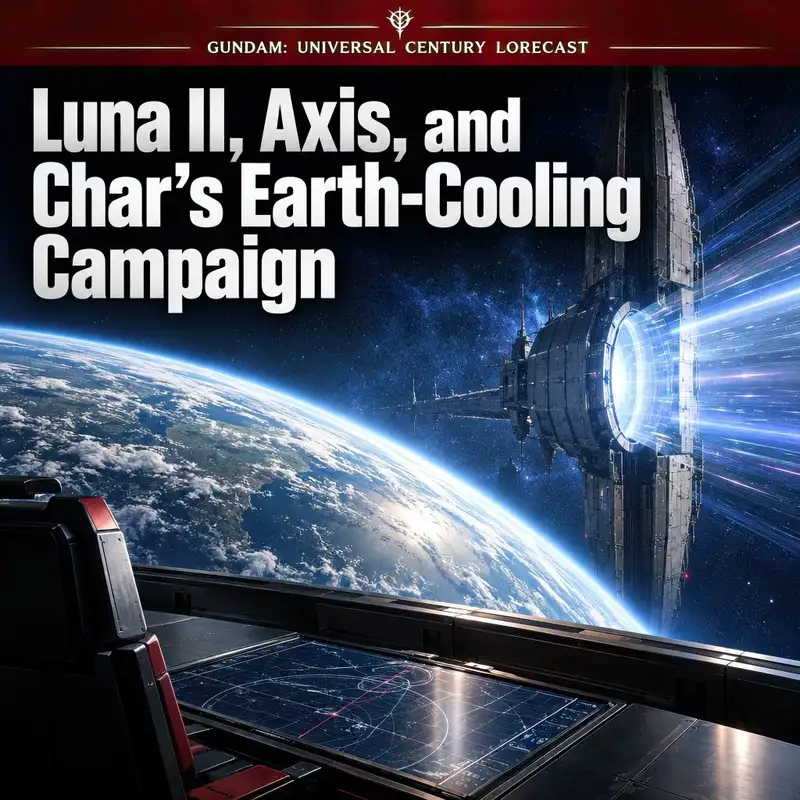
Luna II, Axis, and Char’s Earth-Cooling Campaign
The bargain looked like the end of a crisis. Federation officials had agreed to transfer Axis to Neo Zeon. In return, Char Aznable’s forces were supposed to proceed toward Luna II for disarmament. Gold changed hands. Axis could be presented as a resource for expanding Sweetwater, the overcrowded colony that had become a symbol of Spacenoid displacement. On paper, the arrangement gave the Federation a way to avoid another full-scale war. It converted a hostile asteroid fortress into a commercial and political transaction.
But an asteroid fortress is not neutralized because ownership changes in a private agreement. And a military force is not disarmed because some of its ships are seen moving toward a surrender point. The Federation had negotiated over an object with enormous strategic mobility, while accepting Neo Zeon’s account of what its own forces were doing. Londo Bell, the formation already fighting Char’s rebellion, did not control the agreement. It was left to confront the military consequences of a political decision made elsewhere.
That divide between formal settlement and enforceable control is the center of Char’s Earth-cooling campaign. Char did not simply find a large asteroid and point it at Earth. He combined diplomacy, deception, orbital engineering, the seizure of nuclear weapons, fleet protection, mobile-suit combat, and political terror. The campaign nearly succeeded because the Federation treated an appearance of compliance as proof that the threat had been contained.
By the time Axis changed hands, Char had already demonstrated what he intended to do with orbital bodies. Fifth Luna, another massive asteroid, was sent toward Lhasa, where the Federation government maintained its central headquarters. Londo Bell attempted to stop the operation. It could not prevent the impact.
That attack mattered for more than the immediate destruction. Fifth Luna was a proof of concept. Char had shown that an asteroid could be used as a strategic weapon, not merely as a base, mine, or fortress. It could strike a government center from space, disrupt command, terrify civilians, and demonstrate that the Federation’s vast territory did not guarantee safety. The Earth Sphere had long depended on orbital infrastructure for trade, migration, industry, and military movement. Char turned that same infrastructure into a threat hanging over the planet.
Lhasa was not an empty point on a map. It was a seat of government, a city, and part of the civilian world that the Federation claimed to defend. The Fifth Luna strike was therefore both military and political. It attacked administrative capacity, but it also announced that Char was willing to use mass destruction as an instrument of policy. The operation made later negotiations harder to understand as ordinary diplomacy. The Federation was not bargaining with a movement that had merely demonstrated leverage. It was bargaining with a movement that had already used an asteroid against Earth.
For Neo Zeon, Fifth Luna was an operational success. It proved capability, imposed urgency, and forced the Federation to react. For Londo Bell, it was a tactical and mission failure. The force fought, but it did not stop the impact. For the Federation government, it was a strategic shock. Yet shock does not always produce clear judgment. It can produce the opposite. Leaders under pressure may seek any arrangement that appears to reduce the immediate threat, especially when the alternative is mobilization, political confrontation, and another major war.
That is the setting in which the Axis agreement became possible. The Federation’s negotiators were not necessarily trying to assist Char’s wider plan. Their apparent objective was more limited and more conventional. They wanted to contain the crisis, avoid expanded conflict, and turn a military confrontation into a managed transfer. Sweetwater’s need for expansion gave the arrangement a practical political justification. Payment in gold gave it the familiar shape of a settlement. Neo Zeon’s supposed movement toward Luna II for disarmament gave it the appearance of verification.
But verification requires more than an announced destination. It requires control over the force being verified, secure observation of its weapons and command structure, and the ability to respond when the other side fails to comply. The Federation possessed none of those conditions in a reliable form. It had made an agreement with Char while leaving the military formation most capable of challenging him outside the arrangement’s direct control.
This was not simply a story of one foolish politician signing a bad deal. The failure was institutional. The Federation government wanted a political solution. Its military system was fragmented. Londo Bell was a mobile response force under Bright Noa, not the whole Earth Federation Forces and not an independent government. It could identify danger and act against it, but it could not compel the Federation’s civilian leadership to organize the crisis around its own operational judgment.
Char understood that divide. He understood that the Federation had more ships, more territory, more people, and a deeper industrial base than Neo Zeon. He could not defeat such a system through a straightforward contest of attrition. Neo Zeon needed initiative. It needed the Federation to misread the situation, commit attention to the wrong objective, and lose the time required to concentrate a larger force. Char’s greatest weapon was not Axis alone. It was the ability to make the Federation participate in its own misunderstanding.
His stated objective gave the campaign its ideological language. Char argued that humanity’s attachment to Earth preserved inequality, stagnation, and conflict. Earthbound elites remained insulated from the conditions of the colonies. Spacenoids bore the burdens of migration, labor, political exclusion, and war, while Earth retained the prestige and privilege of the old center of human civilization. Those grievances were not inventions. The Federation had repeatedly failed to build a political order in which people living in space possessed equal security, representation, and dignity.
But Char’s method did not offer political reform, negotiated migration, or a workable transfer of power. It offered coercion on a planetary scale. His plan was to cool Earth through nuclear winter, rendering its environment so damaged that humanity would be compelled to abandon it and move permanently into space. The film establishes that intended result. It does not provide a credible climate timetable, a precise inventory of weapons, or a technical model of how long such devastation would last. What matters is the political purpose. Char intended to make civilian survival on Earth dependent on submission to his vision of history.
That distinction is essential. An argument that Earth’s institutions were unjust did not make Earth’s population a legitimate target. The people living on Earth were not a single ruling class, any more than Spacenoids were a single political movement. They included workers, families, refugees, soldiers, officials, and people with little influence over the Federation’s policies. A campaign designed to poison or freeze the planet did not liberate them. It treated them as material for ideological transformation.
Char’s rhetoric invoked humanity’s future in space. His operational method held humanity hostage to that future. That is one of the central contradictions of Char’s rebellion. He claimed to force humanity toward a higher political condition, yet he relied on dictatorship, secrecy, mass coercion, and indiscriminate environmental violence. He treated the failure of Federation governance as evidence that Earth itself had to be punished.
Axis was the instrument that made that punishment possible. It was not just a large rock drifting through the Earth Sphere. Axis had been a strategic fortress. It possessed internal spaces, crews, propulsion systems, docking facilities, technical personnel, defensive resources, and the ability to support military operations. Its mass mattered, certainly. But its military value came from the combination of mass and infrastructure. An ordinary asteroid cannot become a strategic weapon simply because someone wishes it toward a planet. It must be moved, controlled, defended, supplied, and directed.
Using Axis as an Earth-impact weapon created several difficult operational problems. Its propulsion had to be activated and employed with enough precision to put it on a threatening trajectory. Its internal systems had to remain functional under attack. Its approach had to be protected from interception. The crews responsible for engineering, navigation, security, and damage control had to keep working while fleets and mobile suits fought around them. Even an asteroid fortress required a support system. Reactors and engines did not remove the need for technicians, access routes, weapon handling, repairs, and command decisions.
Axis also had political value. Whoever controlled it possessed not only a military platform but a visible symbol of strategic reach. It could be offered as a colony-expansion resource, treated as a bargaining chip, or turned into a weapon. The Federation’s mistake was to see these possibilities as separate. Char saw them as parts of one operation. The same object could be transferred through negotiation, secured by military force, and redirected into a planetary threat.
The film does not fully document every stage of Char’s planning before the Axis agreement. It does not establish with certainty that every detail of the Luna II operation had already been fixed before the negotiations began. It does establish something more important. Once the agreement was in motion, Char used the Axis transfer, the supposed disarmament process, and Luna II’s nuclear arsenal as mutually supporting parts of a single campaign.
The deception depended on false movement and false emphasis. Neo Zeon sent dummy ships toward Luna II, reinforcing the appearance that its forces were complying with the disarmament arrangement. The visible movement created a false center of gravity. Federation leaders saw what looked like a force moving toward surrender and treated that movement as the principal fact of the crisis. Meanwhile, Neo Zeon retained enough cohesion, mobility, and combat power to strike where it actually mattered.
This was particularly effective in the Minovsky environment. Minovsky particles did not make information impossible to obtain, but they degraded the kind of long-range surveillance, communication, and centralized control that modern militaries prefer. Commanders could not assume that every ship, mobile suit, or task group could be tracked continuously and identified with perfect certainty. Under those conditions, deception did not require invisibility. It required the enemy to interpret incomplete information incorrectly.
Char did not need to hide all of Neo Zeon. He needed the Federation to believe that the Neo Zeon force it could see represented Neo Zeon’s real intention. That is a subtler and more dangerous form of deception. A force can remain visible while its purpose remains concealed. The dummy movement toward Luna II suggested demobilization. The actual operation preserved the initiative needed for a sudden assault.
Luna II was the critical target because it was more than a convenient waypoint. It was a Federation-controlled military installation and a repository for nuclear weapons. In principle, that made sense. Strategic weapons require secure storage, trained personnel, command controls, transport systems, and separation from ordinary civilian life. A military base is supposed to provide those safeguards. It concentrates dangerous assets where they can be guarded and managed.
But concentration creates risk. A secure arsenal remains secure only as long as the installation itself remains secure. In a political crisis, an enemy does not need to defeat the entire Federation to gain strategic advantage. It may only need to seize one critical location before the larger institution understands what is happening. Luna II held weapons whose significance went far beyond their immediate destructive power. In Char’s hands, they could help alter the movement of Axis and reinforce the threatened environmental consequences of its descent.
The nominal disarmament movement made the Luna II assault especially damaging. Neo Zeon was supposed to be approaching the installation in a posture of submission. Instead, it preserved the means to attack. That gap between declared intent and actual readiness is the practical meaning of failed disarmament. A force has not been disarmed if it retains mobile suits, ships, crews, command links, ammunition, and the ability to choose the time and place of combat. Disarmament is not a change in language. It is a loss of military capacity under verified conditions.
Neo Zeon’s assault exposed several Federation failures at once. There was an intelligence failure, because the government and its military apparatus did not correctly identify the real operation in time. There was an operational failure, because the nuclear arsenal could not be protected against the attack. And there was a political failure, because the secret arrangement had been managed in a way that limited direct scrutiny by the very force trying to stop Char.
Londo Bell arrived too late to prevent the seizure of the weapons. That did not mean its personnel lacked courage or technical ability. It meant that the campaign had already gained the one advantage Char most needed: time. The Federation’s larger resources could not matter immediately if they were not concentrated, informed, and authorized to act. An institution can possess overwhelming strength on paper and still lose a decisive opening because its leaders have misunderstood the threat.
The captured nuclear weapons changed the geometry of the campaign. Axis was already dangerous as a massive, mobile fortress. With the Luna II arsenal available, Char gained tools that could be used to assist its descent and deepen the threat posed to Earth. The weapons were not just symbols of destruction. They were engineering instruments, coercive instruments, and political instruments. They helped transform Axis from a strategic object into an immediate planetary emergency.
The exact number of weapons captured is not securely established in the film as a reliable military inventory. There is no need to invent one. The important fact is that enough nuclear weapons were seized to matter operationally. Their acquisition required transport, handling, preparation, security, and integration into a broader plan. Warheads do not teleport from a storage site into an asteroid operation. Someone must move them. Someone must protect the routes. Someone must prepare the delivery systems and ensure that the crews assigned to the task can reach their targets.
That logistics burden is easy to overlook because the final crisis is so visually dominated by mobile suits and the falling asteroid. Yet the operation depended on technical labor. Engineers had to manage Axis’s systems. Crews had to maintain propulsion and internal access. Combat units had to defend the asteroid against attack. Ships had to carry personnel and equipment. Commanders had to coordinate forces despite degraded communications and rapidly changing conditions. Char’s campaign was dramatic, but it was not magical. It was a military operation sustained by people, machinery, and preparation.
Once Axis began moving toward Earth, the political transaction was over. The campaign shifted from covert preparation to emergency interception. At that point, the Federation could no longer pretend that it had purchased stability. It faced a strategic threat already in motion. The problem was no longer whether Char’s intentions were sincere. The problem was whether anyone could physically stop the object he had set on course.
Bright Noa’s command problem was severe. Londo Bell had incomplete information, limited political authority, and no guarantee that the wider Federation would provide timely support. It was not the entirety of the Earth Federation Forces. It was a response formation, designed to act where larger institutions had failed to react quickly enough. That made it valuable, but it also made it vulnerable. Londo Bell had to confront a crisis of planetary scale without the force structure that such a crisis should have demanded.
Its response was necessarily layered. Axis had to be intercepted. Its propulsion had to be disrupted or destroyed. Nuclear weapons had to be used where conventional firepower was insufficient. The asteroid had to be broken apart, and the resulting fragments had to be prevented from reaching Earth. Neo Zeon’s defensive screen had to be fought through. None of these tasks could be solved by one ship, one mobile suit, or one commander.
Fleet operations mattered because mobile suits depended on ships for transport, launch, recovery, ammunition, repairs, medical support, and command. A high-performance machine could protect a missile salvo, intercept an enemy unit, or open access to a target. It could not replace the ships carrying the missiles. It could not replace the crews managing launch operations. It could not replace engineers working inside Axis or the larger command decisions required to coordinate an interception.
Minovsky interference made the situation harder. The defenders could not depend on uninterrupted communication with distant headquarters. They needed prearranged plans, local initiative, visual identification, and commanders willing to act on incomplete information. Bright’s role was therefore not merely to order attacks. It was to hold a coherent mission together while the physical and political conditions of the crisis changed around him.
The mission’s urgency did not make Londo Bell sufficient. It made Londo Bell necessary. The larger Federation system had lost time through compartmentalization, negotiation, and misjudgment. By the time the scale of Char’s deception was clear, the force closest to the threat had to act, whether or not it possessed ideal support. That is often how emergency formations are used. They become the answer to failures they did not create.
Neo Zeon’s defense around Axis showed why mobile suits remained central to Universal Century warfare. A fleet attempting to destroy or divert the asteroid required missile attacks, nuclear delivery systems, and close protection. Neo Zeon could use mobile suits to intercept missiles, strike attacking ships, defend key approach routes, and force the attackers into close-range combat. Remote weapons extended that defensive reach. Char’s funnels could threaten multiple targets and complicate any direct assault on the asteroid.
Amuro Ray’s ν Gundam and its fin funnels mattered in the same operational sense. They gave Londo Bell an unusually capable platform for interception, local defense, and combat against Neo Zeon’s best units. In a battle where seconds, approach lanes, and access to targets mattered, that capability could have major consequences. But it did not make the ν Gundam a substitute for the rest of the operation.
The final defense of Earth was not decided by a machine comparison. The ν Gundam was not a fleet. The Sazabi was not Neo Zeon’s entire strategy. Fin funnels and funnels did not eliminate the need for nuclear missiles, ship crews, damage control, engineering teams, and political decisions. Their importance lay in how they affected local tactical conditions. They could intercept, screen, confuse, and create openings. They could help determine who reached an objective. They could not by themselves halt a moving asteroid fortress.
This distinction matters because the campaign repeatedly moved between scales. A mobile-suit duel could decide whether a pilot reached Axis. Reaching Axis could decide whether an internal sabotage effort began. Sabotage could alter the asteroid’s physical condition. The asteroid’s condition could determine whether Earth survived. But each link depended on the others. The history is not that one exceptional pilot saved the planet alone. It is that a collection of desperate actions, by crews and combatants across several levels of war, created a narrow chance to stop the disaster.
The duel between Amuro and Char was a decisive tactical and personal event. Amuro defeated Char’s Sazabi. In any ordinary battle, the defeat of an enemy commander in a high-performance mobile suit might have signaled the collapse of the operation. But Axis was not an ordinary objective. It had momentum. It had internal systems. It had fragments. It had already been committed to a course toward Earth.
Char’s defeat therefore did not automatically end the strategic crisis. The campaign had become partially independent of its architect. That is one of the dangers of mass-casualty weapons and large-scale engineering operations. Once launched, they can continue to threaten people even after the commander who ordered them is defeated. The machinery, trajectory, and physical consequences outlast the immediate battle.
The defenders attempted to destroy Axis’s propulsion and break the asteroid apart. Nuclear weapons were used as part of that effort. Combatants also fought within the asteroid’s internal spaces, where sabotage, access, and engineering became as important as maneuver in open space. The battle was no longer simply about killing enemy mobile suits. It was a race between physical momentum, improvised engineering, and the ability of each side to preserve or destroy the systems that still controlled Axis.
Breaking Axis apart did not end the danger. Fragmentation could create a new one. Large pieces of the asteroid could still descend toward Earth. The defenders had to consider not only whether Axis could be destroyed, but what destruction would mean. In planetary defense, the phrase destroy the target can be misleading. A damaged object may remain lethal. A shattered object may threaten a wider area. The desired outcome is not merely visible destruction. It is the prevention of catastrophic impact.
At the end of that struggle, conventional military explanation reaches its limit. The phenomenon later known as the Axis Shock prevents the remaining fragments from completing their descent in the way the crisis had threatened. The event is associated with psycho-frame resonance, with the ν Gundam, with the people participating in the battle, and with an extraordinary collective response. It is one of the most consequential events in the Universal Century, and one of the least reducible to ordinary doctrine.
The outcome can be described. Axis is pushed away from the immediate disaster that seemed inevitable. The exact mechanism cannot be turned into a reliable military manual. The film does not establish a repeatable weapon system that can be activated whenever a force equips psycho-frame. It does not show an institution that understands, controls, or can reproduce the event on demand. The people present witness something unprecedented. Their interpretations are shaped by fear, grief, belief, technical knowledge, and the limits of what they can observe.
That uncertainty matters. The Axis Shock should not be treated as proof that conventional defenses were adequate after all. They were not. Londo Bell fought with every available tool, but Earth’s survival ultimately depended on a phenomenon no government had planned, no commander had ordered, and no laboratory had mastered. The most powerful institutions in the Earth Sphere had allowed the crisis to reach a point where the final safeguard lay outside their control.
Char’s campaign therefore produced different results at different levels. Tactically, Neo Zeon achieved major successes. It seized nuclear weapons from Luna II, defended Axis long enough to bring it toward Earth, and forced Londo Bell into a desperate fight. Londo Bell, in turn, destroyed or disrupted critical elements of the operation and defeated Char in the decisive mobile-suit confrontation.
Operationally, Char achieved surprise. He exploited the Federation’s divided command system and forced it into crisis response. He turned a supposed settlement into a cover for action. But he failed to complete the Earth-cooling operation. Axis did not inflict the full environmental devastation he intended. The campaign’s central military objective was prevented.
Strategically, Char failed to compel humanity’s controlled and permanent migration into space. Even if such an objective could have been achieved through terror, the operation did not reach its intended conclusion. It did not establish a legitimate new political order. It did not solve colonial inequality. It did not create a durable future for Spacenoids. It demonstrated only that an authoritarian movement could threaten the planet more quickly than the Federation could respond.
Politically, the campaign exposed the Federation’s complacency. Its leaders had confused a transaction with control. They had accepted secrecy, compartmentalization, and nominal disarmament in place of verification and unified command. Their error was not that diplomacy itself was foolish. Diplomacy is often necessary. Their error was treating diplomacy as a substitute for the institutions required to enforce an agreement against an adversary who had already demonstrated willingness to use mass violence.
Char’s own political program was exposed as well. He identified genuine failures in the Federation’s relationship with the colonies. But he answered those failures by making civilian survival the price of ideological change. He did not trust humanity to choose migration, reform, or political equality. He intended to force those outcomes through environmental catastrophe. The campaign showed that grievance can be real while the movement claiming to speak for it becomes destructive and authoritarian.
Luna II, Axis, and the Earth-cooling campaign reveal why the final crisis of Char’s Rebellion was more than an asteroid drop. Axis became dangerous because Char combined strategic mobility, captured nuclear weapons, operational deception, and a willingness to target the conditions of civilian life itself. The Federation made that combination possible by mistaking negotiated appearance for military reality. Londo Bell stopped the immediate catastrophe, but only after the Federation had shown how easily complacency could turn diplomacy into an accomplice to war.