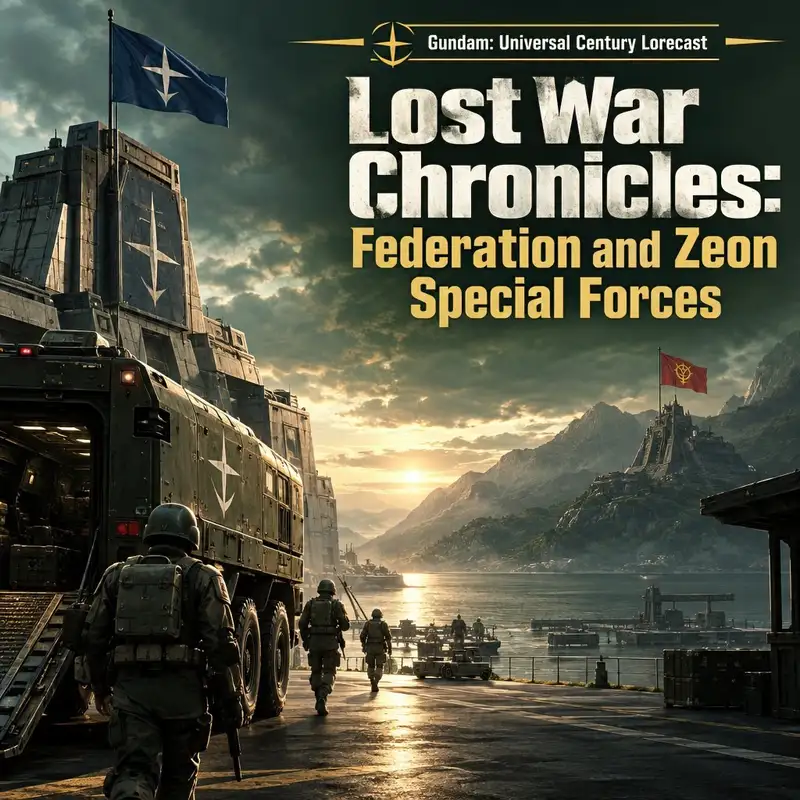
Lost War Chronicles: Federation and Zeon Special Forces [Game]
A defended gate is an unglamorous place to find the meaning of the One Year War. There is no room for a grand fleet maneuver inside a fortified approach. There is only a route that must remain open, a facility behind it, a few mobile suits available for immediate response, and incomplete information about what is coming through the dust, trees, snow, or concrete corridors. In Mobile Suit Gundam: Lost War Chronicles, that is the recurring military problem. The commander does not simply hunt enemy machines. The commander protects a land battleship, intercepts a transport, rescues a separated ally, holds a base entrance, destroys supplies, or prevents an enemy formation from reaching a shelter or nuclear facility. The mobile suits are the visible instruments. The objective is almost always something larger, slower, and more vulnerable.
That distinction is the game’s most useful contribution to Universal Century military history. Lost War Chronicles is a PlayStation Two game set during Universal Century seventy-nine, but it is not a fixed biography of one famous pilot. The player occupies the role of a unit commander on either the Earth Federation or Principality of Zeon side. The game gives that commander wingmen, operators, mechanics, superiors, and a succession of urgent missions across the Earth front. It does not establish a single detailed identity for the player character comparable to the protagonists later associated with print adaptations of the same title. That matters. The game’s historical perspective is not the private story of one named hero. It is the narrow, practical view from a small formation that is always being sent where a larger military system is about to fail.
Every recurring objective in Lost War Chronicles identifies a vulnerability. A Gaw transport aircraft is vulnerable because it carries men, equipment, and supplies but cannot defend itself like a mobile suit. A Big Tray land battleship is powerful because it combines mobility, command facilities, and heavy weapons, but it is also a major target whose destruction can disrupt an entire ground operation. A base gate is only concrete and steel until an enemy reaches it. Then it becomes the boundary between a raid and a penetration. A supply concentration may look less dramatic than a Gundam, yet it can determine whether armored formations have fuel, whether mobile suits can reload, and whether damaged equipment can be returned to service. Lost War Chronicles repeatedly makes the player fight over these systems, even when the immediate mission briefing frames the problem as destroying enemy machines.
The game offers two campaigns, one Federation and one Zeon, and their mirrored structure is central to its argument. They should not be read as one perfectly synchronized campaign diary. The mission sequence includes reversals of perspective, familiar One Year War locations, and encounters with machines and people associated with other stories. A Federation mission may ask the player to defend an asset that a Zeon mission asks the player to attack. That is useful as a military comparison. It is not proof that the same three mobile suits fought the same battle from opposite sides on a specific day. The game is constructing operational situations, not providing a complete archival chronology.
What those situations reveal is that the two sides face different forms of pressure. The Federation campaign follows a military that is expanding its mobile-suit capability while still relying heavily on older and conventional systems. Federation tanks, anti-aircraft defenses, land battleships, transports, fixed positions, and base complexes remain necessary. The arrival of Ground-type GMs, Ground-type Gundams, and other advanced machines does not erase that structure. It creates a transition. The Federation is learning how to place mobile suits inside a broader army that was not designed around them from the beginning. In that environment, a small mobile-suit unit often functions as protection for the rest of the force.
Zeon begins from a different position. Its forces possess more experience with mobile-suit warfare, a wider array of specialized designs, and a doctrine already shaped by the use of humanoid combat machines in space and on Earth. Zakus, Goufs, Doms, amphibious machines, and specialized support systems give Zeon commanders options that the Federation spent much of the war trying to match. Yet experience does not solve every problem. As Federation mobilization accelerates, Zeon increasingly has to protect assets that cannot be easily replaced. A carrier, supply dump, experimental weapon, major base, or withdrawal route becomes more important because the larger strategic margin is shrinking. The same kind of small mobile-suit team that once supported aggressive maneuver can become an emergency fire brigade, sent to stabilize whatever part of the front is beginning to come apart.
That is why the Federation and Zeon campaigns feel similar at the tactical level but different in their strategic tone. Both sides escort, intercept, defend, raid, and destroy. Both depend on crews and vehicles outside the player’s cockpit. Both encounter threats they cannot ignore merely because another enemy mobile suit is closer. But the Federation’s missions often show an army trying to protect and integrate a growing set of capabilities. Zeon’s missions more often emphasize the preservation of scarce assets, the disruption of Federation movement, and the defense of positions whose loss carries wider consequences. Neither side is reduced to a simple military stereotype. The Federation is not merely a lumbering giant, and Zeon is not merely a collection of doomed elite pilots. Both are institutions struggling to make local force serve broader objectives.
The Federation side makes the combined-arms transition especially clear. In one set of missions, the player operates near Type Sixty-One tanks, anti-aircraft positions, and a Big Tray land battleship. These are not relics waiting politely to be replaced by mobile suits. They are part of the force that must survive if the Federation is to hold ground, move supplies, and sustain a campaign. The tank offers armored firepower and can operate within established ground formations. Anti-aircraft defenses protect routes and installations against air attack. The land battleship provides heavy weapons, mobility, and command presence. None of them has the flexibility of a mobile suit in close terrain. But mobile suits cannot perform every function those systems perform, and they cannot be everywhere at once.
The Federation player unit therefore acts less like a detached knightly order and more like a maneuver reserve. When conventional assets are threatened, the mobile suits move toward the point of danger. When a Gaw must be intercepted, mobile suits provide the speed and firepower to reach it before it can complete its mission. When urban terrain breaks up movement and sightlines, mobile suits can move through spaces that are difficult for larger vehicles to negotiate. When an allied machine becomes isolated, the team can attempt a rescue. This is not evidence that the Federation had perfected a mobile-suit doctrine. It is evidence that commanders were discovering, under combat conditions, where mobile suits could compensate for the limitations of existing formations.
The Ground-type GM and Ground-type Gundam are important in that context because they suggest adaptation, not completion. A machine suited to terrestrial operations must deal with terrain, weather, resupply, recovery, and maintenance in a way that a space-oriented design may not. It needs crews who understand ground navigation and fields of fire. It requires transport, spare parts, ammunition, and facilities able to repair damage far from major arsenals. The game’s Federation formations operate across towns, deserts, forested regions, Arctic conditions, and heavily defended base complexes. That variety is a reminder that there was no single Earth-front solution. A machine that can maneuver effectively in one environment may face different constraints in another, and a unit trained for a particular mission can still be surprised by the ground it is asked to hold.
The Federation missions around cities are particularly instructive. Urban combat is not simply a mobile-suit duel with buildings in the background. Streets channel movement. Structures block observation. Civilians, utilities, and transportation networks may be nearby even when the game’s camera remains focused on military targets. Tanks and fixed weapons can use prepared positions. Mobile suits can exploit elevation and mobility, but their firepower also creates risks to infrastructure that cannot be easily repaired during an active campaign. Lost War Chronicles does not offer a full civilian account of these battles. It does not provide the kind of domestic perspective found in stories centered on colony residents or occupied communities. Still, its repeated use of towns and installations makes clear that ground fighting happens inside systems people depend upon.
The Federation defense of Jaburo develops the same theme at a larger scale. Jaburo is not important merely because it is a famous Federation headquarters. It is a strategic complex. It connects command authority, basing, repair, storage, transportation, and the political security of the Federation’s war effort. An enemy reaching its entrances or internal gates is not automatically taking Jaburo. A defended complex can have multiple layers, reserves, barriers, and routes. But a breach can force commanders to divert forces, interrupt operations, expose sensitive facilities, and create uncertainty far beyond the immediate firefight. For the mobile-suit unit, the task is local. Hold an approach. Stop an intruder. Protect a gate. The purpose is operational. Prevent the local action from becoming a wider disruption.
The Zeon campaign approaches many of these problems from the other direction. It includes attacks on Federation Medea transports, operations against Big Tray land battleships, defense of Gaw carriers, movement around Gallop support vehicles, strikes on supply positions, and fighting connected to bases and withdrawal routes. These missions reveal a force still capable of aggressive action, but increasingly conscious that the war is not decided only by winning the next encounter. A Medea transport may be an easier target than a mobile-suit formation, but it represents the movement of reinforcements and equipment. A Gallop is not glamorous, but it is a ground support vehicle that can help sustain operations across difficult terrain. A Zanzibar’s movement matters because ships connect theaters, carry forces, and provide the mobility that isolated ground units lack.
Zeon’s specialized machines fit this operational picture. A Zaku is a general-purpose military tool. A Gouf emphasizes ground combat. A Dom offers a different approach to mobility and firepower. Amphibious machines are designed for operations where water, shorelines, and submerged approaches shape the fight. Such variety can provide tactical advantages, especially in a war where terrain and local conditions differ sharply. But specialization also carries costs. Different systems require different parts, different maintenance knowledge, and different support arrangements. A machine designed for a particular environment does not become universally useful merely because it performs well in that environment. Zeon’s technical breadth offers flexibility, but it can also complicate sustainment at a time when the force can least afford waste.
Here, the special-purpose unit becomes most revealing. A small team can be sent to guard a Gaw, attack a transport route, defend a base, or support an experimental weapon. It can arrive quickly and hit hard. But its presence also indicates that higher headquarters has identified a local crisis that ordinary security forces cannot handle alone. The unit is not replacing the army. It is compensating for a gap in the army’s posture. If a depot needs three mobile suits to defend it, that depot is valuable enough to attract attack and vulnerable enough that static security may not be sufficient. If a carrier needs a mobile-suit escort, the carrier’s own weapons and escorts are not considered adequate against the expected threat. The special unit exists because the larger system is under strain.
Zeon’s defense of California Base reflects that strain. A major base is more than a collection of hangars. It is a place where machines can be repaired, crews can be organized, supplies can be stored, and orders can be distributed. It may connect a local front to broader industrial and transport networks. Losing such a facility can mean more than losing ground. It can mean losing the ability to operate from that region at all. Yet defending a base creates its own problems. Fixed infrastructure cannot retreat. Its approaches can be studied. Its supply stores can become targets. Its defenders may be forced to fight around equipment and facilities they cannot simply abandon. The mobile-suit unit can counterattack, block an approach, or buy time. It cannot make a fixed position less fixed.
The supply missions make the underlying reality impossible to miss. Lost War Chronicles includes objectives and battle spaces built around fuel and ammunition tents, Magella tanks, speed bikes, Gallops, transports, and dispersed field equipment. The exact numbers on the screen are game design, not a reliable order of battle. The lesson, however, is sound. Mobile suits do not operate on admiration. They require propellant, ammunition, replacement components, tools, technical labor, and routes by which all of those necessities can reach the unit. A damaged machine that cannot be recovered may be lost even if its pilot survives. A machine with an empty weapon can still occupy ground, but it cannot perform the mission it was sent to accomplish. No army has ever made maintenance glamorous, even when maintenance was deciding the campaign.
A raid on a supply site therefore has effects at several levels, and Lost War Chronicles helps separate them. The tactical effect may be the destruction of vehicles, tents, or defensive positions. The immediate mission effect may be that an enemy force loses the supplies it needed for a planned operation. The operational effect could be a delay in movement, reduced sortie rates, weakened defenses, or the loss of a route through which reinforcements were supposed to pass. The strategic effect is harder to prove from the game alone. One successful raid does not automatically alter the entire One Year War. The game does not establish how much material a depot held, what alternate stocks existed, or how rapidly a larger command could compensate. That uncertainty is not a weakness in the analysis. It is a warning against treating a mission result screen as a complete military archive.
Terrain adds another layer of uncertainty. The Earth-front battles in Lost War Chronicles take place across deserts, forests, towns, Arctic regions, fortified approaches, and enclosed base environments. These are not interchangeable maps with different paint. Desert terrain favors long sightlines and exposes movement, but it also creates problems of dust, heat, distance, and navigation. Forests offer concealment and break up observation, while limiting firing lanes and making it easier for an enemy to approach unseen. Arctic conditions place stress on equipment and people alike, while snow and ice can complicate movement and recognition. A commander who treats every environment as an open firing range will discover that the terrain has already made the first decision.
Mobile suits change some of these calculations without eliminating them. Their height, mobility, and ability to use arms and hand-held weapons can give them options unavailable to conventional armored vehicles. They can step over obstacles, use cover in different ways, and engage targets from changing elevations. But they are also large, mechanically complex, and dependent on clear routes for movement and recovery. A disabled tank may be difficult to tow. A disabled mobile suit can be an even larger problem, especially in a forest, city, mountain pass, or frozen zone. Repair crews need access. Recovery vehicles need space. Ammunition and spare parts still have to arrive. The machine’s flexibility is real. So are the physical systems required to keep it from becoming a very expensive obstacle.
The game’s Arctic operations against amphibious mobile suits show why environment-specific designs matter. Water, ice, shorelines, and harsh weather create tactical problems that a general-purpose ground force may not be prepared to solve. An amphibious machine can threaten routes that defenders assumed were protected by terrain. It can approach from water, exploit poorly observed coastlines, or move through conditions that slow conventional vehicles. But the defender is not helpless. Bases can prepare fields of fire, use fixed defenses, establish patrols, and rely on local knowledge. The real question is whether the defenders have enough warning and enough mobile reserves to respond before the attacker reaches a critical facility. Again, the player unit is not the whole defense. It is the force committed when the defense needs to react.
The fights around Jaburo and Torrington bring the game’s infrastructure logic into sharp focus. These locations matter because they are nodes. They connect storage, repair, command, transportation, security, and access to larger military systems. An attacker may seek to penetrate a gate, destroy a facility, gather intelligence, sabotage a stockpile, or force defenders to divert forces from another task. A defender seeks delay, denial, and preservation. That does not mean every raid is an attempt to conquer the entire complex. Military history is full of operations that aim not to seize a city or base permanently, but to disrupt its function long enough to create an opening elsewhere. Lost War Chronicles captures that logic even when it cannot provide the higher-level planning behind every mission.
Torrington is especially useful because the game ties military operations to shelters and nuclear-related infrastructure. That should be handled without turning the location into spectacle. A nuclear facility is not just another target marker. It is an installation whose damage can carry consequences beyond the immediate tactical exchange. A shelter is not merely a protected structure. It represents the fact that military operations take place near people who need protection from the fighting. The game does not provide extensive testimony from those civilians, so it cannot tell us how residents understood the battle, whether they were evacuated, or how damage affected them afterward. But its mission architecture reminds us that military infrastructure and civilian security can occupy the same physical space. A force defending one may endanger the other. A force attacking one may claim military necessity while creating risks it cannot fully control.
That is one reason a gate matters. Gates regulate access. They channel movement and create points where defenders can concentrate fire and attackers can concentrate effort. In a massive underground or fortified complex, taking one gate may grant entry to a limited area, but it does not settle the wider contest. The attacker still faces internal defenses, confused routes, possible counterattacks, and the problem of sustaining forces inside hostile terrain. The defender may lose a position but preserve the core facility. Lost War Chronicles gives the player a local objective because local objectives are what small units can actually accomplish. Its better military reading is not that three mobile suits can seize an entire strategic fortress. It is that three mobile suits can create a breach, seal one, or buy the time on which larger decisions depend.
The game also treats unusual machines as focal points of intelligence and operational anxiety. The Apsalus Two, the secret Federation R X seventy-eight N T One, and other exceptional machines appear as mission concerns because prototypes attract attention. They represent investment, secrecy, and the possibility that the enemy is developing an advantage that has not yet reached ordinary units. A commander may want to destroy such a machine before it can be deployed. Intelligence officers may want its data. Engineers may want its wreckage. Political leaders may want to protect it because its loss would expose a program or waste scarce resources. In this sense, prototype warfare is never only about the machine’s battlefield performance. It is about what the machine might become, and what the enemy fears it might become.
There is a larger point here about historical memory. Wars are often remembered through their most famous machines and pilots because those stories are easy to tell. An ace has a face, a custom paint scheme, a dramatic victory, and a clear place in propaganda. A maintenance crew repairing a damaged actuator in bad weather has none of those advantages. Neither does the communications operator trying to keep a small team coordinated, the administrator processing orders and replacements, the wingman covering a withdrawal, or the base commander deciding which threatened point receives the last available reserve. Lost War Chronicles gives names to members of this support structure on both sides. Federation personnel such as Noel Anderson, Annie Brebig, Rachel Milsteen, Larry Radley, Anish Roffman, and Brigadier General John Kowen surround the player unit. Zeon has its own structure in Yuki Nakasato, May Kauwin, Jane Contie, Garsky Zinobiev, Jake Gunns, and Colonel Douglas Rodin.
Those personnel are not interchangeable decoration. The communications operator represents the problem of information. The mechanic represents the problem of keeping machinery operational. The wingmen represent the fact that a commander never fights alone, even when the game puts the player at the center of the screen. The base commander represents higher authority, mission assignment, and the reality that a small unit is committed according to priorities set elsewhere. The game does not develop each supporting figure into a full political or personal study, and it should not be forced to do so. Their importance is institutional. They remind us that special-purpose mobile-suit operations depend on people who do not carry beam rifles into the final engagement.
The player’s restricted perspective is also the game’s central limitation. Lost War Chronicles can show the urgency of a local mission very effectively. It can show a commander facing several threats at once, deciding whether to pursue an enemy mobile suit or protect an exposed asset. It can show why a lost allied machine must be recovered, why a transport route must be cut, or why a facility cannot be allowed to fall. What it cannot show well is the full political process above the mission. It offers little direct evidence about civilian opinion, high-level war aims, force totals, casualty figures, industrial output, or postwar consequences. It rarely gives the player enough information to determine whether a local victory was strategically decisive, merely useful, or quickly undone somewhere off screen.
That does not make the game historically empty. It defines the evidence correctly. The fixed structure of the two campaigns, the repeated protect-and-destroy objectives, the presence of combined-arms assets, the emphasis on transport and supply, the varied terrain, and the pressure around bases and prototypes all support an operational reading of the One Year War. The gameplay rosters do not. Enemy counts, player-selected machines, equipment upgrades, alternate colors, rankings, unlock conditions, and mission scores are systems designed to make a game playable. They cannot be turned into exact evidence for wartime production, unit strength, or historical performance. A player who completes a mission without losses has demonstrated skill with a controller, not necessarily the official survival of every unit in an in-universe battle.
What it reveals most clearly is that mobile suits are committed where the larger military machine is vulnerable. A convoy cannot sprint away from danger. A gate cannot relocate. A supply dump cannot defend itself effectively once discovered. A damaged prototype cannot always be replaced. A base may have heavy weapons but still lack enough mobile reserves to respond everywhere at once. Special-purpose units become valuable because they can move between these vulnerabilities. They are not independent superweapons. They are enablers. They escort, screen, raid, reinforce, delay, and exploit. Their value lies in their ability to turn up at the decisive local point before the enemy does.
For the Federation, that role supports a military learning to combine newly fielded mobile suits with tanks, land battleships, fixed defenses, transports, and expanding industrial capacity. For Zeon, it supports a military with greater mobile-suit experience but a narrowing ability to absorb losses of bases, carriers, supplies, and specialized equipment. Those are different pressures, but both produce the same demand for small formations willing to take high-risk missions. A skilled team may preserve an important asset. It may also be consumed trying. The game does not romanticize this completely, even when its action is built around individual performance. Every mission makes clear that the unit is being sent because something important is already exposed.
Lost War Chronicles is therefore most valuable not as a perfect master chronology of the One Year War, but as a record of war at the level where strategy becomes work. It shows the commander who sees a threatened route rather than a complete campaign map, the mechanic who must keep a machine running, the wingman who covers an objective, and the transport crew whose survival may matter more than another destroyed mobile suit. Its famous pilots and rare prototypes provide texture, but its real history lies in depots, gates, carriers, shelters, repair facilities, and retreat routes. The war was never sustained by exceptional machines alone. It was sustained, contested, and often lost through the ordinary systems those machines were sent to defend.