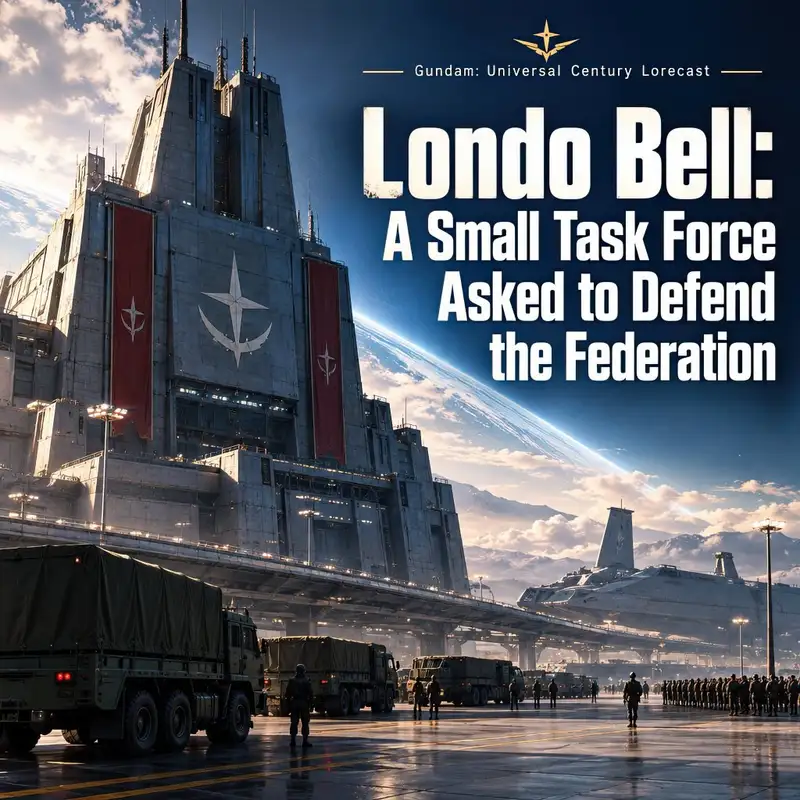
Londo Bell: A Small Task Force Asked to Defend the Federation
Fifth Luna reached Earth before Londo Bell could stop it. The asteroid’s descent destroyed Lhasa, the seat of the Earth Federation government, and demonstrated the central weakness of Federation security in Universal Century ninety-three. The Federation possessed far more ships, troops, industrial capacity, and territory than Char Aznable’s Neo Zeon movement. Yet the force actively trying to track Char, challenge his ships, and interrupt his operation was not a theater fleet or a unified planetary defense command. It was Bright Noa’s Londo Bell task force, centered on the Ra Cailum and a handful of supporting warships.
That did not mean Londo Bell had failed because its people were timid, untrained, or badly equipped. Quite the opposite. It contained some of the Federation’s most experienced commanders and mobile-suit personnel. Its ships could move, launch mobile suits, and respond to danger faster than much of the wider military bureaucracy. But it could not cover every route, secure every strategic installation, monitor every colony, or force civilian leaders to act before a threat became politically inconvenient. Fifth Luna was not simply a battlefield defeat. It was proof that a rapid-response force is not the same thing as a security system.
Londo Bell existed because the Federation had learned, painfully and incompletely, that it needed an organization capable of acting against emerging threats. It remained limited because the Federation had also learned what could happen when an anti-insurgency force became too politically powerful, too ideologically certain, and too insulated from accountability. Its history is therefore a history of compromise. The Federation wanted an instrument that could move faster than its ordinary institutions, but not one so autonomous that it became another Titans. In the process, it created a force capable of saving the Federation in emergencies, while leaving it unable to prevent many of those emergencies from forming.
The immediate background lies in the disasters of Universal Century eighty-seven and eighty-eight. During the Gryps Conflict, the Titans began as a Federation security formation justified by the need to suppress Zeon remnants and protect the Earth Sphere after the One Year War. In practice, the organization became a vehicle for repression, political intimidation, collective punishment, and mass violence against colonial populations. The Titans did not become dangerous merely because they had weapons. They became dangerous because they combined military authority, ideological certainty, privileged access to the state, and weak external restraint.
The Anti-Earth Union Group, usually called the A E U G, and Karaba emerged in opposition to that system. Their existence revealed another Federation problem. The regular state could not reliably correct its own abuses through ordinary channels. Reform required resistance movements, defectors, sympathetic officers, civilian networks, and military formations operating outside the official structure. By the end of the Gryps Conflict and the First Neo Zeon War, the Federation had survived, but it had not emerged with a simple institutional lesson. It needed forces willing to respond to anti-Federation threats. It also had reason to fear what such forces might become.
Londo Bell was shaped by that atmosphere. Reference material generally places its formation around Universal Century ninety, after the immediate wars of the late eighties. The precise founding process is not fully dramatized in the central animated record, and the exact date often attached to its creation belongs more to later reference chronology than to an on-screen founding ceremony. What matters is the institutional purpose. Londo Bell became an external or independent auxiliary formation within the Earth Federation Forces, assigned to investigate and counter threats that ordinary commands either could not address quickly or did not wish to confront.
It was not simply the Titans under a new name. It did not inherit a direct, uncomplicated chain of command from that organization, and the record does not support the idea that every former A E U G or Karaba member automatically entered its ranks. Still, Londo Bell inherited the security problem that had produced both the Titans and their opponents. The Federation needed a force with experience, mobility, and enough political distance from ordinary command structures to challenge a developing crisis. The danger was obvious. Any force assigned to investigate anti-Federation activity can become coercive toward the very colonial society it claims to protect.
The Federation’s answer was to keep Londo Bell limited. That restraint had a real purpose. A small formation was easier to supervise, easier to fund selectively, and less able to become an autonomous political machine. It could be tasked with a dangerous mission without being allowed to dominate the Earth Sphere. But this design also created an enduring contradiction. Londo Bell was expected to recognize threats that spanned colonies, lunar facilities, asteroid bases, remnant networks, corporate supply chains, and Federation political circles. It was expected to act before a crisis became a war. Yet it depended on the wider Federation for intelligence, formal authority, reinforcement, access to facilities, and political support.
This was not a private army belonging to Bright Noa. Bright was its commander in the screen record of Char’s Rebellion, but Londo Bell remained a Federation formation. Its mission and resources came from the state that created it. The distinction matters because Bright’s authority was substantial without being unlimited. He could maneuver ships, direct mobile-suit operations, make urgent decisions under combat conditions, and press warnings upward through the chain of command. He could not compel the Federation government to abandon negotiations, reveal all of its intelligence, or mobilize the full weight of its military whenever his force detected danger.
The practical form of Londo Bell was a task force. Its strength lay in concentration of readiness rather than sheer numbers. The Ra Cailum was the centerpiece. It was a large Federation warship with heavy armament and significant capacity for mobile-suit operations. That made it more than a command platform or a gunship. It was a moving base, a carrier, a communications center, a repair facility, a medical facility, and a place where command decisions could be translated into sorties. A mobile-suit force without its supporting ships is not a strategic instrument. It is a collection of machines waiting for fuel, maintenance, ammunition, recovery, and orders.
The Clop-class cruisers associated with Londo Bell added flexibility. Such ships could carry a limited mobile-suit complement and extend the formation’s ability to patrol, escort, scout, or reinforce a threatened area. They were useful because the Earth Sphere was too large for one flagship to cover alone. But distributed presence has a cost. Every cruiser sent to watch one route is unavailable somewhere else. Every patrol must consider resupply, maintenance, crew fatigue, communications, and the risk of encountering an enemy force stronger than the patrol can handle. A task force can create local superiority. It cannot guarantee universal coverage.
That distinction is especially important in the Minovsky environment. Minovsky particle interference does not make all sensors and communications useless, but it degrades the long-range certainty on which large military systems prefer to rely. Commanders need more visual reconnaissance, local initiative, prearranged plans, and rapid judgment by subordinates. A force such as Londo Bell could perform well under those conditions because it was experienced and relatively compact. Its commanders and crews could act without waiting for every instruction from a distant headquarters. But the same conditions made gaps in intelligence more dangerous. A small force cannot investigate every ambiguous signal, verify every rumor, or maintain contact with every political and military actor across the Earth Sphere.
Its mobile suits reflected the same mixture of standard capability and exceptional concentration. The Jegan represented the ordinary foundation of Federation mobile-suit power. It was a mass-production machine, intended to be reliable enough for broad service, maintainable enough for regular units, and standardized enough to replace older generations of Federation designs. A Jegan was not glamorous because it was not supposed to be unique. Its military value lay in the possibility that it could be fielded, supplied, repaired, and operated by a large institution rather than by one extraordinary pilot and a specially assembled technical team.
Londo Bell also carried more specialized equipment. The Re-GZ was a costly and limited machine, valuable for the kind of rapid response and high-risk mission that fell to this formation. The ν Gundam was more exceptional still. It was closely associated with Amuro Ray and with the urgent requirement to give him a machine capable of meeting Char’s latest mobile suit in combat. Such machines mattered. They could alter a local engagement, protect a flagship, break an enemy formation, or provide a commander with an option unavailable to ordinary forces. But they were not a replacement system for the Federation military.
That is the recurring problem of high-performance prototypes. A prototype can demonstrate a technology, answer a particular tactical need, and carry immense symbolic weight. It can also demand specialized parts, expert maintenance, rare pilot skill, and industrial attention that cannot be replicated at strategic scale. The ν Gundam was not proof that the Federation had solved its defense problem. It was evidence that a focused project, supported by Anaheim Electronics and shaped by Amuro’s experience, could produce an exceptional machine quickly when the crisis was already underway.
Anaheim’s role should be understood with care. The corporation possessed major industrial reach, technical expertise, and access to customers on multiple sides of the Earth Sphere’s conflicts. That made it politically influential and often opportunistic. It does not make Anaheim a hidden government that controlled every decision in the Federation or Neo Zeon. A contractor can profit from instability, cultivate officials, and provide essential weapons without possessing omniscience or total command. The rapid development of the ν Gundam demonstrated industrial capability, not unlimited capacity. A corporation can deliver a brilliant machine while the state that buys it remains divided, slow, and strategically confused.
Londo Bell’s dependence on a few exceptional assets was a strength in a crisis and a warning sign in peacetime. The Federation had a vast military establishment on paper. Yet when Char’s movement emerged as an immediate danger, its active defense increasingly relied on Bright’s command judgment, Amuro’s combat ability, a flagship with unusual capabilities, and a small group of ships and crews prepared to act. That concentration gave Londo Bell sharpness. It also meant that any loss, delay, misreading, or political constraint could have effects out of proportion to the formation’s size.
Bright Noa carried much of that burden. By Universal Century ninety-three, he was not simply the captain of a famous ship. As commander of Londo Bell and captain of the Ra Cailum, he had overlapping responsibilities that would challenge any officer. He had to manage a warship, direct a distributed task force, coordinate mobile-suit operations, interpret intelligence, communicate with higher authority, preserve the lives and readiness of his crews, and make decisions in a political environment where the official policy might not match the danger visible from his bridge.
This was command under uncertainty rather than command from omniscience. Bright could not see the whole Earth Sphere. He did not possess every report available to civilian officials, intelligence agencies, or Neo Zeon planners. Nor could he assume that every message reaching his ship was complete, current, or free of political filtering. In Minovsky conditions, the physical limits on communications and detection made this problem worse. But the deeper problem was political. When a government treats negotiations, secrecy, and domestic stability as separate from military readiness, its field commander may inherit the consequences without receiving the authority to prevent them.
Bright’s role required local initiative, but it also required discipline. Londo Bell could not become effective by ignoring every civilian authority or treating itself as the only institution entitled to decide the future of the Earth Sphere. That path led toward the very kind of autonomous coercive force the Federation had reason to fear. The challenge was to act decisively without becoming unaccountable. In practice, that balance is difficult even for stable governments. It is harder when the government has not fully resolved whether it wants to confront the threat that its own task force is reporting.
Amuro Ray represented another concentration of capability. In Char’s Rebellion, he served as captain and led Londo Bell’s mobile-suit combat element. His value extended beyond individual skill in the cockpit. He brought combat experience from earlier wars, an understanding of mobile-suit development, and the credibility to influence what kind of machine the Federation needed. His involvement in the ν Gundam program mattered because the machine was not designed in an abstract laboratory vacuum. It was shaped by an operational requirement: give a highly capable pilot the tools to confront an enemy who had built his own force around elite mobile-suit warfare, political symbolism, and strategic coercion.
But exceptional personnel can create dangerous illusions. If one pilot can defeat a superior enemy machine, protect a ship, or hold open an escape route, it is tempting to conclude that the organization is healthy because its best people continue to perform. That conclusion confuses emergency competence with institutional resilience. Amuro could not patrol every colony. He could not replace a failed intelligence system. He could not train a generation of pilots by appearing in one battle. He could not make a limited task force equal to a full fleet, and he could not convert a government’s political hesitation into coherent strategy.
The ν Gundam also illustrates the difference between a weapon system and a force structure. Its advanced systems gave Amuro capabilities that ordinary machines did not possess. In the final crisis, those capabilities became part of an event that remains extraordinary and not fully explained. They do not establish a routine doctrine that the Federation could issue to every squadron. The Axis Shock was not a planned, reproducible technique available whenever a psycho-frame-equipped mobile suit entered combat. It was a singular event shaped by conditions, people, machines, and perceptions that no institution in the record fully understood.
A military that depends on rare individuals is not necessarily weak. It may be highly effective in a narrow emergency. Yet the more it depends on them, the more it exposes the weaknesses underneath. Londo Bell’s best personnel gave the Federation a reserve of judgment and skill that ordinary bureaucracy often lacked. Their presence also allowed the larger system to postpone difficult reforms. So long as Bright could be sent toward a crisis and Amuro could be placed in a prototype, the Federation could appear more capable than its institutions really were.
Char’s renewed movement exposed those gaps with precision. By late Universal Century ninety-two, Char had reappeared and taken control of Sweetwater, a colony built around displaced and marginalized populations. Sweetwater was not merely a staging point on a strategic map. It was a political community shaped by the Federation’s failures of settlement, representation, and social policy. Char could draw on genuine resentment toward Earth’s government, the unequal distribution of power, and the enduring humiliation felt by many Spacenoids after decades of conflict. That gave his movement political material. It did not make his methods legitimate.
Char’s Neo Zeon force was not equal to the full Earth Federation Forces in raw resources. It did not need to be. It contained experienced former Zeon personnel, elite officers, capable mobile-suit pilots, and an ideology that could transform a relatively limited force into a strategic threat. Its advantage came from concentration, planning, and willingness to take risks that the Federation found politically difficult. Char’s objective was not simply to win a series of fleet engagements. He intended to coerce the Earth Sphere by making Earth itself vulnerable and by demonstrating that the Federation could not protect its political center or control the future of humanity in space.
The Fifth Luna operation showed how such a strategy worked. An asteroid did not have to annihilate the entire Federation to succeed politically. It only had to reach a target whose destruction carried governmental, symbolic, and psychological force. Lhasa was not just another city. It was the Federation capital. Its destruction disrupted leadership, exposed vulnerability, and created a shock that Char could exploit. Londo Bell fought Neo Zeon forces and attempted to respond, but a task force’s ability to contest an operation is not the same as its ability to seal every approach or prevent every strategic asset from being converted into a weapon.
Char’s campaign was therefore not merely a test of mobile suits. It was a test of whether a small, mobile Federation formation could compensate for the hesitation and fragmentation of the larger state. It could not. No task force could have done so alone. A commander can respond to an attack. He cannot independently build a system of warning, political trust, strategic planning, and civilian protection across the Earth Sphere. Londo Bell was asked to do something close to that, while remaining too small and too constrained to perform it as a permanent mission.
The events at Londenion and Luna Two made the problem even clearer. At Londenion, Char used negotiations as part of his operational design. Diplomacy and military action were not separate tracks. Negotiation could create delay, conceal intentions, divide officials, and alter the readiness of opposing forces. Londo Bell had to operate within the consequences of these political choices. Bright could recognize danger, but he could not assume that his assessment would determine Federation policy. The military problem was not merely whether Neo Zeon could be found and engaged. It was whether the Federation would understand what it was seeing in time to act.
Char’s seizure of nuclear weapons from Luna Two revealed another layer of failure. Luna Two was a major Federation military installation, not an undefended outpost beyond the reach of state power. Its vulnerability demonstrated that the problem extended beyond Londo Bell’s immediate capabilities. A small external task force could investigate threats and pursue enemy units. It could not, by itself, guarantee the security of every stockpile, base, and command facility in the Federation system. That required competent local defense, reliable intelligence, clear authority, and political leaders willing to treat strategic weapons as more than bargaining chips.
The episode should not be read as proof that Londo Bell was incompetent. The opposite is closer to the record. Its personnel repeatedly identified the seriousness of the threat and continued to act when events moved faster than the wider Federation’s response. But competence at the operational edge cannot repair a failure at the institutional center. Intelligence is not just information. It is the process by which institutions collect, evaluate, share, and act upon information. When that process is divided by secrecy, wishful thinking, political calculation, and competing authorities, a task force will receive warnings too late or orders too slowly.
Neo Zeon also benefited from compartmentalization. Char’s planners could conceal the full shape of an operation while presenting different faces to different audiences. Some opponents saw a political movement. Others saw a negotiating partner. Others saw an armed remnant whose strength could be managed. By the time the pieces aligned, Londo Bell was no longer working to prevent a crisis. It was trying to contain one. This is a familiar military pattern. A force built for rapid response arrives precisely because prevention has failed. It may still save lives and avert catastrophe, but it begins from a position chosen by the adversary.
Axis brought that pattern to its most dangerous point. The asteroid was not simply a large object in space. It was a strategic weapon, a mass-casualty threat, a mobile base, and a political statement. Stopping it demanded more than one kind of military action. Londo Bell had to combine fleet operations, mobile-suit combat, nuclear attack, boarding, demolition, and improvised damage control. Each task imposed different requirements. Ships had to maneuver and survive long enough to deliver their people and weapons. Mobile suits had to engage defenders and reach critical points. Boarding teams had to work inside hostile infrastructure. Every damaged machine or lost crew member narrowed the margin for success.
This was not the kind of operation for which a small task force could expect comfortable reserves. There was no time to build a conventional campaign, establish a wide blockade, or wait for a fully coordinated Federation mobilization. The danger was moving toward Earth. Londo Bell’s advantages became essential: readiness, experienced leadership, adaptable crews, and the willingness to make decisions under pressure. Its limitations became equally clear: incomplete information, finite ammunition and machines, dependence on a handful of ships, and the absence of any guarantee that larger institutions would solve the problem before the final moment.
The final effort to stop Axis succeeded in its immediate mission. Axis did not achieve its intended impact on Earth. That outcome required courage from people across the operation, not only the famous pilots at its center. Sailors kept ships functioning under attack. Mechanics supported machines whose readiness could not be taken for granted. Mobile-suit pilots fought in a battle where the stakes extended far beyond a duel. Personnel entered danger knowing that there might be no conventional recovery plan. The success was real. It should not be diminished because the wider system had failed earlier.
But success came at extraordinary cost. Amuro Ray and Char Aznable disappeared during the Axis Shock and were treated as missing or dead. The event itself cannot be reduced to a standard military capability. It involved psycho-frame-equipped machines, human intention, collective response, and phenomena that the surviving record does not fully explain. Londo Bell did not possess a doctrine for producing it again. The Federation did not emerge with a reliable strategic defense against future asteroid threats. The immediate disaster was prevented, but the political, institutional, and technological questions that had led to it remained unresolved.
This is the difference between mission success and strategic resolution. Londo Bell achieved the mission at the final possible stage. It prevented Axis from striking Earth as intended. It demonstrated operational flexibility under pressure and preserved the Federation from a catastrophe that could have transformed the Earth Sphere. Yet it could not restore public trust, reform colonial governance, eliminate resentment in places such as Sweetwater, or make Federation political leaders more willing to confront threats before they became unbearable. It could defeat an operation. It could not, by itself, repair the political order that made that operation possible.
The years that followed did not remove the need for Londo Bell. In Universal Century ninety-six, during the Laplace Incident, Bright remained in command of the formation and the Ra Cailum remained an important part of its presence. The organization was again sent into a crisis involving Zeon remnants, Federation secrecy, powerful military technology, and political information that officials wished to control. The setting had changed, but the institutional pattern had not. Londo Bell was useful because it could be trusted to act in a difficult situation. It was also useful to Federation leaders precisely because its existence allowed them to treat a systemic crisis as a problem for a specialized force.
The Nahel Argama illustrates the complexity of that later role. In the animated record of Gundam Unicorn, it operates as a Londo Bell assault ship under Captain Otto Mitas, with its own crew, immediate command relationships, and operational character. It is not simply another Ra Cailum, and its unusual capabilities do not make it representative of every Federation vessel. Its flexibility made it valuable for a politically sensitive mission. That value also depended on exceptional personnel, a distinctive ship, and circumstances that could not be duplicated across the entire Federation military.
The Laplace Incident also requires a distinction between Londo Bell and other Federation organizations. ECOAS, the special-operations organization involved in efforts to seize or control Laplace’s Box, was not merely a Londo Bell battalion with a different uniform. Its teams had their own command relationships and mission authorities. That separation matters because Federation security was not a single coherent instrument. It was a collection of forces, agencies, political offices, research interests, and classified programs that sometimes cooperated and sometimes acted with different information and different purposes.
Londo Bell entered that environment as a force expected to produce practical results. It could deploy ships and mobile suits, carry out inspections, support assault operations, and respond when the situation became violent. But the political meaning of Laplace’s Box could not be solved by a mobile-suit sortie. The question involved the legitimacy of the Federation’s founding order, the control of historical memory, and the willingness of officials to accept consequences that could not be contained by force. Once again, Londo Bell was positioned at the point where military action met a problem created by politics.
That is why Londo Bell endured. It was not merely a famous name attached to familiar ships and pilots. It represented the Federation’s preferred compromise after the Titans. The state wanted professional personnel who could move quickly, investigate dangerous movements, and fight when regular commands were slow or compromised. It wanted those personnel to retain enough independence to see a problem clearly. At the same time, it did not want them to possess enough autonomous power to become a political force in their own right. Londo Bell’s limited scale was therefore not an accidental defect. It was part of the design.
The cost of that design was permanent dependence. Londo Bell depended on the Federation for ships, bases, intelligence, replacement personnel, industrial support, legal authority, and political backing. It could be sent toward the next emergency, but it could not decide whether the Federation would reform its policies toward the colonies, secure its strategic weapons, discipline its own institutions, or confront the corruption and complacency that allowed threats to mature. The formation could act outside ordinary routines. It could not escape the political system that created those routines.
There is a humane purpose in limiting coercive power. The Titans had shown why the Earth Sphere should fear a security organization convinced that fear and violence entitled it to rule. Londo Bell’s restraint, professionalism, and relatively narrow mission gave it moral distance from that legacy. But limited coercive power is not the same as durable security. A government that refuses broad reform while relying on a small exceptional force is not solving its problems. It is assigning its most capable people to manage the consequences.
Londo Bell could defend the Federation when danger became immediate. It could not make the Federation govern in a way that made immediate danger less likely.