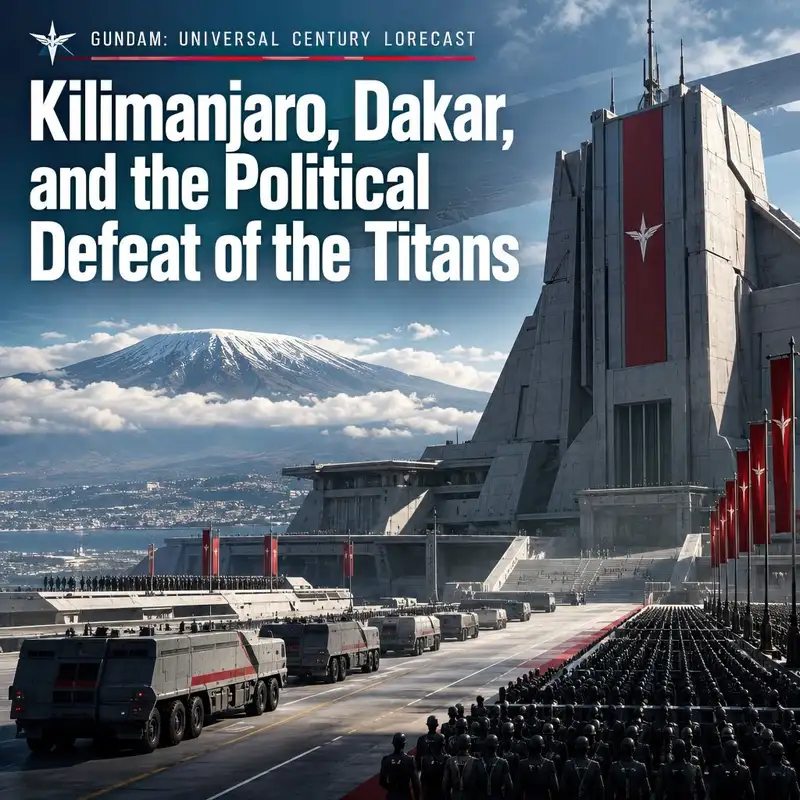
Kilimanjaro, Dakar, and the Political Defeat of the Titans
Inside the Federal Assembly at Dakar, Quattro Bajeena speaks under the pressure of an armed crisis. Outside, Titans mobile suits move against a political institution in one of the Earth Federation’s formal capitals. The immediate military situation is confused, dangerous, and limited. This is not an invasion intended to conquer Africa. It is not a campaign to destroy every Federation force on Earth. The Anti-Earth Union Group and its Karaba allies need something more specific. They need a platform, a broadcast, and enough time for the Federation’s citizens, soldiers, and representatives to see a contradiction that the Titans have spent years trying to conceal.
The Titans claim authority as guardians of the Earth Federation. They justify extraordinary powers in the name of security, especially security against Zeon remnants, colonial unrest, and another great war. Yet at Dakar, the institution claiming to defend Federation order answers political opposition by bringing mobile suits into and around Federation civic space. That response matters because it is visible. A security organization can hide classified directives, manipulate reports, and explain away distant operations. It has much more difficulty explaining why armed forces are threatening the Assembly in order to prevent the Assembly, and the wider public, from hearing a challenge to its authority.
For that reason, Dakar cannot be understood as a speech alone. Quattro’s words matter, but their power comes from the military and political circumstances surrounding them. The audience is not asked to accept an abstract accusation on faith. It can see the Titans acting under pressure. It can see that an organization created inside the Federation system has begun to treat the Federation’s own political institutions as obstacles to be subdued. By the time Quattro speaks at Dakar, the Titans have already suffered a different kind of defeat at Kilimanjaro. The mountain base did not destroy them. It did something more limited, but still consequential. It proved that Titan power on Earth could be challenged and broken.
Before Kilimanjaro and Dakar, the Titans still possessed substantial authority. They were not an independent country occupying Federation territory from outside. They were a Federation security organization that had accumulated exceptional influence within a fearful and exhausted political system. The memory of the One Year War remained powerful. Zeon’s atrocities, the loss of life, the destruction of colonies, and the fear of renewed conflict gave men such as Jamitov Hymem room to argue that ordinary procedures were too slow, too cautious, and too vulnerable to internal enemies.
That argument did not persuade every Federation official, soldier, or citizen. The Federation was too large, too divided, and too bureaucratic for that. But it gave the Titans access to military resources, political cover, and a language of emergency. They could describe repression as security. They could call dissent a threat to public order. They could present anti-Titan opposition as a disguised revival of Zeon extremism, regardless of whether the people involved had any loyalty to the old Principality of Zeon. In that environment, the Titans’ authority rested partly on law and formal appointment, but increasingly on their ability to make resistance appear dangerous.
Jamitov embodied the political side of that system. His power lay not simply in issuing battlefield orders, but in shaping institutions, alliances, appointments, and the broader direction of Titan policy. Bask Om represented a harsher operational reality. Under Bask, coercion was not an unfortunate last resort. It became a normal instrument of governance. The distinction matters. A military organization can possess legal authority and still be driven by commanders whose practical methods hollow out the legitimacy of that authority. The Titans’ problem was not that every person under their command was uniquely cruel. Their problem was that the institution rewarded force while steadily narrowing the space for accountability.
The Anti-Earth Union Group faced a difficult military problem. Opposing the Titans in principle was not enough. The Titans had ships, bases, experienced pilots, advanced mobile suits, access to Federation infrastructure, and the advantage of operating inside an official chain of authority. The AEUG had military capability and Federation connections, but much of its strength was organized around space operations. It could challenge Titan fleets and installations in orbit. It could not simply descend upon Earth and assume that orbital success would produce control over cities, roads, airfields, governments, or populations.
That was where Karaba became essential. Karaba was the Earth-based partner the AEUG required if its opposition to the Titans was to become more than a spaceborne insurgency. It brought local access, personnel familiar with Earthside conditions, political networks, and the ability to move forces through an atmosphere and across territory that the AEUG could not dominate alone. Its airborne flagship, the Audhumla, was not merely a dramatic machine for carrying famous pilots. It was an operational center. It provided transport, launch and recovery capacity, command space, maintenance support, and a way to shift mobile suits and crews across an Earth battlefield without relying on fixed facilities controlled by the enemy.
The Argama performed a related role from orbit. It was not a self-contained symbol of rebellion drifting through space. It was a warship and mobile-suit carrier that had to sustain pilots, mechanics, weapons, fuel or propellant, communications, and damage control. Its contribution to Earth operations depended on coordination with forces below. The ship could provide support, deploy mobile suits, and impose pressure from a different direction. But it could not govern terrain, secure an assembly hall, or hold a mountain installation by itself. The AEUG and Karaba partnership mattered because it connected space-based mobility with Earth-based access.
Minovsky interference made this coordination more difficult and more important. In a battlespace where long-range communications and detection could be degraded, commanders could not assume that every unit shared a perfect picture of the fight. Plans had to be prepared in advance. Subordinate commanders needed room to act on local information. Visual confirmation, prearranged objectives, and the ability to continue a mission after contact with headquarters became uncertain all carried greater weight. The AEUG and Karaba did not solve these problems through technology alone. They managed them through organization, mobility, and a shared political purpose.
Quattro Bajeena stood at the intersection of those military and political requirements. In the field, he was an experienced pilot and commander. To allies and enemies alike, he was also a figure of unusual symbolic importance, even before his public revelation at Dakar. Amuro Ray was another critical asset, particularly within Karaba’s Earthside effort. His skill and experience mattered, but he was not a one-man command structure. No campaign of this scale could rest on one pilot, however capable. Kamille Bidan was likewise a high-value AEUG pilot, but his role at Kilimanjaro would reveal something that no organization could reduce to a tactical asset: the cost of treating human beings as weapons.
In early November, the coalition turned its attention to Kilimanjaro. The Titans had established a major installation there, and its importance was both practical and symbolic. A fortified base provides more than walls and weapons. It can serve as a command post, a maintenance site, a supply node, a place to stage mobile suits, and a visible sign that a government or military organization can reach into a region and remain there. In the Titans’ case, Kilimanjaro represented their capacity to project authority into Africa and to sustain that authority with armed force.
But fixed power has a weakness in a mobile war. A base can be protected, supplied, and defended. It can also be located, surrounded, isolated, and attacked from more than one direction. A mountain fortress may impose severe problems on an attacker, especially in terrain that limits movement and observation. Yet it also gives the attacker a clear objective. If the defender must protect the installation, its command staff, its stores, and its equipment, then the defender cannot simply disengage when the battle turns unfavorable. The base becomes an anchor. Anchors are useful until they become weights.
Kilimanjaro was not the whole of Africa, and its loss would not mean that the Titans had lost the planet. The distinction shapes what follows. The Titans remained capable of fielding forces elsewhere. They retained access to major Federation resources. They still possessed trained personnel and advanced equipment. But the installation mattered because it was a concentrated expression of Titan power. Jamitov himself was present there. The base was not just another outpost. It was a position whose survival carried institutional and political value.
The attack against Kilimanjaro demonstrated why the AEUG and Karaba relationship had become dangerous to the Titans. The Argama added pressure from orbit and supported the wider operation. Karaba, operating through the Audhumla and its Earthside forces, carried the principal burden of fighting in the atmosphere and around the fortified position. Mobile suits were central to the assault, but they were only one part of the system. They required launch platforms, recovery plans, maintenance crews, ammunition, replacement parts, pilots who could function under combat stress, and commanders able to coordinate forces moving through very different environments.
The Titans faced simultaneous problems. They had to defend a fixed installation, protect senior leadership, counter mobile-suit attacks, and maintain enough cohesion to prevent the battle from becoming a rout. The AEUG and Karaba did not need to annihilate every Titan unit. They needed to break the defense, disrupt the base, and demonstrate that Titan control of Earth was not untouchable. In that sense, the campaign was a combined operation. Orbital pressure, air-mobile forces, mobile-suit combat, and the political value of the objective reinforced one another.
The Titans possessed an instrument intended to change the balance quickly. That instrument was Four Murasame and the Psycho Gundam. Militarily, the appeal was obvious. A machine of that scale and destructive capability could impose a localized crisis on an attacking force. It could force enemy pilots to react, break formations, threaten support assets, and turn a defensive battle around through sheer concentration of firepower. In the narrowest tactical sense, the Psycho Gundam was exactly the kind of weapon a desperate garrison might want when ordinary defensive measures were under strain.
But Four was not a component that could be maintained, calibrated, and returned to service like a damaged mobile-suit limb. She was a Cyber Newtype, a person subjected to a system of experimentation, conditioning, memory disruption, and military control. The Titans treated her extraordinary ability as a resource to be extracted. Their research and command structure attempted to convert psychological injury into combat performance. That was not simply cruel. It was militarily shortsighted. A force that relies on coercion to create an exceptional weapon may gain a temporary advantage, but it also creates a system that is difficult to predict, difficult to control, and impossible to understand through ordinary equipment tables.
Kamille’s connection to Four exposed that weakness. He did not encounter a faceless enemy platform. He encountered a person whose identity and memories had been manipulated by institutions that wanted her abilities without accepting responsibility for the damage they had caused. His effort to reach her was personal, and the pain of that relationship cannot be separated from the battle. But it also had a larger meaning. The Titans had assumed that control over Four’s body, environment, and machine would guarantee control over her loyalties. That assumption failed because human agency does not disappear simply because a laboratory has classified it.
This does not make Four’s experience a simple story of personal redemption. It is not enough to say that emotional connection overcame programming. The institutional reality remains harsher. Four had been used by people who saw her as an asset in a military emergency. Her suffering was not an accidental side effect of an otherwise sound policy. It was built into the policy. The Titans’ Cyber Newtype program sought military advantage by making damaged people more usable in combat. At Kilimanjaro, that approach revealed both its tactical value and its moral bankruptcy.
The battle turned on more than a confrontation between Kamille and Four. The broader Titan defense was under coordinated pressure, and the Psycho Gundam could not restore the security of a collapsing position by itself. Jerid Messa’s intervention helped bring the immediate tragedy to its conclusion. Four died while attempting to protect Kamille. Her death was not a noble solution to the Titan problem, and it should not be romanticized as one. It was the final consequence of a system that had taken a vulnerable person, stripped away her stability, and placed her at the center of a battle she had never freely chosen.
Jamitov survived the assault. The Titans did not lose their leadership in a single blow, and they did not suddenly lose the means to continue the war. But Kilimanjaro was lost or collapsed in the aftermath of the operation. Tactically, the defenders had failed to hold the installation. Operationally, the AEUG and Karaba had shown that they could coordinate across orbit and atmosphere, strike a major Titan position, and force the enemy from a visible node of power on Earth.
The institutional lesson was equally damaging. The Titans had defended Kilimanjaro with conventional forces, fortified infrastructure, senior leadership, and an extraordinary human weapon. Even with those advantages, they could not preserve the base. Their reliance on Four and the Psycho Gundam revealed a deeper weakness. The organization that claimed to embody order had become dependent on increasingly extreme methods to compensate for political and operational vulnerability. That did not make the Titans weak in every military sense. It made their power more brittle.
Still, Kilimanjaro had limits as a victory. A destroyed or abandoned base can be rebuilt, replaced, or written off as a local setback. The Titans retained mobile suits, warships, commanders, and influence within the Federation. They could continue to escalate. They could still use the authority they possessed to label their enemies terrorists, rebels, or agents of chaos. The coalition had proved that Titan positions could be beaten. It had not yet made that fact impossible for the Federation public to ignore.
Dakar was designed to do exactly that. The objective there was not the permanent occupation of a city. The AEUG and Karaba did not need to defeat every Federation unit in the region, establish a new government, or hold the Assembly indefinitely. Their military task was narrower and more politically ambitious. They needed temporary control of the Assembly and its communications environment. They needed enough security to place a message before the Federation’s political class and the wider audience beyond the capital.
The difference between Kilimanjaro and Dakar was the difference between destroying a position and seizing a microphone. Kilimanjaro was a fortified outpost of coercive reach. Dakar was a place where legal authority, public legitimacy, and military power met in plain view. The Assembly mattered because the Federation was not merely an army. It was a political structure with representatives, offices, procedures, competing interests, and a claim to govern through more than raw force. To enter that space was to challenge the Titans on terrain where tanks, mobile suits, and fear could not automatically settle the argument.
The operation carried serious risks. Political institutions are not empty military facilities. They contain civilians, officials, staff, security personnel, and people who may not know who controls the situation or whether they can escape it. Any combat around such a site risks turning a political demonstration into a massacre. The AEUG and Karaba needed discipline, timing, and a clear understanding of their limited aim. Their purpose was not to prove that armed seizure itself created legitimacy. Their purpose was to expose the gap between Federation law and Titan practice.
A broadcast could reach audiences a mountain battle could not. A distant Federation citizen might hear that Kilimanjaro had fallen and dismiss the report as propaganda. A soldier in another theater might receive conflicting briefings. A representative could be told that the AEUG was simply an armed extremist group seeking power for itself. But a public address from inside the Federal Assembly, delivered while the Titans attempted to suppress it, offered people evidence they could interpret for themselves. The operation transformed information into a battlefield.
Quattro’s role was central because he was not merely another officer in an unfamiliar uniform. At Dakar, he revealed publicly that he had once been known as Char Aznable, and that he was the son of Zeon Zum Deikun. The revelation was calculated, but calculation does not make it insincere. Quattro understood that the name Char carried political weight across the Earth Sphere. It evoked the One Year War, Zeon, rebellion, military reputation, and the unresolved struggle over the relationship between Earth and the colonies.
That identity also created danger. Char Aznable was not a neutral name. To many within the Federation, it was linked to an enemy state and a war that had killed millions. To others, it carried associations with resistance to Federation domination. Quattro could not use that name without reviving fear, memory, and suspicion. His speech therefore had to make a distinction that the Titans had spent years blurring. Zeon Zum Deikun’s political ideas were not identical to the rule of the Zabi family. Colonial grievance was not identical to dictatorship. Opposition to Titan repression was not a defense of Zeon’s crimes.
Quattro’s argument condemned the Titans’ domination of Federation institutions and challenged the Earth-centered political stagnation that had helped produce the crisis. He spoke of humanity’s need to reduce its dependence on Earth and to confront the structures that kept political power concentrated on the planet. These were broad and difficult claims, not a complete constitutional program. The speech did not settle how the Federation should be reformed, how colonial representation should function, or how military power should be restrained in the future. It did something more immediate. It forced those questions into the open.
His identity gave the argument reach, but identity alone could not make it decisive. Char’s past did not automatically make him correct. It did not erase the crimes of the Principality of Zeon, and it did not transform the AEUG into a ready-made replacement government. The political effect came from the relationship between his words and the circumstances in which they were delivered. The Titans had built their authority on the claim that harsh security measures were necessary to preserve the Federation. At Dakar, their conduct gave Quattro’s accusation a visible demonstration.
The Titans’ decision to suppress the operation was militarily understandable. An armed opposition force had entered the Federation Assembly. A prominent enemy commander was broadcasting a challenge to Titan authority. From the Titans’ perspective, allowing that broadcast to continue risked encouraging resistance, undermining command discipline, and weakening their hold over the political system. A force trained to restore control through rapid coercion would naturally reach for the tools it possessed. It had mobile suits. It had disciplined combat personnel. It had a command culture that treated opposition as a security threat.
Politically, that response was disastrous. The issue was not that the Titans lacked military strength. They still had plenty of it. The issue was that their strength was being used in the most revealing possible setting. They were not fighting a distant raid on an isolated installation. They were using armed force around the Federation’s political center, where civilians and representatives could see the consequences. The more visibly they acted as a faction protecting its own power, the less credible their claim became that they were acting as neutral guardians of public order.
The civilian dimension was central. The Titans’ presence around Dakar did not occur in an empty desert or an uninhabited orbital zone. It endangered people whose lives had no direct connection to the command struggle between Jamitov, Quattro, Karaba, and the AEUG. That danger exposed a familiar pattern of authoritarian security policy. The institution claims to protect the public, then treats the public as an acceptable risk when preserving its own authority becomes more important than preserving civic life. The Titans did not need to declare that principle openly. Their actions made it visible.
Dakar therefore became a political defeat because the Titans failed at information warfare, not because they failed to fire their weapons. They could contest the operation militarily. They could threaten the Assembly. They could disrupt their opponents. But they could not prevent the larger audience from seeing what their response meant. Their use of force became evidence against them. The security organization that had presented itself as the defender of the Federation appeared instead as an armed body prepared to subordinate the Federation’s political institutions to its own survival.
That does not mean every listener accepted Quattro’s message. Some Federation officials would have regarded him as a dangerous opportunist. Some soldiers would have remained loyal to the Titans, whether from conviction, fear, professional duty, or lack of alternatives. Some civilians may have seen only another armed group bringing violence into their capital. The Federation’s political culture did not become unified overnight. Dakar did not remove distrust between Earth and the colonies, nor did it resolve the long legacy of Zeon’s war.
What Dakar did was give different audiences a shared event they could no longer ignore. Political representatives saw a challenge to the Titans from inside the Assembly. Federation personnel saw that opposition to the Titans could be organized, armed, and publicly articulated. Citizens saw the danger of allowing security institutions to operate without meaningful restraint. The AEUG and Karaba gained space for further maneuver because the Titans’ opponents no longer had to rely only on private accusations, rumors, or classified reports. They had a public demonstration of Titan conduct.
This is the difference between propaganda and evidence. Propaganda attempts to impose an interpretation. Evidence gives an audience something it must interpret. Quattro’s speech was political rhetoric, as all major political speeches are. But it did not stand alone. It was attached to the visible behavior of the Titans. The Titans themselves supplied the most damaging image. The more they attempted to silence the challenge through military force, the more they confirmed its central warning about their authority.
The Titans were not defeated at Dakar because they ran out of mobile suits. They were defeated politically because, under public observation, their use of military power exposed the illegitimacy that military power had been meant to conceal.