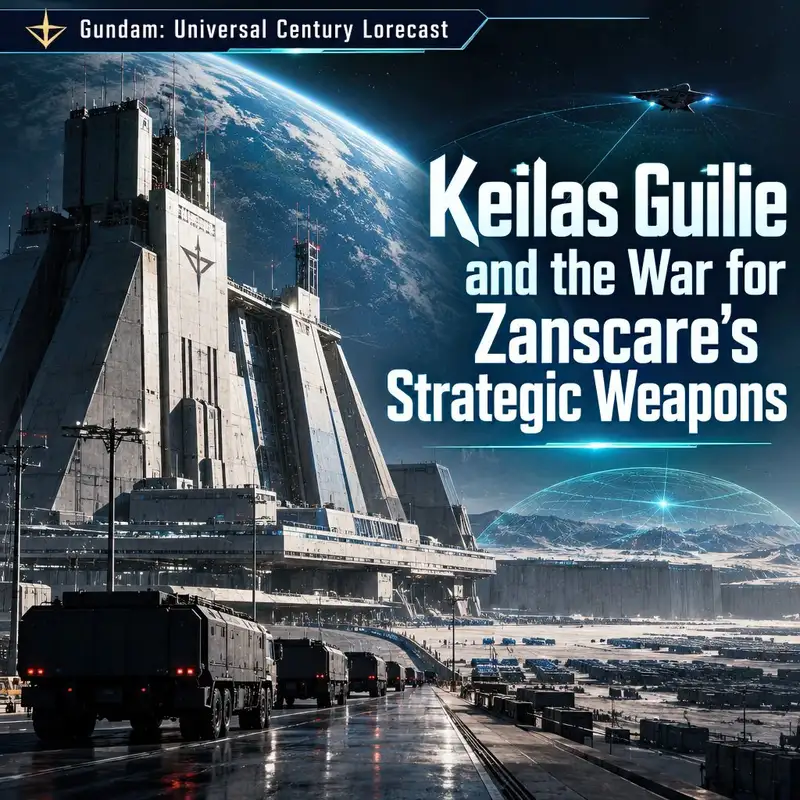
Keilas Guilie and the War for Zanscare’s Strategic Weapons
The Gaunland went forward because the League Militaire could not afford a fair fight. Around Keilas Guilie, Zanscare possessed the heavier fleet, the prepared defenses, and the strategic weapon that made every approaching ship a potential target. The League had a damaged, aging cruiser, a carrier force built around the Reinforce, mobile suits, and crews already accustomed to making decisions with too little time and too few spare parts. So Otis modified the Gaunland for remote control and sent it forward as a shield and decoy. It was an ugly solution, but it had a clear military purpose. If Zanscare concentrated on the Gaunland, the Reinforce might reach the real objective.
That objective was not simply to destroy a large cannon. Keilas Guilie represented a system of coercion. It was a strategic satellite weapon, built around a beam cannon of such scale that its value lay less in any single shot than in the threat it imposed. A weapon positioned in space could menace fleets, colonies, and targets on Earth. It could compel enemies to alter routes, scatter formations, abandon positions, or accept political demands under the shadow of destruction. Zanscare did not need to fire it constantly. The possibility that it could fire was already part of its power.
But a strategic weapon is never just a weapon. It is a chain of people, machinery, ships, power systems, targeting arrangements, communications, security procedures, and political authority. Break enough links in that chain, and the weapon becomes an expensive structure with no reliable purpose. The League Militaire understood this. It did not have the strength to meet Zanscare in a conventional fleet battle and expect favorable odds. It had to attack the system around Keilas Guilie. The Gaunland’s mission was therefore not a gesture of defiance. It was an attempt to purchase access with one scarce hull before Zanscare could bring its overwhelming advantage to bear.
That opening operation captures much of the Zanscare War in miniature. The League Militaire was a resistance movement trying to fight a state. Zanscare had fleets, territory, occupation forces, political institutions, and an increasingly ambitious strategic program. The League had local support, committed crews, a handful of ships, captured equipment, improvised repairs, and people willing to take risks that a regular navy might have judged unacceptable. Neither side was free from weakness. Zanscare’s military strength was real, but its political leadership was divided. The League’s courage was real, but courage could not manufacture replacement crews, spare parts, or secure bases.
Keilas Guilie mattered because it promised to change that balance. A fixed strategic weapon can compensate, at least temporarily, for limits in ordinary military control. A fleet must patrol. An army must occupy. A government must administer. A strategic beam weapon can instead threaten a wide area from a protected position and force the enemy to organize its entire campaign around the danger it presents. It can make an opponent spend resources on evasion, interception, reconnaissance, and contingency planning. It can turn a favorable orbit or a defended satellite into political leverage.
The series does not provide a reliable engineering specification that would permit a precise calculation of Keilas Guilie’s range or destructive yield. That is not the important question. Its strategic role is clear enough. It is presented as a weapon capable of imposing catastrophic risk on major targets. Zanscare treated it as an instrument that could secure its position through fear. The League treated it as a threat too dangerous to leave in enemy hands. Both judgments tell us more about the weapon’s historical importance than an unsupported figure for beam output ever could.
The League Militaire approached Keilas Guilie from the position of a force that understood scarcity. The Reinforce was not the product of an immense industrial base with deep reserves and standardized logistics. It was the center of a small and improvised space force. Its crews had to launch mobile suits, recover damaged machines, maintain a ship under continuous pressure, and make use of whatever equipment could be salvaged, captured, or adapted. A resistance navy does not choose its material conditions. It inherits them from enemy action, friendly losses, local workshops, and the luck of what remains intact after battle.
That made the Reinforce’s role especially important. A mobile suit can dominate a brief local engagement, but it cannot by itself move a campaign across the Earth Sphere. Pilots require carriers, ammunition, propellant, maintenance crews, medical support, intelligence, and a place to return to after the fight. The Reinforce provided those functions under conditions that were never stable. Every sortie committed not only a pilot and machine, but also fuel, repairs, recovery capacity, and the attention of a crew that could not easily be replaced.
The League could not simply order a line of battleships into range and exchange fire with Zanscare until one side withdrew. It lacked the numbers, the depth, and the ability to absorb a prolonged conventional engagement. Its answer was to identify the enemy’s point of dependence. Keilas Guilie might be powerful, but it could not defend itself in isolation. It needed escorts. It needed a fleet screen. It needed security against boarding or infiltration. It needed command access and functioning control systems. It needed a safe enough operating environment for its crews to prepare and fire the weapon.
For that reason, the Gaunland operation mattered. The League was willing to trade one cruiser for a chance to penetrate the Zanscare formation. The Gaunland, remotely controlled, could draw fire and create confusion without requiring its crew to remain aboard for the final approach. The measure was born from necessity, but it was not irrational. In military terms, the League was exchanging a limited asset for the possibility of neutralizing or capturing an asset whose value to Zanscare was much greater.
There was nothing clean about the plan. Remote control reduces the immediate danger to a crew, but it does not make a warship disposable in any larger sense. The Gaunland represented labor, equipment, maintenance effort, and a hull the League could not casually replace. Its use also demonstrates the difference between a military force with industrial depth and one operating on the edge of exhaustion. A major navy may write off a damaged vessel as a loss against broader strategic gain. A resistance force feels the absence of every ship for the rest of the campaign.
The Reinforce used the Gaunland as cover while it pushed through the defensive formation. That maneuver was naval warfare first and mobile-suit warfare second. Mobile suits could screen the approach, attack nearby defenders, board, intercept, and seize local control. But the decisive problem was getting a ship close enough to the weapon system and its supporting infrastructure to interfere with its operation. A mobile suit can breach a point in a defense. It cannot replace the carrier, the boarding force, the command staff, or the technicians needed to exploit what has been seized.
Uso Ewin’s role in this battle also needs to be understood in that context. His ability as a pilot was extraordinary, and the League repeatedly placed burdens on him that no thirteen-year-old should have carried. During the Keilas Guilie operation, his concern for Shakti affects his readiness and attention. Junko encourages him back into the fight. The moment is not merely a personal distraction inserted into a battle. It shows the human limits beneath the League’s operational improvisation. Its best pilot was also a child separated from the person he trusted most, fighting in a campaign where private fear and military necessity could not be kept apart.
The Shrike Team and the other personnel around Uso had to compensate for that reality. They were not simply supporting characters around a gifted pilot. They were trained combatants and crew members carrying the institutional weight that the League lacked elsewhere. In a larger and better resourced military, a commander might rotate pilots, distribute responsibility, or replace a fatigued unit. The League often had no such luxury. It needed Uso precisely because it had so few people capable of doing what he could do. That dependence gave the resistance combat power. It also made it vulnerable.
The League’s penetration of the Keilas Guilie fleet proved that the strategic satellite’s apparent invulnerability was an illusion. The weapon was fixed. Its defenders had to anticipate where the enemy would come from, maintain a perimeter, and preserve command cohesion while under attack. The League did not need to destroy every escort or win every local engagement. It needed to create enough disruption to get inside the system’s decision cycle. Once that happened, Zanscare faced a different problem. The question was no longer whether the cannon could fire. It was who would control it, and against whom.
Capture, however, is not the same as ownership. The aftermath of a fleet engagement is often more dangerous than the decisive moment itself. Ships are damaged but not destroyed. Mobile suits drift in debris fields. Survivors search for rescue, enemy forces regroup, and local commanders try to understand what has actually happened. Communications are disrupted. Sensors are obstructed. A debris field around a strategic objective is not empty space. It is a battlefield full of wreckage, unexploded weapons, disabled machines, trapped personnel, and opportunities for further violence.
The events around the aftermath of the Keilas Guilie battle make that clear. Uso’s encounter with Godwald Hein, the Zanscare pilot known as the Space Tiger, is a reminder that a broken formation can still contain dangerous opponents. A fleet may be disrupted, but individual pilots and surviving ships do not simply vanish because a plan has succeeded. The League had gained an opportunity, not secured a stable rear area. It still had to search, defend, identify threats, recover its own people, and decide what could be done with the weapon it had fought to reach.
This is where strategic weapons reveal their dependence on ordinary military functions. Keilas Guilie required a usable command arrangement. It required control over the access points and systems that made firing possible. It required protection against counterattack and sabotage. It required crews who understood the mechanism and commanders willing to accept the consequences of using it. The League could seize leverage, but it could not instantly create a mature strategic-weapons command, an experienced technical organization, or a secure operating doctrine. It had taken possession of a crisis.
Zanscare understood that danger as well. A strategic system lost to an enemy does not merely represent a material loss. It becomes an intelligence loss, a political humiliation, and a potential threat to one’s own forces. The empire had invested in Keilas Guilie as a statement of dominance. Now it had to confront the possibility that the statement could be reversed. The weapon’s existence made the League’s operation necessary. Its vulnerability made the operation possible.
The renewed conflict around Keilas Guilie reaches its climax when the weapon, described in the series as the Big Cannon, is brought into action. By then, the strategic satellite is no longer an abstract threat. It has become a contested instrument in an active battle, with League forces attempting to use it and Zanscare personnel trying to deny that use. The event is a tactical success for the League, but it is also a demonstration of how quickly control over such a weapon can become unstable.
Cronicle’s intervention is especially important. He understands that a strategic weapon in hostile hands cannot be treated as a recoverable inconvenience. It must be stopped, even if stopping it risks damage to the system and threatens people nearby. His sabotage effort reflects the logic of denial. If Zanscare cannot control Keilas Guilie, it would rather make the weapon unusable than allow the League to turn it against the fleet. That is the cold arithmetic of strategic warfare. A weapon designed to impose fear on the enemy becomes intolerable when its direction changes.
Junko’s death occurs within this desperate struggle over the weapon’s control. She attempts to deal with the threat created by Cronicle’s bomb, and the result damages the remote-control arrangement. Her death should not be reduced to a neat sacrifice planned from the beginning. The League’s operation had already required calculated risk, but the final crisis was not a clean execution of a carefully controlled design. It was a battlefield emergency in which damaged systems, enemy interference, and human bodies were all caught inside the same collapsing chain of command.
That damage changes the character of the weapon’s employment. Uso takes control of Keilas Guilie remotely, but this is not evidence that the League has discovered an easy method for operating strategic satellites. It is an emergency measure. It depends on a particular moment, a particular pilot, and a damaged system that has left the weapon’s normal control arrangements compromised. In war, improvisation can produce remarkable results. It can also create the illusion that an exceptional moment is a repeatable doctrine. The League had not built a strategic-weapons force. It had survived a crisis long enough to use the enemy’s weapon once.
Cronicle interferes with the firing process, diverting the beam and preventing a simple, controlled employment of the cannon. The result is still devastating. Zanscare fleet elements suffer severe losses and disruption. The League gains a major operational advantage. Yet the event does not become a tidy demonstration of precision firepower. The weapon is being used in an environment where fleets, colonies, and civilian infrastructure exist in close relationship. Damage reaches the colony as well. The series does not support a precise accounting of destruction, and there is no need to manufacture one. The historical point is plain. A strategic beam weapon fired around inhabited space cannot separate military effect from civilian danger.
This is the moral burden of capturing an enemy’s coercive instrument. The League Militaire could argue, correctly, that Keilas Guilie had to be denied to Zanscare. It could also use the weapon to protect itself against the fleet that had defended it. But the weapon did not become harmless because the League briefly controlled it. Its basic military purpose was still catastrophic force. Its operating environment was still populated. Its targeting problem was still shaped by confusion, damaged systems, and enemy interference. Liberation forces do not escape the risks of strategic violence simply because they inherit the weapon from an authoritarian enemy.
The firing of Keilas Guilie therefore produces several outcomes at once. At the tactical level, it devastates or disrupts a substantial portion of the immediate Zanscare force. At the operational level, it denies the empire uncontested use of a weapon that could have constrained League movement and threatened broader targets. At the political level, it damages Zanscare’s image of secure military mastery. An empire that cannot protect its own ultimate weapon looks less inevitable than it did the day before.
But tactical success is not the same as strategic victory. Keilas Guilie does not remove Zanscare’s leadership. It does not dissolve the empire’s remaining fleets, occupation structures, or political networks. It does not settle the contest over Queen Maria’s authority, Shakti’s identity, Kagatie’s ambitions, Cronicle’s loyalties, or Tassilo’s military power. The League has won space and time. It has not won a settlement.
Junko’s death makes that distinction painfully clear. Resistance organizations are often measured by the dramatic effects they achieve against stronger opponents. A ship is captured. A fleet is damaged. A weapon is turned around. Those results matter. But the organization must then continue with fewer experienced people than before. Junko was not merely one name among many losses. She represented training, confidence, unit cohesion, and the capacity to make decisions while frightened, exhausted, and under fire. Such people are difficult to replace in any military. They are especially difficult to replace in a resistance force.
Zanscare could lose ships and still draw on the resources of a state. It had territory, production, a formal military establishment, and a political apparatus capable of mobilizing more personnel. That did not make its losses insignificant. The destruction around Keilas Guilie was a serious blow. But the League’s losses had a different weight. Every veteran killed could leave behind a gap in leadership, maintenance, training, or trust that no captured machine could fill.
This is one reason why strategic weapons can distort military judgment. They encourage leaders to focus on visible destruction and dramatic shifts in firepower. They can obscure the quieter assets that sustain a war: trained technicians, trustworthy petty officers, medical personnel, navigators, repair crews, intelligence contacts, and civilians willing to provide food, information, shelter, or legitimacy. Keilas Guilie could destroy ships. It could not restore the League’s dead. It could not make a young pilot less burdened. It could not create a durable command system out of an improvised victory.
The League adapted because it had to. The Reinforce and captured resources would later contribute to the creation of the Reinforce Junior, another example of a force rebuilding from scarcity rather than following a calm procurement plan. That development matters less as a technical story than as evidence of continued pressure. The League did not emerge from Keilas Guilie with a stable industrial base or a fleet of strategic satellites. It remained dependent on recovery, repair, improvisation, and the willingness of its people to keep fighting after losses that larger institutions might have absorbed more easily.
So what did Keilas Guilie actually change? It changed the immediate military balance. Zanscare could no longer treat the strategic satellite as a secure instrument of unilateral coercion. Its fleet suffered a major setback. The League gained breathing room and proof that the empire’s most intimidating systems could be penetrated. That proof mattered to morale, to enemy calculations, and to the political imagination of people living under Zanscare pressure.
It also changed the terms of the war by revealing a weakness in Zanscare’s approach to power. The empire had invested in a weapon meant to make resistance appear irrational. Instead, the weapon became the center of an operation in which resistance succeeded precisely by attacking the institutional assumptions behind it. Zanscare had assumed it could protect the satellite, coordinate the fleet, and maintain control over a weapon whose political value depended on unquestioned possession. The League demonstrated that none of those assumptions was permanent.
Yet Keilas Guilie could not give the League what it lacked most. It could not provide durable political authority over the areas contested in the war. It could not establish a stable government, create an industrial base, or turn the League’s scattered resistance into a conventional force with reliable replacements. The League could seize an opportunity. It could not live permanently on opportunities. This is the difference between exploiting a strategic weapon and sustaining a strategic system.
The civilian consequence also remains central. The damage to the colony during the cannon’s use is not a footnote to the victory. Colonies are inhabited environments, not empty coordinates on a tactical display. A beam weapon used near them threatens pressure systems, infrastructure, transport routes, homes, and people who may have no control over the war being fought around them. The League’s success did not erase that danger. It demonstrated how strategic necessity can force even a resistance movement into choices that carry risk for the population it claims to defend.
Keilas Guilie was not the final form of Zanscare’s strategic ambition. Later in the war, Angel Halo would reveal a far more disturbing project. The two systems should not be confused. Keilas Guilie is fundamentally a weapon of physical destruction, a massive beam cannon whose coercive power rests on the threat of annihilating ships, installations, and inhabited areas. Angel Halo is something different. It is tied to psychickers, to Newtype-related phenomena, to Maria and Shakti, and to an effort to act upon human minds and human will.
That brings us back to the Gaunland moving toward Keilas Guilie. The League Militaire’s decision to use the cruiser as a remote-controlled shield was a recognition of hard reality. It could not win by matching Zanscare ship for ship. It had to find an asymmetry, accept risk, and strike where the empire was most dependent on the appearance of invulnerability. The operation worked well enough to change the immediate campaign. It opened an operational opportunity, damaged Zanscare’s fleet, and turned the empire’s own coercive instrument back against it.
But the operation also showed the cost of that method. The Gaunland was expended. The League’s personnel were placed under immense strain. Junko died in the struggle over a damaged and sabotaged control system. Uso was required to perform beyond what any child should have been asked to do. Civilian infrastructure was endangered when the weapon fired. The League gained a victory, but it did not gain immunity from the moral and material burdens of strategic warfare.
Keilas Guilie was tactically decisive because it changed who could threaten whom in a crucial moment. It was operationally important because it disrupted Zanscare’s plans and denied the empire uncontested use of a major strategic asset. It was politically significant because its capture exposed the limits of Zanscare’s claim to absolute control. Yet it was strategically insufficient because the war was not a problem that could be solved by possessing one cannon, however immense.
Strategic weapons do not administer territory. They do not repair damaged legitimacy. They do not create skilled crews, reconcile rival commanders, replace veteran personnel, or persuade frightened civilians that a government deserves obedience. They can compel decisions at the edge of a crisis. They can destroy fleets and terrorize populations. They can create temporary superiority. But they cannot make an authoritarian political order durable when that order is already divided by ambition, dependent on repression, and unable to offer its subjects a future they can live under.
Angel Halo demonstrates the same truth at a larger and more terrible scale. Zanscare’s leaders seek an instrument capable not only of killing enemies but of mastering human will. In pursuit of that goal, they rely on imprisoned people, contested symbols, unresolved Newtype phenomena, and commanders whose loyalty to one another is collapsing. The ultimate weapon turns out not to be impersonal technological mastery. It is a structure built around vulnerable human beings forced into the machinery of power.
Keilas Guilie proved that a strategic weapon could be seized, turned, and used to alter a battle. It also proved that neither side could use such a weapon to resolve the underlying struggle for legitimacy, control, and human survival. In the Zanscare War, the decisive weakness was not a shortage of destructive power. It was the attempt to make destructive power substitute for a political order that people could live under.