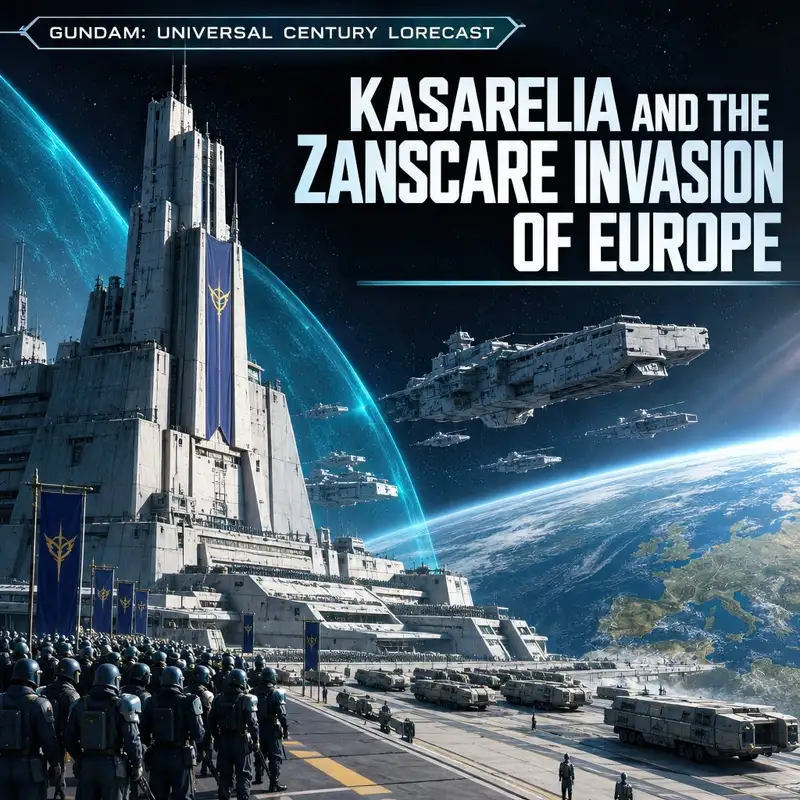
Kasarelia and the Zanscare Invasion of Europe
The forest around Point Kasarelia was not a fortified line. It had no prepared bunkers, no formal garrison, and no promise that reinforcements were on the way. It was an illegal settlement in Eastern Europe, a place where people lived beyond the clean categories of official maps and administrative control. By the time BESPA forces began bombarding the area, it had also become a hiding place for the League Militaire. Civilian vehicles, resistance personnel, concealed mobile-suit components, and the ordinary possessions of people trying to survive were forced onto the same roads. That was the immediate military problem. Zanscare did not need to capture a grand fortress. It needed to force hidden resistance assets into the open, disrupt their movement, and demonstrate that no refuge near its invasion corridor was secure.
The capture of Largane gave BESPA an important regional base. A city and its surrounding infrastructure can provide far more than a place to raise a flag. It offers access to roads, communications, storage, repair space, staging areas, and administrative leverage over the population around it. From Largane, Zanscare could push forces outward, pursue League Militaire elements, and make its presence felt across the surrounding region. Lieutenant Colonel Fuala Griffon commanded the base, making her a significant local military authority in the European campaign. That did not make her the architect of every Zanscare decision, nor did it create a fully documented continent-wide front line. It did mean that BESPA had a command node from which an expeditionary force could become an occupation force.
Kasarelia mattered because it lay within reach of this expanding Zanscare presence. It was near Uwig, within the wider area threatened by forces operating from the Largane-centered invasion effort. But it was not a capital, a major factory, or a fortress that would decide the war. Its value was more immediate and more human. It was a place where people could hide, move through the countryside, exchange information, and support one another beyond the easy reach of formal control. That made it useful to the League Militaire. It also made it dangerous once BESPA understood that resistance activity was taking place nearby.
The League Militaire presence around Kasarelia was centered on the Kamion group. The name suggests movement, and movement was its essential condition. The group was not a regular army with secure depots, permanent airfields, standardized replacements, and reliable command communications. It was a mobile network. It moved personnel, equipment, damaged machines, supplies, and information through terrain where visibility and trust mattered as much as firepower. Its vehicles and concealed facilities supported a resistance effort that had to remain dispersed in order to survive.
That dispersion was a strength. A conventional base can be mapped, observed, surrounded, and destroyed. A network of local contacts, hidden equipment, temporary repair sites, and improvised transport routes is harder to eliminate in one blow. Rural terrain gave the League Militaire concealment. Local knowledge gave it warning and mobility. Civilian support gave it food, shelter, information, and the ability to disappear into places that did not look like military installations. In a Minovsky environment, where long-range detection and communications are impaired, local initiative becomes even more valuable. Small groups can make decisions quickly because headquarters may not know enough, soon enough, to direct every action.
But irregular warfare has hard limits. Vehicles break down. Components must be moved. Mobile suits require maintenance, power, ammunition, recovery, and trained personnel. Concealment works until the enemy identifies the pattern of movement. A hidden machine is only useful if it can be assembled, fueled, launched, and supported before the enemy reaches it. A convoy that carries resistance equipment may also carry refugees and children. It cannot simply move at the speed of the most capable vehicle or abandon everyone who cannot keep up. In this kind of war, logistics are not a background matter. They define what can be saved.
Oi Nyung led the Kamion group. He was elderly, experienced, and deeply connected to the League Militaire’s political and operational life. His past as a former official in the Federation’s Maha organization is important because it shows what institutional collapse looks like at the human level. Resistance movements are not always built by people who stood entirely outside the old system. Often, they are built by people who once believed that system could function, served within it, and eventually concluded that it could no longer protect those in its care.
That experience gave Oi practical value. He understood organizations, authority, and the importance of keeping a network alive under pressure. But it also illustrates the League Militaire’s predicament. It had capable individuals and committed local groups, yet it lacked the depth of a state. It could not easily replace veteran organizers, experienced pilots, technicians, or trusted couriers. It could not assume that a lost vehicle would be replaced by the next scheduled shipment. Its communications were uncertain, its routes vulnerable, and its military assets too scarce to waste.
The League Militaire gained legitimacy because it acted where the Federation did not. For civilians facing Zanscare patrols, an irregular group willing to provide warning, transport, or defense could appear more real than a distant government that still claimed jurisdiction over the region. But legitimacy is not the same as institutional capacity. A resistance organization can earn public support and still be unable to provide secure medical care, regular training, reliable supply, or a protected childhood for the people living in its area. Kasarelia exposes that contradiction with unusual clarity. The League Militaire was necessary precisely because the old political order had failed. Yet its necessity forced civilians into proximity with combat, and it forced its leaders to make choices that a functioning state should never have demanded of a child.
The first encounter that brought Uso Ewin into this war was not a planned enlistment. It was a collision between local life, experimental military activity, and bad timing. The series presents the event through a flashback in its second episode, even though official material places it around the evening of April fifth, Universal Century one hundred fifty-three. The non-linear presentation matters only because it warns us not to treat the opening episodes as a perfectly orderly operational diary. The broad sequence is clear enough. Before the crisis at Uwig and the bombardment of Kasarelia, a Zanscare mobile suit appeared near the settlement, and Uso became involved.
Marbet Fingerhat, a League Militaire test pilot, was operating a small Core Fighter connected to the resistance’s developing Victory Gundam program. She was not simply flying a personal machine on an isolated adventure. Her presence represented the League Militaire’s attempt to turn hidden technical work into an operational capability. Opposing her was Lieutenant Chronicle Asher in a Shokew. Chronicle was Queen Maria’s younger brother, a fact that gave him political significance within Zanscare. But at this stage he was not the overall commander of the European invasion. He was a lieutenant operating on the front, testing and employing Zanscare’s military power at the local level.
The Shokew encounter had the chaos common to early contact between an invading force and an irregular defense. Neither side possessed perfect information. The terrain, the limitations of communications, and the sudden involvement of civilians all narrowed the margin for controlled action. Uso had been paragliding. He was thirteen years old, living at Kasarelia while waiting for his missing parents. He was not a commissioned pilot. He was not a trained Federation soldier. He was not the product of a normal League Militaire training pipeline.
Yet he found himself in the middle of a mobile-suit engagement and ultimately commandeered the Shokew. The event is easy to remember as the moment when an exceptional young pilot first demonstrated his ability. That is true, but it is incomplete. The more important fact is that a child’s unusual aptitude became militarily relevant because the adults around him lacked time, personnel, and control. His action emerged from confusion and emergency, not from a sound system of recruitment and training.
There is a temptation in military history to mistake improvisation for doctrine. A person performs well under impossible conditions, and later observers begin to speak as though the institution had discovered a superior method. Kasarelia offers no such lesson. Uso’s ability helped people survive an immediate crisis. It did not prove that thirteen-year-olds should be placed in cockpits. It did not solve the League Militaire’s shortage of experienced personnel. It did not make its command structure more stable. If anything, it revealed how close that structure already was to breaking point.
The Victory Gundam program must be understood in the same practical way. The Victory Gundam was not merely a powerful mobile suit waiting for a gifted pilot. It was a resistance weapon system shaped by the League Militaire’s material conditions. Its modular construction allowed components to be separated, transported, concealed, and assembled as circumstances required. That design made sense for an organization that could not safely maintain a large, obvious military base. A conventional force might shelter its mobile suits in hardened hangars, protect them with layered defenses, and maintain them through a permanent supply chain. The League Militaire needed something more adaptable.
Separating the machine’s components reduced the risk of losing everything in one strike. Parts could be moved through rural territory. They could be hidden among vehicles and temporary facilities. They could be launched or combined when an opportunity appeared. In an irregular war, that flexibility is valuable. It allows a small organization to preserve a combat capability even when it cannot hold ground. It also complicates the invader’s intelligence problem. Finding one component is not the same as destroying the whole system.
But modularity is not magic. A mobile suit broken into transportable sections still requires trained mechanics, secure storage, spare parts, fuel or propellant, weapons support, communications, and a place from which to operate. It also requires pilots who can survive combat and return to fly again. The League Militaire could disperse its equipment, but dispersion created other burdens. Components had to be brought together at the right moment. Crews had to know where they were. Vehicles had to travel on vulnerable routes. Damage could not always be repaired quickly. A design intended to avoid the enemy’s attention can become difficult to employ when the enemy is already close.
Marbet’s injury made those limitations immediate. The adult pilot linked to the system was no longer able to bear the full operational burden. The machine was present. The danger was present. The civilians who needed protection were present. And Uso was there. This is how emergency becomes coercion even without a formal order. No one needs to read a child a document of enlistment when every available adult understands that a mobile suit may be the difference between escape and destruction. The choice can still be described as voluntary. It can still be morally compromised.
The attack on Uwig brought that compromise into the open. Uwig was not simply a convenient urban arena for mobile-suit combat. It was a civilian city, with homes, shops, families, and people who had expected their ordinary lives to continue despite the instability around them. Zanscare’s assault shattered that expectation. The city burned. Streets became evacuation routes. The distinction between resident, bystander, refugee, and military objective began to collapse under the pressure of an invading force and the resistance trying to oppose it.
Uso entered the fighting because Katejina Loos was in danger. Katejina was seventeen, the daughter of a local shopkeeper, and at this point she remained a civilian caught in a war that had arrived faster than political institutions could respond. Her importance in this opening phase lies not in what she would later become, but in what she recognized immediately. She saw the danger in the League Militaire’s dependence on Uso. She objected to the use of children in combat. Her judgment was not naïve. It was a clear moral reading of the situation.
The war did not allow her observation to remain theoretical. During the chaos at Uwig, Uso helped evacuate Katejina and the infant Karlmann Ducatous. The presence of an infant matters because it strips away the usual language of military necessity. There is no serious operational category that makes a baby part of an enemy order of battle. Karlmann’s vulnerability demonstrates what city fighting does when armored forces and mobile suits enter inhabited spaces. A family may be separated in minutes. A person may be forced to flee without food, documents, medicine, or any idea of where safety lies. The military operation proceeds, but the civilian consequences remain long after the machines leave the street.
For Uso, the rescue at Uwig was still personal before it was military. He did not go into battle because he had accepted a strategic doctrine or sworn loyalty to a command. He went because someone he knew was threatened. That motive is understandable. It is also precisely why armed organizations must be careful when they rely on children. Personal loyalty, fear, and courage can place a young person in danger before any adult has made a formal decision. Once that child proves useful, the institution may begin to rely on the emergency it failed to prevent.
Uwig’s destruction changed the psychological map of the region. Kasarelia had been a place where people could still imagine themselves partly outside the war. Uwig showed that there was no reliable outside. Zanscare’s European campaign was not confined to bases and military convoys. It reached ordinary communities, producing displacement and fear that became part of the operational environment. Civilian movement could conceal resistance personnel. Resistance movement could draw enemy attention toward civilians. The invader could use that ambiguity to justify wider coercion. The result was not security. It was a population made more vulnerable to every side’s military necessity.
This is where Uso’s transition from rescuer to combatant must be examined carefully. He was not forced into a cockpit by a simple scene of adults ordering a child to fight. The coercion was structural. Marbet was injured. Zanscare mobile suits were active. Civilians were endangered. The League Militaire possessed equipment that needed a pilot. The Federation was not arriving in time with a regular formation able to take responsibility. In that environment, Uso’s choice was constrained by danger, affection, and the expectations of adults who had run out of better options.
His aptitude did not erase that fact. A child can be unusually capable and still be exploited. A young pilot can make sound tactical decisions in a moment of danger and still lack the maturity, institutional protection, and informed consent that military service demands. The Universal Century repeatedly turns young people into symbols of hope, weapons of necessity, or proof that an old order has failed. Kasarelia makes the mechanism visible. The child is not recruited because the system is healthy. He is drawn in because the system has already broken down around him.
Decentralized warfare rewards initiative. When communications are limited and units are dispersed, a person who can act quickly may save lives. That is one reason Uso’s ability becomes so valuable. But there is a darker side. If an organization begins treating exceptional improvisation as a substitute for training, command discipline, and personnel policy, desperation hardens into practice. The League Militaire had real reasons to rely on him. It faced an enemy with mobile suits, a regional base, and the freedom to choose where to apply pressure. Still, the fact that Uso could help did not make the burden appropriate.
The issue is not whether the League Militaire cared about him. Many of its members plainly did. The issue is whether care alone can overcome the military logic of scarcity. An irregular force with too few pilots will look for pilots wherever it can find them. A resistance network with wounded adults and threatened civilians will use every available asset. Once Uso had demonstrated that he could operate captured and League Militaire machines, it became harder for those around him to pretend that he was merely a civilian. The war had found a use for him, and that is often the beginning of a tragedy.
Back at Kasarelia, BESPA’s bombardment and pursuit brought all these pressures together. The immediate objective was military. Zanscare needed to locate and disrupt the League Militaire’s concealed equipment, prevent its fighters from regrouping, and deny the Kamion group a safe area from which to continue operating. Indiscriminate pressure was useful because it forced movement. A resistance network depends on concealment and local support. Once civilians, vehicles, and machinery are all compelled onto the road, the network becomes easier to observe, track, and attack.
For the League Militaire, the objective was not to defeat BESPA outright. It was to preserve the ability to exist. That meant moving people, saving vehicles, recovering what mobile-suit equipment could be carried, and preventing the destruction or capture of the small technical base that allowed the group to operate. Survival in this context was an operational achievement. A force that escapes with part of its personnel, part of its equipment, and its internal connections intact can fight again. A force that holds a position too long for symbolic reasons may lose everything.
Uso launched again to protect Shakti Kareen and to help the group escape. Shakti was more than a name on a convoy manifest. She was Uso’s childhood companion and one of the people who connected him to the life he had known before the invasion reached Kasarelia. Her danger gave the battle an immediate human meaning. But it also shows why civilian and military responsibilities had become inseparable. Protecting Shakti meant protecting the convoy. Protecting the convoy meant engaging BESPA. Engaging BESPA meant relying on the same child whose presence in combat had already troubled Katejina.
At the tactical level, Uso’s actions helped prevent immediate destruction or capture. That mattered. At the mission level, the Kamion group escaped with some portion of its people and capability intact. That mattered as well. But the broader balance did not suddenly reverse. BESPA retained the regional initiative. It still possessed the ability to pursue, apply pressure, and operate from its established base structure. The League Militaire’s survival was not the same as a victory over the invasion. It was proof that Zanscare had not yet eliminated local resistance.
The logistical outcome was equally mixed. The resistance preserved assets, but the act of moving them exposed its routes, its dependence on rural concealment, and the fragility of its support system. The Victory Gundam’s modularity gave the League Militaire options, but it did not eliminate the danger of transport. The convoy’s escape preserved a future capability, yet it also demonstrated that hidden infrastructure could no longer be assumed safe. In irregular warfare, every successful withdrawal teaches both sides something. The resistance learns where it is vulnerable. The invader learns that its opponent is more capable than expected.
That mutual learning shaped the wider European campaign. Zanscare’s forces continued to pursue League Militaire elements and to use Largane as a regional center of pressure. The resistance continued to move, conceal, reconnect, and search for ways to turn local survival into a broader defense. Neither side had solved its fundamental problem. BESPA could seize ground and intimidate communities, but it could not assume that fear would end resistance. The League Militaire could survive in fragments, but it could not simply evade a modern military force forever without secure supply, organized command, and broader political support.
Zanscare’s use of exemplary coercion became clearer as the campaign developed. Oi Nyung’s later public execution was not merely the removal of an enemy leader. It was political theater. Such an act seeks to break more than a resistance organization. It seeks to isolate that organization from the civilians who feed it, hide it, guide it, and believe that opposition remains possible. The message is directed at every person considering whether to offer a room, a vehicle, a warning, or a few hours of silence.
Terror can be tactically useful because it creates immediate fear and discourages open cooperation. It can also create long-term resistance because it reveals the character of the occupying power. Zanscare’s violence did not automatically secure political obedience. In fact, its pressure on communities like Kasarelia helped explain why the League Militaire could claim legitimacy despite its limited resources and improvised structure. People may not trust an irregular armed group completely. They may resent the danger it brings. But they may still decide that the invader offers them nothing but submission.
The intelligence consequences of Kasarelia ran in both directions. The League Militaire learned that concealment alone could not guarantee safety. A hidden settlement, a forest route, or a dispersed mobile-suit component could still be exposed once BESPA concentrated attention on the area. The resistance needed mobility, but mobility required routes. It needed civilian support, but that support exposed civilians to reprisals. It needed capable pilots, but its shortage of trained adults pushed it toward dangerous dependence on Uso.
BESPA learned that local opposition could field more than scattered rifles and improvised sabotage. The appearance of a capable resistance mobile-suit system, and a pilot able to make use of it under extraordinary circumstances, complicated the invader’s assumptions. Yet that did not mean Zanscare had lost control of the theater. It meant that the occupation would require more effort, more intelligence, and more coercion than a simple demonstration of military superiority could provide. The old lesson remained. Superior equipment can seize an opening. It cannot settle the political question of who is entitled to rule.
Kasarelia therefore matters less as a battle site than as a point of exposure. It exposes the Earth Federation’s decline in its most concrete form. Decline is not just an entry in a political history. It is a civilian settlement without dependable protection. It is a city like Uwig burning while local people try to evacuate. It is a resistance convoy forced to carry machinery and families down the same vulnerable roads. It is adults with too few resources deciding that a thirteen-year-old’s ability may be necessary for everyone else to survive.
It also exposes the character of Zanscare’s early invasion method. BESPA did not need endless numbers to generate strategic momentum. A regional base, mobile forces, political paralysis, and the calculated use of intimidation could create facts on the ground faster than the Federation could answer them. But military mobility was not political legitimacy. Zanscare could terrorize communities and still fail to win their loyalty. It could seize territory and still create the very resistance networks that made long-term control expensive and unstable.
Finally, Kasarelia exposes the necessity and danger of the League Militaire. The resistance protected people where formal institutions had failed. It preserved technical knowledge, transport capacity, local connections, and the will to oppose occupation. Those were real achievements. Yet it survived by relying on fragile machinery, scarce adults, uncertain routes, and eventually the combat ability of a child. Its moral legitimacy did not erase the cost of that reliance.
The first battles around Kasarelia were therefore not a simple story of a young pilot discovering his destiny or a new Gundam proving its strength. They were the opening evidence of a society in which political failure had reached into the home, the street, the forest, and the cockpit. The League Militaire survived the first pressure because people improvised, protected one another, and refused to accept Zanscare’s control as inevitable. But surviving the first battle was not the same as building the political order that could end the war.