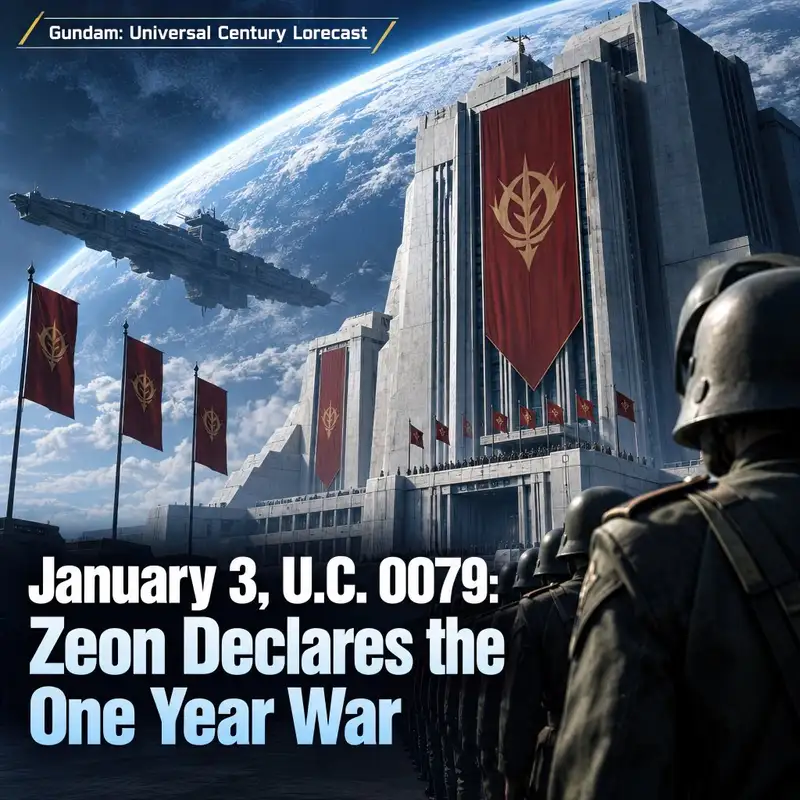
January 3, U.C. 0079: Zeon Declares the One Year War
On January third, Universal Century seventy-nine, the Principality of Zeon declared its independence from the Earth Federation. In another political setting, a declaration of independence might have opened a period of negotiation, recognition disputes, economic pressure, perhaps a border crisis. Zeon’s declaration did none of that. It was the public signal for military operations already prepared across the Earth Sphere. Federation forces and colonial regions were struck before the Federation could decide whether it faced a constitutional rupture, a limited rebellion, or a war for survival.
That distinction matters. Zeon did not merely announce that Side Three would govern itself. Its leadership immediately attempted to change the strategic balance of the entire Earth Sphere by force. The declaration claimed a political right. The offensive that followed sought a military fact so overwhelming that politics would have no choice but to accept it. The One Year War began not with diplomacy failing after an unexpected crisis, but with a state calculating that surprise was its only path to survival and independence.
This was a war Zeon believed it had to win quickly. Side Three possessed industrial capacity, a disciplined military establishment, and a population mobilized behind a powerful political identity. But it could not match the Earth Federation in the long run. The Federation commanded a wider territory, greater demographic depth, more industrial centers, more resources, and more places from which to recruit crews, build ships, repair equipment, and replace losses. A conventional war of endurance favored Earth.
That did not make Zeon weak. It made Zeon dangerous in a particular way. A smaller power that understands it cannot prevail through attrition will often seek to prevent attrition from beginning. It will concentrate its best capabilities, define ambitious objectives, and strike before the larger opponent can bring its full strength into play. Zeon had spent years developing the institutions, doctrine, and weapons required for exactly that kind of war. Its political leaders had centralized authority. Its military had trained for an opening campaign. Its industry had produced a weapon system the Federation was not prepared to meet.
The political language surrounding that preparation was inseparable from the colonial question. Many residents of the space colonies had real grievances against the Earth Federation. The Federation’s authority extended across a civilization that had moved much of humanity into orbit, yet political power remained heavily concentrated around Earth. Colonial communities could be economically important, strategically exposed, and insufficiently represented at the center of government. Zeon Zum Deikun’s earlier ideas of Spacenoid political independence drew strength from those conditions.
But the Principality of Zeon was not simply Deikun’s political movement in military uniform. Under Zabi rule, the demand for independence had become the doctrine of an authoritarian state. It possessed a government, armed services, internal hierarchy, propaganda system, and strategic ambitions of its own. The question was no longer merely whether the colonies deserved greater autonomy or representation. It was whether Zeon’s rulers could create a sovereign state through coercion, conquest, and the destruction of Federation power.
January third revealed their answer. They would not wait for the Federation’s bureaucracy to move, for its military to mobilize, or for uncertain colonial opinion to settle. They would create a crisis so severe that hesitation itself would become impossible. The declaration was therefore both ideological and operational. It addressed Zeon’s citizens, the Federation government, neutral observers, and the other colonies. It said that Side Three had separated from Earth. The attack that followed said that Zeon intended to determine the terms of that separation with fleets and mobile suits.
The Earth Sphere made such a strategy possible. It was not one battlefield with two armies standing across a frontier. Earth, the Moon, the colony Sides, military bases, transport routes, and industrial centers were distributed across vast distances. Forces could be powerful in aggregate while still being vulnerable in detail. A Federation fleet assigned to one region could not instantly reinforce another. A garrison that had not been placed on alert could not become ready merely because a warning reached headquarters. In space, movement required planning, approach geometry, propellant, time, and secure routes.
The Federation’s size created resilience, but it also created complexity. It had commitments across Earth and orbit. It had to defend population centers, bases, shipping lanes, and political institutions. It had to coordinate civilian authorities with military commands that were not necessarily equipped to respond to a simultaneous crisis. A large state can survive a great deal of damage. It can also be slow to recognize which warning deserves immediate action, especially when mobilization itself risks escalating a political confrontation into war.
Zeon’s success did not require the Federation to have known nothing about its military preparations. States rarely conceal an arms buildup perfectly. The more significant failure was one of strategic warning and readiness. Information about Zeon’s military capacity did not become a defensive posture capable of stopping the first blow. Federation leaders had not translated concern into sufficient dispersal, reinforcement, preparation, or political urgency before Zeon chose to act.
That was the advantage Zeon sought. A weaker power does not ask for a fair test of industrial endurance. It tries to make endurance irrelevant. If the Federation could be shocked, disorganized, and politically frightened before it concentrated its resources, then perhaps it could be compelled to recognize Zeon’s independence on terms favorable to Side Three. The campaign did not need to conquer every Federation territory. It needed to break the Federation’s ability or willingness to resist before the Federation’s latent strength became organized power.
The instrument that made this calculation plausible was the mobile suit. Zeon’s Zaku was not decisive because it was a famous shape or because every Federation weapon suddenly became useless. It mattered because it was part of a new system of combat. The Zaku combined maneuver, armor, weapons, sensors, and a human pilot’s ability to make rapid local decisions. In an environment where long-range control and detection were degraded, that combination gave Zeon forces a method of fighting the Federation was poorly prepared to counter.
Minovsky particles were central to that change. Their presence interfered with many forms of long-range electromagnetic detection and communications. They did not erase every sensor, silence every transmission, or make all guided weapons impossible. But they made the battlefield less transparent. Commanders could not assume that they would see enemy formations at great distance, track every contact reliably, or direct forces with the confidence expected in an earlier model of fleet warfare.
Under those conditions, visual identification, local scouting, prearranged plans, and initiative at the point of contact became more important. Mobile suits could move in ways conventional warships had not been designed to counter efficiently. They could use debris, structures, terrain, and changing approach angles. They could close the distance where a pilot’s judgment mattered more than a distant command center’s incomplete picture. Zeon had developed its forces around that reality. The Federation had not yet built an equivalent system.
The Zaku was therefore not an invincible knight in space. It required a ship to carry it to the theater, a hangar to maintain it, technicians to service it, ammunition and propellant to keep it combat capable, and trained pilots who could exploit its advantages. It worked because Zeon had prepared units, doctrine, and fleet support around mobile-suit operations before the war began. Technology mattered, but technology arrived inside an organization. A machine without trained crews, secure transport, spare parts, and an operational plan is only an expensive burden.
Zeon’s opening advantage also rested on timing. A new weapon is most dangerous before the enemy understands its tactical implications. Federation crews accustomed to conventional fleet combat faced an opponent that could appear from unexpected vectors, close rapidly, and attack in a form their existing force structure had not been organized to defeat. Initial surprise magnified the Zaku’s military value. It allowed Zeon to demonstrate the system at the moment the Federation was least ready to adapt.
The early campaign is commonly called the One Week Battle. That name is useful, provided it does not imply that the original television record provides a complete day-by-day operational history. Much of the precise chronology comes from later reference material, and different sources do not always align every action with perfect precision. What is clear is the broader pattern. In the days immediately following the declaration, Zeon launched coordinated attacks against Federation-held colonial regions, commonly identified in later records as Sides One, Two, and Four.
The target set reveals Zeon’s strategic logic. The objective was not simply to win isolated engagements. Zeon needed to disrupt Federation mobilization, damage forces before they could concentrate, frighten civilian populations, and place pressure on colonial communities whose political loyalty could not be taken for granted. A colony was a military objective only in the narrowest sense. It was also a home, an industrial center, a transport hub, a source of labor, and a political community. To threaten one was to threaten far more than a docking facility or a line on a map.
A synchronized offensive offered Zeon several advantages. It divided Federation attention. It made it difficult for commanders to determine which attacks were diversions and which were decisive. It forced local garrisons to act with limited information. It could disrupt transport and communications before a unified response emerged. In a dispersed theater, striking several places at once creates confusion beyond the damage done at any individual target. The defender must decide where to reinforce, where to withdraw, and what can be sacrificed.
That kind of operation required more than mobile suits. Zeon had to move fleets into position, gather reconnaissance, establish timing, coordinate departure and approach routes, and maintain enough communications to execute a broad plan under difficult conditions. Ships remained indispensable. They carried mobile suits, supplied them, protected them, and provided the larger framework of maneuver. The opening of the One Year War was not a collection of duels between individual machines. It was a naval and orbital operation in which mobile suits gave Zeon a powerful edge at the point of contact.
Federation forces suffered because the attack compressed their problems into a few critical days. They faced a new weapons system, uncertain intelligence, disrupted command, and attacks across more than one region. Local units could fight effectively and still be overwhelmed by the larger situation. A ship might repel one mobile-suit assault while losing contact with its formation. A garrison might hold a facility while the colony around it became untenable. A commander might identify the threat correctly but lack the forces or communications necessary to act on that understanding.
The initial results were severe. Zeon achieved local superiority and inflicted major losses on Federation forces. For a brief period, it prevented the Federation from using its larger resources as one coherent military instrument. This was the operational success at the heart of the opening offensive. Zeon demonstrated that the Federation’s apparent strength could be broken into vulnerable pieces. It proved that the Earth Sphere’s dispersed geography, once a source of Federation reach, could also be exploited against it.
But military geography carried a human cost. The same colonial dispersion that offered targets and routes to maneuver also placed civilian populations directly inside the battlespace. A space colony is not an empty station placed conveniently beside a fleet action. It is an inhabited pressure vessel on a vast scale. Its people depend on life support, food production, internal transportation, medical services, work, schools, and a delicate infrastructure that cannot simply be moved out of danger when war begins.
Damage to a colony means more than physical destruction. It can mean loss of atmosphere, collapse of civil administration, interrupted food supplies, hospital systems overwhelmed by casualties, families cut off from one another, and residents forced to decide whether to flee, hide, cooperate, resist, or simply wait for the next attack. Even when an operation does not destroy a colony, military control can turn ordinary life into a condition of fear. Ports become objectives. Industrial districts become targets. Communications networks become instruments of occupation or propaganda.
The original Mobile Suit Gundam presents the early phase of the war as a catastrophe on a nearly unimaginable scale. It states that the fighting and the use of weapons of mass destruction killed approximately half of humanity. That proportion should not be treated as a clean statistical ledger. The surviving Universal Century record does not support converting it into one universally agreed absolute number, nor should those deaths be assigned to a single day. The important fact is the scale. The opening of the war brought civilization-wide loss within days and weeks, not after years of gradual escalation.
That catastrophe exposed the central moral contradiction in Zeon’s strategy. Its leaders claimed to act for the freedom and dignity of people who lived in space. Yet their opening campaign made Spacenoid populations expendable to military objectives. Colonies became targets, occupied spaces, and instruments of coercion. The suffering of colonial civilians could be explained away as necessity only if those civilians were no longer treated as the political community Zeon claimed to defend.
This does not mean every Zeon soldier understood the war in those terms. Many personnel likely believed they were defending their homeland, securing independence, or preventing Federation domination. Soldiers act within the information, discipline, and ideology provided by their institutions. Responsibility for the war’s broad methods rested most heavily with the political and military leadership that authorized them. The distinction matters because condemning state policy does not require pretending that every person in uniform possessed equal authority or equal knowledge.
It also does not mean every colonial resident saw the Federation as a protector. Federation rule had generated resentment for real reasons. Colonial inequality, distant administration, and the concentration of power on Earth were not inventions of Zeon propaganda. But political grievance does not transform mass killing into liberation. A government can identify a genuine injustice and still choose methods that deepen the injustice, destroy the people it claims to represent, and make a stable settlement harder to achieve.
The most extreme expression of the opening strategy was Operation British. It belonged to the same logic as the surprise attacks, though it represented escalation on a far greater scale. If mobile suits and fleet operations could disrupt Federation forces, then a colony turned into a weapon might bypass conventional resistance altogether. It promised a single act that could strike command, infrastructure, population, and morale at once. It was an attempt to force a political decision through physical devastation.
The detailed sequence of Operation British is sensitive to source and adaptation. The original television record establishes the broader catastrophe of the opening war, while later accounts and retellings provide more specific operational detail. The Origin, in particular, gives an expanded account of the colony operation, named command responsibilities, chemical weapons, and the engineering required to move an inhabited colony. Those details belong to that retelling and should not be silently inserted into the original television history as though every element had been shown there.
Even without relying on a particular retelling’s details, the military logic is clear enough. A colony weapon could not be improvised in the middle of a battle. It required seizure or control of a massive inhabited structure. It required the removal, suppression, or domination of the people inside it. It required propulsion, navigation, route planning, security, and defenses against interception. It required crews and commanders willing to treat the most basic infrastructure of civilian life as a delivery system for strategic destruction.
For that reason, a colony drop cannot be described as merely throwing a rock. A colony is a constructed world. It contains homes, industrial systems, agricultural functions, life support, and human memory. Turning it into a weapon requires an institutional decision to erase the difference between a population center and ammunition. It is an act of engineering, but it is also an act of political dehumanization. The people living inside are no longer citizens, workers, families, or fellow Spacenoids. They become obstacles, collateral, or material.
From Zeon’s perspective, the attraction was obvious. The Federation’s scale was daunting because its power was dispersed across an enormous civilization. A mass-casualty strike against a central target appeared to offer a way around that problem. Rather than defeat every fleet, occupy every base, or wait for a long campaign to unfold, Zeon could attempt to destroy the political and military center that coordinated Federation resistance. Coercion would do what conventional operations might not.
But coercion is not the same as decision. A catastrophic blow can produce terror, grief, and dislocation without producing surrender. It may harden resistance. It may destroy useful infrastructure while leaving the opponent’s core institutions functioning. It may reveal the attacker’s capacity for violence without proving that the attacker can govern the world it seeks to reshape. That was the strategic failure embedded in Operation British and in the opening campaign more broadly.
Zeon inflicted immense damage, but it did not destroy the Federation’s ability to continue the war. The Federation’s command system survived. Its political structure survived. Its wider industrial base, though shaken and damaged, remained capable of mobilization. Its territory was still vast. Its population, despite horrific losses, could still support military production and recruitment. The Federation had been struck hard. It had not been removed from history.
That distinction separated operational shock from strategic victory. Zeon had won an opening advantage because it acted first, struck in several places, and fielded a mobile-suit force the Federation could not immediately answer. Yet the very success of that attack created new demands. Zeon now had to maintain tempo against an enemy that was no longer surprised. It had to replace pilots, crews, machines, ships, ammunition, and propellant. It had to protect routes and hold gains. It had to decide whether occupied populations were partners, subjects, or liabilities.
Short-war strategies are brittle. Their strength comes from concentration. Their weakness appears when the opponent survives the first blow. Once the war continues, the smaller power must keep spending resources at a pace it may not be able to sustain. It must keep its elite units effective while training replacements. It must keep advanced systems operational while dealing with combat losses and maintenance demands. It must continue to coordinate forces across distances that do not shrink merely because the opening plan succeeded.
The Federation, meanwhile, had time to adapt. It began developing and fielding responses to Zeon’s mobile-suit advantage. The later Federation Gundam project was one expression of that adaptation, but it should not be mistaken for a single machine suddenly reversing the war. The more important development was institutional learning. The Federation had to understand mobile-suit combat, create its own doctrine, organize production, train pilots and technicians, and employ its larger industrial base in a war it had not expected to fight on these terms.
The Battle of Loum followed the One Week Battle as a separate major phase of the opening war. It should not be collapsed into the initial campaign merely because both belonged to the same disastrous month. Loum further demonstrated Zeon’s ability to impose severe military losses and shape the Federation’s immediate strategic situation. But its very existence also shows that the opening week had not decided the conflict. If Zeon had compelled surrender through its first offensive, there would have been no need for the war to continue into another major fleet battle.
The early mass-casualty phase also led to restrictions associated with the Antarctic Treaty. The treaty is significant not because it made the war humane, and certainly not because it repaired the destruction already done. It did neither. It represented an attempt by the combatants to impose limits on weapons and methods that threatened the survival of the Earth Sphere itself. Nuclear, biological, and chemical weapons, along with the use of colonies as weapons, became subjects of prohibition.
The treaty was an admission of failure before it was an achievement of restraint. The parties had already demonstrated that unrestricted warfare could destroy populations and habitats on a scale that made political victory nearly meaningless. A civilization dependent on fragile colonies, orbital infrastructure, and an inhabited Earth could not treat every target as expendable indefinitely. The treaty recognized that some methods of war endangered not only the enemy but the physical and human systems on which both sides depended.
Still, a treaty cannot restore a destroyed colony, revive its inhabitants, or make survivors trust the governments that failed to protect them. It cannot erase the political conditions that produced the war. It cannot prevent leaders from seeking loopholes, developing new weapons, or shifting violence into methods that are technically permitted but still devastating. The Antarctic Treaty limited certain tools. It did not solve the struggle over colonial power, Federation authority, or the legitimacy of Zeon’s state.
This is the political failure inside Zeon’s military success. The opening offensive had two audiences. One was the Federation, which Zeon sought to intimidate and disable. The other was the broader Spacenoid population, which Zeon hoped to persuade, compel, or impress. Zeon needed to show that Side Three could challenge Earth. It needed to demonstrate competence, strength, and resolve. In those terms, the early victories had real propaganda value.
But power demonstrated through indiscriminate destruction carries a cost. It may silence opposition temporarily. It may force wavering communities to reassess what resistance will cost. It may create an image of military competence. Yet it also tells every colony that its people can be sacrificed by the very state claiming to liberate them. Fear can produce compliance, but compliance under fear is not the same as political legitimacy. A fleet can occupy a port. It cannot manufacture trust.
The Federation faced its own political crisis. Its early defeats exposed complacency, unreadiness, and the vulnerability of a government that had not resolved the grievances of its colonial population. Federation leaders could not simply point to Zeon’s atrocities and assume that their own legitimacy had been restored. A state can be the victim of aggression and still be responsible for the failures that made much of its population alienated, suspicious, or unwilling to sacrifice for it.
That is one reason the One Year War cannot be reduced to a simple morality play in either direction. Zeon’s cause drew on real political grievances, but its government turned independence into aggressive war and mass coercion. The Federation had greater resources and formal authority, but its strategic surprise reflected institutional weakness and political complacency. The suffering of civilians was not an accidental side effect of these failures. It was the place where both systems’ assumptions became most visible.
For Zeon, January third was meant to solve a strategic problem before the Federation could make that problem impossible. Delay favored Earth. A long war favored Earth. Negotiation risked exposing Zeon’s limits or dividing its political base. Surprise offered a chance to substitute concentrated force for material inferiority. Mobile suits, fleet coordination, intelligence preparation, and the Federation’s unreadiness made that gamble militarily credible.
But the gamble required Zeon to treat the Earth Sphere as something that could be shocked into submission. It assumed that damage on a colossal scale would create political obedience. It assumed that the Federation’s institutions would collapse faster than Zeon’s own resources would be consumed. It assumed that the colonies caught in the middle would accept Zeon’s leadership, or at least be too frightened to resist it. Those assumptions were not simply harsh. They were strategically unsound.
The Federation survived the opening blow. Zeon therefore entered the kind of war it had hoped to avoid, against the opponent it was least prepared to outlast. Its early technological edge remained important, but no mobile suit could replace industrial endurance. No tactical surprise could permanently eliminate the need for maintenance, replacement, training, transport, and political legitimacy. No declaration of independence could become a stable new order if the people supposedly liberated were treated as expendable terrain.
January third, Universal Century seventy-nine, was the beginning of the One Year War because Zeon chose to convert a political claim into a preplanned campaign of strategic shock. The decision was rational in the narrow military sense that delay favored the Federation. It was also disastrous in every larger sense. Zeon’s opening attack achieved surprise, inflicted enormous losses, and exposed the Federation’s unpreparedness. It did not compel surrender, destroy Federation power, or create a durable basis for independence.
The opening of the One Year War was therefore more than a sequence of successful Zeon attacks. It was an attempt to turn surprise, mobile-suit superiority, and mass destruction into a political decision before the Federation could recover. The first days proved how much damage that strategy could inflict. They did not prove that damage could be converted into a stable settlement. Colonies became battlefields, civilians became instruments of coercion, and the Federation remained intact enough to keep fighting. Zeon opened the war on favorable terms, but every day the conflict continued moved it farther from the short victory its strategy required.