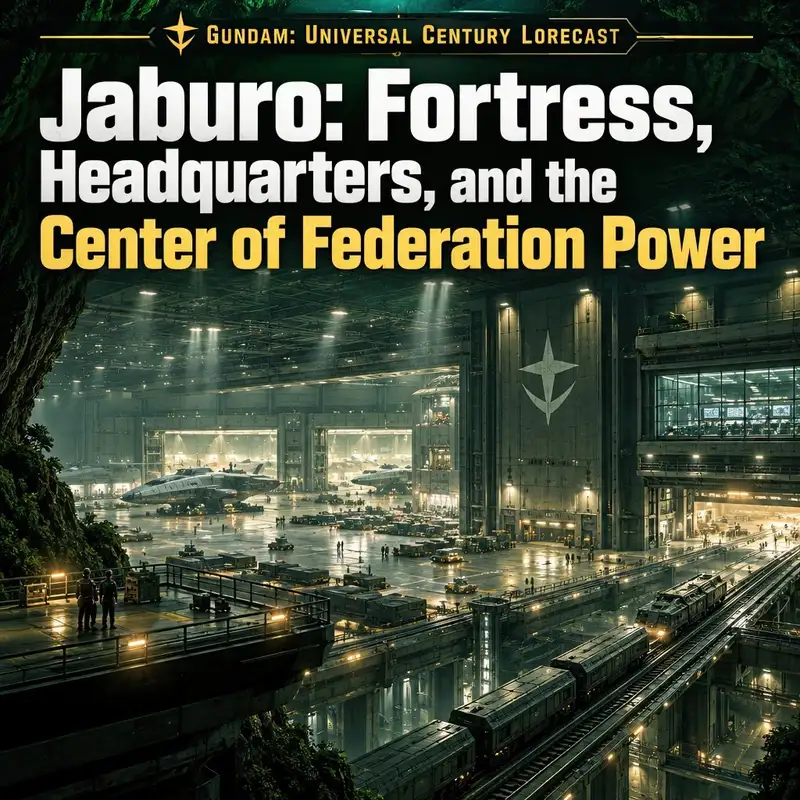
Jaburo: Fortress, Headquarters, and the Center of Federation Power
The assault force entered Jaburo expecting to find the heart of the enemy. In Universal Century eighty-seven, the Anti-Earth Union Group, or AEUG, committed itself to a dangerous attack on the old Earth Federation Forces headquarters beneath South America. The target carried enormous military and political weight. Jaburo had survived Zeon’s attempt to break it during the One Year War. It had become the image of Federation endurance, a buried command center protected by rock, concrete, secrecy, and the accumulated authority of the state that had won that war. If the AEUG could seize it, expose it, or destroy the Titans leadership believed to be inside, the raid might do more than damage a base. It might shake the political structure sustaining the Titans.
Instead, the attackers found an unsettlingly quiet fortress. Resistance was lighter than a direct assault on Jaburo should have produced. The explanation was worse than a hard fight. Major personnel and functions were already being evacuated. The defenders had not been caught asleep. They had changed the mission. Jaburo was no longer a position to hold. It was a position to deny. Deep inside the complex, the AEUG discovered that the old headquarters had been prepared for nuclear demolition. The operation ceased to be a raid for control and became a race to escape a weapon planted by the very authorities claiming to defend Federation order.
That moment captures the central problem of Jaburo. A fortress can be vital without being the entire state. A headquarters can concentrate authority without containing all of a government’s power. In Universal Century seventy-nine, Jaburo mattered because the Federation needed a protected place from which to survive, organize, and mobilize. In Universal Century eighty-seven, it could be abandoned because real power had become more dispersed, more factional, and more concerned with preserving itself than with preserving an old symbol. To understand why the bomb mattered, we have to understand why Jaburo had once been indispensable.
Jaburo was concealed beneath the South American landscape, far from the principal space battlefields where the One Year War began. Its location did not make it unreachable. Zeon proved that clearly enough. But the site imposed costs on any attacker. Forces had to approach across Earth, through difficult terrain, waterways, airspace, or underground access routes. They had to sustain themselves far from their own secure bases. And once inside, they faced a defender operating within a prepared complex whose routes, defenses, communications procedures, and emergency plans were already known to its own personnel.
The underground construction gave the Federation protection from the most obvious form of strategic attack. A headquarters on the surface could be observed, bombarded, or struck from orbit with comparatively little warning. A buried headquarters complicated all of that. Rock and reinforced structures could shelter command staff, communications equipment, workshops, storage areas, transport corridors, and military infrastructure. Concealment also mattered. In a war shaped by Minovsky particle interference, long-range electronic detection and communications could become unreliable. That did not make command impossible. It made prepared command systems more important. A force that already knew where to report, who held authority, and what to do when communications failed had a real advantage over one improvising under pressure.
Still, Jaburo was not invulnerable merely because it was underground. Underground facilities have entrances, ventilation, power systems, transit routes, water access, personnel movements, and internal chokepoints. They can be infiltrated, sabotaged, isolated, or trapped. Their very depth can make evacuation difficult when the defenders lose control. A fortress is a system, not a magic shield. Its survival depends on security, disciplined personnel, reserves, engineering, intelligence, and the ability to keep operating when part of the complex is damaged or cut off.
Its importance was not limited to senior officers sitting behind maps. Headquarters matter because wars are sustained by institutions. Someone has to receive reports, compare intelligence, assign replacements, move supplies, coordinate fleets and ground commands, direct industrial priorities, maintain records, plan operations, and preserve enough organizational memory to continue after disaster. A military that loses an individual commander may recover. A military that loses its trained staff, communications system, planning apparatus, logistical records, and industrial coordination all at once faces a much deeper crisis.
Jaburo also contained the human labor behind the Federation war effort. Technicians, mechanics, engineers, security personnel, transport crews, administrative staff, medical workers, soldiers, and factory labor all formed part of the base’s value. A command center is never just command. Orders become meaningful only when there are people and material able to carry them out. A headquarters directs forces, but it also depends on food, power, transport, repair, spare parts, ammunition, and the quiet labor of people who may never appear in a famous battle report.
The facility’s industrial role was especially important. By the later stages of Universal Century seventy-nine, the Federation was moving from emergency adaptation toward broader mobile-suit production. The RX seventy-eight two Gundam had demonstrated what advanced Federation technology could do in the hands of an exceptional crew and pilot. But a single prototype, no matter how capable, cannot equip an army. The GM program represented something more strategically important: the effort to translate technical knowledge into machines that could be built, maintained, issued, repaired, and integrated into regular units.
That was why Zeon had reason to attack. By the time of the First Battle of Jaburo, Zeon’s opening campaign had achieved spectacular destruction without producing the final political collapse its leadership needed. The Principality of Zeon had inflicted catastrophic losses early in the war. It had seized initiative, used mobile suits to disrupt Federation forces, and carried the war to Earth. Yet the Federation had not disappeared. Its government remained in being. Its armed forces retained important assets. Its industrial base, though damaged and disorganized, was too large to be dismissed. The longer the war continued, the more dangerous Federation recovery became for Zeon.
An attack on Jaburo therefore offered more than a local objective. If Zeon could penetrate the complex, kill or capture senior personnel, disrupt communications, destroy production facilities, or force the Federation to abandon its principal military headquarters, it might create a crisis out of proportion to the number of machines involved. The effect could be operational, by delaying mobilization. It could be political, by demonstrating that the Federation could not defend its own center. It could be psychological, by making a supposedly secure command structure appear penetrable and weak.
But the operation’s ambition should not be confused with its actual capacity. Zeon was not in position to conquer Earth by taking Jaburo. It did not possess the means to occupy a vast fortified complex, govern the Federation, and suppress every surviving regional command. Its Earth forces were dispersed across a global theater. They faced long supply lines, varied local conditions, and the growing problem of maintaining advanced weapons far from the industrial base that had created them. A raid against Jaburo could aim at disruption. Holding Jaburo would require a much larger and more sustainable force.
Zeon’s amphibious mobile suits gave it a practical way to attempt the raid. Waterways, river systems, and concealed approaches could help attacking forces bypass some surface defenses and exploit the fact that a buried base still needed access points. The Acguy was suited to this sort of work. Its value was not simply that it could operate in water. It offered Zeon a means of approaching through environments where conventional land formations might be easier to observe or stop. Other water-capable machines supported the broader effort. Their purpose was infiltration, mobility, and surprise, not a demonstration of aquatic engineering for its own sake.
Char Aznable led the infiltration force in the television account. He was a skilled and aggressive tactical commander, and the operation showed why Zeon had entrusted him with difficult missions. He understood that a direct, obvious assault against Jaburo’s defenses would be costly and unlikely to succeed. The infiltration route was an attempt to convert mobility and surprise into access. In that limited sense, it worked. Zeon forces entered territory the Federation had intended to protect. They brought combat into the interior of a headquarters and industrial complex. That was a real achievement.
Yet penetration is not seizure. A small force can enter a facility without possessing the strength to control it. To seize Jaburo, Zeon would have needed to hold access points, secure internal routes, prevent reinforcements from converging, control vital utilities, protect its own supply and withdrawal routes, neutralize command personnel, and either destroy or occupy the industrial areas it reached. It would also need a plan for what came after the initial shock. The attackers could not assume that one successful entry point gave them control of a vast underground system built for defense.
Their intelligence problem was just as serious. Finding a route into Jaburo demonstrated useful reconnaissance and operational imagination. It did not provide a complete picture of the base’s internal layout, security procedures, reserves, production state, or readiness. Nor could Zeon be certain that the Federation had failed to anticipate an amphibious approach. An intelligence service may identify a vulnerable seam. It cannot safely assume that the enemy has left the seam undefended merely because it looks promising on a map.
Jaburo’s defenders had not confused concealment with safety. The base was protected in depth. The television story shows a system of defense rather than an undefended bunker saved by a last-minute hero. Air defenses and perimeter forces could contest approaches. Security elements could respond inside the complex. Ground units and mobile suits could be brought into the fight. Water access had to be monitored. Passageways could channel movement, complicate navigation, and turn local knowledge into a defensive weapon. A hidden headquarters had to expect attack from more than one direction, because secrecy eventually becomes a target in itself.
The arrival of White Base added an important combat asset at a consequential time. The ship, its crew, and the Gundam were valuable because they brought combat experience acquired under extraordinary pressure. White Base had survived a long journey through contested territory, and its personnel had learned to operate in the difficult conditions of a Minovsky-era war. But it is important not to make White Base the sole explanation for Jaburo’s survival. The ship entered a defense already supported by a prepared fortress, regular Federation forces, internal security, and growing production capacity. A single capable unit can strengthen a defense. It cannot substitute for the whole institution that makes the defense possible.
Fighting inside Jaburo also created dangers beyond military loss. The facility contained sensitive infrastructure. Production areas, transport corridors, power systems, workshops, and communications spaces were not abstract targets. They were places where technicians and service personnel worked. Damage to an internal route could trap people or isolate a section. A firefight near an industrial facility could disrupt work vital to the wider war. The defenders had to defeat the intruders without destroying the very command and production system they were trying to protect. That is one of the burdens of fighting inside one’s own fortress.
Zeon’s assault reached the interior, but it could not convert that access into decisive control. The attackers were contained, suffered losses, and withdrew. In immediate combat terms, the Federation had repelled an infiltration. For the wider operation, it had preserved a major headquarters and industrial node. And at the strategic level, it had denied Zeon a chance to disrupt the Federation’s recovery at a moment when that recovery was becoming increasingly dangerous to the Principality.
The GMs visible at Jaburo carried much of that strategic meaning. The GM was not simply a smaller or lesser Gundam. It was the Federation’s basic mass-produced mobile suit, and that distinction mattered more than an individual comparison of weapons or armor. The Gundam was a high-performance prototype associated with exceptional circumstances: unusual equipment, an extraordinary crew, and a pilot whose abilities outgrew ordinary training categories. The GM represented the more difficult task of turning experience and research into a force structure.
Standardization is not glamorous, but it wins campaigns. A machine that can be produced in useful numbers, maintained by regular technicians, supplied with common parts, operated by trained pilots, and organized into units has a strategic life beyond any one battlefield. It can be replaced after combat loss. Its crews can learn common procedures. Its weapons and repair systems can be incorporated into a broader logistics network. A force built around standardized machines may not possess the singular brilliance of a famous prototype, but it can continue fighting after the prototype is gone.
Jaburo’s survival showed that the Federation had begun this transition. It did not prove that every problem had been solved. Factories require labor, materials, transport, quality control, power, security, and time. Mobile suits require pilots, mechanics, ammunition, propellant, carriers, and commanders who understand how to employ them. The Federation’s new machines still had to reach units, enter training pipelines, and operate within fleets and ground formations. But the direction of travel was clear. Zeon’s early advantage in mobile-suit warfare was no longer an exclusive advantage.
That shift helps explain why the First Battle of Jaburo mattered. Zeon had not merely failed to destroy a buried facility. It had failed to stop an opponent from converting industrial depth into military adaptation. The Federation’s response to Zeon’s first shock was beginning to take institutional form. The Gundam may have revealed possibilities. The GM program represented reproducibility. In war, reproducibility is often more consequential.
The battle’s political effect was nevertheless substantial. Jaburo had been attacked directly, and the Federation had held it. For a government recovering from the devastation of the war’s opening phase, that mattered. A state’s legitimacy in wartime is tied partly to whether it can protect its forces, maintain order, and continue functioning after being struck. The successful defense reinforced the idea that the Federation could endure. It did not resolve the grievances and inequalities that had helped make the war possible, but it prevented Zeon from turning a military penetration into a spectacle of Federation collapse.
After the One Year War, Jaburo remained a symbol of Federation military authority. The victory over the Principality preserved the Federation state, but preservation was not reform. The postwar order inherited enormous destruction, displaced populations, bitter veterans, damaged colonies, and a political system that had survived catastrophe without necessarily learning the right lessons from it. Military reconstruction proceeded alongside security fears. The Federation expanded and reorganized elements of its armed power. Out of that postwar climate emerged the Titans, a Federation military organization granted broad authority in the name of security and anti-Zeon enforcement.
The Titans were not the whole Federation, even though they exercised influence far beyond an ordinary military unit. They drew authority from Federation institutions, postwar anxiety, and the willingness of political leaders to tolerate exceptional methods. Their rise demonstrated a recurring weakness in the Universal Century. A state can defeat an external enemy and still become less accountable afterward. It can preserve its institutions while allowing those institutions to harden into instruments of repression. The headquarters that had symbolized survival in wartime could, in a different political climate, come to symbolize centralization, secrecy, and distance from the people subjected to its authority.
By Universal Century eighty-seven, the AEUG attacked Jaburo for both practical and symbolic reasons. The group opposed the Titans and the political order that enabled them. A successful blow against the historic headquarters might disrupt enemy coordination, capture important personnel or records, expose the Titans’ methods, and prove that resistance could reach the center of Federation military power. The raid was a gamble, but it was not an irrational one. Jaburo’s reputation had been built over years. It still appeared to be a target whose loss might produce consequences far beyond its physical footprint.
The operational risks were severe. An assault force entering a buried complex commits itself to constricted routes, incomplete intelligence, and difficult extraction. The attackers cannot know with certainty which corridors are blocked, which defenses remain active, where the enemy has placed reserves, or whether the route out will still be open after the mission begins. In a fortress, the defender has usually spent years deciding where movement will be easy and where it will become lethal. The AEUG had to assume that any apparent weakness might be an invitation into a trap.
That is precisely what Jaburo became. The light resistance encountered during the assault was not evidence of an undefended headquarters. It was evidence that the defenders had already decided not to fight for the facility in the old way. Important personnel and functions had been evacuated or relocated. The AEUG had planned against Jaburo’s historic role, but the target was no longer performing that role at full strength. Intelligence had failed not because the attackers knew nothing, but because their information no longer described the situation that existed when they arrived.
This distinction is important. From the audience’s perspective, it is easy to see the trap forming. For the AEUG, the facility could not safely be assumed empty until the force had entered and investigated it. A headquarters with light defenses might contain hidden leadership, classified material, or a reserve force. The possibility of a major political and military gain justified the risk. But the Titans had turned Jaburo’s reputation into a weapon. They relied on the attackers believing the base still mattered in exactly the way it had mattered eight years earlier.
The planted nuclear device changed everything. The AEUG could no longer concentrate on seizing facilities, searching for leaders, or exploiting access. Its immediate mission became survival. The demolition was a denial operation. The Titans and the authorities controlling the site would rather destroy the old headquarters than allow it to fall into enemy hands, become a source of political exposure, or serve as a platform for resistance. That decision was militarily understandable in the narrowest sense. It prevented the AEUG from occupying the base. It was also a revealing act of institutional ruthlessness.
In immediate combat terms, the AEUG escaped rather than securing Jaburo. For the wider operation, the Titans denied the facility to their opponents. At the intelligence level, the defenders exploited the difference between Jaburo’s old reputation and its current role. Politically, however, the demolition carried a cost. A regime that destroys its own historic military center rather than permit scrutiny or capture displays not confidence but insecurity. It tells observers that the preservation of institutional control matters more than the preservation of the institution’s own physical legacy.
The escape also demonstrated something the AEUG’s initial raid could not. Resistance movements do not survive on mobile-suit performance alone. The force used an older shuttle system to get clear of Jaburo and linked up with Hayato Kobayashi’s Karaba organization aboard the Audhumla. That connection mattered because Karaba provided terrestrial networks, transport, local knowledge, and political relationships. A mobile suit can fight its way through a corridor. It cannot by itself provide sanctuary, fuel, medical care, intelligence, or a route across a hostile planet.
Karaba’s role showed that the struggle against the Titans was not confined to a single ship or a single elite unit. The AEUG needed allies on Earth. It needed people able to move personnel, conceal equipment, gather information, and connect military action to a wider political opposition. Jaburo became a point of transition. The raid failed to seize the old fortress, but the attackers escaped the trap and remained part of a broader resistance network. In that sense, the Titans denied them the base but did not destroy the movement.
The two battles of Jaburo reveal how much the Federation’s condition had changed. In Universal Century seventy-nine, the Federation faced an external invader seeking to exploit a period of weakness. Jaburo’s depth, preparedness, command role, and industrial capacity made it essential to survival. Its successful defense preserved a place from which the Federation could continue organizing the war and expanding its mobile-suit forces. The fortress mattered because it concentrated capabilities the Federation urgently needed to protect.
In Universal Century eighty-seven, the threat was no longer simply an external army trying to break the Federation’s wartime command system. The conflict had become a struggle over the Federation’s own legitimacy, security apparatus, and political future. The Titans still valued the advantages of protected command and controlled information, but they no longer needed Jaburo in the same way. Practical power had shifted into a wider, more mobile, and more factional system. The old fortress remained symbolically important, but it was no longer indispensable to those making decisions elsewhere.
There is a narrow kind of resilience in that evacuation. The Titans did not allow themselves to be trapped inside a fixed headquarters. They preserved personnel and denied a valuable installation to the enemy. Yet it was resilience of a damaged institution. A healthy political order does not measure survival solely by whether its leaders escape and its enemies are denied a target. It also has to account for the people left behind, the legitimacy it destroys through its methods, and the trust it loses when it treats its own national symbols as disposable.
Jaburo therefore answers its own apparent contradiction. It mattered enormously because it concentrated command, defense, industrial recovery, and institutional confidence during the Federation’s greatest wartime crisis. Its defense in Universal Century seventy-nine helped ensure that the Federation retained the capacity to mobilize, adapt, and continue fighting. But it was never the Federation itself. By Universal Century eighty-seven, the Titans could abandon and destroy Jaburo because practical power had become more dispersed, more factional, and less accountable than the fortress it once celebrated. Hardened concrete and mobile-suit factories can preserve a military system, but they cannot preserve the political order that gives that system a reason to exist.