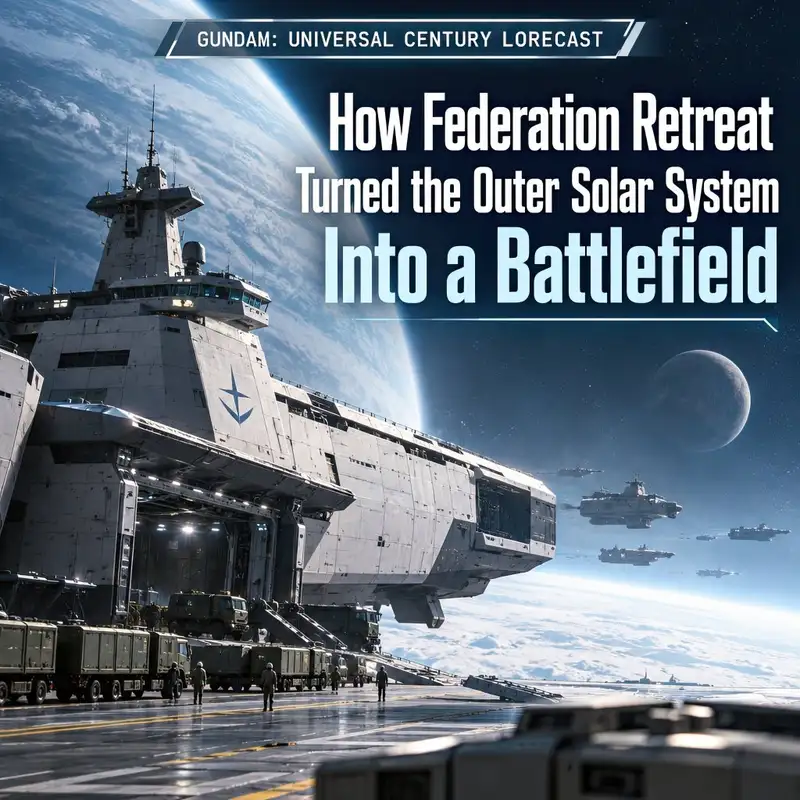
How Federation Retreat Turned the Outer Solar System Into a Battlefield
Earth depended on ships that went farther than its government could easily follow. The Jupiter Energy Fleet carried more than cargo. It carried the practical means of survival across immense distance: crews who understood long-duration operations, technicians who could keep machinery alive far from major dockyards, vessels adapted to transport and repair, and routes linking the Jupiter Sphere to the rest of human civilization. That infrastructure existed because Jupiter remained useful. Its energy resources and transport connections mattered to the Earth Sphere. Yet the same system that made Jupiter economically indispensable also made it politically dangerous. A fleet capable of sustaining commerce, settlements, and industry at that distance could sustain armed power as well.
That is the contradiction at the center of the late Universal Century. Jupiter was never simply outside the Federation’s world. It remained connected to Earth’s economy, military planning, and long-distance transport networks. But formal connection is not the same as effective government. A state may claim sovereignty over distant communities, collect the benefits of their labor, and still fail to provide representation, security, infrastructure, inspection, or rapid intervention. When that happens, distance stops being merely a geographical problem. It becomes a source of political autonomy, military opportunity, and eventually conflict.
The phrase outer solar system is useful here, but it should not be mistaken for a formal Federation theater command or a single neatly bounded frontier. It describes the Jupiter Sphere, the energy fleets that traveled to and from it, distant asteroid routes, and the settlements that depended on them. These were not empty spaces between planets. They were working environments. People lived there, maintained ships there, raised families there, moved supplies there, and depended on systems that could not fail without placing entire communities at risk.
A malfunctioning convoy, a disrupted supply route, or a damaged repair facility could have consequences far beyond a single military engagement. In a distant settlement, there may be no nearby reserve fleet, no immediate evacuation route, and no spare industrial base waiting over the horizon. Security, therefore, was not an abstract matter of flags on maps. It determined whether food, medicine, replacement parts, workers, and passengers arrived at all. A government that could not guarantee those basics invited other organizations to take over the task, whether those organizations were local authorities, commercial interests, armed escorts, pirates, resistance groups, or aspiring states.
The Federation’s later problem was not that Jupiter vanished from its strategic system. The problem was that Jupiter remained inside that system without being fully governed by it. The Federation wanted the benefits of distant development while increasingly struggling to meet the obligations that distant development created. That mismatch did not emerge through one dramatic withdrawal ceremony. No single order abandoned Jupiter. No treaty cleanly surrendered the outer system. What developed instead was an uneven contraction of authority, a gradual weakening of practical control that left formal sovereignty intact long after its credibility had begun to erode.
There were earlier signs that the Federation’s wider ambitions were narrowing. By the later decades of the Universal Century, development beyond the central Earth Sphere was no longer treated with the same confidence that had accompanied humanity’s expansion into space. Political energy, military spending, and administrative attention were repeatedly drawn back toward nearer crises. The Federation faced colonial unrest, factional struggles, military coups, remnant warfare, and the constant burden of repairing the damage caused by previous wars. Distant regions could remain important in official rhetoric and economic planning while becoming secondary in actual political priority.
This was not necessarily the result of one unified policy. The Federation was too large and too fragmented for that simple explanation. Civilian officials, military commands, corporations, local governments, and transport organizations did not all make the same choices for the same reasons. Some may have considered distant projects too expensive. Others may have assumed that commercial networks could manage themselves. Still others were occupied with more immediate threats near Earth, the Moon, and the major colony Sides. But the result was cumulative. The more often distant security was deferred, the more distant communities learned that they could not rely on timely help from the center.
A government can survive for years on the reputation of institutions it no longer maintains. The Earth Federation still possessed fleets, bases, laws, offices, and a claim to govern the wider human sphere. It was not absent everywhere, and it retained considerable power in core regions. But its ability to convert those assets into reliable preventive authority weakened. It became less capable of discovering threats before they matured, less capable of moving forces quickly enough to contain them, and less capable of persuading distant populations that Federation citizenship offered a better future than local power.
By Universal Century one hundred twenty-three, that erosion of preventive authority was visible much closer to Earth than Jupiter. Mobile Suit Gundam F91 presents a Federation that is formally immense but politically tired, vulnerable to surprise, and unable to prevent a regional military movement from attempting to turn armed action into a new state. The Crossbone Vanguard’s seizure of Frontier IV mattered for more than the immediate battle. It demonstrated that a private, highly organized force could exploit Federation weakness, strike a colony, and present itself as the armed foundation of an alternative political order.
The movement’s aristocratic ideology was not simply a costume for a military operation. It was an argument that Federation decay had created a vacuum requiring a different form of rule. That argument was deeply dangerous because it converted real frustration with Federation stagnation into a justification for hierarchy, coercion, and conquest. The Federation’s failures gave the Crossbone Vanguard an opening. They did not make aristocratic authoritarianism a remedy. Yet the movement did not need to prove that it could govern all humanity. It only needed to show that the Federation could not reliably defend a colony community against a determined challenger.
Frontier IV revealed the difference between nominal sovereignty and practical sovereignty. On paper, the colony belonged within the Federation’s political order. In practice, that order failed to deter the attack, failed to prevent its initial success, and struggled to contain the larger political consequences. Military surprise had become state formation by other means. A regional force had demonstrated that it could gather resources, build a military structure, seize infrastructure, and challenge the Federation’s claim to be the only meaningful authority in space.
That episode should not be treated as a direct prelude in which the Crossbone Vanguard of F91 simply becomes every later organization using the Crossbone name. Institutions change, names migrate, and political symbols are often inherited by groups with different purposes. But the lesson of Frontier IV remains important. If a regional movement could create such a crisis in the colony sphere, where Federation forces, population centers, and infrastructure were comparatively close at hand, then the Jupiter Sphere offered even greater room for independent development beyond routine inspection and rapid intervention.
Jupiter was not merely a distant depot at the end of a supply line. It was a strategic ecosystem. Its energy routes required ships, navigation, maintenance, communications, docking facilities, trained labor, and a chain of support extending across vast distances. The people sustaining that system were not interchangeable cargo handlers. They were engineers, mechanics, medical personnel, pilots, administrators, families, and workers whose knowledge could not be replaced quickly from Earth. Long-duration transport creates its own institutions because no expedition can depend forever on instructions and spare parts arriving from the capital.
For that reason, infrastructure matters so much in the military history of the outer system. A shipyard or repair berth can service commercial traffic, but it can also maintain patrol vessels and mobile suits. A fuel and propellant network can sustain trade, but it can also sustain armed escorts. A transport schedule can move workers and equipment, but it can also conceal the redistribution of military resources. A skilled technical workforce can support civilian machinery, then be compelled, persuaded, or paid to support military production and field repair. The line between commerce and military capacity is rarely clean at a frontier.
The Jupiter Energy Fleet represented this dual character. Publicly, it was a strategic transport and resource institution. It linked Jupiter’s value to the needs of the Earth Sphere. But institutions that operate far from close oversight develop their own habits of command, their own information networks, and their own practical authority. That does not mean every worker or crew member became part of a conspiracy. It means that a system designed to survive at distance possesses capabilities that can be captured by political ambition. Distant infrastructure is never politically neutral merely because it is described as commercial.
For the Jupiter-centered history of Mobile Suit Crossbone Gundam, that danger becomes explicit. This is print-branch material rather than animated history, and it presents Universal Century one hundred thirty-three as a moment when the Jupiter Sphere’s strategic depth could be transformed into an invasion platform. The Jupiter Empire concealed its military preparations behind the public identity of the Jupiter Energy Fleet. Distance was not merely an obstacle that the Empire had to overcome. It became a shield behind which military planning, weapons development, and political organization could proceed with reduced scrutiny.
The intelligence problem was central. Earthside authorities and outside observers could see that Jupiter mattered. They could see ships moving, cargo being transported, and economic activity continuing. What they could not easily see was the political meaning of that activity, the degree of compartmentalization behind it, or the military potential being assembled within an institution that appeared necessary to ordinary commerce. A distant transport organization can hide behind the assumption that its complexity is technical rather than political. The more remote it is, the easier it becomes for outsiders to mistake limited information for reassurance.
Minovsky-era communications conditions could complicate military command and reconnaissance, but the Jupiter problem was larger than particle interference. Physical distance delayed inspection. Fragmented authority complicated responsibility. Bureaucratic assumptions encouraged complacency. A government that had become accustomed to treating a region as a source of resources could overlook the possibility that the region was also becoming a separate political center. Intelligence failures are often described as failures to know a secret. In this case, the deeper failure was a failure to ask who controlled the infrastructure that everyone depended upon.
The Jupiter Empire did not need to match the entire Federation industrially in order to become dangerous. That would have been an unnecessary and probably impossible standard. It needed enough local capacity to repair, modify, arm, transport, and sustain a force beyond the range of immediate Federation response. It needed trained personnel, secure routes, organizational discipline, and a political leadership willing to turn economic infrastructure toward military goals. Regional military autonomy does not require equality with a great power. It requires the ability to create a problem that the great power cannot solve quickly, cheaply, or without help.
This is where the Jupiter Sphere’s strategic geography became an asset to those who sought to use it. The same distance that made reinforcement difficult also made preparation harder to observe. The same transport system that carried energy and supplies could provide cover for movement. The same technical labor that kept remote settlements alive could maintain weapons and ships. The same dispersed routes that made commerce possible could complicate surveillance and interception. Jupiter was not dangerous because it was naturally hostile. It became dangerous because essential civilian infrastructure could be reorganized into a military system under conditions of weak external oversight.
The Jupiter Empire War was not resolved by a simple demonstration that the Federation had recovered its old authority. In the Crossbone print record, the threat was checked through the actions of the Crossbone Vanguard, Federation forces, and colonial resistance. That coalition matters. It shows that the Empire could be opposed, and that distant authoritarian power was not inevitable. But it also reveals the limits of Federation recovery. A danger can be defeated by improvised cooperation without repairing the political and institutional conditions that allowed it to emerge.
Coalitions are often necessary in war. They can combine local knowledge, committed personnel, mobile forces, and political legitimacy that a central government lacks. Yet they are not a substitute for durable public authority. A resistance force may understand local conditions better than a distant fleet. A regional militia may move more quickly than a formal command. A volunteer crew may accept risks that a regular service cannot. But none of those advantages automatically provide standardized law, dependable defense, safe trade routes, medical support, accountable administration, or a stable system for resolving disputes without violence.
The suppression of one Jupiter-centered threat therefore did not settle the larger question. It prevented a particular invasion plan from succeeding. It did not remove the incentives that had made distant military autonomy possible. It did not guarantee that commercial organizations would remain politically neutral. It did not restore confidence that the Federation could identify and contain the next crisis before local actors had to organize their own defense. Tactical and operational success had not yet become institutional success.
The animated record of Universal Century one hundred fifty-three makes that broader failure impossible to ignore. Mobile Suit Victory Gundam depicts the Zanscare Empire emerging from Side Two as a regional power capable of carrying war toward Earth itself. The Federation still exists in this period. Its forces have not disappeared, and its government retains formal authority. But it cannot reliably prevent Zanscare and its military arm, BESPA, from becoming strategic actors. A state based in the colonies can organize armed power, pursue major political objectives, and threaten the center of the Earth Sphere.
Jupiter was distant from this conflict, but the governing failure was familiar. The Federation’s weakness was not confined to one route, one colony cluster, or one frontier. It was a wider problem of declining credibility. Regional organizations had learned that Federation power could be uneven, slow, compromised, or simply absent when local society needed it most. Zanscare did not arise because every colony wanted the same political order. Nor did it succeed merely because Federation officers lacked courage. It succeeded within a political environment in which central authority had become less capable of preventing regional militarization.
Victory Gundam also shows how the burden of defense shifted onto local society. The League Militaire was not a regular Federation formation with a clear chain of command extending from an effective central government. It was a heterogeneous resistance and military coalition formed under pressure. Civilians, local networks, transport groups, families, mechanics, and irregular fighters all carried responsibilities that a functioning state normally tries to organize and protect. Their participation demonstrates resilience, but it also demonstrates institutional failure. When communities must build their own armed structures to survive, the state has already surrendered much of its practical monopoly on force.
This shift imposed costs that are easy to overlook when history is told only through famous mobile suits and exceptional pilots. Local resistance requires people to move supplies through dangerous routes. It requires workshops to repair damaged machines. It requires medical workers to treat casualties. It requires civilians to decide whether to cooperate, hide, flee, or risk supporting fighters. It creates opportunities for courage, but also for coercion, reprisal, and political fragmentation. The population becomes the source of labor, intelligence, shelter, recruits, and legitimacy. It also becomes the population most exposed when military force changes hands.
The Federation’s decline did not mean that all independent action was criminal, or that every local defense organization was equivalent to piracy. That distinction matters. Communities may arm themselves because no one else will protect them. Resistance may emerge in response to occupation or authoritarian violence. Transport crews may form escorts because commercial routes have become unsafe. But once the provision of security becomes decentralized, the tools of defense can also become tools of private coercion. The same armed ship that protects a convoy can extort it. The same militia that guards a settlement can dominate it.
This is how a security vacuum becomes a military economy. Protection becomes a commodity. Route intelligence becomes a source of power. Repair yards become strategic assets. Ships become more valuable not only for what they carry, but for whom they can escort, whom they can deny passage, and which political authority they recognize. Armed groups form around trade, local government, old military stockpiles, and access to technical expertise. None of this requires every commercial organization to become a pirate fleet. It requires only enough uncertainty that security can no longer be assumed as a public service.
Mobile suits are part of this process, but they do not explain it by themselves. A mobile suit cannot sustain local warfare without carriers, maintenance crews, propellant, ammunition, spare parts, recovery systems, and trained pilots. A damaged machine must be repaired somewhere. A pilot must be fed, housed, trained, and replaced. A force that cannot maintain its equipment eventually becomes a collection of impressive wreckage. In a fragmented political environment, the organizations that can keep machines operating acquire influence far beyond their formal size.
For that reason, the later Crossbone print record does not present military decline as a simple slide from advanced machines to primitive ones. By Universal Century one hundred sixty-nine, Mobile Suit Crossbone Gundam: Dust describes a period often called the Space Warring States. That label is an analytical description of the setting’s condition, not a neat official Federation era designation. It refers to a political environment in which the Federation government’s influence has greatly diminished and colonies struggle with intensified independence movements and contests for local hegemony.
The important development is not that every colony becomes a battlefield or that all central authority vanishes overnight. The important development is that common rules no longer carry the same force across the human sphere. Colonies can treat one another as rivals rather than as members of a political order capable of settling disputes. Local powers can build armed followings around territory, resources, grievances, and control of infrastructure. The Federation’s flag may still exist, but its presence no longer guarantees that a route is secure, a treaty will be enforced, or a population can expect protection from a stronger neighbor.
Dust presents the material expression of this fragmentation in its military environment. Machines of different origins, ages, and conditions continue to appear in service. Some are repaired, salvaged, modified, or sustained through whatever local means remain available. That should not be mistaken for proof that all late Universal Century technology had become useless. Nor should it be treated as evidence that every local force was technologically backward. The more meaningful point is that standardization had broken down. A machine’s value increasingly depended on whether a community could keep it operating, not whether it represented the newest ideal in a design bureau.
That kind of warfare rewards improvisation, but improvisation is not the same as strength. A workshop able to restore one damaged mobile suit may be essential to local survival, yet it may lack the capacity to support a larger campaign. A regional power may assemble formidable weapons from mixed sources, yet struggle to train replacements or maintain ammunition supplies. A convoy may be heavily escorted on one journey and vulnerable on the next because the mechanics, fuel, or intelligence network is missing. Fragmentation produces lethal local capability without producing reliable strategic stability.
At the tactical level, local forces in the Space Warring States environment can fight fiercely and sometimes effectively. At the operational level, control of routes, docks, repair facilities, and supply points becomes decisive. At the strategic level, no authority possesses a dependable monopoly on force across the wider sphere. At the political level, competing sovereignties replace a common framework, even where the Federation’s legal claims persist. And at the civilian level, colonies become garrisons, recruiting pools, targets, bargaining chips, and contested infrastructure. Their residents are expected to live ordinary lives inside systems increasingly organized for war.
The civilian cost is not limited to direct combat. Trade disruption can produce shortages. Local conscription can pull young people into conflicts they did not choose. Armed checkpoints and convoy escorts can reshape movement, employment, and family life. Repair yards may become military objectives, making surrounding communities vulnerable. A colony that seeks neutrality may still be pressured to provide fuel, labor, docking rights, or intelligence. In a fragmented order, simply trying to keep a settlement alive can look like taking sides.
The Jupiter Sphere returns to this later history not as a distant launch platform for a single empire, but as a contested society in its own right. Crossbone Gundam: X-11 revisits Jupiter during the Dust period, while Crossbone Gundam: Zeroiwer places later material in the Jupiter region in Universal Century one hundred seventy-two. These are again print-branch accounts, and they should not be used to overwrite the animated record. But they show how the outer system’s condition had changed. Jupiter was no longer merely a remote economic support zone discussed from Earth. It had become a lived frontier with its own armed actors, local insecurity, and struggles over movement and authority.
Small-scale raiding and pirate activity matter in this context because they reveal the everyday consequences of weakened governance. A major invasion plan attracts attention. A raid on a transport route may not. Yet repeated smaller acts of coercion can be just as important to the people who depend on those routes. They determine whether workers reach a station, whether a settlement receives supplies, whether crews can travel without paying armed intermediaries, and whether local authorities are respected or ignored. Security failure is often experienced first not as a grand battle, but as the gradual loss of ordinary predictability.
It would be a mistake to collapse all Jupiter-based institutions into one lineage. The Jupiter Energy Fleet, the Jupiter Empire, later political organizations, local settlers, armed crews, and pirate formations do not become the same institution merely because they operate in the same broad region. The point is not that Jupiter developed one permanent anti-Earth identity. The point is that once central supervision became unreliable, different groups could use the region’s distance and infrastructure for very different purposes. Some sought survival. Some sought profit. Some sought local autonomy. Some sought domination.
The Federation still held significant assets during this long decline. It retained political institutions near Earth and the major colonies. It retained military units, legal claims, administrative structures, and enough prestige that local actors still had to account for it. It could not be described as simply absent from space, much less from the entire outer system. The Federation’s problem was more subtle, and more damaging. Its authority became selective. It could act in some places, at some times, under some political conditions. But it could no longer reliably make distant populations believe that assistance would arrive before local crisis became local war.
That loss of reliability affected every layer of security. Prevention weakened because inspection and intelligence were incomplete. Deterrence weakened because regional actors doubted that threats would bring immediate consequences. Representation weakened because distant communities increasingly saw decisions being made elsewhere by institutions unable to understand their conditions. Reinforcement weakened because forces had to be assembled, moved, supplied, and coordinated across a political system already under strain. Infrastructure maintenance weakened because long-term investment could always be postponed in favor of the next emergency nearer the center.
Distance alone did not cause this outcome. Jupiter had always been distant. The crucial change was political. Distance became dangerous when the Federation’s institutions no longer compensated for it. A capable state can use transport networks, communication systems, public investment, local representation, and credible defense commitments to bind far-flung communities together. An incapable or unwilling state leaves those same communities to organize security for themselves. Once armed self-help becomes normal, every dispute over resources, routes, and political authority carries the risk of becoming military.
That is how Federation retreat turned the outer solar system into a battlefield. Not through one order abandoning Jupiter, and not through the simple disappearance of Federation power, but through a widening gap between sovereignty on paper and capacity in practice. Jupiter’s distance, energy role, transport infrastructure, technical labor, and local industrial capacity gave regional actors the means to organize independently. Federation weakness gave them the opportunity. Repeated crises, from the challenge visible at Frontier IV to the rise of Zanscare and the fragmented conflicts of the later Crossbone record, taught communities that central intervention could be delayed, uneven, or dependent on improvised coalitions.
By the Space Warring States period, armed competition had become an ordinary method of settling political and economic disputes in places where no trusted authority could secure routes, protect civilians, or enforce common rules. The outer system became militarized because it remained connected to Earth’s economy while losing a secure connection to Earth’s governance.