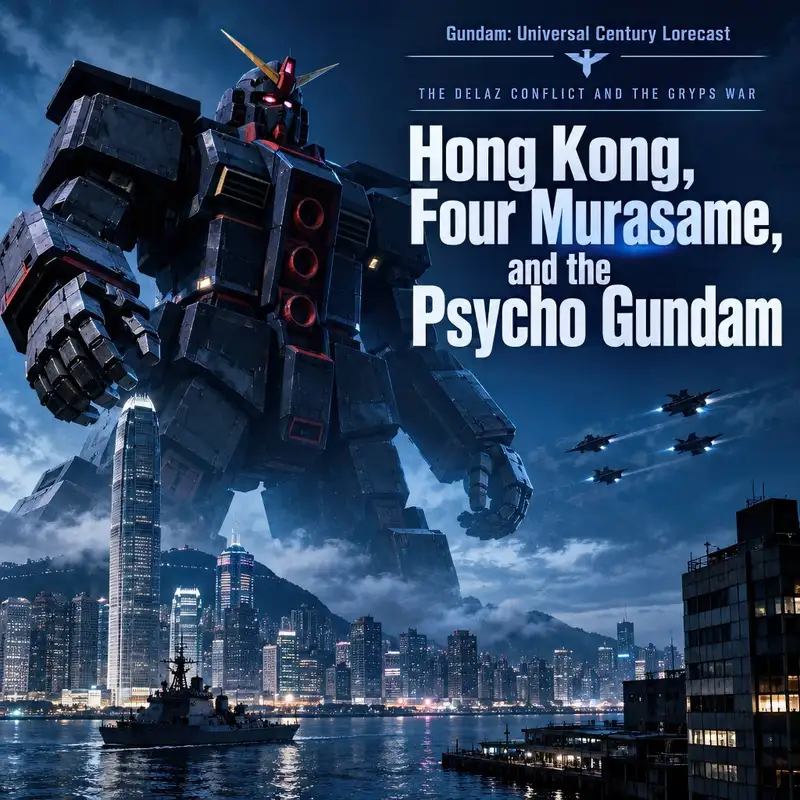
Hong Kong, Four Murasame, and the Psycho Gundam
The Audhumla came to New Hong Kong looking for the ordinary things that keep an irregular force alive. Supplies. Equipment. Access to transport. A way to move people and matériel toward the next phase of the war. It was not arriving to conquer the city. It was arriving because Karaba could not sustain an anti-Titans campaign on courage, captured weapons, and good intentions alone. It needed commercial contacts, spare equipment, fuel, maintenance, and a route back into space for people whose skills mattered there, including Kamille Bidan and Amuro Ray.
The Titans answered that logistical problem with the Psycho Gundam. A forty-meter transforming mobile armor descended into the airspace around a living city, carrying enough firepower to make streets, towers, docks, vehicles, and civilian shelters part of the battlefield. That contrast defines the Hong Kong operation. One side was trying to preserve mobility through a commercial and political network. The other possessed a weapon built to dominate local combat. Yet by the end, neither side had achieved anything resembling a clean victory.
Karaba’s position in Universal Century eighty-seven was precarious by design. It opposed the Titans on Earth, while the Anti-Earth Union Group operated primarily in space. Those two movements shared enemies and interests, but they did not possess one seamless command structure or one secure supply system. Karaba had to move men and machines across a planet increasingly shaped by Titans surveillance, military garrisons, and political intimidation. The Audhumla was therefore more than a transport. It was a moving headquarters, a mobile base, a supply problem, and a visible symbol that the Titans had not secured the Earth as thoroughly as they claimed.
New Hong Kong mattered because it was not an empty patch of terrain chosen for a duel. It was a commercial city, tied to civilian traffic, corporate access, local infrastructure, and the practical requirements of moving people between Earth and orbit. Luio and Company could provide access that Karaba could not create by itself. That did not make the company a formal military headquarters, nor did it make commerce politically innocent. It meant that resistance to the Titans depended on connections outside the conventional military chain of command.
That dependence created vulnerability. A force that needs to stop for supplies can be observed. A transport seeking specialized equipment can be tracked. People moving through a major city create patterns, contacts, and leverage points. The Titans did not need to defeat every Karaba cell across Earth. They needed to prevent the Audhumla from collecting resources, personnel, and political support at a critical moment. If they could destroy or capture it, they would damage Karaba’s ability to coordinate with the Anti-Earth Union Group and demonstrate that no city could safely assist the opposition.
Ben Wooder’s Sudori was sent to pursue that objective. Its mission was practical. Find the Audhumla. Intercept it. Prevent its escape. If possible, destroy it or compel its surrender. But the Sudori was not arriving with the forces needed to govern New Hong Kong, protect its population, or maintain lasting political order. It was conducting a punitive interception operation inside a populated city. That distinction matters, because the Titans repeatedly confused the ability to threaten a place with the ability to control it.
When conventional pursuit did not promise a quick result, the Titans turned to the Murasame Research Institute. The institute supplied something far more dangerous than another squadron of Hizacks. It supplied Four Murasame and the machine built around her. In military terms, this was an attempt to solve an operational problem through technological concentration. If ordinary forces could not reliably corner the Audhumla, then deploy a weapon powerful enough to overmatch it and mobile enough to pursue it through the atmosphere.
The Murasame program, however, had not produced a conventional pilot. It had produced a Cyber Newtype. Four Murasame was not simply a gifted young woman placed in a powerful machine. She was a test subject shaped by an institution that sought to exploit heightened sensitivity for military purposes. Her identity had been damaged, her memories were incomplete, and her service was connected to the promise that those memories might be restored. The Titans and the institute did not merely issue her orders. They held out the possibility of a self she had lost.
That arrangement was coercion, even when it was presented as treatment, training, or opportunity. A military organization can compel obedience with rank, discipline, law, pay, and punishment. The Murasame Institute depended on something more intimate. It made access to Four’s own past conditional on her usefulness as a weapon. The result was a pilot who could demonstrate extraordinary capability, but whose loyalty was neither ordinary nor secure. Her obedience rested on manipulation, dependency, fear, and the hope that compliance might return something the institution had taken or withheld.
The television record does not provide a complete and settled account of Four’s life before the institute. That uncertainty is important. It prevents her from becoming a tidy case study with one simple explanation. What is clear is the institutional pattern. Her memories are disrupted. Her emotional condition is unstable under pressure. Her Newtype sensitivity is treated as military property. And the people commanding her use the promise of recovered identity as part of the control system. The program seeks human sensitivity, but it treats the sensitive human being as equipment.
The machine assigned to her embodied that same logic. The MRX zero zero nine Psycho Gundam is often remembered because it looks, at first glance, like an enormous Gundam-shaped mobile suit. Officially, it is classified as a transforming mobile armor. That distinction is not mere catalog language. The Psycho Gundam was designed as a heavy, specialized combat system, not as an ordinary frontline mobile suit with a familiar silhouette. Its size, weapons, flight capability, and Psycommu control system placed it in a different operational category.
The machine carried multiple mega particle weapons and could transform for atmospheric movement. Its Minovsky Craft system allowed it to remain airborne for extended operations without depending on conventional aircraft support. That gave the Titans an asset capable of rapid pursuit, area denial, and overwhelming fire against large targets. Against a transport like the Audhumla, or against fixed positions near a city, the Psycho Gundam could create a problem that Karaba could not answer by simply fielding more ordinary machines.
But combat power is never only about weapons. The Psycho Gundam’s enormous size made it difficult to conceal, difficult to transport, difficult to base, and difficult to operate without specialized support. Its effectiveness depended on a unique pilot, a research institution, and a command system that could direct the weapon without pushing its operator beyond the limits of control. The Titans had concentrated mobility, firepower, and Newtype capability in a single platform. They had also concentrated risk.
A mass-production force can lose individual machines and replace them. A prototype program centered on one damaged pilot cannot absorb failure so easily. The Psycho Gundam was formidable precisely because it was exceptional. That also meant its combat value could not be separated from Four’s condition. The Titans did not possess a simple mechanical advantage that could be distributed across every unit in the field. They possessed one highly specialized mobile armor, one rare pilot, and an institution trying to make both behave predictably.
When Four attacked, the Psycho Gundam immediately changed the scale of the engagement. Karaba was no longer dealing with a conventional pursuit by the Sudori and its mobile suits. It was facing a flying mobile fortress in urban airspace. The question was not simply whether the Gundam Mark Two could defeat it. The question was whether Karaba could defend the Audhumla, protect its route of escape, and avoid turning New Hong Kong into the price of survival.
A machine of that size cannot fight around a city without making the city part of the target environment. Buildings limit lines of sight. Streets channel movement. Civilian transport becomes an obstacle, cover, or hazard. Damaged infrastructure can trap residents, block evacuation, and destroy the commercial networks that make the city politically useful. The Psycho Gundam’s weapons made it terrifying, but they did not make it precise in the political sense. Firepower that can destroy a threat can also destroy the conditions that make security meaningful.
Kamille responded in the Gundam Mark Two. On paper, the difference in scale was obvious. The Mark Two was a mobile suit operating against a giant mobile armor with superior firepower and atmospheric mobility. But the encounter did not remain a straightforward comparison of machines. Kamille and Four made contact through their Newtype sensitivity. The series presents this as an extraordinary experience of perception and emotional awareness, not as a clean exchange of tactical data. Neither pilot simply reads the other’s mind. Neither gains a complete answer to the battle. But the encounter disrupts the categories through which the Titans intend to fight.
Four is supposed to see Karaba as an enemy. Kamille is supposed to see the Psycho Gundam as a target. Their contact makes that impossible to sustain without strain. Kamille recognizes that there is a person inside the machine, and that the person is suffering under conditions he cannot fully understand. Four encounters someone who responds to her as more than a research subject or weapons operator. In a war built around command categories, unit assignments, and political labels, that recognition matters.
It does not solve the battle. It does not neutralize the Psycho Gundam. It does not turn Four into a free agent capable of walking away from the Titans. Newtype contact is not moral enlightenment, and it is not an automatic cure for trauma or conditioning. What it changes is decision-making. Kamille cannot treat the machine as an impersonal threat once he understands something of the pilot inside it. Four cannot entirely reduce Kamille to a target once she recognizes a connection that the institute cannot explain away.
Others sense that something unusual is happening. Amuro Ray, present with Karaba, recognizes the significance of the encounter without possessing a complete explanation for it. Mirai Noa, whose experience in the One Year War has made her sensitive to the human costs hidden behind military operations, also perceives that the engagement involves more than ordinary combat. Their awareness is important because it shows that Four’s condition is not visible only to Kamille. The Murasame Institute may classify her as a test subject, but people outside that system can recognize the damage in its results.
That recognition carries military consequences. An enemy force that assumes its special weapon will obey as a machine obeys has misunderstood the nature of the weapon. Four is not a missile. She is not a remote-controlled system. She is a person whose reactions, memories, fear, anger, and attachment shape how the Psycho Gundam is used. The Titans can command the Sudori. They can issue orders to conventional pilots. They cannot fully command the emotional reality that sits at the center of their Cyber Newtype program.
Four’s later civilian encounter with Kamille exposes this weakness even more clearly. Away from the immediate cockpit environment, she is not simply the operator of a giant mobile armor. She is a young woman trying to understand who she is and why fragments of the past feel inaccessible. Kamille meets her without the immediate clarity of opposing uniforms and weapons. Their connection develops not because the war disappears, but because the war’s institutional language proves inadequate to explain what Four has become.
The Titans’ leverage over her becomes visible in that gap. They promise the return of memory, or at least the possibility of it, in exchange for continued service. That promise gives the program power, but it also reveals its insecurity. A system confident in its legitimacy does not need to bargain with its own pilot through withheld identity. A command structure confident in its methods does not depend on making a damaged young woman believe that obedience is the price of becoming whole.
This is the central contradiction of Cyber Newtype warfare. The research institute wants a pilot capable of perceiving beyond ordinary limits. It needs sensitivity, intuition, and an ability to connect with a Psycommu system at extraordinary intensity. But the institution also wants obedience. It wants predictable mission performance. It wants the pilot’s inner life to remain subordinate to the requirements of the weapon. Those goals are in tension. The more the program depends on the individual’s mind, the less it can safely treat that individual as interchangeable equipment.
Ben Wooder responds to this uncertainty not by reducing the pressure on the city, but by escalating it. His forces capture Mirai and her children. This is not a side incident. It transforms the operation. Until that point, the Titans are pursuing an armed transport and attempting to break a resistance force. By taking civilians connected to Amuro and Karaba, Wooder turns personal relationships into instruments of military coercion. He demonstrates an intelligence success. The Titans know where pressure can be applied.
They understand that Mirai is not merely a civilian bystander. She is connected to Amuro through the shared history of the White Base crew, and her family gives the threat immediate emotional force. In a more conventional military problem, the Titans might have sought to isolate the Audhumla, deny it resupply, and force it into an unfavorable engagement. Wooder instead seeks to compel surrender by holding people hostage and threatening the city around them.
Amuro offers himself in exchange. That decision reflects personal loyalty and responsibility, not a simple tactical calculation. He is a veteran whose name and experience carry weight, but he is also a man confronted by the danger facing people he once served beside. The offer does not resolve the crisis because hostage operations are rarely stable bargaining arrangements. Once a commander relies on coercion, every concession creates new questions. Will the captor honor the exchange? Will the threatened force surrender? Will local allies accept the humiliation? Will the public see security, or will it see extortion backed by military power?
Wooder’s strategy also demonstrates the limits of intelligence. He knows enough to identify a vulnerability. He does not know enough to predict every response. He does not fully control the emotional bonds among the people involved. He does not control Four’s developing connection to Kamille. He does not control the wider political effect of threatening a major city. Intelligence can identify pressure points. It cannot guarantee that coercion will produce the desired political result.
The hostage operation deepens the Titans’ legitimacy problem. The Titans justify their existence through the language of security, order, and the suppression of dangerous opposition. Yet in New Hong Kong, their methods endanger civilians, place children at risk, and make an urban population subject to the requirements of a military pursuit. The distinction between counterinsurgency and collective punishment begins to collapse. A force may claim that it is restoring order, but residents judge it by what happens to their streets, homes, families, and ability to live without becoming leverage in someone else’s operation.
Karaba and its allies cannot answer the Titans with equal firepower. They do not possess a Psycho Gundam. They do not command the city as an established government. Their advantage lies elsewhere. They have local relationships, personal knowledge, flexibility, and the willingness to improvise when central control breaks down. Under Minovsky conditions, communications are never as certain as staff maps suggest. Orders do not always move quickly. Units lose contact. Individuals make decisions based on limited information and immediate trust.
That environment favors neither side automatically. It punishes rigid plans. The Titans possess more formal authority and more destructive equipment, but their operation depends on coordinating a warship, conventional mobile suits, a research asset, hostages, and a giant mobile armor in a crowded political environment. Each new layer creates another point of failure. Karaba, by contrast, survives through decentralization. It cannot impose total control, but it can exploit opportunities that appear too quickly for a centralized coercive system to manage cleanly.
The rescue effort is therefore not simply an act of heroism. It is an example of how irregular forces preserve initiative. Personal ties, rapid adaptation, and knowledge of who can be trusted matter as much as formal firepower. The Titans can seize hostages, but they cannot fully map every relationship that connects Karaba, the Anti-Earth Union Group, commercial actors, and civilians opposed to Titans rule. The more Wooder expands the operation through coercion, the more people he gives a reason to resist him.
This does not mean Karaba is operating without risk or cost. Improvisation can fail. Informal networks can be penetrated. A resistance force that depends on personal loyalty can be vulnerable to loss, exhaustion, and political fracture. But in New Hong Kong, flexibility becomes a survival mechanism. Karaba does not defeat the Titans in a pitched battle. It prevents them from turning a tactical advantage into a decisive political result.
As the Audhumla prepares to leave, the crisis returns to the Psycho Gundam. Wooder attempts to employ the machine directly, seeking the decisive destruction or capture that has so far escaped him. From a narrow operational view, the choice is understandable. The Audhumla remains the central objective. It is still moving. It still contains personnel the Titans want to deny to the Anti-Earth Union Group. The giant mobile armor remains the strongest weapon available in the immediate theater.
But the attempt exposes the same command failure that has defined the entire operation. Wooder can direct the mission. He cannot simply command Four’s inner life out of existence. Four reasserts control over the Psycho Gundam. Her actions create an opening for Kamille and the others to escape. This is not a clean defection, and it is not the destruction of the Murasame system. It is a constrained act of agency by someone still trapped within the institution that has shaped and damaged her.
Kamille’s response is also constrained. He has every military reason to treat the Psycho Gundam as a deadly threat. The machine can destroy the Audhumla, devastate its surroundings, and kill the people he is trying to protect. Yet he tries to reach Four rather than simply reduce the problem to the destruction of an enemy mobile armor. That choice carries tactical danger. It also reflects the reality that a weapon built around a person cannot be understood solely through target data and fire-control solutions.
The fighting again places New Hong Kong at risk. The city has not become safer because Four’s agency has emerged. A machine of the Psycho Gundam’s scale remains hazardous in urban airspace regardless of who is trying to control it. The damage already done cannot be erased by one moment of hesitation or one decision to help an enemy escape. The city’s residents remain caught between a Titans pursuit operation, Karaba’s need to preserve its force, and a specialized weapon system too destructive to use cleanly around civilian infrastructure.
The Audhumla’s escape does not end its logistical crisis. It merely preserves the possibility of solving it elsewhere. Karaba still needs a route toward space. It still needs transportation arrangements, equipment, and coordination with forces beyond Earth. The problems connected to New Guinea and the available shuttle route show that operational movement is not a cinematic convenience. A force cannot simply decide to return to orbit and expect the necessary vehicles, access, fuel, maintenance, and launch arrangements to appear on command.
For that reason, the Audhumla’s survival matters. It keeps Karaba in the war. It preserves experienced personnel, a mobile command platform, and a link between the Earth-based resistance and the wider anti-Titans struggle. That is an operational success. The Titans fail to destroy or seize the transport. They fail to prevent the movement of people and resources needed by their opponents. They fail to make their overwhelming local weapon produce a decisive result.
But escape is not liberation. Karaba does not secure New Hong Kong permanently. It does not remove Titans influence from the city. It does not protect every civilian harmed or threatened during the operation. It does not dismantle the Murasame Research Institute. It does not free Four from the system that still claims authority over her body, memories, and military use. The Audhumla escapes because it can move. The city remains exposed because it cannot.
That difference is the moral and political center of the operation. Military histories often focus on the escaping ship, the giant weapon, or the famous pilots. Those are important, but they can obscure the larger result. The Titans use New Hong Kong as a pressure point because it is inhabited, economically valuable, and connected to the networks Karaba needs. The city’s population is not incidental to the battle. Its vulnerability is the reason the battle can be fought in this form.
Four Murasame stands at the center of that contradiction. She is neither a simple Titans loyalist nor a magically liberated victim. She is a person whose identity has been made into a battlefield. The Murasame program seeks to own her sensitivity. Ben Wooder seeks to use her power. Kamille seeks to reach the person buried beneath those demands. Her brief act of agency matters because it shows that the Titans’ most advanced weapon cannot be reduced to the orders given to it.
Hong Kong reveals the weakness of the Titans’ Cyber Newtype project with unusual clarity. It can produce terrifying local combat power, but it cannot create reliable loyalty, political legitimacy, or lasting control. The Psycho Gundam nearly destroys Karaba’s escape route, yet its use exposes the Titans’ willingness to endanger civilians and consume a damaged young woman as military equipment. The Audhumla survives, but New Hong Kong pays the price, and Four’s moment of agency remains constrained by the institution that still claims ownership of her identity.