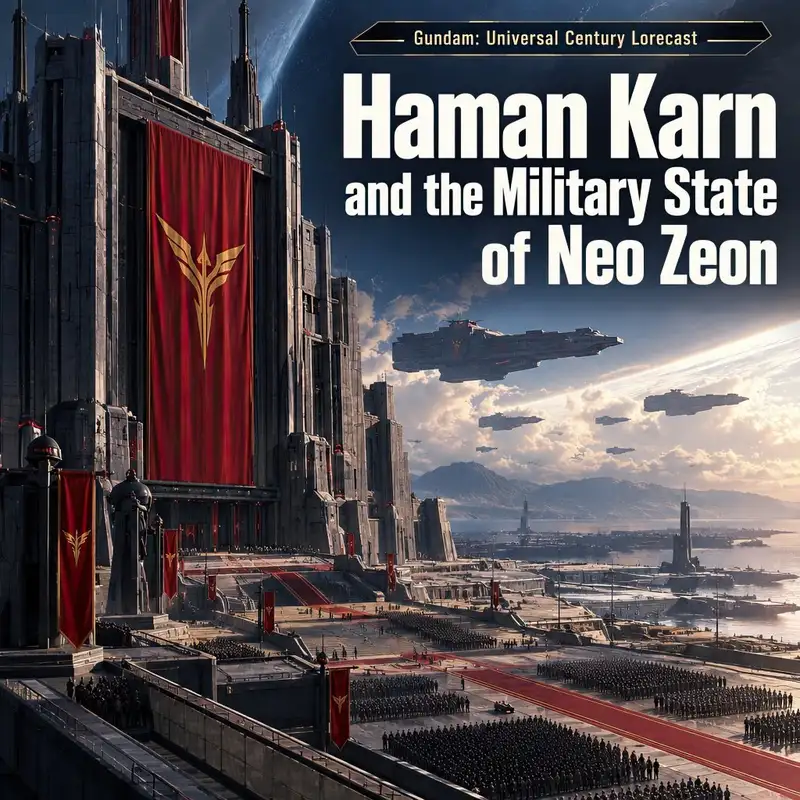
Haman Karn and the Military State of Neo Zeon
On October thirty-first, Universal Century eighty-eight, Neo Zeon turned a colony into a political weapon over Dublin. The operation was not simply an act of destruction, and it was not a conventional effort to seize terrain. Haman Karn did not need to defeat the Earth Federation in every ocean, city, orbit, and colony cluster. She needed to demonstrate something more immediate and more frightening. The Federation government could not guarantee the safety of the people under its authority. Once that fact had been made visible, fear could do the rest of the diplomatic work.
Dublin mattered because people lived there. Its homes, transport systems, public institutions, and civilian population were not incidental damage around a military target. They were the target of coercion. Neo Zeon used mass civilian vulnerability to force a political settlement, one that included the transfer of Side Three. That was the central method of Haman’s regime. It combined mobile military power, inherited Zeon symbolism, elite technology, and calculated terror to make a larger opponent concede what Neo Zeon could not simply administer by force.
Calling Neo Zeon a military state is an analytical description, not a formal title used in its own constitutional documents. The television record does not offer a detailed account of ministries, elections, courts, taxation, or civilian administration. What it does show is a political order in which authority flowed chiefly through military command, personal loyalty, armed mobility, and the symbolic authority of the Zabi family. Haman’s government could move fleets, occupy a political center, direct advanced weapons programs, and impose terms on the Federation. It could do all of that without showing the deeper institutions needed to turn obedience under pressure into stable political consent.
Dublin was therefore not an aberration from Haman’s rule. It was its clearest statement of purpose. Neo Zeon’s strength was real. So was its political weakness. The regime could make its enemies yield, but it could not escape the question that haunted every government claiming the Zeon legacy. Who possessed the right to rule the people of the colonies, and what did that right mean when it was enforced by warships, mobile suits, and a falling colony?
Haman’s answer began with Axis. During the Gryps Conflict, Axis entered the Earth Sphere as an armed remnant with resources, personnel, and political ambitions of its own. It was not merely another combat unit in the struggle between the Titans and the Anti-Earth Union Group. Haman intervened in that conflict while preserving her own strength. She understood that the war between the Titans and the Anti-Earth Union Group was exhausting both sides, and that an outside force could gain far more by surviving the contest than by spending itself in somebody else’s victory.
By that point, Haman was already the practical leader of Axis and the regent for Mineva Lao Zabi. Mineva’s ancestry gave Axis access to the emotional and political weight of the Zabi name. Haman provided the command ability, discipline, and strategic calculation that a child could not. This arrangement was useful, but it contained a permanent contradiction. The state claimed continuity with the old Zeon order through Mineva, while its actual direction came from a regent whose power rested on military command and personal authority.
Official reference chronology places the adoption of the name Neo Zeon on February twenty-ninth, Universal Century eighty-eight, after Axis absorbed the military strength of the Republic of Zeon. The exact day comes from later official reference material rather than a calendar displayed in the television series, but the broader transition is clear. Axis ceased to be simply an isolated asteroid-based remnant. It became Neo Zeon, a regime claiming a larger historical role in the Earth Sphere and inheriting both military resources and the burden of Zeon’s past.
That inheritance included more than ships and mobile suits. Axis possessed experienced personnel, a mobile fleet, technical expertise, and an established political image. It also possessed the memory of Zeon’s defeat, the scattered loyalties of former Zeon soldiers, and the unresolved grievance of people who believed the Federation’s victory had restored order without solving colonial inequality. Haman did not create those conditions. She made them usable. She took an armed remnant and gave it a political objective broad enough to attract followers, intimidate opponents, and justify expansion.
The Zabi name was central to that effort. Mineva Lao Zabi was not the actual architect of Neo Zeon policy during the First Neo Zeon War. She was young, protected, and politically managed. Her importance was symbolic. In a movement built on claims of historical restoration, lineage could stand in for continuity. Mineva allowed Neo Zeon to present itself not merely as a surviving force from Axis, but as the heir to a lost political order. Her presence gave military power a dynastic frame.
Haman’s position was more complicated. She was not simply a caretaker waiting for Mineva to come of age. She was the effective ruler. She directed military operations, managed senior officers, employed political pressure, and determined how Neo Zeon would use its strength. Her authority drew on several sources at once. She had personal command presence, demonstrated military competence, a reputation enhanced by her Newtype ability, and control over the public symbolism attached to Mineva. Those sources made her formidable. They did not make her rule institutionally secure.
The series does not present Haman as pursuing a fully detailed civilian program for colonial representation, economic reform, or constitutional government. Her aims are broader and less transparent than a simple restoration of the Zabi family, but her methods are unmistakable. She seeks power for Neo Zeon, leverage over the Federation, and the reassertion of a Zeon-centered order. The problem was that Neo Zeon’s claim to legitimacy depended on a hereditary symbol, while its actual authority depended on a regent commanding an elite military organization.
That gap mattered. A dynasty can provide a succession principle, at least in theory. A military commander can provide immediate direction. But when the dynasty is represented by a child and the commander governs in her name, every ambitious subordinate has reason to ask where legitimate authority really resides. Is loyalty owed to Mineva, to Haman, to the memory of the Zabis, or to whichever commander can seize the military means of rule? Haman could suppress that question while she remained dominant. She could not make it disappear.
Her practical answer was to make military effectiveness itself a form of legitimacy. Neo Zeon would demonstrate that it could act where the Federation hesitated, strike where the Anti-Earth Union Group was weak, and impose decisions that exhausted opponents could not prevent. In that sense, Haman’s state did not rest on a public mandate. It rested on proof of capacity. It would rule because it could move forces, defeat rivals, seize strategic positions, and make resistance look futile.
The timing was favorable. The Gryps Conflict had left the Anti-Earth Union Group badly weakened. Its surviving forces retained skill, experience, and political importance, but they had lost leaders, personnel, equipment, and cohesion. Kamille Bidan was incapacitated. The Argama remained active, but it was operating with severe limits in manpower and readiness. Bright Noa and the people around him represented a dangerous surviving core, not a restored military establishment capable of independently stabilizing the Earth Sphere.
The Federation, meanwhile, had survived the Titans without emerging healthy from the experience. The destruction and political shock of the conflict had not created a unified, alert, and confident government. It had created exhaustion, caution, and uncertainty. That did not mean the Federation lacked resources. It remained vastly larger than Neo Zeon in population, territory, and potential industry. But large institutions can be slow to recognize danger, particularly when they have just emerged from a crisis and are reluctant to commit themselves to another war.
Haman exploited a vacuum, not an empty battlefield. The Federation still had armed forces. The Anti-Earth Union Group still had capable personnel. Local commanders, colonies, and political factions still possessed their own interests. But Neo Zeon could choose where to concentrate strength. It could force its opponents to respond to threats spread across space and Earth, while avoiding the kind of prolonged, evenly matched campaign that would expose its own limits in manpower and production.
The Endra and its commander, Mashymre Cello, illustrate this method. Mashymre’s force could pursue the Argama, pressure colonies, and act as a local expression of Neo Zeon authority. A cruiser in this environment was not merely a platform for firing weapons. It was a mobile headquarters, transport, repair facility, supply base, communications node, and launch platform. It carried the means to move armed power into a region where Neo Zeon might have little permanent administrative presence.
That mattered more than any single mobile suit’s specifications. A high-performance machine without fuel, maintenance, ammunition, trained pilots, recovery capability, and a ship to transport it is a brief tactical event. A cruiser force could sustain repeated operations. It could launch patrols, recover damaged machines, transfer personnel, intimidate local authorities, and keep a commander connected to the wider hierarchy. Neo Zeon’s early campaigns depended on this kind of fleet mobility.
But mobility also encouraged a command culture built around individual officers. The regime needed aggressive local commanders because Haman could not personally direct every encounter across the Earth Sphere. Those commanders needed discretion. They had to make decisions under Minovsky conditions, incomplete communications, and the pressure of operating far from the center of power. Yet every capable subordinate with independent ships, armed followers, and political ambition also represented a potential challenge to the ruler.
Mashymre’s career shows the tension. He was enthusiastic, personally loyal, and willing to pursue Haman’s objectives with considerable energy. But he was also impulsive and vulnerable to failure. Neo Zeon could use devotion like his, but it could not entirely trust it. Chara Soon was sent to monitor him. That assignment reveals a great deal about the structure of Haman’s government. Surveillance was not simply an intelligence function directed outward at the Federation or the Anti-Earth Union Group. It was also necessary inside Neo Zeon’s own command system.
In a more durable institution, commanders might be checked by clear chains of authority, professional standards, civilian oversight, established promotion systems, and accepted procedures for replacing failure. Neo Zeon had hierarchy, but much of its hierarchy was personal. Haman rewarded, redirected, watched, and disciplined subordinates through patronage and direct control. This could be effective in a crisis. It could also produce insecurity, rivalry, and a constant need to prove loyalty.
The later treatment of Mashymre and Chara makes the cost of that system even clearer. Both become subjects of enhancement measures intended to make them more useful as military assets. The series does not provide a complete technical account of every procedure or institution involved, and it would be a mistake to invent one. But the political meaning is plain enough. When ordinary loyalty, training, and command discipline seemed insufficient, Neo Zeon turned to more coercive means of shaping personnel.
This was not merely a matter of ambitious officers receiving better equipment. It was part of a larger pattern in which people were treated as resources to be optimized for war. The state valued Newtype potential, psycommu compatibility, physical endurance, obedience, and combat performance. It did not treat those qualities as belonging to citizens with independent rights. It treated them as military capital. That approach could produce terrifying local capability. It also made human beings vulnerable to abuse, manipulation, and disposal.
Neo Zeon’s advanced mobile suits reflected a similar mixture of real capability and structural limitation. Haman’s Qubeley was an elite Newtype-use machine whose psycommu weapons expanded the geometry of combat. The Baw, Doven Wolf, Quin Mantha, and other advanced systems showed that Neo Zeon retained serious technical resources. They were not decorative evidence of a fading remnant. They represented design knowledge, specialized manufacturing, maintenance skill, and a willingness to invest heavily in selected units and pilots.
Yet these machines were not proof that every Neo Zeon formation enjoyed equal quality. A high-performance mobile suit is not the same thing as a standardized force structure. It may require exceptional pilots, specialized parts, more complex maintenance, and a supply chain that cannot be replicated across an entire military. Neo Zeon could concentrate advanced systems where they mattered most. It could not automatically translate those systems into Federation-scale production, replacement capacity, or territorial administration.
This was the persistent problem facing Haman’s regime. Axis-derived industry gave Neo Zeon a qualitative edge in selected areas, but it did not erase the Federation’s deeper material advantages. The Federation could draw on a far larger population, a larger industrial base, and access to multiple regions of the Earth Sphere. Its weakness in Universal Century eighty-eight was not the absence of resources. It was the inability to organize those resources quickly and decisively after the Gryps Conflict.
Newtype and Cyber Newtype programs offered Haman another way to compensate for scale. A compatible pilot using psycommu equipment could perform tasks that ordinary systems could not easily reproduce. Remote weapons could attack from multiple directions. Heightened awareness could improve reaction time, spatial judgment, and the ability to operate in confusing combat conditions. These were genuine military advantages when the pilot, machine, and tactical situation aligned.
But Neo Zeon’s use of such people was also an institutional failure. Ple and Ple Two were not simply gifted pilots added to an order of battle. They were products of a system that treated vulnerable young people, conditioning, identity, and Newtype potential as instruments of state power. Their value to commanders was inseparable from the coercion surrounding them. The regime attempted to turn extraordinary human capacity into a controlled military resource.
That effort had limits. Newtype ability was not a standardized weapon system. It did not create automatic obedience, moral insight, or reliable political loyalty. Cyber Newtypes and enhanced personnel could be powerful, but they were also subject to trauma, manipulation, instability, and competing command relationships. A state that concentrates too much combat power in rare and controlled individuals gains a sharp instrument. It also becomes dependent on programs that are difficult to replace, ethically indefensible, and vulnerable to internal seizure.
Glemy Toto understood that vulnerability. His later rebellion would draw strength not only from claims about succession, but also from access to specialized personnel and advanced weapons. That was one of the dangers of Neo Zeon’s elite military culture. The same high-value assets created to strengthen Haman’s authority could become the foundation for a rival authority if command loyalty fractured.
Before that fracture became open rebellion, Haman carried the war to Earth. Official chronology places the beginning of Neo Zeon’s ground invasion in August of Universal Century eighty-eight, with the seizure of Dakar later that month. Dakar was not just another objective on a map. It was political geography. Its occupation demonstrated that Neo Zeon could place armed forces on Earth and threaten the visible center of Federation government.
A force that can descend from space, establish itself in a major city, sustain mobile suits under gravity, and maintain communications with its ships has solved real operational problems. It requires transport, planning, ground support, maintenance, medical care, local security, and command arrangements that extend beyond a single dramatic landing. Neo Zeon’s Earth operation therefore showed competence. It was more than a raid by isolated aces.
At the same time, Dakar exposed the limits of what Neo Zeon could achieve. Occupying a city is not the same as controlling a continent, much less governing Earth. A mobile invasion force can seize political symbols and force a government into crisis. It cannot indefinitely police every road, administer every population, protect every supply route, and replace losses across a planet unless it has the manpower, local support, and bureaucratic depth to do so. The series does not show Neo Zeon possessing that kind of durable terrestrial apparatus.
Haman’s strategy did not require it. She was not trying to build a conventional occupation of Earth by gradual territorial administration. She was using the Earth invasion to alter political calculations. Dakar showed that the Federation was exposed. It made the possibility of escalation credible. It also demonstrated that Neo Zeon could choose targets whose political meaning exceeded their immediate military value.
The operation had several results, and they must be kept separate. Tactically, it achieved destructive effect on a catastrophic scale. Operationally, it demonstrated that Neo Zeon could prepare and execute an escalation beyond the reach of a normal mobile-suit engagement. It showed that Haman’s forces could threaten the Federation with forms of violence that could not be answered simply by winning a local battle.
Strategically, Dublin helped compel the Federation to accept the transfer of Side Three. That was a major political objective. Side Three was not merely a geographic prize. It carried the symbolic center of Zeon’s historical identity, the memory of the Republic and Principality, and the claim that the people of the colonies could form a political community independent of Earth’s rule. Recovering it allowed Haman to present Neo Zeon as more than a refugee force operating from Axis.
But the transfer did not establish a just or durable settlement. The Federation’s concession reflected fear, exhaustion, and the threat of further escalation. It was a coerced political decision, not evidence that Neo Zeon had gained broad consent. Haman had demonstrated that the Federation could be forced to surrender a major objective. She had not demonstrated that the people affected by the settlement had chosen her rule, trusted her institutions, or accepted the methods by which she had obtained it.
The civilian and moral consequences are central here. Neo Zeon claimed the language and imagery of Spacenoid political inheritance. Yet at Dublin, it treated civilian populations as bargaining instruments. The regime was willing to kill and destroy on a massive scale in order to improve its negotiating position. That fact did not erase the Federation’s failures toward the colonies. It did reveal the hollowness of any claim that Neo Zeon’s military victory automatically represented liberation.
Dublin also exposed a broader truth about coercive diplomacy. Mass violence can force a government to make concessions. It can change borders, transfer territory, and produce signatures on agreements. It cannot guarantee that the settlement will be accepted as legitimate by the people who survive it. Fear creates compliance under immediate threat. It does not create trust. In fact, the more a regime relies on terror to prove its power, the more it teaches potential subjects that power is all it has to offer.
For Haman, Dublin was her greatest political success and the moment when her state’s deepest contradictions became impossible to ignore. Neo Zeon had gained Side Three. It had shown the Federation that military weakness could have political consequences. It had vindicated Haman’s belief that concentrated force and audacious action could bend a larger power. But success also raised the stakes inside Neo Zeon itself.
Victory creates prizes. Territory, prestige, access to resources, and control over the Zabi legacy all became more valuable after the Dublin settlement. That made the unresolved question of succession more dangerous. Haman ruled in Mineva’s name, but she was not Mineva. The regime relied on the Zabi image, but Haman’s personal authority was the actual center of power. Officers and factions could support the state while disagreeing fundamentally about who had the right to inherit it.
Some could be loyal to Haman as the leader who had restored Neo Zeon’s military strength. Others could be loyal to Mineva as the public heir of the Zabi line. Still others could be loyal to a more abstract idea of Zabi restoration, one that did not require obedience to Haman at all. These distinctions were not academic. In a military state, political disagreement among armed elites can become a question of fleets, mobile suits, laboratories, and who controls the people trained to use them.
Glemy Toto emerged from precisely this environment. He began as a subordinate favored by Haman, but he later became a rival claimant. His assertion of a more direct Zabi connection was politically useful because Neo Zeon had made dynastic legitimacy part of its own foundation. The selected television record does not securely establish the biological truth of Glemy’s claim. That uncertainty is important. His claim did not need to be proven beyond doubt to become dangerous. It only needed to give dissatisfied officers and pro-Zabi elements a language for opposing Haman.
A more resilient state might have contained such a dispute through accepted succession procedures, representative institutions, legal authority recognized beyond one leader’s immediate circle, or a professional military separated from personal dynastic claims. Neo Zeon had none of those protections clearly established. It had personal loyalties, military resources, and political symbols. Once those symbols could be claimed by more than one armed figure, the regime’s apparent unity became fragile.
Official chronology places Glemy’s rebellion beginning on December twenty-fifth, Universal Century eighty-eight. The timing is revealing. It comes after Haman’s greatest political gains, not before them. The rebellion was not simply an attack on a failing regime from outside. It was the internal consequence of a regime that had become powerful enough to make control of it worth fighting over.
Glemy gathered support among forces willing to oppose Haman and made use of specialized Newtype assets, including Ple Two and the Ple-series units. This gave the conflict a particularly cruel character. People shaped by Neo Zeon’s own military programs became tools in a struggle between rival Neo Zeon commands. The state’s investment in exceptional, controlled combatants had not created a monopoly on power. It had created valuable assets that competing factions could attempt to command.
The consequences were immediate. Elite machines, trained personnel, fleet resources, and command attention that might have been directed against the Federation or the surviving Anti-Earth Union Group were redirected into civil war. Intelligence failures became more damaging because the enemy was no longer a distant government with recognizable formations. It was a rival faction drawn from the same political world, using familiar equipment, shared symbols, and many of the same operational methods.
Haman’s system had always depended on balancing initiative and control. She needed officers capable of acting independently across a wide theater. She also needed them to remain personally loyal to her. That balance is difficult even in a mature professional military. It is far more difficult in a regime where promotion, prestige, ideology, and succession are tied directly to one leader and one contested dynasty. Glemy’s rebellion proved that personal command can be powerful without being durable.
It would be too simple to describe the split as jealousy or betrayal. Personal ambition was certainly present, but ambition becomes decisive only when institutions cannot contain it. Glemy did not create Neo Zeon’s succession problem. He exploited it. Haman had built a state that invoked the Zabi legacy without resolving who possessed it, used elite military assets without creating impersonal control over them, and demanded loyalty while giving commanders reasons to fear one another.
The final phase of the war centered on Axis and Core Three, where Haman’s and Glemy’s forces struggled for control of the regime’s remaining power. The surviving Anti-Earth Union Group force remained important in this period despite the weakness that had marked the beginning of the conflict. The Argama and later the Nahel Argama did not represent a vast state apparatus. They represented a surviving operational core whose persistence mattered because Neo Zeon was now consuming itself.
The final confrontation between Judau Ashta and Haman took place on January seventeenth, Universal Century eighty-nine, according to official reference chronology. In the television series, Haman’s defeat and death mark the end of her rule and the collapse of the First Neo Zeon War. The individual battle matters, but not because a single duel can explain the fall of a state. It matters because Haman herself had become inseparable from the system she created.
Her personal presence at the decisive point reflected both leadership and over-centralization. Haman was capable, disciplined, and willing to assume risk. But Neo Zeon had concentrated too much authority in her person. Its political legitimacy, military direction, factional balance, and strategic identity all depended on her ability to command. When that command was broken, there was no stable institutional mechanism ready to carry the regime forward in the same form.
The tactical result was Haman’s defeat. The operational result was the collapse of Neo Zeon’s command cohesion. The strategic result was the end of the First Neo Zeon War without the durable Zeon-centered order Haman had sought to build. Neo Zeon had won major concessions, occupied politically significant territory, and displayed formidable military capability. Yet it had not solved the problem of succession, created broad political legitimacy, or built a state capable of surviving the loss of its ruler.
Haman Karn should therefore not be remembered as the leader of a failed remnant that never became significant. Her Neo Zeon was a functioning military regime. It moved fleets across the Earth Sphere. It fielded advanced mobile suits and specialized Newtype weapons. It invaded Earth, seized Dakar, coerced the Federation government, and regained Side Three. Those were real accomplishments, achieved against opponents weakened by the Gryps Conflict and constrained by political exhaustion.
But the same foundations that made the regime dangerous also made it brittle. Neo Zeon relied on coercion more than consent, dynastic image more than settled legitimacy, elite technology more than broad institutional capacity, and personal loyalty more than transparent authority. It could produce obedience, but not trust. It could generate fear, but not a durable civic order. It could reward ambitious commanders, but it could not safely contain all of them.
Its Newtype and enhancement programs exposed the moral cost of treating human beings as military resources. Its advanced machines provided concentrated capability without solving the wider problems of production, replacement, and administration. Its conquest of Side Three gave it prestige without resolving the question of who had the right to govern in Mineva’s name. Its use of terror at Dublin forced a settlement while demonstrating that the regime was prepared to sacrifice civilians for political leverage.
Haman proved that a smaller, disciplined military power could bend a much larger but exhausted opponent. She understood timing, mobility, intimidation, and the political value of selective force. Her failure was not a lack of military skill. It was the belief, or at least the governing assumption, that military leverage could substitute for durable political institutions. It could seize territory, compel concessions, and silence rivals for a time. It could not by itself create the legitimate and stable order that Neo Zeon claimed to restore.