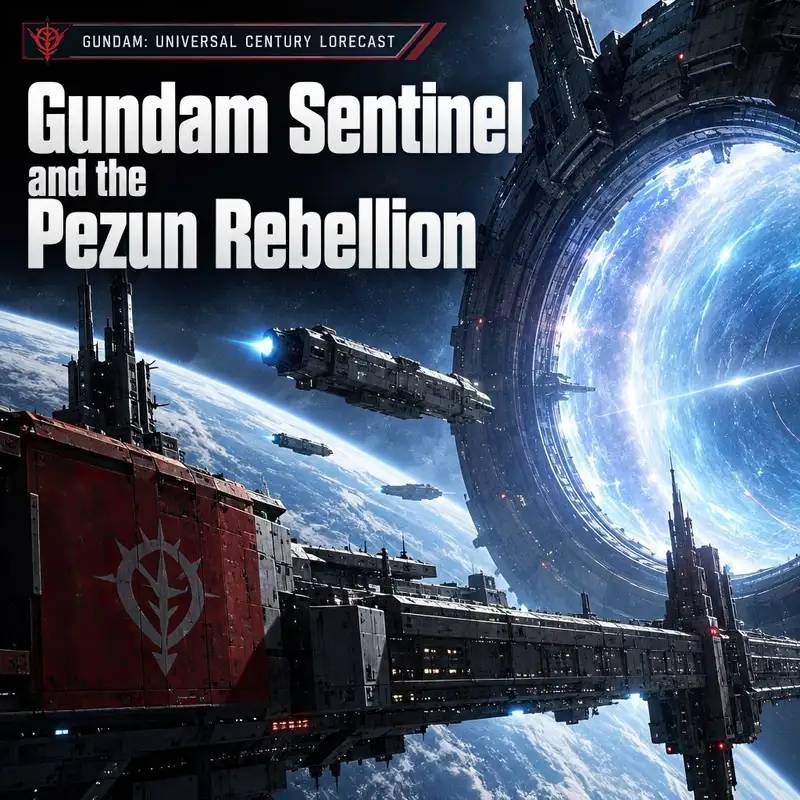
Gundam Sentinel and the Pezun Rebellion [Novel]
Task Force Alpha approached Pezun expecting a punitive operation. The Federation had assembled a modern force, given it an urgent mandate, and sent it against what looked, at first glance, like an isolated revolt on an asteroid base. That description was technically true and militarily misleading. Pezun was not just a rock with hangars cut into it. It was a technical installation manned by trained officers and specialists who knew its approach routes, its defensive geometry, its missile fields, its stores, and its vulnerabilities better than the force sent to suppress them. More important, its defenders believed that the defeat of the Titans had placed the Federation in the hands of enemies they considered illegitimate. They had a base, weapons, and a cause. None of those elements was sufficient to win a war. Together, they were enough to turn a garrison revolt into a dangerous civil-military crisis.
The Pezun Rebellion unfolded in early Universal Century eighty-eight, during the unstable interval between the fall of the Titans and the opening struggles of the First Neo Zeon War. It belongs here to the complete novel Gundam Sentinel: Alice’s Confession, not as an unrecorded episode of the television history surrounding it, but as its own account of a Federation trying to survive the consequences of victory. The Titans had been defeated as a political and military force. Their defeat did not erase the officers who had served them, the facilities they had used, the habits of command they had normalized, or the fear and resentment generated by the Anti-Earth Union Group’s rise inside the new political order.
That distinction matters. An organization can be destroyed on paper and still survive in the loyalties, prejudices, and professional networks of its former members. The Titans had justified extraordinary authority in the name of security. They had treated colonial dissent as a threat requiring surveillance, coercion, and military force. Their collapse left many personnel facing a choice between accepting a changed Federation and resisting it. The New Desides chose resistance. Their movement was not a broad democratic uprising of lunar or colonial citizens. It was a reactionary military revolt, rooted in the surviving political language of Earthnoid supremacy and the institutional memory of the Titans.
Brave Cod emerged as the rebellion’s principal leader, while Tosh Cray provided much of its operational direction. Their organization drew together personnel who saw the post-Titans settlement not as a correction, but as a surrender of authority to forces they distrusted. That belief gave the revolt a degree of cohesion. It also imposed a severe political limit. The New Desides could appeal to fear of change, to resentment among displaced officers, and to conservative institutions that had sheltered former Titans personnel. They could not easily persuade the wider Earth Sphere that a return to Titans principles offered a legitimate future.
The rebels did not need to solve that larger problem immediately. Their first requirement was survival. Pezun gave them the means to survive longer than a small mutiny should have lasted. An asteroid base offered isolation, fortification, and technical capacity. It could hold mobile suits, weapons, spare parts, fuel, ammunition, workshops, command facilities, and personnel whose skills were more valuable than any individual machine. A fortified base is often described in terms of armor and guns. In practice, its real strength lies in the system behind those defenses. It is a concentration of trained people, maintenance routines, stored resources, communications, and local knowledge.
The Federation therefore needed a response that was fast, visible, and credible. It formed Task Force Alpha, a specialized expeditionary formation commanded by Eton F. Heathrow from the Pegasus III. The task force included Federation personnel as well as veterans associated with the Anti-Earth Union Group and Karaba. That mixture was politically useful. It demonstrated that the post-Titans Federation could draw on experienced personnel outside the old security establishment. It was also potentially awkward. Forces built quickly from people with different service cultures, political histories, and wartime experiences do not automatically become a seamless command.
Task Force Alpha was built for a limited mission. It was not intended to occupy the Earth Sphere or fight every hostile force emerging from the Titans’ collapse. Its purpose was to isolate and destroy the New Desides before the rebellion gained momentum, before more regular units defected, and before sympathetic communities could present the Federation with a wider political challenge. Its flagship, the Pegasus III, was central to that effort. The ship was not merely a backdrop for mobile suits launching into combat. It provided command facilities, communications, hangar space, recovery capacity, repair support, medical care, and the means to move scarce combat machines between theaters.
The supporting cruisers mattered for the same reason. Mobile suits could dominate a local engagement, but they could not sustain an expedition by themselves. They required ships to carry them, technicians to service them, stores to arm them, pilots to fly them, and officers to decide when their loss was acceptable. The more specialized the machine, the more dependent it became on the organization behind it. That was especially true of Task Force Alpha’s most advanced asset, the S Gundam.
Ryou Roots piloted the S Gundam, while Stole Mannings served as the senior mobile-suit officer within the force. Tex West, Shin Crypt, Sigman Shade, Chung Yung, and other personnel contributed specialized capabilities through Zeta Plus and FAZZ elements. Their names matter less as a roll call than as evidence of what Task Force Alpha represented. It was a concentrated, high-end formation assembled under political pressure. The Federation had not solved its postwar problems. It had created a task force capable of responding to one of them.
The S Gundam was exceptional equipment, not a normal expression of Federation-wide military capability. Its importance lay not only in its weapons or performance, but in the system installed within it. That system was ALICE, an artificial intelligence designed to assist human decision-making and, in extreme circumstances, to act beyond ordinary pilot control. The idea was understandable. The Federation had emerged from a conflict in which command systems had failed, loyalties had fractured, and individual pilots had sometimes decided engagements faster than headquarters could understand them. An advanced combat intelligence promised a way to reduce hesitation, process information, and preserve a mission when human beings reached their limits.
But that promise contained a contradiction. The crisis at Pezun was not caused by a lack of computing power. It was caused by political division, institutional mistrust, ideological reaction, and the unfinished business of the Titans. An artificial intelligence could help a pilot survive a battle. It could not determine whether a government deserved loyalty, whether a command climate was healthy, or whether a military victory had produced political legitimacy. The Federation was using a remarkable machine to answer a problem that was, at its root, human.
At the beginning of the campaign, ALICE should not be treated as a simple artificial person waiting to announce itself. The system was designed to learn. Its significance developed through exposure to the behavior of the people around it. It observed fear, orders, responsibility, loss, error, and the gap between what a machine could calculate and what a human being had to endure. That process would eventually make ALICE central to the campaign’s conclusion. At Pezun, however, it was still part of a larger institutional gamble. Task Force Alpha had advanced machines. The question was whether its doctrine, intelligence, and command arrangements were advanced enough to use them effectively.
The initial operations against Pezun exposed the answer. The New Desides did not meet the Federation in a simple contest of equipment. They used prepared defenses, missile positions, mobile-suit forces, and their understanding of the asteroid itself. In space warfare, a fortified asteroid is not merely terrain. Its mass blocks lines of approach, conceals movement, shapes firing arcs, and gives defenders the advantage of preparation. An attacker must identify threats, coordinate ships and mobile suits, preserve room to maneuver, and avoid being drawn into the defender’s preferred geometry.
Minovsky conditions made that problem sharper. Long-range detection and communications could be impaired, forcing commanders to rely more heavily on local initiative, visual confirmation, prearranged plans, and the judgment of subordinate crews. That did not make sensors useless or turn combat into medieval single combat. It meant that a defending force which understood its own environment could create uncertainty far beyond its numbers. The New Desides did exactly that. Their strength came from position and preparation, not from the ability to match the Federation ship for ship across the Earth Sphere.
Task Force Alpha could bring superior resources to the fight, but its resources had to be used within a confined, dangerous operational environment. The Pegasus III and its escorts had to remain intact long enough to support sorties and recover damaged machines. Pilots needed targeting information. Mechanics needed time and protected facilities to keep specialized equipment operating. Commanders needed to distinguish a tactical success from a trap. The rebels understood that the Federation’s force was politically urgent and materially valuable. If they could force it into a costly or embarrassing failure, they might gain more than they could from simply defending Pezun.
The most important moment of the Pezun operation came when the New Desides withdrew from the base. Withdrawal can look like defeat, and in one sense it was. The rebels were giving up their original fortress. But they did not abandon Pezun in confusion. They left behind a nuclear self-destruct device intended to destroy the asteroid after Task Force Alpha had committed itself. The plan aimed at more than physical destruction. It sought to eliminate the Federation force, erase useful facilities, and prove that the rebels could turn a retreat into a strategic blow.
Tex West recognized the danger in time. That recognition allowed Task Force Alpha to withdraw before Pezun was destroyed. It was an intelligence success, but also a warning about the nature of the war it was fighting. The Federation had denied the rebels their original base. It had not destroyed their organization. The New Desides preserved personnel, leadership, and momentum. They had demonstrated that they could plan a complex withdrawal, exploit the assumptions of a stronger force, and continue the conflict elsewhere.
This is where a narrow reading of the campaign fails. If Pezun is treated only as a battle over an asteroid, Task Force Alpha appears to have won. If the operation is understood as a campaign to contain a political-military revolt, the outcome was less complete. The Federation had removed one sanctuary but had not resolved the institutional fracture that had made the sanctuary possible. The New Desides had lost fixed infrastructure while preserving their ability to move, recruit, and disrupt. The war had shifted from a fortress problem to a loyalty problem.
That shift became unmistakable when Admiral Brian Aeno defected. His defection mattered not simply because the New Desides gained additional ships and trained crews. It mattered because an officer of the Federation’s own fleet structure had declared that the rebellion was not confined to Pezun. The defection transformed the crisis from a revolt by a stranded garrison into a conflict involving regular military personnel with knowledge of Federation doctrine, procedures, communications, and command habits.
Aeno’s decision also created a problem of confidence. Every military depends on some degree of trust that orders will be carried out, that reinforcements will remain loyal, and that a formation approaching under friendly identification is not preparing to change sides. In a period of political transition, those assumptions become fragile. The Federation now had to consider whether other former Titans personnel might follow the same path, whether political resentment had penetrated more deeply than expected, and whether the New Desides could turn military professionalism into a weapon against the government.
The rebellion’s military value increased because it could now present itself as more than a cornered remnant. It had an admiral, defecting forces, and the appearance of expanding support. Yet appearance was not the same as strategic depth. A defecting formation can bring immediate combat power, but it also brings fuel requirements, maintenance demands, ammunition needs, wounded personnel, command friction, and the difficulty of coordinating officers who have chosen rebellion for different reasons. The New Desides had gained momentum, but momentum is not a supply system.
Their next refuge was Ayers City on the Moon. Ayers was not Pezun. Pezun had been a military installation, built for defense and technical work. Ayers was an inhabited lunar city, a civic and political community with its own leaders, infrastructure, residents, and interests. Mayor Kaiser Pinefield offered shelter to former Titans personnel, and the city’s conservative elements were willing to give the New Desides room to operate. That made Ayers a sanctuary. It did not make it a rebel capital accepted by all lunar residents, or even by every resident within the city itself.
The distinction placed Task Force Alpha under new constraints. A direct assault on a military asteroid had been dangerous. An assault on a lunar city carried a different kind of danger. The Federation needed to isolate armed rebels while avoiding unnecessary damage to a civilian community. Lunar infrastructure was not easily replaced. Habitation systems, transport networks, industrial facilities, and civilian confidence could all be damaged by indiscriminate combat. A city under low gravity and artificial life-support conditions is not an empty battlefield. It is a place where every damaged system can endanger people who have no part in the fighting.
Political consequences mattered as much as physical ones. If the Federation treated Ayers as though it were merely another fortress, it could validate the New Desides’ claim that the new government had replaced Titans authoritarianism with a different form of coercion. The rebels hoped for precisely that outcome. Their sanctuary would become more valuable if a Federation attack frightened neutral residents, humiliated local leaders, or transformed conservative sympathy into open resistance. The military contest was therefore inseparable from a question of restraint.
The New Desides were gambling that local protection could become a wider lunar coalition. They assumed that hostility toward the Federation, fear of political change, and nostalgia for a more hierarchical order could be organized into durable support. That was a serious misreading of the political environment. Conservative residents might object to Federation pressure without wanting a renewed Titans regime. Civilians might shelter former officers without accepting the risks of rebellion. A mayor could make a local calculation about autonomy without commanding the loyalty of an entire population.
Before the Federation could fully exploit those political limits, it suffered a reminder that technological sophistication did not guarantee operational security. New Desides intelligence personnel compromised the software and operational data used by Task Force Alpha’s mobile suits. The result was described as a logistic bomb. Its significance was not in a dramatic detonation or a single piece of sabotage. It was an attack on the trust embedded in military systems.
A mobile suit is not only armor, reactors, weapons, and propulsion. It is also maintenance data, diagnostic routines, software, authentication procedures, mission planning, supply records, technical manuals, and the people who understand how those systems interact. When the integrity of that network is compromised, the most advanced machine can become a liability. The logistic bomb caused malfunctions during the lunar descent and landing operation. At the moment Task Force Alpha needed precision and coordination, its own equipment became unreliable.
The logistic bomb also changed the relationship between the pilots and the command system. A pilot who cannot trust a machine’s response, a mechanic who cannot trust a diagnostic report, and a commander who cannot trust readiness data are all operating under a form of fog more dangerous than ordinary sensor interference. The Federation’s response had to become more deliberate. It needed to verify systems, adapt procedures, and regain control of its own operational foundation before it could claim that superior technology offered a decisive advantage.
The crisis at Ayers therefore became a contest of adaptation. The Federation had to apply force carefully enough to avoid turning the city against it, while also defeating a rebel organization that had demonstrated competence in defense, deception, and intelligence penetration. The New Desides, for their part, had to convert shelter into political momentum before their military position deteriorated. Neither side could simply rely on the machines it possessed. Each needed a functioning system of command, support, and legitimacy.
Operation Eagle Fall was the Federation’s answer. The operation was larger and more deliberate than the earlier attempt to suppress the rebellion at Pezun. Its goal was not simply to storm a position and declare victory. It was to isolate the New Desides within the lunar environment, break their armed resistance, and prevent Ayers City from becoming the center of a broader anti-Federation coalition. The fighting extended over a substantial period because the Federation could not solve the problem through a single overwhelming strike without accepting political and civilian risks.
The battle involved the kind of high-performance machines for which Gundam Sentinel is often remembered. But the campaign’s meaning cannot be reduced to their silhouettes. The FAZZ units, the Zeta Plus machines, the S Gundam, and the Gundam Mark Five were not pieces on a game board. They were scarce systems operated by crews and pilots under pressure, dependent on launch support, repairs, ammunition, intelligence, and command decisions. Their presence raised the stakes of individual encounters, but it did not erase the wider operation around them.
Brave Cod took the field in the Gundam Mark Five. His destruction of the FAZZ unit group was a severe tactical blow. It demonstrated both the danger of concentrating rare equipment in an exposed fight and the ability of a determined commander to exploit a moment of advantage. Yet a tactical success, even a spectacular one, does not automatically reverse an operational situation. The New Desides could inflict losses. They still needed to hold a sanctuary, preserve their fleet, maintain supplies, and convince a civilian population that their cause deserved the risks they were imposing.
Ryou Roots, operating the S Gundam in its Ex-S configuration, eventually defeated Cod. That engagement was decisive in a narrow but important sense. Cod’s loss deprived the New Desides of their most visible military and political leader at the moment they needed confidence and coherence. But it should not be mistaken for a lone pilot settling an entire war. Ryou’s success occurred within an operation sustained by Task Force Alpha, the Pegasus III, supporting ships, staff work, repair crews, and a Federation effort to regain control of the lunar battlespace.
The encounter also tested ALICE’s role. The system’s value was not merely that it could make the S Gundam more dangerous in combat. It was becoming increasingly involved in the human problem of command. Ryou was a pilot, not an abstract component. He experienced uncertainty, pressure, fatigue, and the consequences of fighting opponents whose decisions could not be reduced to predictable variables. ALICE learned through that exposure. The novel’s central question was never simply whether a machine could fight better than a human. It was whether a machine could understand why a human being sometimes must act despite fear, incomplete knowledge, and responsibility for others.
The political collapse at Ayers followed the military one. Kaiser Pinefield surrendered when the hoped-for lunar uprising did not materialize. That outcome revealed the New Desides’ central weakness. They had mistaken shelter for mass support. They had confused conservative resentment, local autonomy, and hostility to Federation intrusion with a mandate to restore the principles associated with the Titans. Their military competence had been real. Their political legitimacy had not.
Neo Zeon’s intervention came at this point, extracting surviving New Desides personnel from the collapsing situation. That assistance should be understood as opportunistic rather than as proof that the New Desides had always been a formal Neo Zeon formation. Neo Zeon had its own strategic interests. Experienced personnel, trained pilots, and officers familiar with Federation procedures were useful assets in a wider conflict. Extracting them preserved military value that would otherwise have been lost to the Federation.
The intervention also revealed the difference between ideological affinity and strategic convenience. Neo Zeon could exploit the collapse of the New Desides without fully endorsing the rebels’ political objectives or inheriting responsibility for their failures. In the fractured politics of the late Universal Century, defeated factions often became reservoirs of manpower for the next war. The names changed. The uniforms changed. The unresolved skills, resentments, and habits of command remained available for use.
Tosh Cray recognized that the New Desides could no longer function as a durable movement. He formally dissolved the organization and offered the remaining personnel choices: join Neo Zeon, leave the struggle, or continue with him. That moment was more than an administrative decision. It was an admission that the rebellion had failed to establish a political base capable of sustaining itself. A movement that began with a fortified base and a claim to restore order had become a shrinking group of armed survivors deciding where their skills might still be useful.
A small number remained with Cray. Their next plan abandoned the pretense of conventional victory. Instead of holding territory or building support, they aimed at Penta, an orbital communications station. Penta offered strategic utility as an orbital staging point. Control of such infrastructure could help a force coordinate movement, establish a route, and threaten targets below. But the larger purpose was clear. Cray’s remaining force intended to strike toward Dakar, the Federation’s political center on Earth.
The final operation depended in part on the AMA-100 Z’od-iacok, a large mobile armor supplied through Neo Zeon support. Its role must be kept in proportion. The Z’od-iacok was mission-specific equipment, suited to a high-risk attempt to bridge orbital and atmospheric operations. It was not proof that Neo Zeon could routinely field such systems across every theater, nor was it a solution to the New Desides’ political weakness. Exceptional equipment can extend the reach of a desperate force. It cannot manufacture the civilian support, secure logistics, or durable command structure that force lacks.
Task Force Alpha moved against the Penta operation because allowing the rebels to gain an orbital staging point would create risks far beyond the surviving size of their force. A strike toward Dakar could have political effects disproportionate to the number of personnel involved. The Federation had to stop the operation before a symbolic attack became a mass-casualty event or a propaganda victory. That required fleet action, mobile-suit engagement, and the ability to track a force moving through a complex environment shaped by orbital mechanics, Minovsky interference, and the approach to Earth’s atmosphere.
The Z’od-iacok complicated the engagement through its transformation and separation capabilities. Such a machine created uncertainty because the Federation could not assume that destroying or disabling one visible component ended the threat. But complexity also imposed burdens. Large, specialized equipment demands preparation, coordination, and an understanding of how its parts will function under extreme conditions. The closer the operation moved toward reentry, the less forgiving the environment became. Atmospheric approach was not simply another direction of travel. It imposed heat, stress, timing, and survival constraints on every participant.
Stole Mannings was killed defending the Pegasus III during this final phase. His death should not be turned into a decorative heroic moment. It represented the cost of keeping a carrier and command ship alive while its embarked forces pursued a dangerous enemy. The Pegasus III was the center of Task Force Alpha’s ability to continue fighting. If it were destroyed, the force would lose more than a vessel. It would lose a platform for command, recovery, maintenance, and the coordination of its remaining assets. Mannings’s defense protected that system at the cost of his life.
The final pursuit extended into the upper atmosphere, where the remaining New Desides force and the S Gundam entered a realm in which escape, maneuver, and survival were sharply constrained. A mobile suit capable of fighting in space was not automatically secure in reentry. Heat, aerodynamic stress, control, and the problem of separating a pilot from a damaged combat machine all mattered. There was no simple reset button, no repair bay waiting just beyond the frame, and no guarantee that a victory in combat would leave a crew alive to claim it.
At that point, ALICE made its final decision. The system separated Ryou Roots in the reentry-capable core fighter, preserving the pilot while retaining control of the S Gundam. It then used the machine and itself to destroy the remaining New Desides survivors. Operationally, the action ended the immediate threat. It prevented a defeated remnant from converting a desperate attack into another crisis for the Federation. But the meaning of the decision went beyond tactical calculation.
ALICE had been created to assist human combat judgment. Through the campaign, it had encountered human fear, hesitation, loyalty, loss, and responsibility. Its final action did not prove a settled theory of artificial consciousness, nor did it establish that the Federation had discovered a reproducible solution to command failure. The novel does not permit that kind of comfort. What ALICE demonstrated was that judgment is not simply the ability to process data faster. It is the ability to recognize what must be protected, what can be sacrificed, and who should not be required to bear every cost alone.
The Federation did not emerge from the Pezun Rebellion with a simple triumph. Task Force Alpha had contained a dangerous revolt, adapted to intelligence compromise, defeated the rebels at Ayers, and stopped the final Penta operation before it could become a strike on Dakar. Yet the campaign had required scarce equipment, costly effort, and an extraordinary artificial intelligence that ultimately could not be recovered. It exposed how deeply the Titans’ legacy remained embedded inside Federation military institutions. A formal victory over authoritarianism had not automatically produced loyal, healthy, or politically unified armed forces.
The New Desides failed for the opposite reason. Their leaders possessed military competence, fortified infrastructure, trained personnel, and enough institutional sympathy to create a genuine emergency. But they mistook those assets for political legitimacy. They could disrupt the Federation because the post-Titans military was divided and vulnerable. They could not build the civilian coalition, logistical depth, or durable authority required to replace the order they opposed. In the end, the Pezun Rebellion showed that reactionary military skill can make a state bleed, but it cannot make a discredited political project govern.