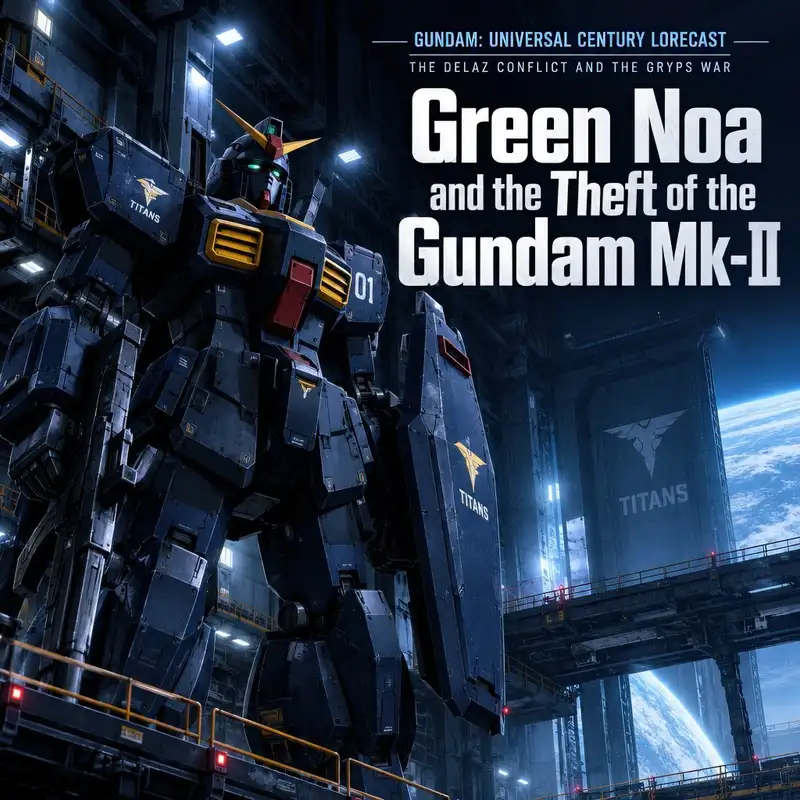
Green Noa and the Theft of the Gundam Mk-II
Green Noa was supposed to be secure. It was a civilian colony, but it also hosted one of the Titans’ most sensitive weapons programs. Inside its walls were military police, engineers, test crews, transport routes, civilian apartments, and three black Gundam Mk-IIs awaiting evaluation. Into that crowded environment came an Anti-Earth Union Group infiltration team, a detained teenager with a grudge against Titans authority, and a command structure that mistook fear for control. Before the new machines had established any battlefield reputation, the Titans lost them to the very movement they were intended to intimidate.
That was not simply a theft of hardware. It was an intelligence failure, a security failure, and a political failure compressed into a few chaotic days in early Universal Century eighty-seven. The Anti-Earth Union Group, or AEUG, gained prototypes, technical access, and new personnel. The Titans lost custody of a classified development program, lost the confidence of at least one of their own officers, and showed civilians that military authority inside Green Noa could turn a home into a hostage environment with alarming speed.
Green Noa was especially vulnerable to that kind of failure because it was not an empty military test range. It was an inhabited colony. People lived there, worked there, moved through its public spaces, and depended on its transportation and life-support systems. Engineers connected to the Mk-II project had civilian lives and family ties. Military police could detain residents, but they could not make the colony politically sterile. Any security operation conducted inside such a place had to account for local knowledge, civilian movement, divided loyalties, and the basic fact that a habitat is not merely terrain. It is a community.
The AEUG understood that the Titans’ apparent control over Green Noa might conceal a weakness. Quattro Bajeena entered the colony with Apolly Bay and Roberto to investigate reports that the Titans were developing a new Gundam-type mobile suit. Their immediate task was reconnaissance. They needed to confirm that the program existed, assess the installation, and learn what kind of machine the Titans were preparing to field. If an opportunity appeared to seize the machines, that would be valuable. But this was not a conventional invasion meant to occupy Green Noa or defeat the Titans in open battle.
The distinction between reconnaissance and assault is important. A small infiltration team does not need to destroy an enemy’s entire security apparatus. It needs to identify a weakness, reach the target, act before the defender understands the full situation, and leave with something worth the risk. Quattro’s team could exploit surprise, local confusion, and the limits of Titans command inside a civilian colony. They could not count on prolonged combat, a large reserve force, or a secure rear area. The operation depended on speed, judgment, and the defender making mistakes.
The intelligence value alone justified the risk. The Titans’ possession of a new Gundam-type project would reveal more than a single weapon. It would show where the organization was investing research funds, which technologies it considered important, and how it intended to associate itself with the Federation’s military legacy. The Gundam name still carried weight after the One Year War. It was linked to the Federation’s recovery from surprise, to advanced research, and to the idea that technical superiority could reverse defeat. The Titans wanted some of that prestige for themselves.
The black Gundam Mk-IIs were therefore political objects as well as military prototypes. Their appearance was a statement. The Titans were not simply developing a new mobile suit. They were claiming the right to inherit the Federation’s most famous wartime symbol and place it under their own command. In a more stable political environment, that symbolism might have reinforced their authority. At Green Noa, it did the opposite. Once the AEUG took possession of the machines, the Titans’ symbol became evidence that their authority could be challenged.
The Mk-II was significant, but it was not a flawless superweapon. Three prototypes existed, and they represented an important transition in mobile-suit design. Their major innovation was the full movable frame. Earlier mobile suits had internal structures and armor arranged in more integrated ways. The Mk-II separated the machine’s structural skeleton from the armor attached around it. That allowed more flexible movement, easier access to internal systems, and a design approach that could support more sophisticated machines in the future.
For a pilot, a movable frame could improve responsiveness and articulation. For engineers, it offered a new foundation for developing mobile suits whose structures, armor, and mechanisms could be treated as more distinct systems. That did not make the Mk-II invulnerable or automatically superior in every fight. Its armor did not yet use the later Gundarium Gamma associated with subsequent second-generation designs. It remained an experimental machine with the maintenance burden, uncertain reliability, and limited availability that prototype status always implies.
Its historical importance lay in what it demonstrated. The Titans had committed resources to a new structural approach. The AEUG, if it could examine the machines, would gain insight into the direction of Federation military research. That was valuable even if the captured units could not be copied immediately. A prototype can reveal design choices, manufacturing problems, maintenance demands, and test priorities. It can show what an opponent thinks the next war will require. In this case, the Mk-II’s movable-frame concept would later contribute to work associated with the Zeta Project. But that was a later development, not an instant industrial revolution.
Capturing a prototype does not mean capturing the factory that built it. The AEUG did not suddenly acquire a secure production line, a warehouse of components, trained replacement pilots, or a reliable supply chain for every specialized part. It acquired machines, data, and opportunity. Those were substantial gains. They were not the same thing as self-sufficient military power. The difference between a successful raid and a sustainable weapons capability would matter throughout the Gryps Conflict.
The Titans, meanwhile, had brought those prototypes into a colony environment without establishing the level of control such assets required. Their error was not simply that an infiltrator got past a guard. The error was institutional. Valuable test machines were present in a setting where military personnel, technical staff, residents, and transport systems all overlapped. Authority was dispersed and confused. Guards, test personnel, officers, and local police did not appear to operate from a single coherent response plan once the crisis began.
An unplanned factor made that weakness worse. Kamille Bidan was not an AEUG operative placed inside Green Noa to assist Quattro’s raid. He was a civilian teenager living in the colony, technically capable, politically frustrated, and deeply hostile to Titans arrogance. His path into the operation began not with revolutionary discipline, but with a personal confrontation. Jerid Messa insulted him, and Kamille reacted violently. The dispute led to his detention by Titans military police.
It is tempting to treat that moment as the first act of a fully formed political hero. It was not. Kamille’s anger was real, and his resentment toward the Titans had a political context. But his immediate actions were shaped by humiliation, fear, and the experience of being handled by an armed authority that expected obedience. He had not entered Green Noa’s military facilities as part of Quattro’s plan. He was caught inside a coercive system at the very moment that system was beginning to lose control of its own security situation.
This is one of the less glamorous lessons of military history. Low-level arrogance can have operational consequences. An organization that relies on status, intimidation, and discretionary punishment creates friction inside its own command structure. Personnel begin making decisions to preserve pride rather than accomplish missions. Civilians become hostile rather than cooperative. A small incident that should be contained becomes another source of confusion. The Titans did not lose the Mk-IIs because Jerid insulted Kamille. They lost them because their culture left little room for restraint once such a confrontation began.
As Quattro’s team moved against the Mk-II program, Kamille’s detention became part of the wider crisis. The AEUG had entered Green Noa to confirm intelligence and seize an opportunity. The Titans suddenly had to deal with infiltrators, endangered prototypes, uncertain access points, and a civilian detainee who knew the colony’s environment better than the people trying to contain him. The situation developed too quickly for a rigid hierarchy to manage cleanly.
The raid worked because the AEUG operated at close range and because the Titans failed to establish a coherent perimeter around the assets that mattered most. Quattro, Apolly, and Roberto could identify the target, move on it, and act before Titans command fully understood the scale of the threat. The defenders had armed personnel and formal authority, but authority did not automatically produce coordination. Test machines are not ordinary warehouse equipment. They require specialized crews, access procedures, maintenance support, and pilots or evaluators who understand their systems. During the confusion, those requirements became vulnerabilities.
The result was that the AEUG gained control of two Gundam Mk-IIs. That was a considerable tactical success. The Titans had not merely suffered damage to an installation. They had lost two of three experimental machines from a classified program. Yet the immediate significance was still limited by the nature of the captured equipment. Two prototypes could strengthen the AEUG, provide intelligence, and create propaganda value. They could not by themselves reverse the broader balance between the Titans and their opponents.
The larger operational lesson was more severe for the Titans. A high-value program inside an inhabited colony requires layered security. It requires clear authority over guards, engineers, pilots, transport access, and emergency response. It requires the ability to distinguish an intelligence probe from a larger attack. And it requires discipline when civilians are present. The Titans had enough force to make Green Noa intimidating. They did not demonstrate enough control to make it secure.
Kamille then entered the crisis directly by reaching a Gundam Mk-II amid the confusion. His ability to operate the machine was real. He had technical familiarity, quick reactions, and the confidence, or perhaps recklessness, needed to act when many trained personnel were hesitating. But it would be a mistake to treat this as proof that he had already become a finished pilot, a mature political actor, or a fully understood Newtype. At this point, he was trying to escape a situation in which military authority had become personally threatening.
That distinction matters because the Titans now faced a problem they had not planned for. Their opponents were no longer only covert AEUG infiltrators. One of their own test machines was being used by a local civilian who had been detained by their police and who had every reason to distrust their promises. The loss of a prototype was now tied to a visible failure of local governance. The machine could not be separated from the person inside it, and the person inside it could not be separated from the way the Titans had treated him.
Quattro’s decision to leave Green Noa with Kamille turned disorder into a durable AEUG gain. He did not create Kamille’s anger, and he did not place him in detention. But he recognized that the Titans’ handling of the crisis had created an opening. The AEUG now had captured machines and a young pilot who had crossed a line that made a return to ordinary civilian life difficult. That did not make Kamille’s future inevitable. It did, however, connect his personal conflict with the larger struggle against Titans authority.
The Argama received more than trophies. It received equipment that had to be kept operational under difficult circumstances. Captured prototypes require hangar space, technicians, diagnostic work, spare parts, and careful evaluation. Their systems may be unfamiliar. Their condition may be uncertain. The people who built them are not necessarily available to explain them, and the organization that lost them will not provide a maintenance manual out of professional courtesy. Every sortie must be weighed against the risk of damage that cannot be repaired quickly.
For that reason, the Mk-IIs became unequal assets after their capture. One would serve as the principal combat machine aboard the Argama after being repainted. Another would be dismantled for parts, providing sustainment value that might be more important than placing every available frame in combat. The remaining unit would be studied by Anaheim Electronics, where its movable-frame technology could be examined and incorporated into later development work. The AEUG had acquired three machines, but it had not acquired three identical frontline capabilities.
That practical arrangement reveals the difference between possession and use. A fielded mobile suit has immediate combat and symbolic value. A machine broken down for spares contributes to readiness, even though it no longer appears in battle. A machine used for technical study may have its greatest effect months or years later, when its design knowledge influences a new project. A less disciplined organization might have tried to display all three captured Gundams at once. The AEUG needed to think about sustainment, not just spectacle.
The Titans might still have limited the political damage. They could have treated the theft as a security breach, conducted a disciplined recovery effort, protected civilians, and prevented the incident from becoming a larger indictment of their rule. Instead, their response intensified the crisis. Bask Om used Franklin and Hilda Bidan, Kamille’s parents, as leverage. Both were linked to the Mk-II program as engineers. Their situation showed how dependent advanced military projects were on civilian technical labor, and how little control those civilians possessed once the military decided that security took precedence over their rights.
The hostage operation was not simply a private tragedy inside the Bidan family. It was a command decision with institutional consequences. The Titans had already lost control of classified machines. By seizing engineers and using them to pressure Kamille and the AEUG, they shifted from recovery to coercion. That choice told everyone involved that the organization regarded technical personnel and their families not as citizens with obligations and protections, but as tools that could be used to regain prestige.
Green Noa’s civilian status made this especially destructive. A colony cannot function if residents believe that every military emergency may turn them into bargaining chips. Engineers cannot work freely if their professional association with a weapons program makes their families vulnerable. Military police may gain short-term leverage through detention, but they also create long-term hostility, silence, and fear. The Titans were trying to recover three prototypes. In the process, they were teaching people why an anti-Titans movement could find support.
Franklin and Hilda’s relationship was already strained, and the personal pain of their family should not be reduced to an abstract political lesson. But their experiences still reveal something larger. They helped create machines that the Titans regarded as symbols of their authority. Once the project became compromised, the institution did not treat its civilian contributors as partners or even as protected specialists. It treated them as expendable pressure points. That is a poor way to secure either technological loyalty or political legitimacy.
Hilda’s death made the consequences irreversible. It demonstrated that the hostage operation was not a controlled negotiation tool. It had become lethal. For Kamille, the loss was personal and traumatic. For the Titans, it was evidence that their command methods had crossed from harshness into a willingness to sacrifice civilians in pursuit of control. An organization can describe such actions as necessity, security, or discipline. The people who witness the result will judge it by what it does, not by the language used to defend it.
Emma Sheen’s role is crucial here because she begins inside the Titans system. She was not an outsider arriving with a fixed plan to defect. She was a Titans officer who initially accepted that the organization’s security mission could justify coercive action. Like many professional soldiers, she operated within assumptions about authority, chain of command, and legitimate purpose. The hostage operation exposed the weakness in those assumptions. It showed that orders could be issued in the name of security while producing conduct that undermined the institution they were supposed to protect.
Her defection was therefore more than a sudden personal change of heart. It was a command-climate failure. Military organizations depend on subordinates believing that orders serve some defensible mission and that authority has limits. When senior commanders use civilians as leverage and accept lethal outcomes, they force officers below them to confront the gap between the institution’s stated purpose and its actual behavior. Emma did not merely reject an unpleasant assignment. She lost confidence in the moral and professional basis on which Titans obedience had been demanded.
That had practical military consequences. The Titans lost a trained officer who knew their procedures and had seen the aftermath of the Green Noa operation from inside the chain of command. The AEUG gained someone who understood that the conflict was not only about mobile suits or personal rivalries. It was about what kind of authority the Federation would tolerate in the name of security. Defection is often treated as a matter of individual loyalty. In reality, it can also be an assessment of institutional competence.
Bright Noa’s presence around these events adds another layer to the political damage, though he should not be made the center of the raid. Bright was a Federation veteran whose wartime record carried public meaning. The Titans’ treatment of figures like him revealed their broader attitude toward professional legitimacy. They wanted the prestige of Federation victory and the symbols associated with it, but they were less interested in the restraint, responsibility, and public trust that gave those symbols value in the first place.
The same contradiction ran through the Mk-II project. The Titans wanted black Gundams. They wanted advanced machines that could embody Federation military power while remaining firmly under their own authority. Yet they could not protect the prototypes inside Green Noa. They could not prevent a civilian detainee from becoming part of the escape. They could not recover their losses without resorting to hostage coercion. And they could not stop one of their own officers from concluding that obedience had become complicity.
By the end of the immediate crisis, all three Gundam Mk-IIs had come under AEUG control. That result mattered. It deprived the Titans of a complete prototype set, provided the AEUG with direct technical access to a new mobile-suit concept, and gave the Argama a powerful combat asset. It also placed the captured technology into a network that included Anaheim Electronics, an industrial actor capable of studying its possibilities. The movable-frame concept would become one of the important technical foundations for later work, including the development path that produced the Zeta Gundam.
But it is important not to exaggerate the timeline. The AEUG did not open a captured Mk-II cockpit and immediately acquire mastery of the technology. Advanced design knowledge has to be interpreted, tested, adapted, and integrated into other systems. A movable frame is not a complete mobile suit. It does not solve armor, propulsion, transformation, weapons integration, pilot workload, manufacturing quality, or maintenance. The Mk-II gave the AEUG and its industrial partners a valuable starting point. It did not erase the Titans’ wider material advantages.
Nor did the loss of three prototypes make the Titans militarily helpless. The Titans retained forces, facilities, political connections, and access to the Federation’s larger military structure. Their immediate loss was serious because prototypes are expensive, sensitive, and hard to replace quickly. Yet the military effect of the theft, in isolation, was limited. Three experimental mobile suits did not decide the Gryps Conflict. The deeper damage came from what the theft revealed about the Titans’ methods and their inability to contain the consequences of those methods.
Tactically, the Titans lost custody of three Mk-IIs. Operationally, the AEUG gained combat equipment, maintenance resources, intelligence, and a defector. Strategically, the incident helped push the relationship between the AEUG and the Titans into open armed confrontation. But at the political level, Green Noa was even more important. The Titans had claimed to preserve Federation order. Instead, they had turned a civilian colony into the scene of a classified security breach, arbitrary detention, hostage coercion, and lethal abuse of civilians.
That damage could not be repaired by simply building replacement machines. A new prototype might replace a lost frame. It could not easily replace the trust lost among engineers, residents, and officers who had watched the Titans respond to failure with intimidation. The Titans had created an organization designed to suppress threats quickly. Green Noa showed that it had become poorly equipped to recognize the difference between a security problem and a political crisis.
The AEUG’s victory was therefore not a victory of machinery alone. The organization succeeded because it saw an opening inside a brittle system. Quattro’s infiltration team exploited weak local security and divided command. Kamille’s personal crisis created an unforeseen path to a third machine. Emma’s defection exposed the limits of Titans obedience. The Argama turned captured equipment into military and technical value. None of those factors alone would have been enough. Together, they transformed a limited raid into a symbolic defeat for the Titans.
Green Noa also showed why colonies mattered so much in the Universal Century. They were not simply bases floating in space, and they were not disposable containers for military equipment. They were inhabited political spaces where ordinary people lived under institutions they did not always control. When a security organization brought secret weapons programs, military police, and hostage tactics into that environment, it did not merely risk property damage. It risked teaching its own population that protection and oppression had become difficult to distinguish.
The Gundam Mk-II theft became the AEUG’s opening operational victory because the Titans confused possession with security. They possessed Green Noa, the prototypes, armed personnel, and legal authority. But they did not control the colony’s political atmosphere, the loyalty of every subordinate, the reactions of detained civilians, or the consequences of their own coercion. The AEUG gained machines, intelligence, and future technical opportunity. More importantly, the Titans demonstrated that their version of Federation security could no longer distinguish between defending order and destroying the trust on which order depended.