GMs, Balls, Salamis Cruisers, and the New Federation Fleet Doctrine
A Salamis cruiser captain who survived Loum faced an unpleasant fact. His ship still had heavy guns, trained sailors, endurance, and the ability to move men and material across the Earth Sphere. It was still a warship. But it had been built for a different kind of war. Its weapons and fire-control arrangements assumed that the enemy would be another ship, another formation, or perhaps a conventional aerospace threat at a range where detection, identification, and concentrated gunnery could do their work. Zeon mobile suits had demonstrated that they could force the fight much closer, under conditions where a cruiser’s own weapons became harder to use safely and effectively.
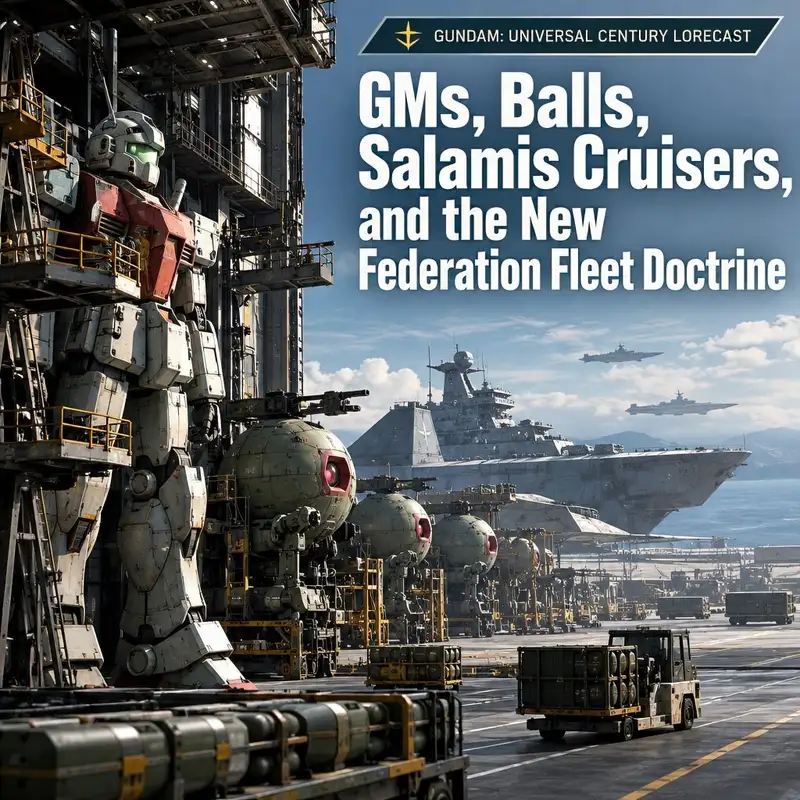
The Earth Federation did not solve that problem by throwing its surviving cruisers into the scrapyard. It could not have done so even if it wanted to. Warships represented years of construction, trained crews, dockyard capacity, weapons stockpiles, and transport infrastructure. More importantly, the Federation needed those ships immediately. Its answer was to make the cruiser part of a larger combat system. Salamis cruisers would keep their guns and their fleet role. GM mobile suits would provide maneuver, close protection, interception, and local striking power. Balls would add direct fire and numbers at a lower industrial cost. Fighters, transports, bases, tenders, technicians, and recovery crews would make the whole arrangement usable beyond a single dramatic engagement.
That combination was not a formal program called the New Federation Fleet Doctrine. The surviving record does not offer one neat manual with that title on the cover. It is an analytical description of a real wartime transformation. Between Loum and the final battles of Universal Century seventy-nine, the Federation changed from a force built around capital ships into one that treated mobile suits as essential to fleet operations. The crucial point is that it did not replace naval warfare with mobile-suit warfare. It turned mobile suits into part of naval warfare.
The Salamis and Magellan classes came from an earlier phase of Federation military expansion. By Universal Century seventy, the Federation had begun building up its space forces in response to growing political tension across the Earth Sphere. The Magellan was the larger battleship, built to carry heavy firepower and to serve in the center of a battle line. The Salamis was the more numerous cruiser, a practical fleet workhorse intended to operate in numbers. Together, these classes reflected a familiar idea of space power. A state protected its routes, bases, and colonies through fleets of large warships whose sensors, guns, escorts, and command networks could concentrate force where it mattered.
Minovsky particles made that imbalance more serious. They did not make every sensor blind or every radio silent. The effects varied with density, equipment, and circumstance. But they did reduce the confidence commanders could place in long-range electronic detection and communications. That mattered enormously to a fleet accustomed to organizing combat through centralized awareness, range, and fire control. A ship could still see, signal, maneuver, and fight. What it could not safely assume was that it would identify a threat early enough, at long enough range, and with enough certainty to destroy it before that threat reached the formation.
Zeon had prepared for this environment more thoroughly. Its mobile suits were not merely new weapons. They were part of a new operational answer to Minovsky-era warfare. They could scout, raid, screen, ambush, land forces, fight in close proximity to installations, and threaten large ships from angles that traditional fleet defenses had not been designed to cover. That did not make Zeon’s mobile suits invulnerable, and it did not make its warships irrelevant. It gave Zeon a way to impose tactical problems on an opponent still organized around older assumptions.
The Battle of Loum exposed the cost of that mismatch. The exact details of the battle vary across Universal Century sources, and the original television record does not provide a complete, reliable order of battle. It would be unwise to count ships in the background and convert animation frames into a precise fleet census. What the broader record makes clear is more important than any disputed number. The Federation entered Loum with substantial naval strength, but Zeon’s mobile suits and experienced crews were able to operate inside the defensive geometry of a battleship-centered fleet.
A heavy ship’s guns were powerful, but power was not the same as flexibility. A cruiser designed to engage another cruiser could not always bring its main batteries to bear on a dispersed mobile suit moving near friendly vessels, through wreckage, or against the visual confusion of a Minovsky-contaminated battlespace. Defensive fire had to avoid friendly ships. Commanders had incomplete information. Formations lost cohesion. Individual ships could find themselves fighting threats that appeared too close, too suddenly, and from too many directions.
Loum was therefore not proof that warships had become useless. It was proof that warships operating without a suitable close-defense and maneuver element had become dangerously exposed. That distinction mattered. If the Federation had concluded that the answer was simply to abandon capital ships, it would have surrendered its remaining fleet infrastructure at the very moment it needed it most. The real lesson was harsher and more practical. A warship could no longer assume that its own hull, guns, and escorts were enough. It needed mobile forces around it.
The defeat also had an institutional effect. It revealed a failure not of courage alone, but of preparation. Federation sailors and officers had been sent into a war for which their organizations had not been properly designed. In any military, that sort of failure creates pressure for simple explanations. The enemy had an unfair weapon. The commanders were incompetent. The intelligence was bad. The ships were obsolete. Each explanation contains a portion of the truth. None explains the whole problem. Zeon had developed a system that joined technology, training, doctrine, and operational purpose. The Federation had to build a comparable system while already fighting for survival.
On April first, Universal Century seventy-nine, the Federation began two efforts that answered different parts of the same crisis. V Operation was the advanced development program associated with the Gundam, Guncannon, Guntank, and the technical knowledge gained from those projects. The Vinson Plan concerned fleet rebuilding and adaptation after Loum. The two are sometimes blended together in hindsight because both contributed to the Federation’s recovery. They should remain distinct. One pursued advanced combat technology and gathered experience from exceptional machines. The other addressed the immediate problem of restoring a battered space force and making it capable of fighting in the new environment.
V Operation mattered because the Federation needed to understand mobile suits at a high level. It needed data on armor, beam weapons, propulsion, control systems, pilot workload, maintenance, and combat performance. The Gundam was valuable not because it could be copied unchanged across the fleet, but because it demonstrated what Federation engineers and crews could learn from a highly advanced prototype. A prototype can discover possibilities. It can expose weaknesses. It can shape later designs. But it cannot, by itself, occupy routes, screen fleets, defend every colony, or survive a campaign of attrition.
The Vinson Plan addressed that less glamorous problem. The Federation had surviving hulls, but those hulls had not originally been built to operate mobile suits. The Salamis class, in particular, had entered service before mobile suits became central to space combat. Retrofitting such vessels was a wartime compromise. Mobile suits could be secured to external deck positions rather than supported by purpose-built internal hangars. That arrangement was awkward. It exposed machines to the environment, limited handling efficiency, and imposed constraints on launch, recovery, repair, and protection. But it allowed the Federation to add mobile-suit capability without waiting for an entirely new carrier fleet to emerge from the shipyards.
That decision reflects a basic rule of wartime adaptation. The perfect fleet that exists only on a drawing board is less useful than an imperfect fleet that can sail, launch, repair, and fight. The Federation could not pause the war while it designed ideal mobile-suit carriers, trained entirely new crews, and replaced every cruiser in service. It had to adapt what it had. Salamis and Magellan hulls remained necessary because they carried long-range weapons, communications equipment, command staffs, supplies, and people. Mobile suits would give them the tactical flexibility they lacked. Neither element alone was sufficient.
The mass-produced GM became the central combat machine in that emerging system. The RGM-79 GM drew on the Federation’s Gundam development experience, but it was not simply the Gundam reproduced on an assembly line. It represented a deliberate reduction of complexity. The GM used less capable armor than the Gundam. It omitted the Core Block System. Its sensors were simplified. Its standard beam spray gun was a more practical service weapon than the Gundam’s demanding beam rifle arrangement. These were not accidental shortcomings. They were choices made in favor of production, maintenance, training, and distribution.
A military organization cannot build its strategy around every machine being exceptional. Exceptional machines require exceptional components, exceptional technicians, exceptional pilots, and often exceptional patience from the supply system. The Federation needed a mobile suit that could be organized into units, issued to ordinary trained pilots, repaired by field personnel, armed from common stocks, and replaced after combat losses. The GM’s historical significance lay in that repeatability. It was a service weapon, not a lone champion.
The GM changed the tactical problem for Zeon. A Federation cruiser no longer had to face an approaching mobile-suit threat with ship guns alone. GMs could patrol around the fleet, investigate contacts, intercept attackers, screen vulnerable ships, strike enemy vessels, and operate against fixed defenses where large warships were constrained by geometry or friendly proximity. They gave Federation commanders more options, but they also created new demands. A GM needed a pilot, a maintenance crew, spare parts, weapons support, recovery arrangements, and somewhere to launch and return. Mobile suits distributed combat power, but they also distributed the burden of sustaining combat.
They changed command as well. A captain could no longer treat all fighting as an extension of the ship’s gunnery plot. Mobile-suit teams required local initiative. They moved too quickly, and often too far from the parent vessel, for every decision to be made from a bridge. Under Minovsky conditions, they might have only partial communications with the fleet. They needed prearranged missions, clear intent, visual recognition procedures, and leaders capable of acting without waiting for constant instructions. The Federation was not merely buying machinery. It was learning how to delegate tactical action while preserving operational control.
Even with the GM entering production, the Federation faced a shortage of time, machines, and trained personnel. That is where the RB-79 Ball entered the story. The Ball began as the SP-W03 space work pod, an industrial machine adapted for combat by mounting a 180-millimeter low-recoil cannon. It was not a mobile suit. It did not have the GM’s mobility, armor, or versatile manipulation systems. It was far less capable of surviving independent maneuver combat. Its role was supporting fire, not the same kind of flexible operations expected from a GM formation.
The Ball is easy to dismiss because it is visibly crude beside a mobile suit. That would miss the institutional logic behind it. The Federation had a vast industrial society, but industrial capacity still had to be converted into usable weapons before the war ended. A modified work pod could be fielded more quickly and more cheaply than a wholly new combat machine. It could add cannon fire to a mobile-suit formation. It could contribute to defense, attacks on exposed targets, and the mass of a larger formation. It allowed the Federation to expand its available combat strength without waiting for every pilot and factory line to become capable of producing a GM.
The Ball’s deficiencies were real, and its crews bore the consequences. It lacked the protection and agility of a full mobile suit. In close combat against experienced Zeon mobile-suit forces, it was exposed. Later tradition often describes the Ball with grim nicknames, and the image persists because the machine’s vulnerability is obvious. But a nickname is not an analysis. The Ball was not designed to duel Zakus on equal terms. It was an expedient supporting platform intended to operate with other elements of a fleet. Its value depended on the formation around it.
That formation was essential. A Ball could add direct fire, but it needed protection and direction. GMs could screen, intercept, and engage more flexibly. Cruisers could provide command support, transportation, heavier weapons, and endurance. Fighters and smaller craft continued to perform specialized missions. The Federation did not discover one universal machine that replaced every other platform. It built a layered force in which each element compensated, imperfectly, for the limitations of the others.
The new Federation fleet system can therefore be understood as a division of labor. Salamis cruisers remained gun platforms, command nodes, transports, and sources of fleet-level endurance. Their main batteries still mattered, particularly against large targets, fortifications, and enemy ships at suitable engagement ranges. Magellan battleships retained their own value as heavier fleet units. But neither class could safely assume that its guns alone would protect it from close mobile-suit attack.
GMs provided the fleet’s maneuver element. They could investigate threats, establish local security, conduct reconnaissance, strike enemy ships and defenses, and operate in spaces too complex for capital ships to dominate alone. They were not invincible, and a GM pilot was not automatically equal to a veteran Zeon ace. Their value was organizational. They could be fielded in groups. Losses, while painful, could be replaced more readily than the loss of a unique prototype or a capital ship.
Balls supplied economical supporting fire and additional numbers. They did not transform into independent mobile-suit equivalents merely because they carried a cannon. Their crews depended on the broader formation for protection and direction. But in a fleet battle, useful firepower did not have to come from the most sophisticated platform. A force that can deploy more guns, cover more approaches, and absorb more disruption may gain options that a smaller, more elegant force lacks.
Supporting craft remained relevant as well. The arrival of mobile suits did not erase the need for fighters, transports, scouts, tenders, landing vessels, and repair assets. A fleet was not a parade of combat machines. It was a mobile system of fuel, ammunition, spare parts, technical labor, medical care, navigation, communications, and command. The dramatic moment might belong to a pilot in a mobile suit. The ability to continue fighting after that moment belonged to the wider organization.
This was the Federation’s real adaptation: combat power was no longer concentrated solely in the hulls and guns of capital ships. It was distributed among ships, mobile suits, support pods, crews, and shore infrastructure. Distribution brought resilience. If a cruiser lost a mobile suit, the fleet might still fight. If a mobile-suit team lost its parent ship, it might still complete an immediate defensive task or seek recovery elsewhere. If one weapons system was poorly suited to a target, another could take its place. The system did not eliminate vulnerability. It made vulnerability less likely to become instant paralysis.
It also created difficult command problems. In a Minovsky environment, a fleet commander did not receive a perfect map of the battle. A cruiser captain might see threats that headquarters did not. A mobile-suit leader might be close enough to identify an enemy machine but too far from the fleet to transmit every detail immediately. GMs and Balls expanded the Federation’s local awareness because they put more crews into the battlespace. Yet every additional unit also created a new requirement for coordination, identification, and discipline.
Preplanned orders became more important. Commanders needed to establish objectives, patrol areas, rally points, priorities for defense, and conditions for withdrawal before contact. Visual signals, line-of-sight communication, local judgment, and simple instructions all gained value when reliable long-range control could not be assumed. This did not mean that the Federation suddenly became a perfectly flexible organization. No army or fleet transforms its command culture overnight. But the operational environment forced it to place more weight on junior leaders and mobile-suit teams.
The new system also required commanders to think in layers. A fleet commander was concerned with routes, objectives, reserves, and the position of major formations. A ship captain had to protect the vessel, sustain its embarked personnel, and contribute to the fleet plan. A mobile-suit leader had to decide what could be accomplished in the immediate tactical situation. These actors did not possess the same information. A pilot might see an opening that the fleet commander could not confirm. A captain might order a withdrawal that appeared incomprehensible to a team engaged ahead of the formation. Such friction was not evidence that the system had failed. It was the normal cost of fighting a dispersed battle with limited communications.
The famous Gundam could provide valuable combat data and demonstrate possibilities, but its experience was not automatically transmitted to every GM squadron by magic or by paperwork. Data had to be collected, understood, converted into training, incorporated into maintenance procedures, and translated into equipment changes. Those steps take time. They also require institutions willing to learn. The Federation’s late-war success depended not only on its ability to build machines, but on its ability to make lessons usable beyond the crews who learned them first.
That process leads to the least glamorous part of the story, and perhaps the most decisive. A mobile suit is not a self-sustaining weapon. It requires inspections, seals, power systems, weapons checks, replacement parts, propellant, ammunition or energy support, cockpit servicing, and recovery after damage. A pilot requires training, rest, briefing, medical care, and a replacement system when casualties occur. A fleet operating GMs and Balls needed technicians who understood machines that had not existed in Federation service before the war.
Modified Salamis cruisers made the problem visible. Attaching mobile suits to external deck positions created immediate capability, but it did not create an ideal carrier arrangement. Launching and securing machines took time and exposed them to combat risk. Maintenance space was limited. A damaged mobile suit could become a recovery problem at exactly the moment the ship was trying to maneuver, fight, or withdraw. The solution was workable because the Federation accepted imperfection. It was not elegant because the war did not allow elegance.
Bases and tenders mattered for the same reason. A damaged GM needed more than a heroic pilot. It needed a place to be recovered, assessed, repaired, cannibalized for parts, or replaced. A Ball with a malfunctioning cannon or damaged propulsion unit was not simply a tactical inconvenience. It was part of a larger maintenance burden. Ships had to carry supplies. Rear areas had to move spares forward. Dockyards had to repair the ships that carried the machines. Training commands had to produce new crews faster than combat consumed them.
The Federation’s larger industrial base became decisive only because it could be converted into repeatable military power. Industrial advantage is not a magic reserve of machines waiting in a warehouse. It depends on factories, raw materials, skilled labor, transport, standardization, quality control, and political direction. A state can possess enormous resources and still fail if its production is delayed, its training system is inadequate, or its commanders do not know how to use what industry produces.
The GM represented the Federation’s movement toward repeatable production. It accepted that a mass-service mobile suit did not need to equal the Gundam in every respect. It needed to be good enough for its mission and practical enough for a large organization. The Ball extended the same logic from another direction. Instead of waiting for every combat requirement to be met by a sophisticated mobile suit, the Federation adapted an existing work platform for direct-fire support. Neither machine was individually perfect. Together, they helped create formations that could be expanded, repaired, and replaced.
Zeon still retained real advantages. Its forces had more mobile-suit combat experience. Many of its pilots and units had learned their trade under war conditions months before the Federation fielded GMs in substantial numbers. Zeon also possessed purpose-built mobile-suit support ships and an institutional familiarity with the demands of mobile-suit operations. It would be a mistake to portray the final months of the war as a simple reversal in which every Federation machine was better and every Zeon formation was collapsing.
But Zeon faced its own strategic constraints. Its early victories had not solved its industrial and political problems. It had to defend a widening perimeter, sustain forces across multiple theaters, replace losses, and hold together a war effort increasingly strained by attrition and internal conflict. The Federation had suffered catastrophic damage, yet its larger base of population, territory, industry, and infrastructure gave it the capacity to rebuild if it could survive long enough to organize that capacity. By late Universal Century seventy-nine, it had begun to do so.
The assault on Solomon on December twenty-four demonstrated that the Federation could now mount a major offensive against a fortified space position. The official reference chronology identifies the Third Federation Fleet as approaching the area by using the wreckage of Side Four as cover or approach infrastructure. That detail is revealing. In the Earth Sphere, battles were shaped not only by weapons but by debris fields, colony remains, orbital routes, and the geography of destruction. A shattered Side was not empty scenery. It was hazardous material, political memory, and operational terrain.
Solomon was a strategic fortress, not merely a target for an ace duel. It protected Zeon’s outer defenses and represented a major obstacle on the route toward the regime’s remaining core positions. An attack on such a place required more than heavy ship guns. Fleet commanders needed to approach under threat, coordinate formations, engage defenses, sustain mobile-suit operations, and preserve enough combat power for what would come next. The Federation’s GMs and Balls did not make these difficulties disappear. They gave the fleet tools to contest the close, cluttered, and dangerous spaces where cruisers and battleships could not operate freely on their own.
At Solomon, the Federation’s new system showed its strength and its limits. Mobile suits could press closer to defenses, protect ships from enemy mobile suits, and attack targets that did not fit neatly into a capital ship’s firing solution. Balls could contribute supporting fire in formations. Cruisers and battleships could maintain pressure with heavier weapons and provide the infrastructure that kept mobile units in the fight. Yet each element remained vulnerable. A Ball could be destroyed quickly. A GM squadron could be disrupted. A ship could still be overwhelmed if its screen failed. Success came from integration, not immunity.
Solomon did not end the war. It proved that the Federation could sustain major offensive fleet action after months of reconstruction. That was the operational achievement. The Federation had moved from reacting to Zeon’s mobile-suit advantage toward employing mobile suits as a standard element of its own fleet warfare. With the fortress reduced and the path toward Zeon’s final defenses opening, the Federation could concentrate pressure on the remaining center of conventional resistance.
The Battle of A Baoa Qu on December thirty-first presented the mature image of that system in the original television record. It was not technologically pure. The Federation had not discarded its old fleet and replaced it with a perfectly designed mobile-suit navy. It came to the battle with warships, GMs, Balls, supporting craft, transport networks, command staffs, mechanics, and the accumulated lessons of a war fought at terrible cost. The force was a synthesis of legacy infrastructure and emergency innovation.
At A Baoa Qu, the mature version of that system was visible. Federation mobile-suit formations could contest the close battle around a major fortress while cruisers, transports, and support ships sustained the offensive behind them. The immediate fight still depended on pilots and local initiative, but the operational effect came from persistence. Losses could be absorbed, damaged units could be supported, and pressure could continue after the first exchange. That was the change since Loum. The Federation had not abandoned fleet warfare for mobile suits. It had rebuilt fleet warfare around a division of labor in which ships, GMs, Balls, support craft, bases, and technicians all carried part of the burden.
The human cost remains important. A Baoa Qu was not an elegant confirmation of technological progress. It was a battle fought amid enormous destruction, accumulated grief, exhausted personnel, and the final violence of a war that had already devastated colonies and worlds. The Federation’s adaptation gave it the means to win. It did not make the victory clean. Every successful fleet system still depended on people sent into dangerous machinery, often with limited information and little control over the political decisions that had placed them there.
The Salamis cruiser is the best symbol of what survived the war. It had been designed for a pre-mobile-suit fleet. Loum revealed that its original assumptions were no longer enough. Yet the class remained in service because it retained useful qualities: guns, endurance, transport capacity, experienced crews, and the ability to serve as part of a larger formation. Adapted for mobile-suit operations, however imperfectly, it became one component of a new way of fighting.
The GM, the Ball, and the Salamis therefore tell one connected story. The GM translated advanced development into a repeatable service weapon. The Ball converted industrial expediency into supporting fire and mass. The Salamis preserved the fleet’s ability to move, command, supply, and strike at the operational level. None of them was sufficient alone. A GM without a support system was a limited sortie. A Ball without protection was an exposed gun platform. A Salamis without mobile-suit defense was vulnerable to the threat that Loum had revealed.
Together, they made adaptation reproducible. That was the Federation’s decisive advantage. It did not win because every platform was ideal, every commander was brilliant, or every pilot was exceptional. It won because it could build a system capable of fighting, repairing, replacing, and learning at scale. The late-war fleet was a wartime synthesis, not a technological miracle. It retained old guns, accepted crude compromises, and relied on large numbers of ordinary people performing difficult work.