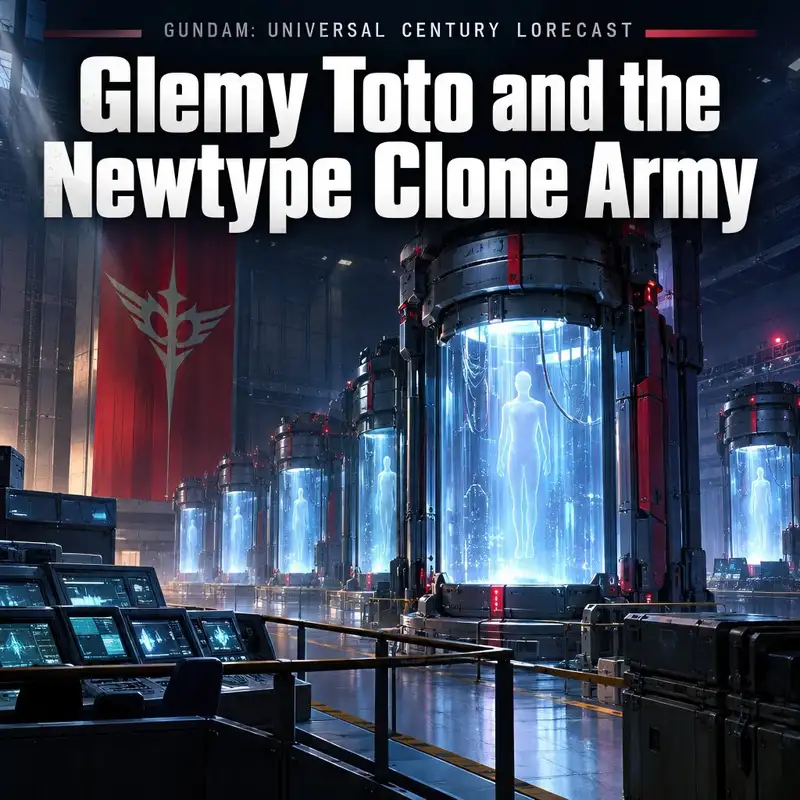
Glemy Toto and the Newtype Clone Army
Funnels came from every direction. The Gundam Team was not facing one exceptional Newtype pilot, or one experimental machine that could be isolated and overwhelmed. It was facing a formation. Glemy Toto’s mass-produced Qubeleys turned remote weapons into coordinated pressure, forcing pilots to watch multiple vectors at once while protecting their ships and one another. At the center of that threat stood Ple Two in the Queen Mansa, a mobile armor large enough, heavily armed enough, and controlled through a psycommu system demanding enough to dominate the immediate battle. The Queen Mansa destroyed the La Vie en Rose and battered the Gundam Team with a combination of heavy beam fire and funnels that made ordinary defensive maneuver increasingly difficult. For a few decisive moments, Glemy appeared to possess the future of mobile-suit warfare. He had not merely found a powerful pilot. He had assembled what looked like a Newtype arm: specialist machines, compatible operators, and a flagship weapon capable of breaking a battle open.
That appearance was the point. Glemy’s army was a military instrument, but it was also an argument. He was trying to prove that he possessed the means, the bloodline, and the force of will to replace Haman Karn as ruler of Neo Zeon. A claimant who could field an organized formation of Newtype-use mobile suits could present himself as more than an ambitious junior officer. He could present himself as the man capable of restoring the Zabi order through military superiority. Yet the weakness of that project existed before the first funnel launched. Glemy’s force was built around uncertain family claims, conditional alliances, and children whose obedience depended on isolation and coercion. It could create a terrifying tactical problem. It could not automatically create a government.
Neo Zeon had entered the First Neo Zeon War with an advantage created by the collapse of the Gryps Conflict. The Titans had been defeated, but the Anti-Earth Union Group, or AEUG, was exhausted by the struggle. The Earth Federation had survived, but it was politically compromised, militarily uneven, and still trying to understand how much authority it had lost to its own security institutions. Haman Karn moved into that opening. Operating in the name of Mineva Lao Zabi, the young heir of the Zabi family, Haman transformed the Axis remnant into Neo Zeon, a force capable of threatening colonies, intervening on Earth, and bargaining with the Federation from a position of armed leverage.
Mineva’s existence gave Haman’s regime a dynastic language. The Zabi name connected Neo Zeon to the Principality of Zeon, to the memory of the One Year War, and to a claim of continuity that could resonate with some supporters. But Mineva was not the practical ruler of the movement. Haman was. She commanded the military apparatus, shaped the diplomacy, managed the internal factions, and made the decisions that determined whether Neo Zeon could convert its military pressure into political power. The regency gave her authority, but it also created an obvious vulnerability. Any rival who could claim a closer, purer, or more legitimate connection to the Zabi family could challenge the arrangement without rejecting the regime’s own symbolism.
That was the opening Glemy Toto saw. His rebellion was not a revolution against Neo Zeon’s political culture. It was a fight over who had the right to own it. He did not argue that inherited legitimacy was a fraud, or that Mineva should be free of manipulation, or that Neo Zeon needed a broader political settlement with the colonies and the Earth Federation. He argued, in effect, that Haman had usurped a dynasty which belonged to someone else. The distinction mattered. Glemy’s coup did not challenge the militarized succession politics of Neo Zeon. It attempted to seize them.
At first, Glemy did not look like the architect of a state. He appeared within Mashymre Cello’s orbit as a young Neo Zeon officer with ambition, vanity, and a talent for making his importance known before he had fully earned it. He could be immature and self-regarding, but those qualities should not be mistaken for harmlessness. In a political-military system where patronage, access to elite units, and proximity to senior leadership mattered greatly, an officer who learned how to make himself useful could rise quickly. Haman recognized that Glemy had ability. She trusted him with increasing responsibility, including command of the cruiser Sandra. That promotion gave him ships, staff, access to information, and a place in the chain of command from which he could build a personal following.
Haman’s decision was not necessarily simple carelessness. Neo Zeon needed capable officers. It was conducting operations across a broad and unstable Earth Sphere, while competing factions, damaged institutions, and the demands of war put pressure on every senior commander. A ruler cannot personally supervise every ambitious subordinate, especially when the ruler’s own political system relies on personal loyalty. But patronage creates risks. The officer elevated to serve the regime may conclude that the regime exists to reward him. Glemy learned the habits of authority inside Haman’s system, then turned them against her.
His exact relationship to the Zabi family remains deliberately unsettled in the television-oriented record. Glemy makes claims of hereditary legitimacy, and later official material has preserved several competing explanations for his origin. He has been described in different contexts as a possible hidden descendant, a test-tube child, a clone-related figure, or something else entirely. Those explanations cannot be combined into one secure biography, and the television series does not provide enough evidence to settle the matter. What matters historically is not whether Glemy’s claim can be proven after the fact. What matters is that he believed, or at least understood, that an assertion of Zabi blood could be politically useful.
The Ple project became central to that effort because it promised to solve one of the hardest military problems in the Universal Century. Psycommu weapons were powerful precisely because they depended on rare human capabilities. A funnel system could attack from angles that conventional weapons could not easily cover. It could divide an opponent’s attention, exploit blind spots, and allow a mobile suit to threaten several targets in rapid succession. But the machine was not the whole system. It required a pilot able to perceive the engagement, direct the weapons, withstand the mental strain, and make decisions fast enough to use the system effectively. Newtype capability could not simply be ordered from a factory, and exceptional pilots could not easily be replaced.
Elpeo Ple showed both the military attraction and the human cruelty of that idea. She was a young Neo Zeon-created Newtype, talented enough to matter in combat and vulnerable enough to reveal the cost of the institution that produced her. Ple was not simply a laboratory product speaking in military terminology. She formed attachments, acted unpredictably, and responded to people around her, especially Judau Ashta. Her behavior made her difficult to reduce to an asset. That was not a failure of her humanity. It was a failure of the system’s assumption that a child could be made into property merely by placing her inside a weapons program.
Ple Two made the problem even clearer. The television record presents her as Ple’s twin or clone-derived counterpart, shaped by harsher conditioning and psychological manipulation. Her aggression and hostility are not evidence that she is an inhuman copy, nor proof that one version of Ple is real and the other is false. They are evidence of different treatment. The institution that developed her tried to suppress independence and cultivate obedience. It made combat capacity central to her identity. It taught her to regard connections with others as threats, because affection, memory, and choice could interfere with command control.
This was the logic Glemy adopted. Bloodline could be claimed. Newtype ability could be reproduced or at least imitated through a controlled series of related personnel. A line of young operators could be paired with Qubeley-derived machines, creating a force which looked both technologically modern and dynastically ordained. The plan had a brutal elegance. It treated the uncertainty of politics as a technical problem. If loyalty was unreliable, condition it. If Newtypes were rare, manufacture more. If legitimacy was contested, attach it to the Zabi name and display enough military power that rivals would have to accept the claim.
The Dublin campaign exposed the limits of that equation. Ple and Ple Two encountered one another in combat under circumstances that turned a military engagement into a confrontation between two people made from the same institutional violence. Ple operated a dismantled Qubeley Mark Two. Ple Two piloted the Psycho Gundam Mark Two, a machine designed around overwhelming firepower and Newtype control. Their encounter was dangerous because both possessed heightened perception and because each machine magnified the pilot’s capacity to act. This was not an ordinary contest of equipment. Both pilots could sense the other in ways that made surprise, fear, recognition, and emotional shock part of the tactical environment.
The battle also demonstrated that the clone project had not erased individuality. Ple recognized Ple Two not as a disposable enemy unit but as someone bound to her by a connection neither of them had chosen. Ple Two responded through the conditioning imposed upon her, with violence and hostility. Yet the very intensity of that response suggested that the imposed identity was not complete. She was not an empty shell executing commands. She was a person in conflict, trapped between the role built for her and an emerging awareness that another life might be possible.
Ple died protecting Judau. The immediate military fact was simple and terrible. A child soldier, already shaped by Neo Zeon’s Newtype program, gave her life in a battle produced by adult institutions competing for power. But the historical significance went beyond the loss of one pilot. The program had created a weapon that could confront its own origin. Ple Two was now living proof that the project could generate not only obedience, but comparison, memory, attachment, and resistance. Her existence raised a question that Glemy’s planners did not want to ask. If the Ple series could feel kinship, grief, and choice, then on what basis could Neo Zeon claim to own them?
Glemy took the wrong lesson. The Dublin encounter did not persuade him that the project itself was morally corrupt or militarily unreliable. Instead, he continued to treat control as the answer. If one conditioned Newtype was unstable, then command needed to be tighter. If human attachment disrupted obedience, then isolation and psychological pressure had to be reinforced. This is a familiar institutional response to the failure of coercion. Rather than recognize that coercion has created the instability, leaders often conclude that they have not applied enough of it.
When Ple Two was awakened from cold sleep and sent into combat against the Argama, Glemy demonstrated the practical character of that command system. She was not an officer brought into a briefing room, asked to understand an operational objective, and trusted to exercise judgment within commander’s intent. She was activated and directed toward a target. In the short term, this could be effective. A highly capable Newtype pilot in a powerful mobile weapon could threaten an enemy ship or force its pilots into a defensive posture. Under battlefield pressure, the distinction between a loyal subordinate and a controlled asset may seem academic. The weapon fires either way.
The Core Three episodes make the failure visible. Glemy orders Ple Two to assassinate Haman, turning his personal conflict with Neo Zeon’s ruler into a mission for a conditioned young pilot. The order itself reveals much about his political weakness. An assassination could remove a rival, but it could not settle the larger question of who would govern afterward, how the military would respond, or why ordinary Neo Zeon personnel should accept Glemy’s authority. Yet it offered the seductive promise of a clean solution. One weapon, one target, one decisive act.
Ple Two does not remain the obedient instrument Glemy expects. Her encounter with Lucina and the decision that allows the captive girl to escape show that the conditioning is already breaking down. The moment is important not because it transforms Ple Two into a conventional hero, but because it reveals the limits of command through psychological domination. Contact with another vulnerable person creates a response that the program has not authorized. Glemy sees a security failure. Judau sees someone being used and harmed. The difference between those interpretations is the difference between treating a person as equipment and recognizing that equipment does not suffer, but people do.
Judau’s role matters here, though the story is not primarily about him. He does not defeat Glemy’s system through a better bureaucratic design or a superior intelligence network. He reaches Ple Two through recognition, persistence, and a refusal to accept the identity imposed upon her as final. In military terms, that makes him an external pressure on Glemy’s command system. He introduces a variable that cannot be controlled by programming or threat. The Newtype connection shown in the series is extraordinary, emotionally powerful, and difficult to explain in ordinary scientific language. It should not be treated as a routine communications technology. What the record establishes is that Ple Two responds to connection in ways that undermine the political and military role Glemy assigned to her.
By December twenty-fifth, Universal Century eighty-eight, Glemy had converted his private project into open rebellion. He took control of Axis and openly challenged Haman. This was an audacious move. Axis was not merely a symbol. It was a strategic base, a mobile fortress, a source of military infrastructure, and a center from which Neo Zeon could project force. Holding it gave Glemy a platform from which to present himself as more than a dissatisfied subordinate. He now possessed territory, ships, a visible command structure, and access to elite weapons.
But a coalition is not a state. Glemy’s forces included dissident Neo Zeon personnel, the Space Wolf Team under Rakan Dahkaran, Ple Two, the clone-derived Newtype pilots, and the Qubeley formations associated with the Ple project. Each component brought something useful. Rakan and his veterans brought experience, conventional combat credibility, and the ability to lead soldiers who were not part of Glemy’s laboratory program. The Ple series brought specialized Newtype capability. The Qubeleys brought the ability to turn that capability into concentrated combat power. Glemy himself supplied ambition, a succession claim, and the willingness to gamble everything on a rapid seizure of authority.
What they did not share was a durable political foundation. Rakan’s participation did not mean that every veteran officer believed in Glemy’s dynastic story. It meant that a powerful commander had reasons to oppose Haman or seek advantage in the division. Regular Neo Zeon troops did not automatically become loyal because Glemy possessed Axis. The Ple series could be ordered into battle, but they were not citizens who had consented to a government or officers who had built careers within a common professional culture. They were controlled personnel whose loyalty was being assumed rather than earned.
Glemy’s claim on Mineva sharpened the contradiction. Mineva was still the central symbol around which Haman’s Neo Zeon derived a language of continuity. Glemy wanted to displace Haman while using that same Zabi legitimacy for himself. But legitimacy cannot be secured merely by capturing the symbols of a regime. A claimant must persuade, intimidate, bargain, or organize. Glemy could do some of each, but his strategy relied too heavily on spectacle. If the army could demonstrate overwhelming superiority, perhaps the political argument would settle itself. If the clone army could prove that he commanded the next generation of Newtype warfare, perhaps the question of succession would become irrelevant.
Civil war made that calculation worse. Neo Zeon was already fighting for influence across the Earth Sphere. It needed coherent fleet operations, reliable lines of communication, functioning logistics, and a political strategy for dealing with the Federation and the colonies. Glemy’s rebellion divided officers, ships, and attention at the moment when unity mattered most. The Earth Federation benefited from this fracture, as governments often benefit when their opponents destroy one another. But the Federation was not the sole cause of Glemy’s failure. The decisive weakness lay within his own force. He had split Neo Zeon in order to inherit it, then discovered that the act of splitting it reduced the value of what he hoped to inherit.
The mass-produced Qubeley was Glemy’s clearest attempt to answer this political weakness with military organization. The original Qubeley concept had been associated with rare Newtype-use combat systems and elite operators. Glemy’s version extended that lineage toward formation warfare. These Qubeley-derived machines carried funnels in enlarged storage arrangements and added active cannon armament, allowing them to threaten enemies through a blend of direct fire and remote all-range attack. The important feature was not simply the number of weapons attached to one machine. It was the possibility of several compatible machines attacking together.
A formation of Qubeleys could saturate an engagement zone. Enemy pilots had to track the parent mobile suits, incoming beam fire, and funnels approaching from different directions. Defending ships faced a related problem. Their gunners and escorts could not concentrate easily on one target when multiple mobile suits and remote weapons were dividing the battlespace. A local defense might defeat one attacker, but the formation could use that distraction to create openings elsewhere. Against opponents already tired, damaged, or protecting vulnerable vessels, the psychological effect was as important as the technical one. The enemy did not merely face greater firepower. It faced the impression that the usual rules of orientation and threat assessment had stopped working.
The television series shows a large force of these machines, while later official reference material supports the broader point that a formation of more than ten psycommu-equipped mobile suits represented an unprecedented danger. The exact total should not be treated as securely established. What matters is the change in concept. Glemy was moving from the exceptional Newtype ace toward a semi-standardized Newtype formation. He was trying to make all-range attack a unit capability rather than a singular feat of an extraordinary pilot.
The bottleneck had shifted rather than disappeared. Glemy had reduced the scarcity of suitable pilots only by relying on a tightly controlled program of clone-derived and conditioned children. The human operator remained the hardest component to replace. A damaged Qubeley might be repaired if the necessary facilities and parts were available. A psychologically exhausted or morally resistant pilot could not be restored to obedience with a spare part. Glemy had built an army around specialist warfare, but its specialists had been denied the security and trust that make military organizations durable.
The Queen Mansa represented the same concept in concentrated form. It drew on the technological lineages of the Psycho Gundam and the Qubeley, combining heavy beam armament, funnels, and a psycommu-centered control system into a single massive breakthrough weapon. On the battlefield, it was formidable. It had the firepower to threaten ships directly, the remote weapons to complicate mobile-suit defenses, and the size and armor to endure punishment that would disable less heavily built machines. Its attack on the La Vie en Rose demonstrated that it could impose operational costs beyond a duel with the Gundam Team. It could destroy a support vessel and reduce the enemy’s ability to sustain damaged machines, move personnel, and retain options in the campaign.
Against the Gundam Team, the Queen Mansa also showed what a concentrated Newtype-use platform could do when paired with a capable pilot. It could overwhelm the immediate defensive rhythm of several enemy mobile suits. It forced them to react rather than maneuver on their own terms. But a breakthrough weapon is not the same thing as a complete operational system. The Queen Mansa concentrated risk as well as firepower. Its effectiveness depended heavily on Ple Two’s ability to bear its cognitive load. A machine with many weapons, many attack angles, and an immense field of action does not remove pilot workload. It intensifies it.
The mobile armor also required a support structure. It needed maintenance, protection, supplies, command coordination, and a plan for what happened if it was damaged, isolated, or deprived of its pilot. Glemy could use it as a symbol of power because it was spectacular. Yet spectacle can conceal dependence. The Queen Mansa was not a self-sustaining state. It was one weapon system resting on one exploited young woman, within a coalition already struggling to establish who was actually in command.
Ple Two bore the burden of that design. Her military performance was genuine. She was not simply being carried by the machine, and it would be a mistake to deny her agency by describing her only as a victim. She made decisions, fought with skill, and responded to the people around her. But her skill existed within circumstances she had not chosen. The institution that developed her had weaponized her perceptions, isolated her from ordinary human bonds, and demanded that she function as the core of a political-military project she could not reasonably understand as her own. The Queen Mansa magnified her combat capacity while also magnifying the pressure placed upon her identity.
That contradiction destroyed Glemy’s assumptions at the decisive moment. Ple Two responded to Judau, and the bond that emerged between them could not be reduced to a command signal or a technical malfunction. The series depicts an extraordinary Newtype recognition and emotional influence, but it does not provide a settled scientific formula for it. What can be said with confidence is that Glemy’s most important asset no longer behaved as an asset. Ple Two recognized a claim on herself stronger than the one imposed by her commander. She chose to withdraw from the role he had designed for her.
Militarily, this was catastrophic. The Queen Mansa was not merely another unit in Glemy’s order of battle. It was the centerpiece of his striking power and the proof he hoped would compel acceptance of his authority. When Ple Two ceased to serve his purpose, he lost more than a powerful mobile armor. He lost the demonstration on which his political argument depended. The Newtype army was supposed to show that Glemy could command the future. Instead, its most formidable pilot showed that his command rested on a false understanding of loyalty.
Glemy tried to stop Ple Two. The act revealed the poverty of his command relationship. He had no language of persuasion available to him because he had built no relationship of trust. He could threaten, order, and demand, but those tools worked only while the person on the receiving end accepted the role assigned to her. Once Ple Two rejected that role, Glemy was left with the raw fact of his weakness. He had attempted to own another person’s identity, and he discovered that possession was not command.
Roux Louka killed Glemy from the Zeta Gundam during this collapse. The shot ended his rebellion in immediate military terms, but it did not create the conditions that made the rebellion fail. By then, his coalition had already begun to unravel. His personal authority had been exposed as dependent on an uncertain dynasty, a divided Neo Zeon officer corps, and a Newtype weapons program that could not guarantee obedience. His death was sudden. The failure behind it had been developing since the moment he decided that biological engineering and dynastic symbolism could replace political legitimacy.
Glemy’s clone army still changed the final phase of the war. Tactically, it made the campaign more dangerous. The coordinated Qubeley formations demonstrated the threat posed by concentrated psycommu-equipped mobile suits. The Queen Mansa showed how a single high-performance Newtype platform could disrupt enemy operations and inflict severe losses. These systems forced the Gundam Team and its allies to face a kind of attack geometry that ordinary mobile-suit doctrine did not easily solve. Remote weapons, Newtype perception, and concentrated beam fire created a genuine local advantage.
Strategically, neither Glemy nor Haman converted battlefield strength into lasting control of the Earth Sphere. Haman retained greater political experience and a more established position within Neo Zeon, but she could not prevent the succession crisis from becoming open war. Glemy possessed elite weapons and a compelling display of military innovation, but he could not turn those tools into a stable government. The Earth Federation benefited from Neo Zeon’s collapse, but that benefit should not be confused with a Federation masterstroke. Neo Zeon’s internal divisions had already done much of the work.
Institutionally, the Ple project exposed a deeper failure within Neo Zeon’s military culture. It treated Newtype potential not as a human development to be understood, protected, or allowed to remain unpredictable, but as material to be standardized for war. The effort was sophisticated in technical terms and bankrupt in moral terms. Children were conditioned, isolated, and placed inside weapon systems beyond the demands made of ordinary soldiers. The program sought to create loyalty by controlling identity. It instead created a force whose greatest strength carried within it the possibility of refusal.
That moral fact was not separate from the military outcome. Ple Two’s autonomy was not an irrelevant personal subplot interrupting a battle. It was the central operational vulnerability of Glemy’s army. His command system depended on denying that she possessed an autonomous self. When that denial failed, so did the system built upon it. The same was true at a larger scale. Glemy denied that legitimacy required consent, durable institutions, and shared political purpose. He believed superior machines could make those requirements unnecessary. They could not.
Glemy Toto’s Newtype clone army failed because it was designed to make legitimacy, loyalty, and institutional competence unnecessary. Its machines were formidable, and its pilots were dangerously capable, but the force rested on an uncertain dynasty, an opportunistic coalition, and the coercion of children whose humanity could not be engineered out of them.