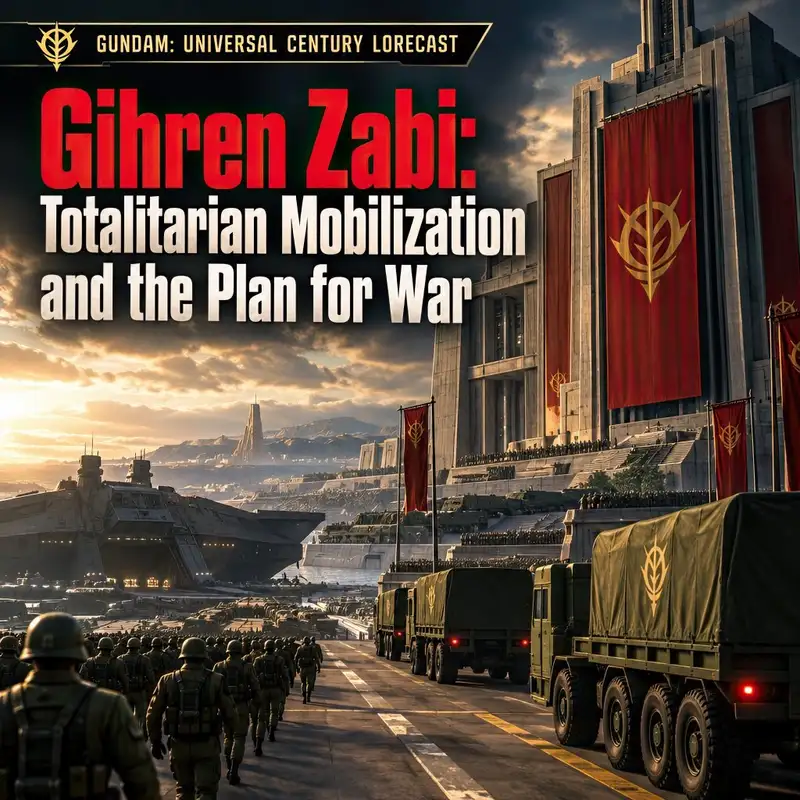
Gihren Zabi: Totalitarian Mobilization and the Plan for War
The Federation assault on A Baoa Qu had begun when Degwin Sodo Zabi made his own move to end the war. The formal head of the Principality of Zeon boarded the Great Degwin and sought contact with General Revil, one of the Federation’s most important commanders. Degwin was not trying to win a better tactical position. He was trying to stop a war that had consumed Zeon’s strength, devastated the Earth Sphere, and brought the Federation to the gates of the regime’s final fortress.
Gihren Zabi saw something else. He saw a rival authority acting without his permission, a possible peace that could limit his power, and a father willing to negotiate with the enemy rather than accept the final battle Gihren had chosen. His response was the Solar Ray. The weapon fired along the path of Degwin’s ship and the Federation formation around Revil. It killed the Federation commander, destroyed a major part of the attacking force, and killed Degwin as well.
The immediate military result was immense. The political meaning was even greater. At the moment Zeon needed coherent leadership, Gihren demonstrated that no institution, family bond, or prospect of peace stood above his own definition of victory. A Baoa Qu was not merely a battlefield for famous pilots. It was a fortress, fleet base, command center, and political headquarters. By ordering the Solar Ray fired, Gihren turned that headquarters into the center of a struggle within the Zabi regime itself.
The order was not an improvised act of desperation. It was the final expression of a political system Gihren had spent years shaping. His career explains how a spacenoid independence movement became a centralized war state. It also explains why that state could strike the Earth Federation with extraordinary force in the opening days of the One Year War, yet prove incapable of surviving strategic defeat, internal disagreement, or the limits of its own violence.
Side Three’s original grievance was real. The Earth Federation governed an expanding human civilization in which political power, wealth, and institutional attention remained heavily concentrated around Earth. Space colonies were not empty industrial platforms. They were communities with workers, families, local economies, and political interests. Many colonists had good reason to believe that decisions affecting their lives were being made by distant authorities who treated space as a resource frontier rather than a collection of societies deserving meaningful representation.
In Universal Century fifty-eight, Side Three declared independence and established the Republic of Zeon under Zeon Zum Deikun. Deikun gave political language to spacenoid frustration. He argued that humanity’s movement into space should produce a new political consciousness and a new relationship between Earth and the colonies. Whatever one makes of his broader philosophy, the central issue was not imaginary. The Federation’s political order had not kept pace with the civilization it claimed to govern.
But an independence movement can be captured by people whose ambitions exceed independence. After Deikun’s death, Degwin Sodo Zabi became Side Three’s leading political figure. By Universal Century sixty-nine, the republic had become the Principality of Zeon. That change mattered. It marked a movement away from republican language and toward hereditary rule by the Zabi family. The state still used the language of spacenoid dignity and self-determination, but practical power increasingly rested in a dynasty, its armed forces, its security apparatus, and the institutions prepared to carry out its will.
The television record does not provide a complete constitutional history of this transformation. It does not need to. The direction is clear enough. A political movement built around colonial grievance became a militarized state in which authority was concentrated within one family. The change was not simply cosmetic. Once the state defined itself through hierarchy, obedience, and armed preparation, it became easier to present dissent as disloyalty and compromise as betrayal.
Gihren was the most important architect of that transformation. In the television-era record, he is a thirty-five-year-old admiral and the de facto supreme leader of the Principality. Degwin remains the formal head of state, but Gihren exercises the kind of political and strategic authority that determines the state’s direction. He is not merely an officer in uniform. He is a political organizer who understands that war requires more than weapons and plans. It requires a population conditioned to accept sacrifice, enemies defined as less than fully human, and institutions that place the state’s purpose above individual life.
Reference material associated with the television setting identifies Gihren with a doctrine called the Theory of the Superior Human. Its essential idea is not difficult to see in his wartime conduct. Gihren regarded Zeon’s population as an elite community entitled to rule the Earth Sphere. He did not treat humanity’s future in space as a reason to expand political equality. He treated it as a reason to create a hierarchy, with Zeon at the top and other populations available for control, displacement, or destruction.
That was a profound departure from the political problem that had given Zeon its original appeal. Zeon Zum Deikun’s ideas about humanity’s future in space could be interpreted as a challenge to Earth-centered government and stagnant political institutions. Gihren turned human development into an instrument of state power. Even the prospect of Newtypes, people associated with new forms of perception and communication, became in his thinking a resource to be managed by a victorious Zeon rather than evidence that humanity might need a more humane political order.
The distinction matters because ideology was not decoration around Gihren’s strategy. It authorized policy. It determined who deserved protection, who could be sacrificed, and what forms of violence could be called necessary. A state that sees whole populations as inferior, obstructive, or disposable will make different military choices from one that sees those populations as political communities. Gihren’s later actions were not contradictions of his ideology. They were its operational consequences.
Before the One Year War began, Zeon had already invested heavily in the military tools needed to challenge a much larger opponent. By Universal Century seventy-three, Zeon had completed its first mobile weapon. That achievement rested on more than an inspired engineer or a single revolutionary machine. It required research institutions, factories, test programs, trained pilots, mechanics, supply networks, ship support, and a government prepared to direct resources toward military development.
Mobile suits offered Zeon an answer to the battlefield created by Minovsky particle warfare. Under heavy particle conditions, long-range electronic detection and communications became less reliable. Fleets could no longer expect to find, track, and destroy one another from vast distances with the confidence assumed by earlier doctrine. The value of local initiative increased. So did the value of a compact combat machine that could maneuver in space, identify targets at close range, carry substantial weapons, and operate from warships or bases.
The Zaku was not important because it was a dramatic machine in isolation. It was important because Zeon had built doctrine and support around it before the Federation had done the same. The machine gave Zeon a qualitative edge, but only because crews could launch it, technicians could service it, commanders could employ it, and industrial organizations could keep producing parts and replacements. Mobile suits were a system, not a miracle.
Gihren’s strategic problem was straightforward and severe. Zeon was smaller than the Earth Federation. The Federation possessed greater population, greater territorial depth, and a larger industrial base. Zeon could not reasonably expect to win a prolonged contest of replacement if the Federation had time to organize its advantages. Therefore, Zeon’s early strategy had to create shock. It had to gain time, seize initiative, and impose a political crisis before the Federation’s larger system could adapt.
On January third, Universal Century seventy-nine, Zeon declared independence and war against the Earth Federation. The opening campaign reflected the logic of a smaller power trying to defeat a stronger one before that stronger power could turn potential into usable force. Surprise, mobile-suit superiority, rapid attacks, and aggressive escalation all served that purpose. Zeon did not need to outproduce the Federation immediately. It needed to make the Federation’s numerical strength irrelevant long enough to force a political decision.
Gihren helped shape that political-military direction, but he did not personally administer every operation. Zeon’s armed forces contained distinct commands, formations, research organizations, and local authorities. Individual commanders made operational decisions under conditions Gihren could not fully observe. Still, the overall design of the war bore his mark. It assumed that a violent opening blow could compensate for Zeon’s structural disadvantages and create an Earth Sphere ordered around Zeon’s interests.
For a time, the plan worked. Federation forces were surprised by the mobile suit’s effectiveness. Zeon gained rapid operational success and demonstrated that the Federation had been dangerously unprepared for the new conditions of war. But no mobile suit, however capable, eliminated the need for crews, carriers, repair facilities, ammunition, propellant, spare parts, training, and replacement pilots. Zeon had created a formidable striking force. It had not escaped the arithmetic of a long war.
More importantly, Gihren did not limit his strategy to defeating Federation military power. He made mass violence against civilian populations part of the war’s design. The early campaign included chemical attacks against colonies and Operation British, the attempt to use a colony as a weapon against Earth. These were not unfortunate accidents produced by confused combat near civilian areas. They were deliberate acts of mass destruction.
The operational purpose of Operation British was clear enough. A colony transformed into a strategic weapon could destroy infrastructure, cripple the Federation’s capacity to continue the war, terrorize the surviving population, and force political surrender. It was an attempt to reshape the conflict in a single catastrophic stroke. But the military purpose cannot be separated from the political worldview behind it. To use a colony in this way was to treat an inhabited society, with its life-support systems and civilian population, as material for a larger project of coercion.
The broad historical framing of the One Year War describes the losses from these early operations on a civilization-shattering scale. Precise demographic totals vary across reference accounts, and the television series itself does not provide a reliable ledger of every death. The exact number is less important than the nature of the decision. Zeon’s leadership accepted, and Gihren’s strategy helped direct, the destruction of populations on a scale that could not be explained away as ordinary military necessity.
A colony was not simply a large cylinder that happened to be in space. It was housing, transport, food production, industry, schools, families, and political life inside a fragile artificial environment. Gassing a colony or turning one into a projectile meant killing people who had no meaningful role in the military contest. It also meant declaring that their status as civilians placed no limit on state violence.
That is where Gihren’s totalitarian mobilization became most visible. He did not merely demand sacrifice from Zeon’s own citizens. He divided humanity into populations whose lives carried different political value. Zeon’s people were to be mobilized as an elite national community. Others could be ruled, displaced, terrorized, or annihilated if their destruction served the state’s objective. The idea of independence had become inseparable from conquest and population control.
The result was catastrophic harm, but not durable political control. Operation British did not produce the clean strategic decision Zeon required. It did not remove the Federation’s ability to fight. It did not solve Zeon’s industrial weakness. It did not create legitimate authority over Earth or the colonies. Terror can destroy infrastructure and frighten populations. It cannot by itself create consent, stabilize an occupation, or make a smaller state able to sustain a long war against a larger industrial opponent.
The Earth Federation’s corruption, complacency, and failure to address colonial inequality remain central to the history of the Universal Century. They explain why Zeon’s appeal found an audience. They do not justify chemical warfare, conquest, or mass killing. Gihren did not solve the political problem between Earth and space. He exploited it, then made peaceful resolution harder by binding Zeon’s cause to atrocities that could not be undone.
Gihren’s regime also contained a contradiction at its center. His power was highly centralized, but Zeon was not institutionally unified. Degwin held formal authority as head of state. Gihren exercised practical supremacy. Dozle Zabi commanded major space forces and became central to the defense of Solomon. Kycilia Zabi led the Assault Mobile Fleet and maintained her own political reach, intelligence connections, and military following. Garma Zabi served as a regional commander and a highly useful family symbol.
This was not a clean chain of command. It was a family-centered distribution of power, held together by shared interest, fear, rivalry, and the apparent momentum of victory. Such arrangements can accelerate decisions in the short term. A ruler does not need to negotiate with independent institutions when relatives and loyalists command the principal levers of force. But the same system weakens accountability. It rewards personal access. It encourages commanders to protect their own networks. It makes honest reporting dangerous when bad news may be interpreted as disloyalty.
Gihren could issue broad strategic direction, but he could not erase the separate ambitions of his siblings. Kycilia in particular possessed her own base of authority. Her intelligence reach gave her access to information that could not be completely controlled from Gihren’s headquarters. Dozle’s command responsibilities gave him a different perspective on the war’s military burden. Degwin’s formal position preserved a competing source of legitimacy, even after his practical influence had declined.
The regime therefore looked more united than it was. Its ceremonies, uniforms, speeches, and family symbolism projected coherence. Beneath that surface, authority overlapped. No stable mechanism existed to resolve a fundamental disagreement between Gihren’s will, Degwin’s title, Kycilia’s ambition, and the military demands faced by commanders in the field. The state’s strength depended on personal supremacy. That made it brittle.
Garma’s death revealed how effectively Gihren could turn personal tragedy into political power. Garma had been a Zabi son, a commander, and a public representative of the regime’s ruling family. His death was a military setback and a private loss. Gihren treated it as something else as well: an opportunity to mobilize the population through grief.
At Garma’s funeral, Gihren transformed mourning into a state ritual. The ceremony did not simply honor the dead. It instructed the living. Garma’s death became evidence of enemy cruelty, a demand for sacrifice, and a reason to continue the war with greater intensity. The message was aimed not only at soldiers but at the wider Zeon population. Their grief was to become obedience. Their pain was to become political fuel.
That is what propaganda means in a wartime state. It is not merely a poster or a speech. It is a practical instrument for sustaining morale, maintaining discipline, recruiting support, narrowing the space for dissent, and making continued sacrifice appear morally unavoidable. A government at war must explain why people should endure loss. Gihren’s method was to merge the nation, the family, and the war into one emotional demand.
Degwin objected to exploiting Garma’s death in this way. That objection is revealing. Degwin was no democratic reformer, and he had allowed the Zabi regime to emerge. But even he recognized the extremity of Gihren’s political method. Gihren did not treat the funeral as an occasion for restraint or reflection. He used it to intensify the war and reinforce his own vision of Zeon’s destiny.
The funeral also shows why totalitarian mobilization can be so effective in the short term. It converts diffuse anxiety into a simple moral story. The state is under attack. The fallen are martyrs. Doubt dishonors the dead. Continued war becomes a test of loyalty. Such a message can bind a population together, especially when wartime censorship, fear, and genuine grief limit the ability to question it.
But propaganda cannot replace strategic resources. It cannot manufacture new shipyards, train experienced pilots overnight, repair damaged fleets, or create an industrial base equal to that of the Federation. It can make retreat politically costly. It can make negotiation appear treasonous. It can persuade leaders to continue a war after the conditions that justified the original gamble have changed. In that sense, Gihren’s greatest political strength became one of his greatest strategic weaknesses.
As the One Year War continued, the Federation adapted. Its initial failure to anticipate Zeon’s mobile-suit advantage was serious, but it was not permanent. Federation development of the Gundam and related systems demonstrated that the larger power had begun to learn from the battlefield. The Gundam was important as a prototype and combat machine, but it did not win the war by itself. Its greater significance was as evidence that the Federation could develop mobile-suit capability, gather experience, and begin integrating that experience into a wider mobilization.
The Federation’s advantage lay not in a single machine but in its capacity to absorb shock. It possessed broader industry, more territory, and a larger pool of manpower. Those resources did not automatically produce competence. Bureaucratic delay, uneven readiness, and early battlefield failures had shown that clearly. Yet once the Federation adjusted, Zeon faced the problem it had tried to avoid from the beginning: a war of endurance.
Zeon had to sustain operations across dispersed fronts. It had to maintain mobile suits and ships far from the industrial centers that supported them. It had to replace combat losses, train new pilots, preserve experienced technical personnel, defend strategic bases, and continue fighting while the Federation’s industrial system became more effective. A smaller state can achieve remarkable results through preparation and superior doctrine. It still has to survive the cumulative burden of attrition.
Gihren’s political system made adaptation harder. Totalitarian states can direct resources quickly, especially when leaders are willing to ignore legal and moral limits. They can also create incentives to hide failure. A commander who reports a deteriorating position may look disloyal. An official who recommends withdrawal may appear weak. A politician who suggests negotiation can be accused of betraying the dead. The system becomes skilled at demanding confidence and poor at hearing unwelcome facts.
This did not mean Zeon’s commanders were uniformly incompetent, or that every defeat resulted from Gihren’s interference. The war was shaped by many decisions, many fronts, and many people. But Gihren’s strategic judgment imposed a dangerous political condition on all of them. The longer the war continued, the more he needed a negotiated end or a decisive result. The more he treated either possibility as unacceptable, the more he converted a difficult war into an existential gamble.
The fall of Solomon marked one of the clearest signs that the balance had turned. Solomon had been a major Zeon fortress and an important node in its space defense. Its loss was not simply the capture of a dramatic battlefield. It weakened Zeon’s defensive system, reduced its ability to shape the approaching campaign, and demonstrated that the Federation could now bring substantial force against Zeon’s fortified positions.
In the television account, Gihren responded by presenting A Baoa Qu as Zeon’s final defensive line. The fortress had real military value. It contained defensive infrastructure, fleet support, command facilities, and the political center of the remaining regime. It was the kind of position from which a defender might impose severe costs on an attacking fleet. But a fortress is not a solution to strategic insolvency.
A Baoa Qu could concentrate surviving strength. It could not restore lost industrial capacity, replace every ship and pilot already consumed, or reverse the Federation’s growing ability to mobilize. It could delay defeat. It could perhaps influence the terms of a settlement. What it could not do was repair the political and military balance that had produced the crisis.
By concentrating Zeon’s remaining leadership, military assets, and political symbolism in one location, Gihren also increased the consequences of failure. If A Baoa Qu held, the regime might claim continued authority. If it collapsed, there was no deeper institutional reserve behind it. The final defense became inseparable from the survival of Gihren’s own system of rule.
Degwin reached a different conclusion. He had watched the war expand beyond the scale at which its original political objectives could plausibly justify its cost. He also understood, however late, that Zeon could not simply will a favorable outcome into existence. His decision to seek contact with Revil aboard the Great Degwin was an effort to open a path toward negotiation before the final battle destroyed what remained.
The initiative revealed the collapse of formal authority inside the Principality. Degwin was head of state. Yet he had to bypass the man who exercised real power in order to pursue peace. In a functioning system, a head of state seeking negotiations would use established political channels, consult responsible ministers and commanders, and define the terms on which the state could end a war. In Zeon’s system, peace itself had become an act of internal rebellion.
Gihren’s decision to fire the Solar Ray produced an immediate military gain. The weapon devastated a substantial portion of the Federation force and killed General Revil. At the operational level, it disrupted the assault at a critical moment. Any commander facing an approaching enemy fleet would recognize the tactical value of destroying enemy ships before they could join the battle.
But the Solar Ray order did more than strike the Federation. It removed Degwin, the one person whose formal legitimacy could challenge Gihren’s supremacy. It also destroyed the possibility that Degwin’s initiative might create a negotiated end to the war. Gihren chose battlefield effect and personal control over the political flexibility Zeon desperately needed.
That was strategic self-destruction. The Solar Ray did not restore Zeon’s industrial position. It did not guarantee A Baoa Qu’s survival. It did not recreate the forces lost at Solomon or elsewhere in the war. It did not make the Federation abandon its offensive. It killed an important enemy commander, but it also killed the ruler whose title gave the Zabi state a measure of continuity.
The political effect was ruinous because it exposed the real nature of Gihren’s authority. He was not defending a shared national interest against a weak or compromised leader. He was willing to murder his own father when that father threatened to limit his control. A regime built around family rule had always depended on the idea that the Zabis represented a unified national household. Gihren destroyed that image with one order.
Kycilia understood what had happened. Once she learned that Gihren had deliberately caused Degwin’s death, she no longer had reason to believe that loyalty to him protected anyone or served any interest beyond his own. During the Battle of A Baoa Qu, she shot Gihren. The scene can be remembered as family melodrama, but it was more consequential than that. It was a command collapse at the decisive moment of Zeon’s final defense.
Gihren had concentrated authority so thoroughly that his removal created an immediate vacuum. A resilient military system has procedures for succession, delegated responsibilities, and institutions capable of continuing an operation when senior leaders are killed or cut off. Zeon had networks of command, skilled officers, and formations still fighting. But it did not possess a stable political mechanism capable of absorbing the loss of its de facto ruler while the state’s survival was at stake.
Kycilia’s action did not redeem the regime. She was not restoring a constitutional order or offering a durable alternative. Her assassination of Gihren revealed the terminal fragmentation of the system the Zabis had built. Personal rule had reached its logical end. When the supreme leader proved willing to destroy the formal head of state, another family power center responded with violence of its own.
The military consequence was immediate. Leadership continuity, coordination, and strategic direction were damaged while the battle continued. Zeon forces still possessed weapons, ships, mobile suits, and defensive positions. But war is not only a collection of armed machines. It is the ability to direct them toward a coherent objective. At A Baoa Qu, the regime’s internal collapse became as decisive as the Federation’s external assault.
Gihren Zabi’s achievement was real, and it was terrible. He helped turn Zeon into a state capable of challenging a materially stronger Earth Federation. He linked industrial preparation, military innovation, propaganda, political coercion, and strategic surprise more effectively than the Federation expected. Zeon’s early victories were not accidents. They reflected planning, technological preparation, and a willingness to take risks that the Federation had not anticipated.
But Gihren’s system failed because it confused mobilization with legitimacy. It treated obedience as unity, terror as control, and destruction as strategy. It could demand sacrifice, but it could not create a durable political settlement. It could inspire fear, but it could not solve the material burden of a long war. It could concentrate power in one leader, but it could not manage disagreement, succession, or the possibility that the leader himself might become the greatest threat to the state.
Zeon’s early tactical and operational successes did not produce strategic sustainability. The Solar Ray’s devastating strike did not produce political survival. Garma’s funeral propaganda did not restore the fleets, factories, and trained personnel lost to attrition. A Baoa Qu’s defenses did not reverse the balance of industry and manpower. The regime had built formidable instruments of war, but it had not built institutions capable of surviving military failure or political compromise.
The deeper failure was moral as well as strategic. Gihren made mass death a tool of policy. He turned civilian populations into targets of population engineering. He converted a real struggle over colonial inequality into a project of dictatorship and conquest. In doing so, he ensured that Zeon’s claim to represent spacenoid liberation would remain inseparable from the destruction ordered in its name.
Gihren’s strength was his ability to mobilize a state for war, and that was also the limit of the system he built. It could demand sacrifice, accelerate weapons programs, turn grief into propaganda, and concentrate authority behind a single political vision. It was far less capable of absorbing dissent, negotiating retreat, or surviving a conflict inside the ruling family. By the time Degwin sought another path, peace itself threatened Gihren’s control. The Solar Ray destroyed enemies, but it also destroyed the sovereign whose title still anchored the regime. Zeon reached A Baoa Qu with formidable weapons and no stable way to manage its own leadership crisis. The state did not merely lose a battle. It revealed how brittle total power becomes when the person at its center can no longer be corrected.