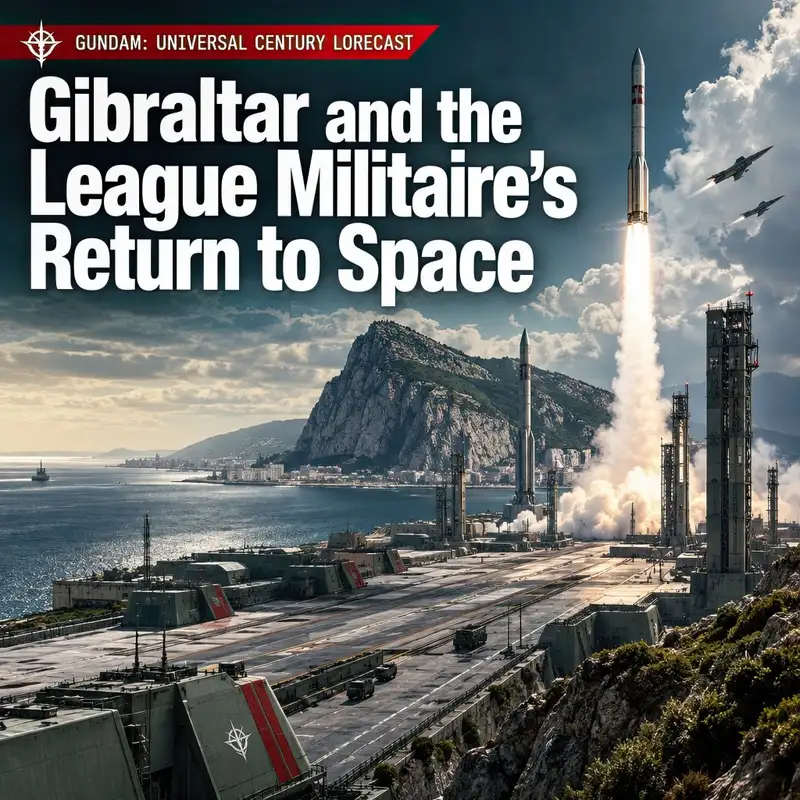
Gibraltar and the League Militaire’s Return to Space
Arti Gibraltar was built to move people away from Earth. In the Zanscare War, that civilian purpose made it more valuable than a fortress. Its mass driver offered a route from the surface into orbit, a route that could carry personnel, supplies, mobile suits, and the political will to use them. For the League Militaire, control of that route would determine whether it remained a hunted resistance force moving across Europe or became capable of contesting Zanscare where the empire’s larger strategic systems operated. The mass driver was not a weapon in the ordinary sense. It did not destroy an enemy formation or hold a defensive line. It created mobility. And in a war divided between Earth and space, mobility was power.
That made Gibraltar dangerous for everyone around it. A transport center is not empty terrain waiting for armies to claim it. It contains workers, travelers, launch crews, maintenance teams, civilian administrators, vehicles, structures, and systems that cannot be casually moved out of the line of fire. The same facilities that could send a resistance force toward orbit could also become targets, bargaining chips, or hostages. Zanscare understood that. So did the League Militaire. Neither side could treat the place as politically neutral once it became strategically decisive. Yet neither could destroy it without destroying the very access to space they wanted to control.
The struggle at Gibraltar, in Universal Century one hundred fifty-three, was therefore not mainly a contest for a patch of ground. It was a fight over connection. Zanscare wanted to deny the League Militaire access to the orbital war and to bring the space-emigration corporation under its authority. The League Militaire needed the launch facility to survive as more than a local insurgency. The Earth Federation, meanwhile, was present in fragments. Some Federation personnel and units still possessed ships, training, and professional habits. But the Federation did not appear as a coherent government capable of defending its own strategic infrastructure. That absence shaped every decision made at Gibraltar.
The League Militaire had courage, mobile suits, local supporters, and a growing reputation for resistance. It did not possess the full structure of a state military. It had no secure continental rear area, no dependable chain of depots, no large pool of replacement pilots, and no guarantee that civilian authorities would cooperate when threatened. Its formations were mobile because they had to be. A convoy could evade a stronger enemy, improvise repairs, and collect support from communities that opposed Zanscare rule. But a convoy could not manufacture spare parts at will, replace experienced personnel quickly, or move an entire force into orbit without infrastructure already built and defended by somebody else.
The Shrike Team represented both the League Militaire’s strength and its vulnerability. Its pilots were experienced, capable, and willing to take on missions that regular forces might have avoided. Their Gun-EZ mobile suits were practical combat machines rather than unique symbols. They could be maintained and employed as part of a small resistance force. But the team was thin. Every pilot had to perform several jobs at once. A mobile suit team might serve as escort, reconnaissance screen, reserve, rear guard, and visible proof that the League Militaire could protect the people who supported it. That is an efficient use of scarce personnel only until the fighting begins. Then it becomes a recipe for exhaustion.
The Victory Gundam added another kind of capability. Its unusual design gave Uso Ewin flexibility and survivability in situations where conventional machines might have been trapped or overwhelmed. But the Victory Gundam was not a substitute for an army, a transport service, or a fleet. It still required support crews, parts, ammunition, fuel or propellant, recovery procedures, and a place to land when damaged. A mobile suit can defend a launch facility. It cannot replace the launch facility. It can defeat an enemy machine in local combat. It cannot by itself create a secure route between Earth and orbit. Gibraltar made that distinction painfully clear.
The League Militaire’s answer to this problem arrived in the form of the Reinforce. The ship was not a miraculous new warship and not the later Reinforce Junior. It was an old Federation vessel, derived from the Clap class and already carrying the limitations of age. Its value lay elsewhere. Under Captain Roberto Gomez, the Reinforce brought trained personnel, a command structure, maintenance capacity, medical support, hangar procedures, and the ability to launch and recover mobile suits as part of an organized operation. Those functions are easy to overlook beside a Gundam in combat. They are also what turn individual acts of resistance into sustained military activity.
Zanscare’s approach showed that the empire understood the political value of the facility. Its military arm, BESPA, did not begin only with bombardment. Chronicle Asher appeared as a negotiator. That role was not a sign that Zanscare lacked force. It was an attempt to obtain control without paying the full political and material cost of destroying the infrastructure it wanted. The empire needed the space-emigration corporation to submit. It needed the facility’s systems, workers, and routes to remain usable. A military can occupy a perimeter. It cannot easily operate a complex civilian transport system if every technician, administrator, and local resident sees it as an instrument of coercion.
Chronicle’s negotiation also carried a threat that did not need to be stated in every sentence. Zanscare had the ability to escalate. It had forces in the region, mobile suits, and a political system accustomed to turning opposition into an example. The demand for submission placed the corporation in an impossible position. If it complied, it became a tool of occupation. If it resisted openly, it risked bringing combat into a heavily populated transport center. Such choices are common in wars of occupation. Neutrality becomes difficult when one side can compel access to the roads, ports, airfields, or launch systems on which civilian life depends.
Zanscare had additional reasons to secure Gibraltar. Fuala Griffon was being moved toward space after earlier failures had placed her under intense pressure within the Zanscare system. The operation was therefore not merely about defeating the League Militaire. It was also about discipline, status, and control inside the empire’s own military structure. Zanscare’s officers did not operate outside politics simply because they wore uniforms. Their assignments were shaped by failure, punishment, personal advancement, and the expectations of a regime that demanded visible obedience. Gibraltar became one more place where military action served internal political purposes.
The League Militaire, for its part, could not afford to respond as though this were a normal diplomatic dispute. It knew what Zanscare control of the mass driver would mean. Still, resistance forces face a recurring danger in such confrontations. Their anger is real. Their losses are real. Their need to defend supporters is real. But a stronger opponent can exploit an emotional reaction to create a pretext for escalation. The Shrike Team had already suffered losses, and its members had every reason to distrust Zanscare promises. Their response was understandable. It was also useful to an enemy seeking to portray military coercion as a response rather than an act of aggression.
On April seventeenth, the confrontation became open fighting. One Shrike Team mobile suit was lost. The record does not provide a reliable complete account of every casualty or every machine involved, and it does not need to. The important fact is that the League Militaire could not absorb losses as easily as BESPA could. A small resistance formation does not lose only a machine when a pilot is killed. It loses experience, local trust, accumulated teamwork, and one more person who understands how to operate under pressure with limited supplies and uncertain command. For a regular army, replacement is difficult. For a resistance movement, it can be nearly impossible.
For that reason, Gibraltar was not a clean defensive success even when the League Militaire managed to keep fighting. The Shrike Team was being used as a combat arm and as a political shield for the facility. Its members had to demonstrate that Zanscare could not simply seize civilian infrastructure at will. At the same time, every sortie risked weakening the force needed to protect the next convoy, the next launch site, or the next group of civilians caught between two armed organizations. Resistance warfare often produces a cruel arithmetic. The people best able to defend a community are also the people the movement can least afford to lose.
Zanscare then introduced the Memedorza, an experimental mobile suit designed to improve on the limitations of earlier ground-use beam-rotor arrangements. Its rotors were mounted on the shoulders, while thermal jets in the legs supported its mobility. Around Gibraltar, these features mattered because the battle was taking place near fixed structures, support equipment, and a launch system that could not retreat. A mobile suit with unusual ground mobility did not have to destroy every League Militaire machine to succeed. It only had to threaten the infrastructure that gave the resistance access to space.
The Memedorza was a serious local advantage, but it should not be mistaken for standard BESPA equipment. It was experimental and was not mass-produced. Its appearance demonstrates that Zanscare could concentrate advanced systems at an important point. It does not prove that every Zanscare unit possessed the same capability or that the empire had solved the broader problem of fielding complex machines at scale. This distinction matters. Militaries often gain short-term tactical value from prototypes, especially when the enemy has not prepared countermeasures. But a prototype’s success does not automatically become a durable advantage. It must still be built, supplied, maintained, and crewed in numbers.
At Gibraltar, however, the League Militaire did not have the luxury of waiting for that distinction to matter. The Memedorza damaged the mass-driver support structure. That attack reached beyond the usual logic of mobile-suit combat. The target was not simply a machine or a pilot. It was the network of engineering, labor, and physical infrastructure that made launch possible. A damaged support structure can stop an operation just as effectively as a destroyed mobile suit, and sometimes more effectively. Machines can maneuver around a battlefield. A launch facility remains where it was built.
On April eighteenth, another Shrike Team mobile suit was lost. The effect was cumulative. The League Militaire was not merely trading machines with Zanscare. It was spending trained people to preserve an asset that neither side could replace quickly. This is the hard reality behind stories of sacrifice. A pilot who remains at a damaged structure or holds an enemy back may save others in the immediate moment. But the force that survives must continue without that pilot’s skill. There is no sentimental way to describe that loss. Courage can be indispensable, but courage does not replenish a squadron.
The defense of the mass driver also imposed restraint. The League Militaire needed to use mobile suits and beam weapons near a civilian transport center without turning the facility into ruins. That meant every defensive action carried risk. A missed shot, a falling machine, a damaged support system, or panic among the civilian population could create consequences beyond the tactical exchange. The same condition constrained Zanscare, though not equally. Both sides needed the infrastructure. The difference was that the League Militaire depended on the local population’s continued willingness to see it as a defender rather than another armed force endangering civilian life.
Kate Bush’s decision to remain behind to stabilize or protect the damaged mass-driver structure belongs in that context. It was not simply a dramatic final stand. It was an engineering and operational necessity imposed on a small force with too few people. Someone had to remain with the damaged facility. Someone had to preserve the route to orbit long enough for the larger movement to use it. Kate’s loss, alongside Maheria Merrill’s, showed what Gibraltar cost the League Militaire. These were not expendable figures in a large military establishment. They were experienced combat personnel, and their absence would be felt in every operation that followed.
Their deaths also reveal the burden placed on resistance organizations when public infrastructure becomes contested ground. Civilian systems are built for movement, commerce, migration, and ordinary life. Once war reaches them, the people who maintain those systems become strategically important whether they want that role or not. A launch worker, technician, or transport official may never fire a weapon, yet their ability to keep a facility functioning can decide whether an armed force reaches the next theater. That dependence creates responsibility. The League Militaire had to defend Gibraltar because it needed the mass driver. It also had to defend it because the people working there had been placed at risk by a struggle they did not control.
Uso Ewin stood at the center of many of these immediate tactical decisions, but his importance should not obscure the larger system around him. Uso was thirteen years old, exceptionally capable, and already carrying responsibilities that should not have been placed on a child. His skill in the Victory Gundam made him one of the League Militaire’s most valuable pilots. That did not make him a strategic commander or free him from the pressures of personal attachment, fear, grief, and incomplete information. A military organization may exploit the skill of a young pilot because it has no better option. That does not make the arrangement sound.
His attempt to persuade Katejina Loos to return illustrates the problem. The moment was personal, but it also had military consequences. War divides people who knew one another before uniforms and political loyalties hardened. Defection, recruitment, coercion, and emotional manipulation all operate through those relationships. Uso’s desire to reach Katejina was understandable. It was not a sound basis for command judgment. He could see something in her that the larger conflict had not yet erased, while others had to judge her according to the danger she represented in the present. The difference between those perspectives is not trivial. It is one of the costs imposed when children are made participants in adult war.
Uso’s ability did help the League Militaire survive local crises. But individual brilliance could not resolve the movement’s central problem. The League needed access, transport, command, and a route into orbit. It needed trained adults who could coordinate a ship, maintain machines, plan launches, and protect civilians. The Victory Gundam gave it a sharp instrument. Gibraltar forced it to build the hand capable of using that instrument in a larger war. The difference between a talented pilot and a functioning military organization is the difference between winning an encounter and sustaining a campaign.
Once the mass driver remained available, the League Militaire had to convert access into movement. This was not done through a formal order issued by a secure government. It depended on deception. A shuttle connected to the space-emigration corporation was used in a staged hijacking plan involving Uso, Marbet Fingerhat, and the Victory Gundam. The operation was improvised, pressured, and politically awkward. It was not a clean special operation conducted by a state with unquestioned authority over its own transport network. The League Militaire had to manipulate civilian systems because the institutions that should have protected those systems were compromised, divided, or unable to act.
That fact should not be treated casually. Resistance movements often argue that extraordinary circumstances require extraordinary measures. Sometimes they are right. A population under coercive rule may have no legal mechanism left for defending itself. But the use of civilian transport as part of a military movement still carries costs. It increases the danger to crews and passengers. It blurs the line between protected infrastructure and military objective. It can create fear among the very people whose support the resistance requires. The League Militaire’s need for the deception did not make the arrangement ideal. It revealed how little room remained for ideal solutions.
Uso’s own search for his missing parents added further friction to the plan. The search was not merely a private subplot occurring beside the war. Displacement had become a central fact of the conflict. Families were separated by occupation, evacuation, military movement, and the simple difficulty of knowing who had survived. For Uso, the possibility of finding his parents was inseparable from the route into space. For the League Militaire, his personal mission had to be managed alongside the larger need to move people and equipment. Command is often the attempt to hold these competing demands together without pretending that human attachment can be ordered away.
The ascent itself did not bring safety. In orbit, the shuttle entered a region filled with debris, what the story calls space dust. The phrase can sound almost harmless until one remembers what debris means in space. Damaged equipment, fragments from prior fighting, abandoned material, and disrupted traffic all become hazards when there is little margin for error. A small object moving at relative speed can threaten a shuttle, a mobile suit, or a fragile system needed for life support. The League Militaire had escaped the immediate danger around Gibraltar only to enter an environment where navigation, identification, and rescue became even more difficult.
The encounter with the stranded Zanscare pilot Godwald Hein makes that point at a human scale. In the ground battle, an enemy machine is often understood first as a threat. In orbit, stranded personnel can become a different kind of problem. They may be hostile. They may hold intelligence. They may require rescue. They may be trapped by the same disrupted operations that trapped their opponents. The League Militaire could not ignore those realities simply because it had reached space. A force that wishes to operate beyond Earth must make decisions about prisoners, survivors, identification, and security under conditions where abandoning someone can be a death sentence.
This was another transition from resistance warfare to space operations. On Earth, a damaged vehicle may stop beside a road, reach a settlement, or be recovered by a convoy. In orbit, a damaged craft may drift beyond practical help. Communications can be uncertain. Friendly and enemy forces may be difficult to identify quickly. The same Minovsky conditions that favor local initiative and visual engagement can also complicate command and authentication. The League Militaire was entering a theater where small mistakes could become permanent losses, and where every available ship and trained crew member mattered even more than before.
The Reinforce’s launch on April twentieth was therefore the most consequential outcome of the Gibraltar operation. Its ascent did not make the League Militaire a major fleet overnight. It did not erase the losses suffered by the Shrike Team, restore the people killed defending the mass driver, or solve the movement’s shortage of trained personnel. But it gave the resistance a durable platform in orbit. From the Reinforce, the League could organize mobile-suit sorties, recover damaged machines, coordinate crews, carry supplies, and remain present in a theater that could not be contested by isolated shuttles alone.
At roughly the same stage of the operation, Uso and his companions seized a Zanscare Sinope-class patrol craft. Capturing an enemy vessel was useful. It could provide immediate mobility, information, and a way to escape detention or maneuver through a hostile environment. Yet captured equipment always comes with limits. A patrol craft requires people who understand its controls, systems, and maintenance needs. It requires fuel, parts, communications procedures, and some way to avoid being mistaken for an enemy by one side or the other. A captured ship can be an asset. It can also become a burden if the force that seized it cannot integrate it.
The Sinope’s capture mattered tactically. The Reinforce mattered operationally. That distinction is the key to Gibraltar. The patrol craft represented a moment of initiative under pressure. The Reinforce represented continuity. It brought the League Militaire closer to a force able to remain in space, not simply reach it. Its old hull and limited capabilities did not diminish that importance. In fact, the ship’s age made the point more clearly. The League Militaire did not require perfection. It required enough command, maintenance, transport, and organizational capacity to turn scattered resistance into a campaign presence.
The results at Gibraltar must be separated by scale. Tactically, the League Militaire prevented Zanscare from simply taking the mass driver and eliminating its route to orbit. It survived combat around a vulnerable civilian facility, protected enough of the infrastructure to use it, and seized an enemy patrol craft. Operationally, it restored access between Earth and the orbital theater. The Reinforce reached space, and the League Militaire could begin moving toward the forces and installations that mattered in the next phase of the war. Strategically, however, the League had not defeated Zanscare. It had only gained the means to challenge Zanscare where that challenge might become meaningful.
The approaching operations near Highland and the Kailas Guilie theater gave the ascent its urgency. Zanscare’s power was not confined to roadblocks, occupied towns, or isolated ground bases. Its strategic strength depended on its ability to connect Earth operations with orbital forces, mobile-suit formations, and larger systems of coercion. A resistance trapped on the surface could harass, delay, and defend communities. A resistance with a ship in orbit could begin to interfere with Zanscare’s broader design. That was the change made possible by Gibraltar. It was not victory. It was entry into the arena where victory and defeat would be decided.
Zanscare’s position was also less secure than a map of occupied territory might suggest. It could pressure the corporation. It could deploy advanced experimental machines. It could threaten civilians and resistance personnel alike. But its need to compel cooperation at Gibraltar showed the limits of military occupation. A spaceport is not merely concrete, machinery, and launch rails. It is a community of skilled people. If those people do not accept the occupier’s authority, the occupier must rely on fear, surveillance, and force. That may secure a facility temporarily. It does not create legitimacy, and it does not guarantee that the facility will function smoothly under wartime pressure.
For the civilians of Gibraltar, the distinction between Zanscare coercion and League Militaire necessity may have offered little immediate comfort. Workers and travelers still faced combat near the systems that sustained their lives and movement. The mass driver became a military objective because the wider political order had failed to protect civilian infrastructure from war. That is one of the recurring tragedies of the Universal Century. Technologies meant to connect distant communities become targets when political institutions cannot resolve the conflicts those communities inherit. The people who build and maintain the routes between Earth and space are left to bear the danger when armies decide those routes are decisive.
Gibraltar proved that the League Militaire’s return to space was not opened by a single Gundam victory or by a clean liberation of territory. It was opened by preserving a civilian route to orbit, absorbing losses the resistance could scarcely replace, using limited Federation support, and turning improvised access into a command-and-logistics platform capable of sustained operations. The Reinforce did not make the League Militaire a great power, but it allowed the movement to enter the theater where Zanscare’s strategic power could actually be challenged.