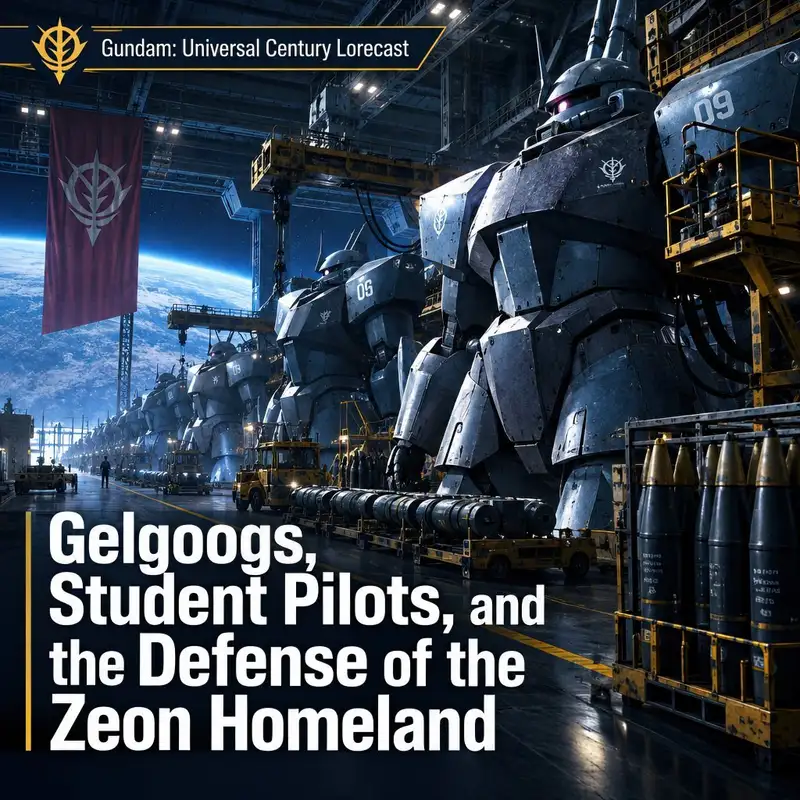
Gelgoogs, Student Pilots, and the Defense of the Zeon Homeland
Kycilia Zabi is watching the defense of A Baoa Qu come apart in real time. The fortress still has mobile suits. It still has Rick Doms, Gelgoogs, ships, guns, launch facilities, and the heavy infrastructure of a state that has spent a year fighting for survival. Yet the formations on her displays are not performing as a final homeland defense ought to perform. Their attacks lack effect. Their losses are mounting. Their coordination is failing under pressure.
Her staff officer, Trawning, offers the explanation with none of the comfort that political language usually provides. Many of the pilots are student mobilization troops. In other words, Zeon has committed newly mobilized personnel to one of the war’s most demanding battles, and it has put many of them into some of its most advanced available mobile suits.
That exchange is brief, but it explains a great deal about the final battle of the One Year War. The question is not whether the Gelgoog was a poor machine. The television record gives no reason to think that it was. The question is why a capable new machine could not produce capable combat power when Zeon needed it most. The answer lies in timing, training, command, and strategy. A mobile suit can leave a factory long before a force becomes ready to fight with it.
A Baoa Qu was not simply the place where the war’s famous final duels occurred. It was Zeon’s last major military barrier before Side Three, the political and symbolic center of the Principality. It was a fortress, a fleet position, a mobile-suit base, a command center, and a statement of national survival. Its defenses protected approach routes toward the homeland. Its loss would not automatically mean that every part of Side Three had fallen, but it would strip Zeon of its decisive forward military position at the worst possible moment.
That gave the battle a double meaning. Zeon’s soldiers were defending a real homeland, with civilians, infrastructure, families, and a political community behind them. They were also defending the Zabi regime, a dictatorship that had brought the Earth Sphere into catastrophic war and committed mass killing in the name of independence, security, and Zeon’s future. Those purposes overlapped, but they were not identical. A soldier attempting to prevent a Federation breakthrough could be protecting home and comrades without endorsing every decision made by Gihren Zabi.
For Zeon’s leadership, the immediate military task was to stop, delay, or damage the Federation assault badly enough to preserve political survival. A fortress defense does not always need to annihilate the attacker. It may only need to make the attack too costly, too slow, or too uncertain to continue. In this case, Zeon needed time and leverage. It needed the Federation to hesitate, negotiate, or lose enough cohesion that the war could end on terms other than unconditional collapse.
But A Baoa Qu was being defended after Zeon had already spent most of its strategic margin. The fall of Solomon had removed an earlier major bastion. Earth had become increasingly difficult for Zeon to hold. Federation industrial mobilization was reaching the front in growing strength. Zeon still possessed dangerous weapons and experienced commanders, but it no longer had the freedom to choose where and when to fight. It was concentrating what remained around the homeland because the larger war had narrowed to that point.
This is the setting in which the Gelgoog entered service. It did not appear at the beginning of a confident campaign, when Zeon could test doctrine, rotate units, and build experience at a manageable pace. It arrived amid strategic exhaustion, losses among veteran pilots, and a looming final battle. It was a late answer to problems that had been accumulating for months.
The situation worsened before the Federation fleet even reached A Baoa Qu. Degwin Sodo Zabi, the elderly sovereign of Zeon, sought contact with General Revil of the Earth Federation. The effort offered at least the possibility of negotiation. Degwin was not acting from disinterested humanitarian principle. He was a ruler trying to save what could still be saved of Zeon’s position and, perhaps, of his family’s state. Still, contact between the two leaders represented a political alternative to an all-or-nothing final battle.
Gihren Zabi chose to destroy that alternative. He anticipated the route of the Federation force and ordered the Solar Ray fired. The weapon annihilated Degwin’s ship and killed Revil as well. It was a remarkable intelligence and military strike. Zeon used a strategic weapon against a concentration of enemy leadership and fleet assets, removing a major Federation commander and inflicting severe immediate damage.
It was also political murder. Gihren killed his own father because Degwin’s pursuit of peace threatened Gihren’s authority and his preferred course of war. The Solar Ray did not merely strike the Federation. It eliminated the one figure within Zeon’s ruling structure who could plausibly challenge Gihren’s decision to continue fighting.
In the short term, the attack gave Zeon an advantage. The Federation fleet lost personnel, ships, and command continuity. Any force hit at that scale would suffer confusion. Orders would need to be reissued. Survivors would have to determine who held authority, what ships remained combat capable, and whether the operation could continue. Under ordinary circumstances, such a blow might have forced a halt.
The Federation assault did not halt. It continued toward A Baoa Qu. That fact matters because it reveals the difference between inflicting damage and changing the strategic situation. Solar Ray hurt the Federation badly, but it did not restore Zeon’s lost operational depth. It did not replace Zeon’s depleted pilots. It did not erase Federation industrial capacity. It did not create a secure political settlement. And it did not heal the fractures inside the Zeon command system. If anything, Gihren’s decision made those fractures more dangerous by tying the regime’s survival to victory in a battle it could no longer afford to lose.
The MS-14A Gelgoog represented Zeon’s effort to meet the changing technical demands of the war. The machine was a late-war mass-production mobile suit, not merely an experimental curiosity reserved for a single ace. It carried a beam rifle, making it Zeon’s first mobile suit equipped with that class of weapon. It also carried a shield and a beam naginata, giving its pilot both ranged and close-combat options in the increasingly lethal environment of late Universal Century seventy-nine.
Those features mattered. A beam rifle offered a mobile suit a more powerful and flexible means of engaging enemy machines than many earlier Zeon weapons. A shield could improve a pilot’s chance of surviving the first exchange of fire. The Gelgoog was evidence that Zeon’s engineering base had not simply collapsed. Its factories, designers, and military planners were still capable of producing a modern frontline weapon system under the pressure of total war.
That is why it is misleading to describe the Gelgoog as a technological failure. The problem was not that Zeon had built an obviously inadequate machine. Nor does the television series justify the popular sort of counterfactual in which the Gelgoog appears earlier and automatically wins the war. History is rarely so generous to procurement programs. A machine can be technically credible without being strategically decisive. It can be powerful in the hands of a trained pilot and still fail to change a campaign if it arrives after the campaign’s central decisions have already gone against its owner.
The Gelgoog’s significance lies in what it reveals about Zeon’s condition. By the final battle, Zeon could still build advanced equipment. What it could not do was turn that equipment into a fully mature combat force quickly enough. It had machines, but it lacked the time required to create experienced crews, stable formations, reliable maintenance routines, and a coherent operational system around them.
Replacing a mobile suit is a difficult industrial task. Replacing a veteran pilot is more difficult still. A factory can manufacture a new airframe, reactor, weapon, or shield through a process that can be standardized, expanded, and inspected. Training can also be organized, of course, but combat judgment does not emerge from a production line.
A pilot assigned to a new mobile suit needs far more than the ability to move it. That pilot must learn how the machine responds in combat, how its weapons behave, how long to remain exposed, when to disengage, how to identify friend from foe in confused conditions, and how to interpret signals from leaders whose transmissions may be degraded or interrupted. The pilot must learn formation discipline, navigation, recovery procedures, emergency actions after damage, and the difficult art of deciding when an apparently recoverable machine must be abandoned before it carries its crew to destruction.
In the Minovsky environment, these demands become sharper. Long-range detection and communications are constrained. Commanders cannot assume that every subordinate sees the same picture or receives the same order. Formations may have to operate with incomplete information, visual identification, local initiative, and prearranged plans. That does not make communications impossible, and it does not mean every battle becomes an individual duel. It means the quality of judgment at the cockpit and unit level matters more.
A veteran learns what panic feels like before it takes control. A veteran recognizes when an enemy formation is drawing a unit into a trap, when a damaged suit can still be recovered, when ammunition or propellant is becoming the real limit, and when a commander’s plan has ceased to match the battle in front of them. None of this makes veterans invincible. Experienced pilots can be killed, can make catastrophic errors, and can become prisoners of their own habits. But experience gives a force a reservoir of practical knowledge that cannot be improvised during a final defensive battle.
The television series does not provide a complete personnel record for the student mobilization troops at A Baoa Qu. It does not give their precise ages, the schools from which they came, the duration of their training, or their exact numbers. It would be easy to fill those gaps with later stories, model material, or fan reconstructions. But the central fact is already clear enough. Zeon had mobilized students and sent many of them into frontline formations during the battle for its homeland.
That should not be treated as evidence that the individual pilots were cowardly, foolish, or personally responsible for the defense’s failure. They were young personnel placed into a crisis created by decisions above them. Some may have fought with determination. Some may have performed better than their training suggested. Some may have died before they had enough information even to understand the scale of the battle around them. Their presence tells us much more about Zeon’s force-generation failure than it tells us about their personal character.
A state at war can mobilize new personnel quickly. It can issue uniforms, assign instructors, distribute weapons, and create units on paper. It cannot rapidly produce the accumulated experience of a force that has survived a year of increasingly demanding combat. Zeon had lost pilots through death, injury, capture, exhaustion, reassignment, and the ordinary erosion of a military that had committed its best people again and again to urgent fronts. By the time A Baoa Qu became the decisive battlefield, the pool from which Zeon could draw trained replacements had become dangerously shallow.
This was not unique to mobile suits. Every military system has a similar problem. A navy can build a ship faster than it can create a crew that understands its machinery, command relationships, damage control, and combat role. An armored force can receive tanks faster than it can create commanders able to move them through difficult terrain under artillery fire. A space force can launch new machines faster than it can develop pilots, mechanics, and staff officers who know how to employ them as a unit.
The Gelgoog exposed that problem because it was advanced enough to demand more from its users, not less. A better weapon does not erase the need for training. In some respects, it raises the cost of insufficient training. A beam rifle, a shield, and a high-performance mobile suit give a pilot more capability. They also give that pilot more decisions to make under pressure. The machine may offer a broader tactical envelope, but only if its crew understands how to use it.
Late deployment created another problem. The distance between building a machine and fielding a unit is larger than it appears in a mechanical profile. New suits must be allocated to formations. Pilots must become familiar with their controls and weapons. Technicians must learn maintenance procedures. Spare parts must reach the right depots. Commanders must decide which missions the machines are suited to perform and how they fit beside older equipment. Units need to train together, not merely train as individuals.
The television record does not establish that every older Zeon mobile suit had radically incompatible controls, or that veteran pilots universally rejected the Gelgoog. Those are tempting explanations because they are simple. The more defensible conclusion is also more useful. Any late-war machine introduced during a crisis creates a burden of conversion, sustainment, and integration. The closer a force is to defeat, the less time it has to absorb that burden.
A newly formed Gelgoog unit might have received its machines, weapons, and basic instruction. That does not mean it had developed the confidence and shared understanding of a veteran formation. A unit learns through routine as much as through formal training. It learns which pilot is dependable under pressure, which mechanic can solve a recurring fault, which leader gives clear orders, and which procedures still function after the plan breaks down. Those lessons are usually purchased with time, repetition, mistakes, and sometimes casualties.
A Baoa Qu gave Zeon very little of that time. The fortress was not a quiet proving ground. It was the final barrier before Side Three, under attack by a Federation force determined to break Zeon’s organized capacity to resist. New crews did not have the luxury of a gradual introduction to combat. They were entering a battle in which a first mistake could be fatal, and in which the consequences of many small mistakes could open an entire defensive sector.
This is the paradox of Zeon’s final mobile-suit force. The most modern equipment could end up in the hands of the least prepared crews. That does not make the equipment useless. It makes it difficult to employ at the level its designers and commanders expected. The Gelgoog could improve the chances of a skilled pilot. It could not instantly turn a mobilized student into a seasoned defender of a fortress under fleet assault.
A Baoa Qu itself magnified these weaknesses. Fortress defense is not simply a matter of lining up machines in front of a wall. It depends on layered protection, reserves, sector command, launch and recovery systems, ammunition, maintenance, communications, and the ability to identify where the enemy is concentrating pressure. A defender must decide whether to hold every approach, counterattack a breach, withdraw to a stronger internal position, or preserve forces for a later phase of the battle.
The Federation assault placed all of those functions under strain. The attacking force needed to move its fleet into position, launch mobile suits, coordinate advances, and exploit whatever openings appeared after the Solar Ray’s initial disruption. It did not require every ship or every unit to operate perfectly. It required enough surviving commanders and crews to keep the operation moving forward. Once the Federation found weak points, its task was to widen them before Zeon could restore a coherent defense.
Zeon’s task was harder. It needed to prevent the attackers from turning local gains into a general penetration. That required mobile reserves that could move rapidly to threatened sectors. It required commanders who could understand where the real danger lay. It required pilots who could follow a plan while adapting to conditions their commanders could not fully see. It required launch systems, maintenance personnel, and staff officers to keep machines entering the battle rather than accumulating as damaged hardware behind the lines.
The battle changed character as Federation units penetrated the fortress. At that point, A Baoa Qu ceased to be only a fleet-defense problem. It became a close-range struggle within and around a vast military installation. Internal corridors, docking areas, hangars, defensive positions, and command spaces became part of the battlefield. The defenders could no longer rely only on distance, fixed weapons, or the broad geometry of open space. They had to contain incursions, protect key facilities, and preserve command control while the fortress itself became contested ground.
That is where the weakness of inexperienced formations becomes especially dangerous. A pilot can be brave and still misread a threat. A unit can have powerful machines and still fail to arrive at the threatened sector together. A formation can survive initial contact and still lose cohesion after its leader is destroyed, its communications are interrupted, or its retreat route is cut off. A fortress battle punishes confusion because confusion spreads. One missed order can leave a corridor unguarded. One delayed reserve can turn a probe into a breakthrough.
The White Base group was one part of this larger Federation effort. Its pilots and crew were unusually capable, and their actions mattered in their sector. But the White Base should not be mistaken for the entire assault. The Federation attack was a fleet and mobile-suit operation involving many forces beyond the famous ship. Its success depended on the wider ability of Federation units to keep attacking despite losses, confusion, and the destruction caused by Solar Ray.
The same caution applies to Zeon’s famous personnel. Char Aznable and his final sortie are central to the drama of A Baoa Qu, but they do not explain the whole defense. Char does not launch in a Gelgoog. He sorties in the MSN-02 Zeong, a specialized and extraordinary machine intended for a pilot of exceptional ability. His confrontation with Amuro Ray in the Gundam occurs at the opposite end of the personnel spectrum from the student mobilization formations observed by Kycilia.
Char and Amuro are both unusual pilots operating unique machines under extraordinary circumstances. Their duel reveals what a rare individual can do in the chaos of a major battle. It also reveals the limit of individual excellence. Even a pilot of Char’s skill cannot rebuild a collapsing replacement system, create veteran crews where none exist, restore a shattered chain of command, or close every breach in a fortress under attack. Amuro’s performance, likewise, cannot by itself explain the success of the Federation offensive. Exceptional people can shape a local fight. They cannot substitute for an entire military institution.
The Gundam and Zeong destroy each other in their final confrontation, but the larger battle continues around them. That is an important corrective to the way the battle is often remembered. The fate of A Baoa Qu was not decided solely by two Newtype pilots. It was decided by the accumulated pressure of a year-long war, by fleets and mobile-suit units, by the ability to sustain an assault, by the quality of ordinary personnel, and by the political decisions that had narrowed Zeon’s options to one desperate stand.
Zeon’s command structure made that stand even more fragile. Gihren initially directed the defense from A Baoa Qu. He held enormous political and military authority. In an authoritarian system, this concentration can create speed when the leader is competent and information is clear. It can also create extreme vulnerability when the leader’s judgment is distorted by ideology, ambition, or personal rivalry.
Gihren’s killing of Degwin was not a secret with which the command system could live indefinitely. During the battle, Kycilia learned that he had murdered their father. She responded by shooting Gihren in the command center. The political conflict at the top of Zeon did not wait until after the battle to resolve itself. It erupted while the fortress was still under attack.
Kycilia then assumed command. She was not an uninformed outsider. She had her own military authority and had long been a rival center of power within Zeon. But a transfer of supreme command during a fortress battle is still a major rupture. Subordinate formations must continue fighting while political authority changes above them. Staff officers must determine whose instructions now govern. Command relationships that may already have been strained by rivalry and secrecy must be made to function under fire.
It would go too far to claim that Kycilia’s assassination of Gihren alone caused A Baoa Qu to fall. Zeon’s strategic position was already deteriorating. The Federation had already reached the fortress. The student-pilot problem existed before Gihren died. The defense faced material and personnel pressures that no single command decision could instantly solve. But the assassination plainly removed continuity at the moment continuity mattered most.
The episode’s command-center scene gains force in that context. Kycilia is not calmly inspecting a training report months before a deployment. She is assuming control amid battle and discovering that some of the formations expected to defend the homeland are not capable of performing as their equipment and official designation suggest. Trawning’s explanation is not an excuse. It is a diagnosis of a state that has reached its final defensive line with a force it has not had time to make fully usable.
That is the deeper institutional failure. Zeon had concentrated political power so tightly within the Zabi family that family conflict became an operational problem. Gihren’s strategic gamble, Degwin’s attempt at peace, Kycilia’s rivalry, and the army of young pilots sent into combat were not separate stories. They were connected consequences of a regime that had treated war as the means to resolve political weakness, then treated increasingly desperate military measures as the means to resolve the failures created by that war.
The Gelgoog formations could still fight. The fortress could still inflict damage. Zeon’s defenders could still make the Federation pay for every advance. The final battle was not a simple collapse at first contact. A Baoa Qu remained formidable precisely because it concentrated so much remaining military power. Its mobile suits, fixed defenses, ships, and commanders forced the Federation to continue a costly assault even after the Solar Ray attack.
But tactical resistance is not the same as operational success. To succeed operationally, Zeon needed to prevent the Federation from penetrating the fortress and destroying its capacity to coordinate further defense. It needed its sectors to hold together long enough for the attacker’s cohesion to fail. It needed the Gelgoogs and Rick Doms to function as organized formations, not merely as individual machines appearing in isolated fights.
That did not happen. Federation forces penetrated the fortress. The central position was lost. Zeon’s advanced equipment could not compensate for its inability to generate enough trained pilots, preserve a stable command system, and recover strategic initiative. The Gelgoog was a capable answer to a tactical problem. It was not an answer to the entire war.
Strategically, A Baoa Qu’s fall ended Zeon’s ability to sustain organized resistance from its decisive homeland barrier. That did not erase every Zeon soldier, ship, or political claim overnight. Wars do not become politically simple because a fortress changes hands. But it destroyed the military position on which Gihren’s final gamble depended. Without A Baoa Qu, Zeon no longer possessed the same ability to shield Side Three, threaten the advancing Federation, or negotiate from a position of credible strength.
Politically, the regime had hollowed out its own legitimacy. Gihren claimed to defend Zeon’s future while killing his father to prevent peace and turning the final battle into a test of personal authority. Kycilia removed him, but her seizure of command could not reverse the damage already done. The state that had demanded sacrifice from its population could not maintain unity among the people at its apex.
In industrial terms, Zeon demonstrated that technical sophistication and strategic endurance are different things. It could still produce the Gelgoog. It could still field advanced weapons. Yet the ability to manufacture a machine late in a war is not the same as the ability to field it in sufficient numbers, support it, train its crews, and integrate it into a defensive system before the enemy arrives.
At the human level, the student mobilization troops carried the burden of decisions they had not made. They were sent to defend their homeland in a battle shaped by attrition, political murder, strategic overreach, and institutional exhaustion. Their machines may have been among the best Zeon could provide. That did not make the burden placed upon them reasonable. It made the contrast more tragic. The state had reached the point where it could give young pilots advanced weapons but not the time needed to survive with them.
Kycilia’s observation at A Baoa Qu therefore deserves to be remembered as more than a complaint about poor battlefield performance. It is the final report of a force-generation system breaking down. Zeon had created a technically credible mass-production mobile suit. It had not created the trained mass force required to use that suit effectively under the conditions of a decisive fleet and fortress battle.
The Gelgoog did not fail because its engineers had misunderstood mobile-suit warfare. It failed because no machine, however capable, can restore time already lost. It could not replace veteran pilots killed across the war. It could not teach formation discipline in the middle of a breakthrough. It could not repair a command structure shattered by rivalry and murder. It could not turn the destruction of political options into a durable military advantage.
Zeon’s final homeland defense arrived too late in every important sense. The Principality still had factories, weapons, fortresses, and determined soldiers. What it no longer had was the trained personnel, coherent command, strategic freedom, or political unity needed to turn those assets into victory. At A Baoa Qu, the Gelgoog became proof that advanced weapons are not the same thing as usable combat power.