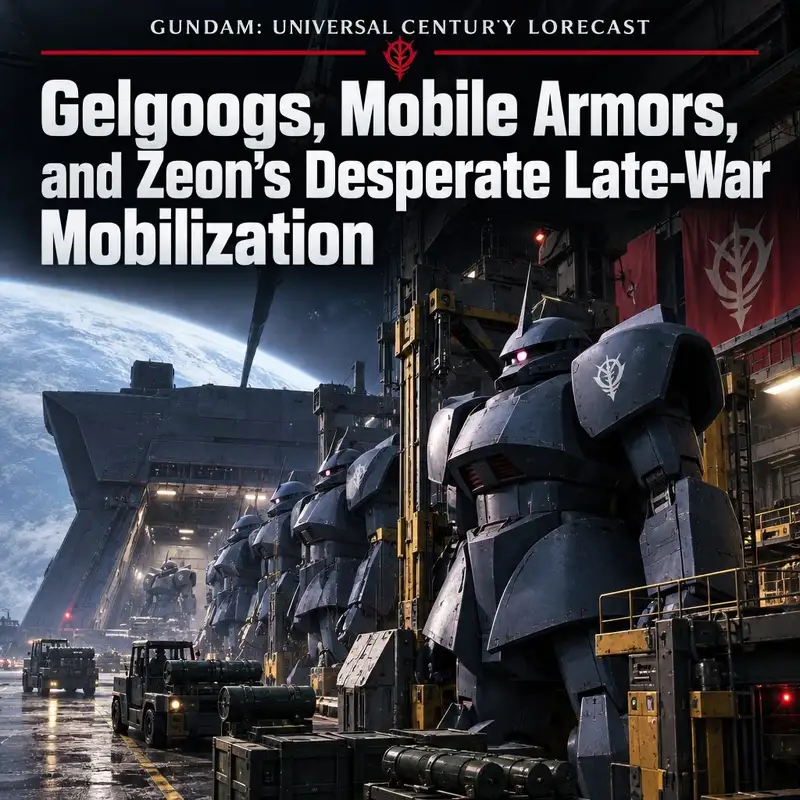
Gelgoogs, Mobile Armors, and Zeon’s Desperate Late-War Mobilization
At A Baoa Qu, the Principality of Zeon committed some of its most advanced conventional mobile suits to its final fortress defense. Gelgoogs entered the battle alongside Doms, older machines, warships, fixed defenses, and the exhausted personnel still available to defend the gate to Side Three. On paper, that should have looked like renewal. The Gelgoog was Zeon’s beam-rifle-equipped answer to the Federation’s Gundam-era mobile suit force. It represented a real technological advance, not a ceremonial last stand in obsolete equipment.
But the television record gives the scene a harder meaning. Many of the Gelgoog pilots were student recruits. They had training, but not the accumulated combat experience that had been consumed across a year of fighting. The problem was not that Zeon had placed incapable people in capable machines. The problem was that it expected a new generation of pilots to master advanced combat systems during the largest and most desperate battle of the war.
That was the contradiction at the heart of Zeon’s late-war mobilization. Its machines had become more sophisticated just as its institutions had become less able to use sophistication well. A Gelgoog could be formidable. A mobile armor could devastate a formation. A Newtype weapon could strike from angles ordinary crews could barely understand. None of that automatically created trained formations, maintenance capacity, reliable command, replacement crews, or the time required to learn from mistakes.
By the final weeks of Universal Century seventy-nine, Zeon was not simply trying to build better weapons. It was trying to recover a war that had already become an industrial, organizational, and political contest. The Gelgoog, the Big Zam, and the Elmeth were three very different answers to that crisis. Each addressed a genuine battlefield problem. Each demonstrated that Zeon had not lost its technical imagination. And each revealed why technical imagination alone could not restore a collapsing strategic position.
Zeon had begun the war with an advantage that mattered enormously. Its mobile suits gave it a form of maneuver and close-range striking power that the Federation had not yet matched. Under Minovsky particle conditions, long-range sensors and communications were degraded enough to make visual identification, local initiative, and mobile maneuver unusually important. Zeon had prepared for that environment. The Federation had not.
But an early military advantage is not the same thing as a durable war-winning system. Zeon’s opening victories inflicted catastrophic damage across the Earth Sphere, yet they did not force a stable political settlement. The Federation survived. It retained enormous territory, population, industry, military infrastructure, and the ability to reorganize after shock. As the war progressed, it developed its own mobile suits, expanded its space forces, and learned to combine ships, mobile suits, mobile pods, bases, and strategic weapons into sustained offensive operations.
That recovery changed Zeon’s strategic problem. It could no longer rely on the shock value of the Zaku or on the assumption that Federation forces would remain technologically behind. It needed to defend its remaining strategic positions while facing an enemy that was becoming more capable with every campaign. It needed machines that could challenge Federation mobile suits. It needed systems that could damage fleets before those fleets reached its fortresses. And it needed ways to offset the gradual loss of experienced personnel.
These needs did not all point to the same solution. A general-purpose mobile suit had to be produced, maintained, assigned to units, and operated by ordinary pilots. A fortress-defense weapon could concentrate enormous firepower in a single place, but it could not be everywhere. A Newtype-use system might offer extraordinary tactical reach, but only if Zeon could find, train, and retain people capable of operating it. Late-war Zeon pursued all three paths, because no single answer was sufficient.
The battle for Solomon showed why the emergency had become so severe. Solomon was not merely a dramatic fortress hanging in space. It was a strategic position within Zeon’s defensive system, a military base, a staging point, a logistical node, and a barrier on the Federation’s approach toward the core of the Principality. Its loss would not end the war by itself, but it would expose the remaining defenses farther inward and demonstrate that the Federation could break Zeon’s fortified line.
The Federation’s objective was therefore larger than the seizure of a single installation. It needed to preserve momentum. A slow, costly siege would give Zeon time to shift forces, reinforce other defenses, or search for a political and military response. The Federation instead assembled a combined operation that used strategic preparation to open an assault, then employed fleets, mobile suits, and Ball mobile pods to exploit the damage.
The Solar System was central to that preparation. By concentrating sunlight on Solomon, the Federation struck the fortress with a weapon designed to weaken defenses on a scale ordinary fleet fire could not easily achieve. It was not a substitute for an assault force. It was a way to make the assault possible. Once the defenses were disrupted, Federation forces still had to move through the breach, identify threats, coordinate formations, recover damaged units where they could, and continue fighting in the confused environment created by Minovsky particles and fortress combat.
Solomon was also not empty. A fortress contains garrison troops, technical personnel, medical staff, communications workers, mechanics, transport crews, and people whose jobs are not visible from a cockpit. As the position became untenable, evacuation became part of the battle. The loss of a major base meant more than destroyed weapons. It meant the displacement or death of personnel, the abandonment of infrastructure, and the collapse of a defensive community built around a strategic installation.
For Zeon’s defenders, the immediate requirement was brutally simple. They needed something that could impose enough damage on the attacking Federation force to break its momentum before the fortress was overwhelmed. That requirement produced one of the most imposing machines of the One Year War.
Dozle Zabi entered the Big Zam after ordering the evacuation of Solomon. The decision was personal, but the machine’s purpose was institutional. The Big Zam was not a normal mobile suit scaled upward. It was a heavy mobile armor built around concentrated defensive firepower. Its large and smaller mega particle weapons could engage both warships and mobile suits. Its beam-defensive equipment made it unusually difficult for attacking forces to stop with the weapons they normally relied upon.
In the immediate tactical sense, the Big Zam worked. It inflicted severe losses and disrupted Federation formations. Ships and mobile units confronting it were not fighting an ordinary opponent. They were facing a mobile fortress with enough firepower to punish concentration and enough protection to frustrate direct beam attacks. In a battle where the Federation needed to maintain pressure through a breach, that was a serious problem.
The Big Zam’s value lay in concentration. It brought a great deal of firepower and protection to one point in space, under the control of one commander. For a fortress under assault, that could be exactly what was needed. It was a weapon for a moment of crisis, when a defender hoped to turn an attacker’s numerical and operational momentum into vulnerability.
But a weapon designed around concentration also has a concentrated failure point. The Big Zam could destroy ships and mobile suits. It could not replace Solomon’s damaged defenses, restore the wider fleet situation, create new escorts, or rebuild the experienced personnel Zeon had already lost. It could not create a reserve force once the fortress had committed what remained of its strength. And it could not ensure that a local tactical shock would become a strategic reversal.
Dozle’s hope that such a system might someday be produced in greater numbers reflects the appeal of the machine. In the middle of a defensive crisis, it was easy to imagine that more Big Zams would change the war. But the television record gives no reason to believe that Zeon had the time, industrial freedom, trained crews, or stable strategic position required for such a program. A massive specialized weapon is not simply a larger item on a production line. It carries demands in materials, testing, transport, maintenance, power systems, training, and command.
The destruction of the Big Zam did not prove that it was ineffective. Its battlefield effect was real. What it proved was narrower and more important. Even an extraordinarily dangerous defensive machine could not by itself restore a collapsing defensive system. Solomon fell. The Federation retained the initiative. And Zeon’s next answer had to be more broadly usable than a single giant mobile armor.
That answer was the Gelgoog.
The Gelgoog represented Zeon’s attempt to regain quality at the level of the ordinary frontline mobile suit. It was a late-war general-purpose machine, intended to stand in the same broad combat space as the Federation’s new mobile suits rather than performing one narrow mission. It carried a beam rifle, making it the first Zeon mobile suit in the television record to bring that kind of beam armament into this general-purpose role. That mattered because beam weapons were not simply another item on an equipment list. They offered a way to threaten armored targets at range and to meet the Federation’s emerging technological standard on more equal terms.
The Gelgoog was therefore not a desperate oddity. In principle, it was the most practical of Zeon’s late-war responses. A force equipped with capable general-purpose mobile suits could conduct patrols, escort operations, mobile defense, fleet screening, assault missions, and local counterattacks. It could fight across a range of ordinary military tasks. That made the Gelgoog more useful as a force-structure answer than a singular fortress weapon.
Char Aznable’s Gelgoog showed the machine’s potential, but also the danger of judging an army by an ace’s performance. Kycilia Zabi provided Char with a high-performance prototype, the MS fourteen S Gelgoog. In the Texas Colony fighting, Char used it against Amuro Ray and the Gundam. The encounter demonstrated that Zeon could field a machine able to challenge the Federation’s most famous prototype in the hands of a highly skilled pilot.
It did not demonstrate that Zeon had solved its wider force problem.
Char was not an average pilot. His machine was not an ordinary example of every Gelgoog in service. He had accumulated combat experience through the war, had access to elite sponsorship, and was operating within a political environment in which particular individuals and projects received exceptional attention. His duel with Amuro mattered to the local battle and to the personal conflict between the two pilots. It was not a field test of whether Zeon could equip, train, sustain, and command an entire Gelgoog force under campaign conditions.
The Gelgoog’s promise was nevertheless genuine. It gave Zeon a credible answer to the Federation’s mobile-suit advance. It offered beam armament, high performance, and the flexibility needed for conventional operations. If introduced earlier, integrated into veteran units, supported by reliable maintenance and supply, and incorporated into coherent formations, it might have materially changed the character of late-war engagements.
But that sentence contains nearly all the conditions Zeon no longer controlled.
A mobile suit does not become military power merely because it leaves a factory or reaches a fortress. Pilots must learn its handling characteristics. Mechanics must understand its systems. Units must develop maintenance routines. Commanders must know what the machine can do and what risks it creates. Formations must practice operating together. Ships must carry the necessary parts, weapons, and technicians. Officers must learn how to employ the machine alongside older types that remain in service. And the enemy, once surprised, begins to adapt.
By A Baoa Qu, Zeon was trying to perform that integration under the pressure of a final battle. The television series makes the manpower problem explicit. Many Gelgoog pilots were student recruits. They were not presented as people who had never received instruction. They had been trained. But training is not the same thing as combat experience, particularly in a battle where formations are breaking apart, communications are strained, and every mistake may be fatal.
Combat experience is difficult to replace because it is not a single skill. It includes judgment under uncertainty. It includes knowing when to pursue and when to disengage. It includes formation discipline, visual identification, fuel awareness, weapon management, damage assessment, and the ability to interpret incomplete orders. It includes understanding how quickly a situation can change when ships, mobile suits, debris, fortress defenses, and friendly units are all moving through the same volume of space.
Minovsky conditions made those qualities more valuable, not less. Particle interference did not make all sensors and communications useless. Forces still used optics, local signals, prearranged plans, direct observation, and whatever communications remained workable. But it did limit the clean, centralized picture that commanders might have preferred. Subordinates had to make decisions. Pilots had to recognize threats at close range. Units had to function even when headquarters could not see every engagement in real time.
That was hard enough for veterans. For newly trained recruits, it was punishing.
The Federation had losses too. Its victory did not come because every Federation pilot was superior or every GM was individually better than a Gelgoog. The Federation’s advantage was systemic. It could field large numbers of acceptable machines. It could send them forward from a larger industrial base. It possessed ships, bases, technicians, and command structures able to sustain offensive operations. It could combine GM mobile suits and Ball pods with fleet power, rather than requiring one machine to solve every problem.
A Ball was not a Gelgoog. A standard GM was not the Gundam. That was beside the point. War at this scale is not decided solely by matching one machine against another in an imaginary duel. The Federation needed enough mobile units to protect ships, exploit openings, overwhelm local defenses, and replace losses. It needed crews able to continue operating after commanders were killed or plans changed. By the final stage of the war, it increasingly possessed those capacities.
Zeon’s late-war machines were attempts to escape that arithmetic. The Big Zam concentrated firepower. The Gelgoog sought qualitative parity in a general-purpose platform. The Elmeth pursued an even more radical answer: turning exceptional human perception into a weapon system.
After Solomon’s fall, Lalah Sune entered combat in the Elmeth near the captured fortress. The Elmeth was a Newtype-use mobile armor, built around remote weapons that could be controlled through a psycommu system. Its operational concept was not simply to give a pilot more guns. It was to alter the geometry of combat. Remote weapons could attack ships and mobile suits from directions conventional defenders did not expect, while the controlling pilot remained separated from the immediate point of attack.
For ordinary fleet crews, this was deeply unsettling. A ship crew normally understands the broad categories of threat. It can look for an approaching vessel, track a mobile suit, respond to fire, or maneuver against an identified attacker. The Elmeth complicated that process. Its remote weapons created danger that appeared detached from an obvious conventional firing platform. The television series shows Lalah destroying multiple Federation warships with striking speed, producing fear among pilots and crews who had no ordinary doctrine for confronting what they were seeing.
The exact count matters less than the military effect. Federation personnel understood that a new threat had entered the battle. Ships could no longer assume that their defenses and formations were oriented toward a single visible attacker. Mobile suits sent to intercept the threat faced a system that challenged their expectations of range, direction, and control.
The Elmeth was therefore a genuine tactical breakthrough. It demonstrated that psycommu-linked remote weapons could turn Newtype perception into combat reach. It suggested that a pilot able to process an unusual volume of spatial information could control attacks in ways that conventional crews could not easily anticipate. In a fleet battle, that possibility was potentially transformative.
But the Elmeth also exposed the difference between extraordinary performance and institutional capacity.
It worked because Lalah was exceptional. The machine did not make any ordinary pilot into a Newtype. It did not prove that Zeon had created a mature doctrine, a reliable training pipeline, or a standardized force of psycommu operators. The Flanagan Institute and related Newtype research provided an institutional setting for such experimentation, but research is not the same thing as a stable military capability. A laboratory can produce an extraordinary result before a military can understand how to organize, command, or reproduce it.
There was also a human cost to this kind of weaponization. A military system built around rare perception becomes dependent on rare people. Those people are not interchangeable components. Their concentration, health, emotional condition, loyalty, and ability to function under pressure all become strategic variables. Commanders may see an exceptional pilot as a solution to a battlefield problem. That does not remove the burden placed on the individual, or the uncertainty involved in making one person carry a mission that would normally require many crews and machines.
The Elmeth’s success created tactical alarm, but it did not repair Zeon’s larger military situation. It could not replace the loss of Solomon. It could not defend every route, escort every ship, or hold every fortress. It could not turn experimental Newtype research into a fleetwide capability in the remaining days of the war. Like the Big Zam, it could impose local costs. Like the Gelgoog, it revealed a genuine technical achievement. But it could not manufacture strategic time.
The three systems answered different versions of the same crisis.
The Gelgoog was the conventional answer. It was the machine Zeon could, in principle, have used to rebuild a competitive frontline mobile-suit force. It was flexible, broadly applicable, and suited to the ordinary demands of mobile warfare. Its problem was not that it lacked value. Its problem was that late deployment left too little time to integrate it into a coherent force with enough experienced pilots and support personnel.
The Big Zam was the concentrated answer. It brought immense defensive firepower and beam protection to a single decisive point. It was suited to a fortress defense and could inflict disproportionate losses on an attacker. Its limitation was scale. It was too specialized and too singular to replace a balanced military system. One giant mobile armor might delay an assault. It could not rebuild a strategic defensive network.
The Elmeth was the asymmetrical answer. It sought to use Newtype ability and remote weapons to create effects that ordinary formations could not easily counter. It was remarkable precisely because it was not ordinary. That made it powerful, but difficult to reproduce. A system dependent on a rare pilot and an immature research field could disrupt an enemy. It could not quickly become the foundation of an entire war effort.
Calling all three systems superweapons would miss the point. The Gelgoog was not a superweapon. It was a serious effort at a modern general-purpose mobile suit. The Big Zam was a specialized heavy defensive weapon. The Elmeth was an experimental Newtype-use mobile armor. Their common feature was not simply power. It was their emergence during a period when Zeon was searching for ways to offset problems that no machine could solve alone.
Those problems included command fragmentation.
Zeon was not one unified institution moving in perfect coordination. Gihren Zabi pursued central political and military control. Dozle commanded the defense of Solomon and faced the immediate burden of holding a fortress under attack. Kycilia controlled elite assets and had influence over specialized programs and personnel, including the circle around Char and Lalah. Char himself was a highly capable individual operator, but individual combat performance is not the same thing as a general staff function.
A state under pressure can still produce impressive machines. In fact, pressure often encourages accelerated development. What becomes difficult is aligning those machines within one coherent operational plan. Procurement, training, deployment, maintenance, intelligence, and command must all move together. If they do not, the result can be a force with advanced equipment but uneven readiness.
That was Zeon’s position at A Baoa Qu. The Federation was not attacking a cleanly rebuilt military. It was attacking a final defensive concentration composed of fortress systems, ships, older mobile suits, Doms, Gelgoogs, elite personnel, recruits, and units that had survived very different parts of the war. Some Zeon formations fought effectively. Some pilots had experience, skill, and determination. The battle was not a simple rout from the opening moment.
But the fortress could not be saved merely by assembling dangerous machines within its perimeter.
The Federation’s objective at A Baoa Qu was to destroy Zeon’s remaining capacity for organized military resistance. That required more than winning isolated engagements. Federation forces had to penetrate the fortress defense, defeat ships and mobile suits, absorb losses, preserve enough cohesion to continue inward, and maintain a campaign structure even as the battle became chaotic.
The attacking side brought the advantages of a force that had been moving forward through a successful counteroffensive. It had endured earlier battles, learned from them, and retained the ability to commit fleet forces and mobile units as part of a larger offensive system. Not every Federation participant was a veteran. Not every command decision was flawless. Yet the organization could continue functioning even when particular ships, pilots, and units were lost.
Zeon’s advanced machines could make that advance costly. A Gelgoog in capable hands remained a serious threat. Fortress defenses could still destroy attackers. Individual pilots could still protect a sector, delay a breakthrough, or win a local engagement. But limited combat experience among many late-wave pilots reduced the value of the machine beneath them. A high-performance mobile suit gives a pilot more capability. It also gives that pilot more decisions to make, more systems to understand, and more ways to be overwhelmed.
The consequences were especially severe in close, confused combat. In a Minovsky environment, a pilot who misidentifies a contact, breaks formation at the wrong moment, expends weapons too quickly, or loses track of the larger tactical situation can turn an advanced machine into an isolated target. No armor, beam rifle, or high-performance frame can fully compensate for poor coordination under pressure.
The final battle also carried a human cost that military analysis can obscure. Fortress warfare traps people inside collapsing systems. Some personnel evacuate. Others remain at their posts because they are ordered to, because their equipment cannot be moved, because they have nowhere to go, or because the battle moves too quickly for an orderly withdrawal. The destruction of a fortress is not only the loss of a strategic objective. It is the end of workplaces, living spaces, command centers, medical stations, hangars, and the people who occupied them.
By the time A Baoa Qu fell, Zeon’s late-war weapons program had not failed in the narrow technical sense. The Big Zam had shown what concentrated anti-fleet firepower could do. The Gelgoog had demonstrated that Zeon could produce a beam-rifle-equipped mobile suit capable of meeting the Federation’s best systems in serious combat. The Elmeth had shown the disruptive potential of psycommu-linked remote weapons and Newtype control.
Those achievements mattered. They imposed risks on Federation forces. They compelled immediate adaptation. A fleet commander facing a Big Zam could not ignore it. A mobile-suit pilot encountering a Gelgoog could not dismiss it as an obsolete Zaku. A ship crew attacked by the Elmeth had to confront a threat that did not fit conventional defensive expectations. In intelligence terms, these systems changed the enemy’s calculation of danger.
But surprise does not end a campaign unless it can be followed by sustained exploitation. To exploit a new weapon, a force needs enough examples of it, enough trained personnel, enough repair capacity, enough ammunition and spare parts, enough doctrine, enough command coordination, and enough strategic room to learn from the first deployment. Zeon’s late-war position gave it very little of that room.
Zeon’s late-war designs could not reverse that balance because they were being asked to solve accumulated failures all at once. They were expected to halt a Federation offensive, compensate for the erosion of experienced manpower, defend vulnerable fortresses, overcome industrial disadvantage, and preserve a regime whose leadership had become increasingly fragmented. No weapon system, however impressive, could carry that burden by itself.
Tactically, the machines worked. The Big Zam inflicted serious losses. Gelgoogs could challenge Federation mobile suits. The Elmeth showed a frightening new form of attack. Operationally, they complicated and delayed Federation attacks, but did not stop the advance. Strategically, they failed to reverse Zeon’s deteriorating position. At the industrial and logistical level, Zeon could not integrate them at the scale required before defeat. Institutionally, rushed mobilization and divided authority weakened their employment.
And at the human level, the final defense placed impossible weight on two very different groups of people. Student recruits were expected to master advanced machines in the most demanding battle of the war. Exceptional Newtype pilots were expected to become weapons of strategic consequence because ordinary military institutions could not generate enough conventional strength. Neither burden was fair, and neither could be solved by the machine surrounding the pilot.
Zeon’s late-war weapons were not evidence that it had regained strength. They were evidence of a state trying to buy back time it no longer possessed.