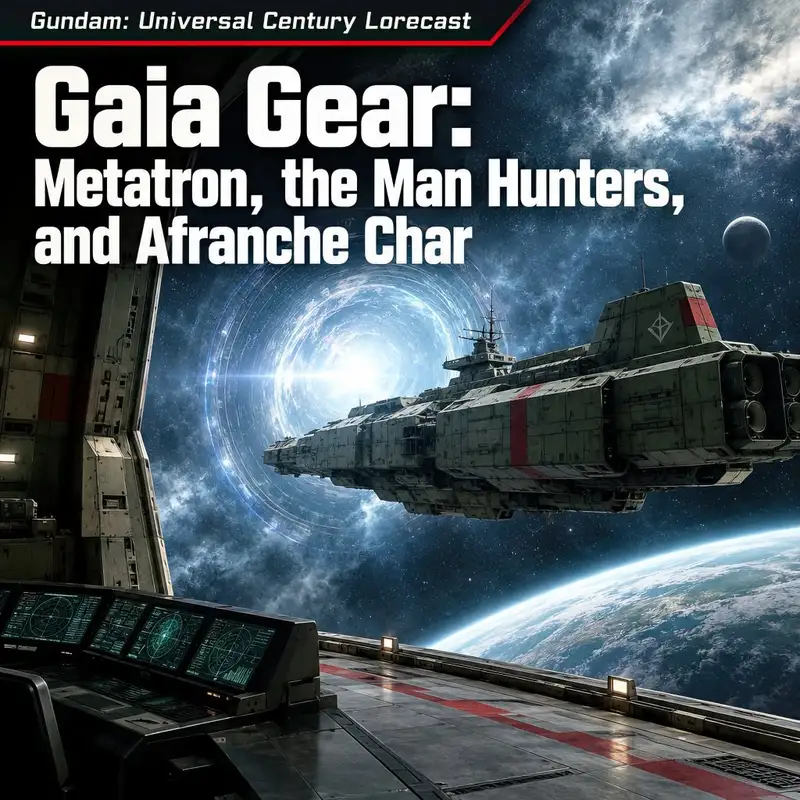
Gaia Gear: Metatron, the Man Hunters, and Afranche Char [Novel and Radio Drama; Disputed]
In Universal Century two hundred three, Earth is supposed to be recovering. It has been turned into a protected world, a sanctuary restored after generations of war, extraction, migration, and abuse. In principle, that is not an unreasonable ambition. A planet that supports billions of people, immense industry, and the political center of the Earth Sphere cannot be treated as an inexhaustible resource forever. But in the world of Gaia Gear, protection has become restriction, and restriction has become a method of rule. Earth is still inhabited. People work there, hide there, raise families there, and seek refuge there. Yet unauthorized residents can be hunted, removed, and deported in the name of ecological recovery.
That is the setting in which Afranche Char is captured in the South Pacific Environmental Protection Zone. The immediate problem is simple enough. The Man-Hunting Agency has taken a valuable enemy operative, and Metatron must decide whether it can afford the risk of recovering him. But Afranche is not merely a pilot or a political fugitive. He is the product of an effort to reconstruct the legacy of Char Aznable. His rescue requires the deployment of the Gaia Gear Alpha, a machine built around an exceptional operator and an exceptional political purpose. The operation is therefore not just a prison break or a battlefield recovery. Metatron is retrieving the human symbol around which it hopes to build a revolution.
Gaia Gear is not an uncontested endpoint of the principal animated Universal Century. It is a Universal Century-related future created by Yoshiyuki Tomino, first told in a five-volume novel series and later adapted into the Sound Theater Gaia Gear radio drama. The two are connected, but they are not identical historical records. The radio drama changes emphasis, characterization, sequence, and conclusion. For this account, the novels provide the principal narrative spine, while the radio drama matters as a related reimagining of the same political and personal questions.
That distinction is more than a technicality for continuity specialists. Gaia Gear is a story about historical inheritance. Its people do not simply live after famous wars. They live under the burden of remembered wars, remembered heroes, and remembered failures. A future can be rewritten by an adaptation, just as it can be rewritten by a government, a revolutionary movement, or a laboratory. Gaia Gear uses the language and memory of the Universal Century, but it should be understood as its own disputed possibility, not as a settled sequel that can be seamlessly joined to every earlier record.
The Man-Hunting Agency, commonly called the MHA, begins in the source chronology as an institution tasked with locating and deporting unauthorized residents on Earth. Its stated mission is tied to environmental protection. If Earth is to recover, human settlement must be limited, controlled, and supervised. That argument has practical force. Environmental damage is real. Unregulated settlement can place extraordinary pressure on water, food, housing, land, and public health. Gaia Gear does not require the listener to dismiss ecological protection as inherently sinister.
The problem is who receives the right to decide, who is excluded, and what tools are used to enforce that decision. The MHA does not operate like an ordinary environmental regulator. It combines policing, intelligence, military force, deportation authority, and political ideology. It determines who belongs on Earth and who does not. It treats unauthorized residence not simply as a legal infraction, but as a threat to the planet and to the social order built around the planet. Environmental policy becomes a means of sorting humanity into categories of permitted and forbidden existence.
For that reason, the word “Man Hunters” matters. It is not merely an ominous name for a security bureau. It describes an institution that has made people into objects of search, classification, detention, and removal. The individual resident becomes a logistical problem. The hidden family becomes an enforcement target. The Earth-based worker becomes a demographic violation. The agency’s mission turns citizenship, residence, and environmental access into matters of security. Once that happens, the line between law enforcement and occupation begins to disappear.
The source chronology places the beginning of the Char Continuation Project in Universal Century one hundred fifty-two. A few years later, anti-Federation activity associated with Metatron’s predecessor movement begins to emerge. In Universal Century one hundred eighty-four, a memory clone connected to Char Aznable is secretly transferred to Earth and raised under the name Afranche Char. Two years later, the Federation establishes the Man-Hunting Agency. By Universal Century one hundred ninety-seven, the MHA’s authority has expanded. These dates belong to Gaia Gear’s own internal history. They should not be treated as uncontested milestones in every version of the Universal Century.
Still, their order reveals the central political logic of the story. The resistance does not wait for the Man Hunters to become powerful before preparing its answer. Metatron’s founders understand that a scattered anti-Federation movement has a problem of legitimacy. Colonial resentment can create recruits, safe houses, and local networks. It does not automatically create a command structure. It does not produce a coherent political program. It does not make separate groups trust one another. And it does not create a leader whose authority reaches across generations of defeat.
The Man Hunters, by contrast, possess the advantages of an institution. They have access to state resources, records, weapons, trained personnel, and a legal rationale for their operations. Their authority may be ambiguous in practice, especially as the agency grows more autonomous, but it is not improvised. They can issue orders, move people, classify residents, and mobilize force under the language of preserving Earth. Metatron has none of that stability. It is a movement without a state. Its strength comes from resentment toward the existing order. Its weakness comes from the fact that resentment alone is not an administrative system.
Metatron is therefore not best understood as a unified revolutionary army. It is an anti-Federation coalition shaped by older spacenoid autonomy movements, clandestine networks, local contacts, military veterans, political activists, and leaders with differing priorities. Its people may agree that the Federation’s Earth-centered order is unjust. They may agree that the MHA’s coercive power must be resisted. Beyond that, unity becomes harder. What exactly should replace the Federation’s hierarchy? How should Earth be governed? Who has authority over local groups? How much secrecy is necessary? How much sacrifice is acceptable?
Metatron’s answer is the Char Continue Operation. Its leaders do not merely search for a capable commander. They manufacture one. Afranche Char is the result. He is a memory clone associated with Char Aznable’s identity, carrying inherited memories or personality traces that link him to the revolutionary figure of an earlier age. But he is not Char Aznable resurrected. He is not simply a body occupied by an old soul. And he is not a convenient excuse to erase the difference between remembered history and a living person.
Afranche is a distinct individual. He has his own relationships, fears, attachments, judgments, and limits. His bond with Everly Key matters because it reveals what the Char Continuation program cannot fully control. A political project can give a person a name. It can implant memories, assign a role, and surround him with people who expect him to become a leader. It cannot guarantee that he will experience those expectations as his own. It cannot prevent him from forming loyalties outside the movement’s plan. It cannot make the burden of history feel natural.
That burden is the point. Metatron requires Afranche because Char’s name still carries political force. The movement needs a figure who can unite groups that might otherwise argue over ideology, personality, and local interest. It needs someone who can inspire pilots, persuade supporters, and make the Federation’s enemies believe that history has returned in a recognizable form. In a fractured resistance, symbolic capital can be as important as ammunition. A famous name can open doors, settle disputes, and recruit people who would not accept the authority of an unknown officer.
But a famous name can also reduce a person to a weapon. Afranche’s value to Metatron is not only what he can do. It is what others project onto him. He is expected to embody Char’s charisma, Char’s anger, Char’s political vision, and Char’s military ability. Those are impossible demands even before one remembers that the historical Char himself was not a single, stable political answer. He was a skilled pilot, a symbol of colonial discontent, a manipulator, a revolutionary, and a man whose actions repeatedly left other people carrying the cost of his ambitions.
Gaia Gear understands that Char’s legacy is powerful precisely because it is unresolved. A movement can invoke his name as a promise of liberation while overlooking the authoritarian habits, personal obsessions, and dependence on spectacle that made his earlier politics so destructive. Metatron wants the useful parts of Char’s myth. It wants the commander who can break deadlock, the public figure who can unify discontent, and the Newtype-adjacent symbol who seems to represent a future beyond ordinary institutions. What it risks recreating is a politics in which the movement cannot imagine itself without a singular savior.
Afranche’s military ability must be understood in that context. The Gaia Gear Alpha is a high-performance man-machine associated with him and with the Continuation project. Gaia Gear uses the term man-machine rather than the older mobile-suit terminology, and that shift is meaningful. The machine is not presented as an ordinary line unit or a standard capability possessed by every force in this future. It is specialized, politically valuable, and closely tied to a particular pilot. Its performance reflects a combination of machine interface, training, psychological inheritance, exceptional aptitude, and the organization’s willingness to concentrate resources around one person.
The source leaves the exact nature of Afranche’s connection to Char deliberately unsettled. There are technological explanations, psychological explanations, and Newtype-adjacent implications. Inherited memory may shape instinct. The machine’s interface may amplify a pilot already trained to respond in unusual ways. The surrounding political culture may interpret success as proof that Char has returned. None of these explanations cancels the others. More importantly, none makes Afranche’s ability a routine military resource. An extraordinary interface and an extraordinary pilot do not solve the larger problem of building an army.
There is an ethical irony here. Metatron opposes a political order that treats people as categories to be managed. The Man Hunters classify residents, decide who may remain on Earth, and use force to enforce those categories. Yet Metatron’s Char Continuation program also treats a human being as an instrument of historical design. Afranche is expected to carry a legacy chosen for him. The movement’s leaders may sincerely believe that he is necessary. They may see him as the only figure capable of breaking a century of political stagnation. But necessity is one of the oldest languages used by institutions that wish to deny individual autonomy.
Afranche’s capture in April of Universal Century two hundred three brings that contradiction into immediate focus. He is taken in the South Pacific Environmental Protection Zone, an area where ecological administration and security enforcement overlap. Such a location is not merely scenic. Protected zones require boundaries, patrols, access rules, transport control, and a bureaucracy empowered to decide who can move through them. Once the MHA captures Afranche, it holds both a prisoner and an intelligence opportunity. His identity, connections, and value make him more dangerous to lose than an ordinary detainee.
For Metatron, the decision to recover him is tactically hazardous. A rescue requires reliable identification, local knowledge, timing, communications, and an extraction route. It requires knowing where the prisoner is being held, how quickly the MHA can reinforce the site, and whether the operation will expose nearby supporters. Under pressure, even a successful recovery can become a strategic failure if it reveals an organization’s local network or consumes resources needed for a larger campaign.
The Gaia Gear Alpha gives Metatron a way to act, but not a guarantee of success. A high-performance man-machine can create mobility, firepower, and psychological shock. It can allow a small force to challenge an opponent that expects compliance or limited resistance. Yet it also creates dependence. A unique machine requires specialized maintenance, trained technicians, secure basing, spare parts, and a pilot capable of using it. If it is damaged, captured, or cut off from support, its advantages can disappear quickly. A resistance force cannot sustain itself on dramatic recoveries alone.
The rescue matters because Metatron is not simply recovering a combat asset. It is preserving the center of its political architecture. Without Afranche, the Char Continue Operation risks becoming exposed as what it always was: an attempt by older leaders to manufacture legitimacy through a reconstructed past. With him restored, Metatron can present itself as a movement with a commander, a future, and a recognizable historical inheritance. Afranche’s subsequent movement through Hong Kong and into fuller association with Metatron marks the point at which he becomes more than a protected subject of the project. He is pressed toward command.
At the same time, the Man Hunters are becoming more than an internal security organization. Their Earth Reverse Immigration Plan turns enforcement doctrine into a strategic project. The phrase sounds administrative. It implies managed population movement, a controlled return to Earth, and the restoration of human presence under official supervision. But the plan is not merely about where people live. It is about who receives the privilege of Earth, who is excluded from it, and which institution has the authority to decide.
In this setting, reverse immigration is a program of selective access. Earth is no longer simply humanity’s common home. It is a guarded asset, a prize, and a symbol of hierarchy. The MHA can claim that its policies protect the planet from uncontrolled settlement, but the political effect is to preserve a system in which selected groups gain access while others remain confined to degraded colonial conditions. The agency’s environmental logic therefore becomes inseparable from its social logic. It protects Earth by policing people, and it polices people by presenting exclusion as ecological necessity.
For that reason, the MHA’s movement from space toward Earth matters. The agency is not conducting a routine transfer of personnel. A major descent requires ships, approach routes, staging areas, trained crews, supply planning, communications, and coordination with forces already on the ground. It requires the ability to land or deploy equipment, sustain it after arrival, and protect the routes that keep it supplied. An organization that can execute such a movement possesses military reach. It can no longer be understood as a narrow bureau with arrest powers.
Colonel Bijan Dargol stands at the center of this MHA effort. He is the principal military and political antagonist in the novel’s campaign, a commander whose role embodies the agency’s confidence that force can impose a managed future. It is unnecessary to invent private motives for him. His institutional position is enough. He commands within a system that has turned environmental protection into coercive authority and administrative authority into armed power. The danger lies not only in one commander’s personality, but in an apparatus that allows military deployment, policing, and ideological rule to reinforce one another.
The Federation’s relationship with the MHA remains deliberately unclear. The Federation is the formal sovereign authority, but the agency’s expanding jurisdiction creates an accountability gap. That is a common danger in security states. Political leaders may authorize a mission in broad terms. Military and police organizations may interpret that mission aggressively. Classified structures can hide responsibility. By the time abuse becomes visible, officials can claim that the agency exceeded its mandate, while the agency can claim that it acted to defend the state. The result is a system in which coercion is real, but responsibility is diffuse.
Metatron follows the MHA’s campaign down to Earth because it cannot defeat a political project from orbit alone. The Mother Metatron can provide command, transport, communications, and a degree of strategic mobility. It can serve as the movement’s visible center. But Earth operations depend on local networks. They require ground intelligence, hidden facilities, airfields or launch sites, repair teams, ammunition, propellant, medical care, and trusted civilian support. A vessel in orbit is useful. It cannot replace the person who knows which road is blocked, which warehouse can conceal equipment, or which local official has begun sharing names with the MHA.
The movement relies on satellite reconnaissance, encrypted messages, prearranged plans, and fragmented reports from the ground. These systems improve coordination, but they do not create perfect knowledge. Satellite observation can identify movement, but not always intent. Encrypted communications can protect an order, but not guarantee that it arrives in time or that local units possess the resources to execute it. Prearranged plans are essential when communications are uncertain, but they can become liabilities when the enemy changes the situation. Afranche’s intuition and exceptional machine cannot repair every gap in Metatron’s information system.
The Earth campaign therefore becomes a test of whether Afranche can become a commander rather than remain a symbol. A protected emblem can be moved toward decisive battles and kept away from unnecessary risk. A commander cannot avoid risk in the same way. Command means deciding who will be sent forward, who will be held in reserve, when a damaged unit can be recovered, when a position must be abandoned, and when a local population should not be asked to absorb the consequences of a military operation. It means accepting that the mission may require choices no inherited memory can make on one’s behalf.
Man-machines are central to the campaign, but they remain part of combined arms and support systems. They need technicians. They need weapons and energy or ammunition supplies. They need recovery when damaged. Their pilots need rest, medical care, training, and replacements. Even the most capable machine is vulnerable when it is isolated from its support structure. The MHA understands this as an expeditionary force. Metatron learns it through necessity. A resistance that wants to challenge state power must eventually become capable of more than hiding and striking. It must sustain operations.
Afranche’s field leadership develops under precisely that pressure. He is repeatedly drawn between the role Metatron has assigned him and the immediate demands of the people around him. The older leadership may want him preserved as the continuation of Char. A field commander has to think about the pilot whose machine will not start, the crew that has been awake too long, the local contact who may be exposed, and the civilian district that will be caught between an MHA sweep and a Metatron counterattack. Those are not glamorous decisions. They are the decisions that reveal whether a movement can become responsible for the world it claims it wishes to change.
This is also where Afranche’s resistance to becoming only Char becomes politically meaningful. If he accepts the role as a costume, Metatron can use him as a ritual object. It can send him where his image is most useful and treat every victory as proof that the past has returned. If he becomes a commander in his own right, he complicates that arrangement. He must judge situations according to the people and resources actually present, not according to the myth others wish to reenact. He must decide whether inherited history offers guidance or merely pressure.
Local victories do not solve the larger conflict. Metatron may disrupt MHA operations, preserve networks, and inspire support. It may prove that the Man Hunters are neither invulnerable nor universally accepted. But a successful clash in a city, a mountain region, or a restricted zone does not dismantle the political economy that produced the MHA. It does not automatically improve colonial conditions. It does not create representation for space-based populations. And it does not resolve Metatron’s own internal question of who gets to define the movement’s future.
That question becomes especially clear in the appearance of Gaiyas units, simplified mass-production machines derived from the Gaia Gear concept. Their importance is not that they provide a neat technical family tree or prove a particular production total. The available record does not support that kind of precision. Their importance is institutional. They suggest an attempt to move from dependence on a unique prototype toward a force that can be trained, supplied, maintained, and fielded by more than one exceptional pilot.
The Gaia Gear Alpha can demonstrate a concept. It can give Metatron an edge in a critical operation. It can serve as a powerful symbol of technological and political renewal. But one unique machine, maintained for one unique pilot, cannot provide durable military capacity. A movement that wishes to outlast a security agency needs standardization. It needs workshops, technical labor, supply chains, training systems, replacement crews, and commanders who can operate without a single charismatic figure present at every decisive point.
There is another irony in that transition. Metatron seeks to free itself from the Federation’s hierarchy and from dependence on Afranche as a symbolic savior. To do so, it must develop bureaucracy. It must create procurement systems, technical standards, command relationships, and institutions capable of distributing capability beyond one famous name. In other words, it must become less dependent on the romance of rebellion and more capable of ordinary governance. That is difficult for any insurgent movement, particularly one whose legitimacy has been built around a manufactured heir to a legendary revolutionary.
The novel’s campaign reaches its culminating crisis in the confrontation involving the MHA flagship, Maha Gayjisu, and Colonel Bijan Dargol. The destruction of the flagship represents a major military shock. A command asset of that kind is not just a large target. It concentrates communications, staff work, political authority, operational direction, and morale. Losing it can disrupt an expeditionary effort, fracture subordinate coordination, and expose the limits of an organization that has come to rely on its own image of inevitability.
At the tactical level, the destruction of Maha Gayjisu is a Metatron victory. It removes or destroys a major MHA asset and demonstrates that the agency’s military power can be challenged. At the operational level, it disrupts the MHA’s ability to direct and sustain its Earth-centered project. A force designed to control movement, secure territory, and enforce a population policy depends on coordination. When command and control break down, local units may still possess weapons, but they lose coherence.
At the strategic level, however, the result is less complete. The defeat of an MHA flagship does not automatically abolish the Federation’s social hierarchy. It does not erase the political concept that Earth should be reserved for selected populations. It does not repair colonial poverty or create a new constitutional order. Metatron can damage the armed expression of the system without yet possessing the institutions needed to replace it. Military victory creates an opening. It does not decide what fills that opening.
Politically, Metatron gains vindication. It has resisted an agency that claims the authority to manage humanity’s relationship with Earth. Afranche’s role reinforces his value as a symbol, perhaps exactly as the Char Continue Operation intended. But that success also deepens the danger. Every dramatic victory can make the organization more dependent on the leader it manufactured. The movement may begin to confuse Afranche’s exceptional presence with its own collective strength. A revolutionary cause that cannot imagine survival without one person has not escaped the weaknesses of leader-centered politics.
Institutionally, the MHA’s authority is damaged, but not necessarily dismantled. Security structures can survive defeats because they are embedded in records, laws, personnel systems, budgets, and habits of governance. Their officers may be killed or disgraced. Their ships may be destroyed. Their methods can remain attractive to leaders who prefer population control to political reform. Gaia Gear’s warning is that an agency like the MHA is not sustained by weapons alone. It is sustained by a society willing to accept exclusion as the price of order.
The civilian result is more painful still. Urban warfare, occupation, deportation campaigns, and counterattacks leave residents exposed regardless of which side claims the language of liberation. A person living under MHA surveillance may fear arrest, removal, or the loss of family. The same person may also fear that Metatron activity will bring raids, destruction, and retaliation to the neighborhood. Resistance can be necessary. It is never costless for the people in whose name it is fought. The work does not permit easy confidence that military courage protects civilians from political failure.
The radio drama revisits this material but does not preserve the novel’s sequence and conclusion unchanged. Its altered characterization and ending should not be folded into the novel’s record as though the two were simply different camera angles on the same events. That separation is fitting. Gaia Gear’s central concerns are memory, revision, and political inheritance. The story itself exists in more than one form, and each form asks how much of the past can be carried forward before it becomes something new.
Afranche Char remains the key to that question. He is neither merely Char Aznable nor merely a victim of programming. To call him Char returned would deny his personhood. To call him only an artificial construction would deny the force of the memories, expectations, and relationships that shape his choices. He is a human being made to bear an impossible historical assignment. He must decide what to do with a legacy created before he could consent to it.
The MHA and Metatron are not morally identical. The Man Hunters institutionalize coercive exclusion. They turn environmental recovery into a rationale for surveillance, deportation, and unequal access to Earth. Their system makes peace into managed violence, because it preserves order by deciding which people may belong. Metatron resists that order, and the grievances driving its resistance are real. Colonial exclusion, degraded living conditions, and political subordination cannot be dismissed as mere propaganda.
But Metatron is compromised by its own method. It seeks liberation through secrecy, elite direction, and the construction of a leader whose identity can unify a movement. It opposes an agency that manages people as instruments of policy while asking Afranche to become an instrument of historical continuity. The difference in purpose matters. The difference in violence matters. Yet the resemblance in political habit is difficult to ignore. Both projects risk subordinating individual lives to an imposed vision of humanity’s future.
Gaia Gear’s deepest conflict is not whether Afranche can defeat the Man Hunters in battle. It is whether a society shaped by colonial exclusion and security-state control can be changed by resurrecting the image of a revolutionary hero. The answer is deliberately uneasy. Defeating a flagship can break an operation. It cannot by itself build a political order that no longer requires hunters, saviors, or inherited memories.