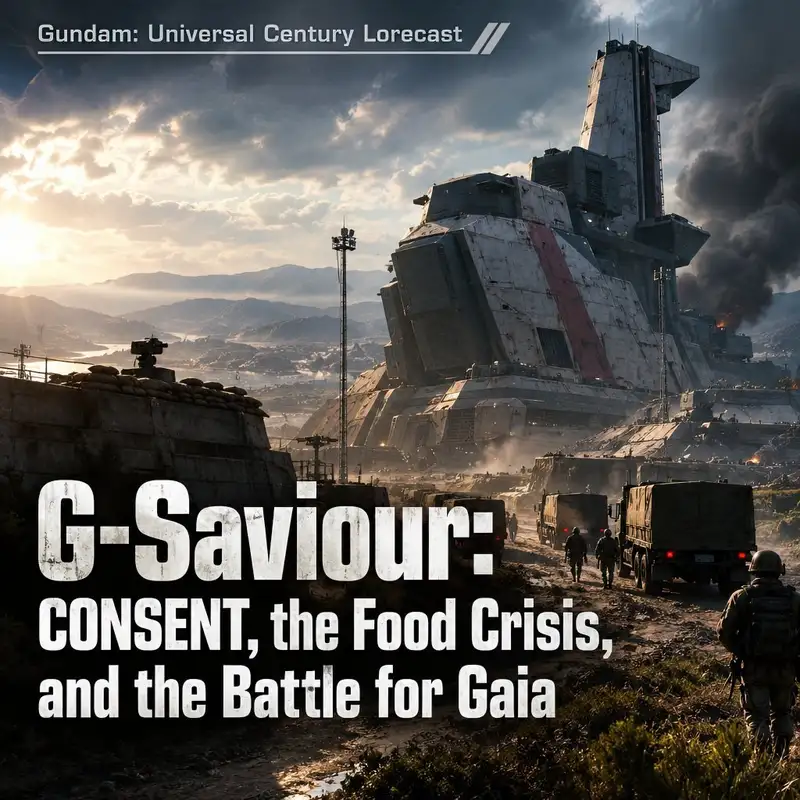
G-Saviour: CONSENT, the Food Crisis, and the Battle for Gaia [Live-Action Continuity]
A breakthrough in food production should have been a moment of relief. In Universal Century two hundred twenty-three, it became a reason to send armed men after a scientist. That contradiction sits at the center of G-Saviour’s live-action history. The Earth Sphere was enduring a severe food shortage, and Gaea possessed research that might expand food production under conditions where ordinary agriculture could not easily function. Yet General Garneaux did not treat that discovery as a humanitarian opportunity. He treated it as a threat to political control. The coming battle was not caused by a new superweapon, an ancient grievance, or a contest to build the better mobile suit. It began because an independent Settlement might gain the means to feed itself without permission from the power governing Earth.
The film does not give us dependable totals for hunger, crop failure, population, mortality, or projected agricultural output. It does not provide a complete scientific account of how Gaea’s research would be scaled across the Earth Sphere. That restraint matters. The biological sample at the center of the crisis is not a guaranteed cure for every empty ration store. It is a possibility, and in a system built around scarcity, possibility can be enough to change politics. If food can be produced outside a government’s controlled distribution network, communities that once depended on that government gain room to bargain, resist, or simply survive on their own terms.
Food is never merely food in a political crisis. It is transport capacity, storage, labor, trade, public health, and the confidence that families will still have a future. It is also authority. A government that distributes food can claim to preserve order. A government that controls access to food can make obedience seem like prudence. For an isolated colony or Settlement, the question is even sharper. A habitat may have air, machinery, and defensive weapons, but none of those sustain a population indefinitely if its food supply is controlled somewhere else. Gaea’s research therefore carried strategic value far beyond the laboratory that produced it.
A food crisis offered several possible responses. Governments could seek trade agreements, distribute scarce supplies, fund research, negotiate access to Gaea’s discovery, or build a coalition around the need to avert starvation. None of those options would have been easy. Fragmented political orders rarely make generous cooperation automatic. But Garneaux’s response was not built around cooperation. He pursued custody. He wanted the scientist, the sample, and ultimately the ability to decide who could use the research. Before there was an invasion of Gaea, there was an attempt to control knowledge.
That attempt began far from the Settlement itself, at the Hydro-Gen research facility in the Deep Face Trench. Hydro-Gen is not developed in the film as a vast industrial empire or a fully explained scientific institution. It is important because it provides the setting where research, intelligence operations, and personal loyalties first collide. Mark Curran worked there after leaving CONSENT’s mobile-suit forces. He was no longer a serving pilot, no longer part of the formal chain of command, and no longer willing to let military authority define the limits of his life. The film presents him as someone with valuable training who has tried to place distance between himself and the kind of work that training once required.
At Hydro-Gen, Mark encounters Cynthia Graves, a scientist from Gaea and the daughter of its chief councilor. Cynthia carries the research that has become the center of the crisis. The sample is described as an enzyme or a bioluminescent organism capable of enabling food production in underwater conditions. The film’s language is broad enough to establish its importance without turning the audience into agricultural engineers. What matters militarily is that the sample is portable, vulnerable, and tied to a person who understands its significance. That makes Cynthia both a scientist and a strategic asset in the eyes of those pursuing her.
The first confrontation is not a conventional battle. It is a security operation carried out under the pressure of intelligence and political urgency. CONSENT personnel are pursuing Gaean infiltrators, and Lieutenant Colonel Jack Halle, Mark’s former superior, is prepared to execute Cynthia rather than risk losing control of the research. That moment reveals the character of the operation. Garneaux’s side is not arriving with an offer to purchase, share, or regulate a new food technology. It is treating the scientist as a problem to be removed from the board. The distinction is decisive. A government that seeks cooperation needs the researcher alive and willing. A coercive system often settles for possession, silence, or destruction.
Mark’s intervention saves Cynthia, but it also changes the scale of the crisis. Until then, the affair could have remained buried inside a classified raid against a remote facility. Once a former CONSENT pilot turns against his old chain of command and escapes with the scientist, the issue becomes harder to contain. Mark is not a great statesman or the commander of a fleet. His importance comes from something more immediate. He understands the military world pursuing them. He knows that orders, uniforms, and official language do not necessarily reveal the real purpose of an operation. He also has the skills to survive long enough for the political meaning of the operation to become visible.
That matters because secrecy is often strongest at the beginning of a crisis. An intelligence service can track individuals, isolate a laboratory, and present force as routine security. It becomes harder to maintain that fiction once targets escape, cross political boundaries, and bring evidence of the operation with them. Mark and Cynthia’s flight turns a concealed seizure effort into a wider contest over jurisdiction. Who has the right to hold the sample? Who has the right to decide where it goes? Who gets to classify an agricultural discovery as a security threat? Those questions follow them from the Deep Face Trench toward space.
Their escape brings them into contact with Franz Dieter, Kobi, and Mimi Devere. Each matters less as a catalogue of companions than as part of a fragile network formed under pressure. Franz and Kobi help move people and information through a dangerous political environment. Mimi is more complicated. She is Mark’s fiancée, and she is also connected to CONSENT intelligence. That relationship gives Garneaux’s side an advantage that cannot be measured by the number of mobile suits in a carrier hangar. Intelligence operations thrive on access. A private connection can become a surveillance channel. Affection can become a vulnerability. Trust can become an operational hazard.
Mimi’s presence also keeps the story from becoming too simple. She is not merely an infiltrator in a black uniform, placed in the narrative to betray the heroes at a convenient moment. Her divided loyalties are central to the episode’s argument. Garneaux can obtain information through her connection to Mark, but he cannot fully command what she will decide once she understands the purpose of the operation. Intelligence services often mistake access for control. They can observe a person, pressure a person, and use a person’s attachments. They cannot always predict the point at which that person decides the mission itself has become intolerable.
The escape route leads to New Manhattan at Side Four, within the political orbit of the Settlement Freedom League. There, Mark and the others meet Philippe San Simeone, who reveals his connection to the Illuminati. The name carries historical associations, but the organization in this film should not be imagined as a conventional army, a public government, or an all-knowing secret directorate. It is a clandestine group opposed to CONSENT’s coercive policies. It has access to information, safe channels, and advanced military equipment. It does not possess the open authority or documented mass forces of a recognized state.
That limitation is important. The Illuminati can help a threatened group move through hostile territory. It can provide a prototype mobile suit. It can intervene at a critical moment. It cannot simply replace the political institutions that have failed. Clandestine organizations are often strongest at disruption, extraction, and selective intervention. They are less suited to feeding populations, administering settlements, or building broad legitimacy in the open. Philippe can give Mark an option. He cannot solve the Earth Sphere’s food crisis with a hidden warehouse and a single advanced machine.
The machine he offers is the G-Saviour. In another kind of story, this would be the point where the appearance of a new mobile suit settles the question. The pilot climbs into a prototype, the music rises, and the wider conflict becomes a sequence of targets waiting to be destroyed. G-Saviour does not support that reading. The machine matters, but it matters as part of an operational problem. Mark and the group need to reach Gaea, and their route is obstructed by debris. In space, access is never just a matter of pointing a ship toward a destination. A blocked route, damaged traffic corridor, or hazardous debris field can deny movement as effectively as an enemy patrol.
Mark initially refuses to return to combat. That refusal is more than personal hesitation. It establishes a basic military fact. A mobile suit is not a weapon merely because it exists in a hangar. It needs a pilot able to operate it under pressure, technicians able to prepare it, and a mission that justifies the risks of deployment. The G-Saviour’s immediate value comes from the fact that an experienced former CONSENT pilot is available when the group needs someone capable of clearing the route. The machine gives Mark a means to act. Mark’s training gives the machine practical military value.
When Mark and Cynthia reach Gaea, the political stakes become visible in physical form. Gaea is not an empty fortress waiting for a battle scene. It is an inhabited agricultural Settlement with civilian authority, defensive infrastructure, and a population whose future is tied to the research Cynthia has carried home. Chief Councilor Graves, Cynthia’s father, represents that civilian authority. His role matters because the conflict is not simply between armed groups claiming a laboratory. It is between an outside force seeking control and a local community insisting that its own political future cannot be dictated at gunpoint.
Gaea’s defense problem is severe. Its local forces rely on aging RGM-196 Freedom mobile suits, fixed defensive systems, and debris-clearing guns. The film makes the broad contrast clear without supplying a complete readiness report. These are not elite expeditionary forces with the same access to training, replacement parts, intelligence, or carrier support available to CONSENT. Gaea’s defenders are protecting their own Settlement, but local knowledge and commitment do not automatically compensate for inferior equipment and limited combat experience. They have to make use of every advantage that comes from defending a known place rather than projecting power across space.
The debris-clearing guns illustrate that defense is not only a matter of mobile suits. Equipment designed for maintaining safe approaches and managing local infrastructure can become militarily significant in an emergency. That does not turn a civilian tool into a perfect weapon. It does show how a Settlement’s survival may depend on systems normally overlooked by a fleet commander. A community facing invasion uses what it has: local networks, fixed installations, pilots who know the terrain, and people willing to keep essential systems running while armed forces approach.
CONSENT arrives with the advantages of an expeditionary force. It can bring a fleet, carrier-supported mobile-suit elements, and more advanced systems. Its equipment includes the CCMS-03 Bugu, the CAMS-13 MS-Rai, and autonomous CAMW-13 MW-Rai weapons. The important distinction is not simply that one side has newer machines and the other side has older ones. CONSENT has a more integrated military system. It can project force beyond its home territory. It has professional personnel, intelligence access, mobile weapons, and the ability to coordinate an assault from outside the Settlement.
Gaea, by contrast, is trying to defend its political independence with whatever local means can be assembled in time. That is a difficult military position even before the first mobile suit launches. An attacker selects the moment of approach and can bring concentrated force against a limited objective. A defender must protect people, infrastructure, communications, and key individuals at once. The defender cannot simply abandon a damaged section of a Settlement if that section contains civilians, food systems, or a route needed for evacuation. Every strike carries risks that extend beyond the immediate exchange of fire.
Before the main battle fully opens, Mimi compromises Gaea’s defense network. That act demonstrates a hard truth about warfare in a networked environment. A settlement can have guns, sensors, mobile suits, and a determined population, yet still be vulnerable if its command systems are penetrated. The resulting use of debris-clearing guns damages a CONSENT vessel. It is a striking reversal, but the deeper point is not the damage itself. Control of information has already shaped the fight before either side can claim a clear tactical victory.
Mimi’s intrusion should not obscure responsibility. She creates the breach in Gaea’s defenses, but Garneaux creates the wider crisis by choosing assault over negotiation. An infiltrator can open a door. The political leadership decides whether armed men walk through it. That distinction is essential because it prevents the battle from being reduced to one person’s betrayal. Gaea is vulnerable because it is under attack by a larger power seeking to seize control of a resource. The network compromise makes that attack easier. It does not explain away the decision to launch it.
The damage to the CONSENT vessel also shows the danger of operating around inhabited infrastructure. In a conventional fleet engagement, commanders might think first in terms of weapons range, formations, and damage tolerance. Around a Settlement, every misused system can threaten approaches, civilian structures, and the very facilities needed to sustain life. The film does not provide enough detail to reconstruct the exact technical effects of the incident, but it makes clear that the battle space is not empty. Ships and mobile suits operate in the shadow of a community that cannot simply be moved out of the way.
Once CONSENT’s mobile suits move against Gaea, the conflict changes character. It is no longer a covert effort to capture a scientist and secure a sample. It is an armed intervention against an independent Settlement. The political meaning of the operation becomes harder to conceal with security language. The presence of advanced mobile suits, autonomous weapons, and an approaching force from outside the Settlement tells the population exactly what is at stake. If Gaea loses, the issue will not be limited to who owns a biological sample. It will be who decides whether Gaea remains capable of directing its own future.
Jack Halle’s role is central at the tactical level. He is Mark’s former superior, which makes their confrontation more than a duel between rival pilots. Halle represents the military structure Mark once served. He is the immediate commander carrying the pursuit and assault forward. Mark, meanwhile, has become a defector from that world, though not a commander of a rival state. Their encounter in the MS-Rai places personal history inside a larger contest over authority. The machine is more advanced than Gaea’s local defenders can comfortably face, but it is still operated by a man pursuing an objective set above his level of command.
The tactical objectives are clear enough. Gaea’s defenders need to protect Cynthia, preserve the biological sample, delay or repel the assault, and keep CONSENT from securing the Settlement’s infrastructure. CONSENT needs to seize the scientist and research before Gaea can turn them into a political asset. These objectives explain why the fighting spreads through the Settlement rather than remaining a clean battle between mobile suits in open space. The attacker needs physical control. The defender needs to deny it. That is the kind of mission in which fixed defenses, local knowledge, and civilians holding essential posts can matter as much as a machine’s nominal performance.
The G-Saviour gives Mark a meaningful tactical role, but it does not fight alone. Gaea’s Freedom units continue to matter because they occupy defensive space and force the attacker to divide attention. Fixed systems matter because they shape approaches and create opportunities. The Illuminati matter because their intervention changes the local balance at the moment Gaea most needs reinforcement. Mimi’s later actions matter because possession of the real sample becomes as important as possession of the laboratory. The battle is a system of interacting decisions, not a single pilot carrying history on his shoulders.
CONSENT’s initial advantages are real. It can penetrate Gaea. It can bring better-equipped forces against locally organized defenders. It can exploit intelligence access and confusion inside the Settlement. At the tactical level, that is what expeditionary power is supposed to do. But tactical penetration is not the same as political success. A force can reach its target and still fail if the target’s value depends on legitimacy, secrecy, or the cooperation of people who no longer accept the attacker’s authority. Garneaux’s operation needs more than military control. It needs the food crisis to remain a justification for centralized control.
That requirement collapses when Garneaux reveals his actual intention. Rather than use Gaea’s discovery to relieve the food shortage, he plans to destroy it and impose selective starvation within CONSENT. The phrase should be understood carefully. The film presents it as Garneaux’s stated intention during the crisis, not as a fully implemented program with established regulations, victim counts, or administrative procedures. But the intent is enough to transform the political meaning of the battle. Scarcity is no longer merely an emergency to be managed. In Garneaux’s strategy, it becomes a tool.
The strategic logic is brutal but recognizable. A population dependent on centrally controlled food supplies has fewer options. It cannot easily support an independent Settlement. It cannot bargain from a position of security. It may accept restrictions that would otherwise provoke resistance because the immediate fear of hunger is stronger than abstract political rights. Gaea’s research threatens that arrangement because it suggests that food production might be distributed more widely, or at least placed beyond Garneaux’s direct control. In that sense, the agricultural breakthrough is dangerous not because it is a weapon, but because it weakens the political value of deprivation.
Garneaux’s plan also reveals the limits of rule by emergency. Emergency authority can survive when people believe leaders are making hard choices to protect them from a disaster. It begins to fail when people learn that the disaster itself is politically useful to those leaders. A government can ask citizens to endure scarcity. It cannot easily justify preserving scarcity after a means of relief has appeared. Once that contradiction becomes visible, the battle for Gaea becomes a legitimacy crisis for CONSENT’s hard-line faction. The question is no longer whether Gaea will share a valuable discovery. It is whether any population can trust Garneaux to use that discovery for survival rather than domination.
For that reason, the conflict resembles an attempted occupation by proxy. Garneaux does not need to annex every corridor of Gaea permanently if he can monopolize the sample, control food access, and reduce the Settlement to dependency. Political control can be exercised through supply systems as effectively as through a flag or a garrison. But it is also more fragile than it appears. It depends on keeping the mechanism of dependency hidden or accepted. Once civilians understand that they are being asked to remain hungry so that someone else can remain powerful, the coercive system loses the moral language it uses to defend itself.
The sample itself remains at the center of the struggle. Kobi is critically wounded while trying to protect it, a reminder that strategic assets are often carried by people who have little formal authority over the policies built around them. The sample is small enough to move, conceal, steal, and substitute. Its political weight is enormous. Yet it should not be mistaken for a magical object. The film does not establish the full industrial process required to turn the organism into large-scale food production. It does not tell us how long that process would take, who could manufacture the necessary equipment, or whether every environment could use it successfully.
That uncertainty does not reduce the sample’s importance. In a food emergency, even the prospect of an independent supply system changes the balance of power. But it does mean that the battle is not the final solution to the crisis. Winning custody of the sample is only the beginning of a harder process involving research, production, distribution, transport, and political agreement. The film’s most disciplined implication is that technology can create an opening. It cannot by itself create justice. A biological discovery may make new food systems possible. It cannot force governments to distribute the resulting food fairly.
Mimi’s eventual decision to substitute the sample is the counterintelligence reversal that Garneaux fails to anticipate. His organization has used personal ties, surveillance, and access to track Mark and the Gaean research. It has penetrated a defense network and followed its targets through a complicated escape route. Yet it has not secured the one thing it truly needs: reliable loyalty. Mimi’s action preserves the real sample for Cynthia while allowing Garneaux’s side to believe that it has gained control. It is a deception operation carried out from inside the very network that was supposed to serve CONSENT.
Her decision does not erase the harm she has caused. The compromised defenses and the danger to Gaea remain real. But it does demonstrate that systems built on compartmentalized coercion are often vulnerable to moral fracture. Subordinates may obey an order when they believe it serves security. They may reassess when the order reveals itself to be a plan to preserve starvation. Garneaux’s political objective has become so extreme that it begins to undermine the loyalty and trust needed to execute it. The same intelligence structure that gave him access now becomes a channel through which his plan can be defeated.
The final escape sequence is compressed, and the film does not support an elaborate reconstruction of every shot or command decision. Garneaux, Mimi, and others attempt to leave Gaea aboard a shuttle. The shuttle is destroyed by CONSENT fire, killing Garneaux and apparently everyone aboard. The immediate military mechanics are less important than the result. Garneaux’s own system ends up consuming the people caught within its confusion. A force sent to seize control of food research fires into a situation it has made too opaque to manage safely. That is not merely an accident of combat. It is the operational cost of secrecy, mistrust, and political objectives that cannot be openly defended.
With Garneaux dead, the assault loses its political center. That does not mean every CONSENT soldier suddenly changes belief or that the wider government becomes innocent of the operation. It means the force on Gaea no longer has a coherent path to mission success. The real sample remains beyond its control. The Settlement’s defenders continue to resist. The Illuminati arrive with support. Mark defeats Halle and helps disable the remaining assault elements inside Gaea. The immediate military balance shifts because several separate efforts finally converge against an operation whose purpose has been exposed.
It would be inaccurate to call this a one-machine victory. Mark’s skill in the G-Saviour matters, particularly against Halle and the more capable CONSENT mobile-suit forces. But his skill operates within a wider defense. Gaea’s fixed systems have already affected the battle. Local defenders have delayed and complicated the assault. Mimi’s deception has preserved the strategic asset at the center of the conflict. The Illuminati have provided reinforcement when the Settlement could not rely on a conventional allied fleet. The attackers have lost leadership and clarity of purpose. The outcome comes from the interaction of those factors, not from a prototype descending from the sky to settle history alone.
At the tactical level, CONSENT’s assault elements are defeated or disabled. At the operational level, the attempt to seize Cynthia and the sample fails. At the strategic level, Garneaux fails to monopolize the means by which food independence might be developed. At the political level, the assault exposes the danger of allowing scarcity to become a tool of rule. These are different outcomes, and they should not be blurred together. Gaea’s defenders do not solve hunger across the Earth Sphere by winning a battle. They do preserve the possibility that the food crisis will not be resolved solely on Garneaux’s terms.
CONSENT withdraws, and Chief Councilor Graves declares that Gaea will remain independent. That declaration is the political result for which the fighting has been conducted. Military survival has made continued autonomy possible. It has not made autonomy effortless. Gaea still exists inside a fractured Earth Sphere. It still has to develop, protect, and eventually distribute the research that made it a target. It still faces the larger question of how an independent Settlement can remain independent when neighboring powers see food production as a strategic asset.
The film does not establish that Gaea’s organism immediately ends the food shortage. It does not present a sphere-wide agricultural revolution, a lasting settlement between CONSENT and the Freedom League, or a comprehensive reform of the post-Federation order. Those would require institutions capable of turning a scientific opportunity into durable public policy. They would require transport networks, production facilities, labor, agreements over access, and above all a political decision that food should serve survival rather than control. The Battle of Gaea creates room for those choices. It does not make them automatically.
For that reason, a food crisis became a war for Gaea. General Garneaux regarded food independence as more dangerous than hunger. His forces could penetrate Gaea’s defenses, field superior systems, and pursue the scientist carrying the research. But they could not turn scarcity into durable political control once the purpose of the operation was exposed. Gaea survived not because one prototype mobile suit solved a war, but because local defense, defection, deception, outside intervention, and civilian political resolve prevented a crisis of food from becoming a permanent system of dependency.