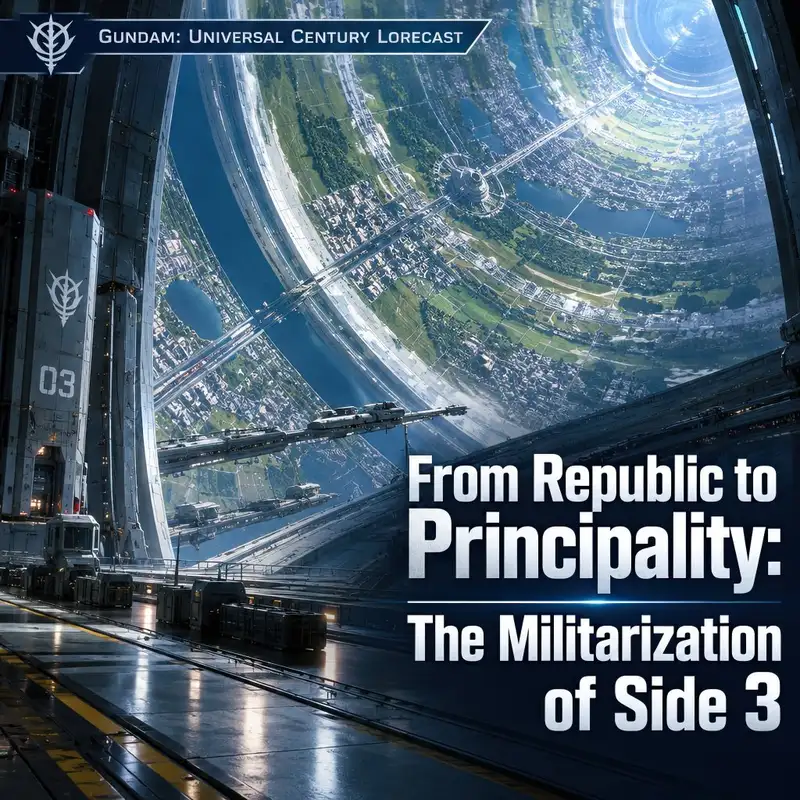
From Republic to Principality: The Militarization of Side 3
On the eve of the One Year War, Side 3 could present itself as the political voice of people living in space. Its leaders spoke of dignity, autonomy, and liberation from a distant Earth Federation. Yet the same government had concentrated power in one ruling family, built security institutions to silence rivals, expanded its armed forces, and prepared to send fleets and mobile suits not only against Earth, but against other colonies. That contradiction is the key to understanding the Principality of Zeon. Side 3 did not begin as a simple military fortress waiting for the right dictator. It was a colony cluster shaped by real political grievances, economic dependence, and resentment toward rule from Earth. But grievance alone did not require dictatorship.
Nor did the demand for colonial representation require aggressive war. The transformation from republic to principality was gradual. It involved ideology, factional struggle, institutional capture, surveillance, officer training, industrial mobilization, and the political use of fear. By the time Side 3 formally became a principality, much of that work had already been done. The dynasty did not create every source of colonial anger. What it did was capture that anger, organize it, and turn it into a state capable of war.
Side 3, also known as Munzo, occupied a politically important position near the Earth-Moon Lagrange Two region, on the far side of the Moon from Earth. That location did not make it unreachable, but it made it feel distant from the centers of Federation power. Distance in the Earth Sphere was never merely geographic. It shaped transport, communications, trade, military presence, and the daily political experience of being governed from elsewhere. Side 3 was not an empty military outpost. It was a populated colony cluster, with homes, workplaces, administrative institutions, transport systems, and people whose lives depended on wider Earth Sphere commerce.
Its residents could see themselves as part of a common human civilization while also believing, with considerable justification, that decisions affecting them were made far away by institutions they did not control. The later retelling in Mobile Suit Gundam: The Origin gives the most detailed account of these pressures. In that version, Side 3 possessed limited self-government but remained within the Federation system. It also faced resentment over unequal distribution of food and resources, and over the costs associated with Federation military deployments. Those details belong specifically to The Origin’s account, but they illustrate a broader and consistent political reality. Colonial autonomy was persuasive because many people believed the Federation treated the colonies as subordinate territory rather than equal political communities. Not everyone shared the same motive. Some wanted local dignity. Some wanted economic change. Some sought influence within a new political order. Some feared Federation coercion. A movement can unite such people without making them ideologically identical.
That movement found its most influential theorist in Zeon Zum Deikun. He is often remembered through his family connection to Char Aznable and Sayla Mass, but that reduces him to a prelude in someone else’s biography. Deikun mattered because he gave colonial resentment a political language. He argued that people living in space should govern themselves rather than remain dependent on Earth-centered institutions. He also linked space settlement to human development. In his view, humanity’s movement into space could produce a new kind of person, later known as a Newtype. At this stage, that was primarily a political and philosophical idea. It was not yet the military research program, pilot classification system, or weapon-interface problem that later governments would pursue.
Deikun’s Newtype thought suggested that people living in space might develop new capacities of understanding and perception. It also suggested that Earthnoid political dominance belonged to an older stage of humanity. That was a potent message for colonists who believed they were treated as second-class citizens. But it carried a danger from the beginning. A doctrine intended to affirm the dignity of Spacenoids could become a doctrine of Spacenoid superiority. The line between saying that colonial people deserve equal representation and saying that they are inherently superior to those on Earth is politically narrow, and historically dangerous. Deikun should not be treated as the direct author of every later Zabi policy.
The dictatorship, military expansion, and atrocities of the Principality were choices made by other people. Still, political ideas do not remain under the control of their creators. Once an idea becomes a mass movement, it can be simplified, sharpened, and repurposed by those who find it useful.
Ideology became dangerous because it entered institutions. Side 3’s autonomy movement was never a single unified bloc. It contained activists, politicians, financiers, media figures, military officers, and rival factions with different visions of independence. The Origin retelling provides a particularly detailed version of this political struggle. In that account, Deikun became chairman of Munzo’s national Diet, while Degwin Sodo Zabi served as vice chairman and powerful ally. Jimba Ral led a competing faction within the Zeon Party. The precise sequence belongs to that retelling, but the institutional lesson is broader. The central issue was not simply whether Side 3 possessed a legislature or a party system. It was who controlled appointments, funding, public messaging, security, and succession.
A republic can retain representative forms while power shifts elsewhere. The decisive offices may be held by people who do not need to abolish an assembly if they can dominate the bureaucracy around it, influence the press, direct the police, and define who counts as a loyal citizen. Side 3’s early autonomy institutions were also vulnerable because their autonomy remained incomplete. They operated under the shadow of Federation sovereignty and military power. That weakness encouraged political hardening. Leaders who believed the Federation might reverse local gains could argue that compromise was dangerous and centralization necessary. But the need for political security can become a permanent excuse for concentrating power. The state begins by defending autonomy against an external authority, then turns inward and treats domestic disagreement as a threat to national survival.
The death of Zeon Zum Deikun in Universal Century sixty-eight was the decisive rupture. In the principal animated record, his death is politically suspicious in later memory, but its exact cause is not securely resolved. It is tempting to turn the event into a solved murder mystery and assign responsibility to Degwin, Gihren, or the Zabi family as a whole. That is more certainty than the central animated history provides. What matters historically is the effect of the death. Side 3 lost the movement’s most important public theorist and unifying figure. His death opened a contest over succession, legitimacy, and the meaning of his legacy. A political movement can survive the death of a leader, but only if its institutions can decide who inherits authority.
Side 3’s institutions were too contested, and too exposed to factional pressure, for that process to remain neutral. The Origin account dramatizes this crisis through the funeral period and the death of Sasro Zabi during the procession. In that version, shock and violence are used to discredit the Ral faction and help the Zabis consolidate control. Those particular events are Origin-specific and should not be treated as a seamless record of the original television continuity. Still, they illustrate a credible political mechanism. Violence does not need to be fully understood to be politically useful. The faction that controls the investigation, the public narrative, and the emergency response can shape who is blamed and who is protected. Deikun’s death did not simply remove one man. It created a vacuum in which control of memory became as important as control of office.
The Zabi family’s answer was not to erase Deikun. It was to inherit him. The name Zeon had immense political value because it linked the state to the independence movement’s moral claim. It suggested continuity with colonial dignity, sacrifice, and self-government. That symbolism allowed the Zabis to present their rule not as a seizure of power, but as the preservation of a national cause. The Origin chronology describes an Autonomous Republic of Zeon by Universal Century seventy-one, a state that retained Deikun’s name while reorganizing authority under Zabi control. That date belongs to The Origin’s timeline and should not be imposed on every Universal Century account. The larger pattern, however, is clear.
Republican language remained useful even as practical power moved into family networks, party machinery, security organizations, and military command. This is one of the more durable lessons of Side 3’s transformation. A government does not become less authoritarian simply because it keeps patriotic ceremonies, legislative titles, elections, or the vocabulary of revolution. The question is where decisions are actually made. Who can remove leaders? Who controls information? Who can investigate the security services? Who directs armed force? Who can dissent without losing employment, freedom, or physical safety? In Side 3, authority increasingly rested not in a broad and accountable colonial public, but in a ruling house that claimed to embody that public. The later title of principality would make the dynastic character explicit. Long before that formal declaration, however, the political substance of the state had begun to change.
Security institutions were essential to that change. Militarization is often imagined as uniforms, parades, ships, and weapons factories. Those are visible signs, but they are not the beginning of the process. A state preparing for confrontation first needs to determine who is trusted, who is watched, and who can be excluded from political life. Kycilia Zabi’s later association with intelligence and state security reflects this side of the regime’s development. Her role was not merely family intrigue carried out in a dramatic cape. Security and intelligence were part of the machinery that made dynastic rule durable. The Origin retelling identifies a strengthened Zeon Special Service as part of the post-Deikun state.
That organization belongs to The Origin’s institutional account, but it captures the basic function of such services. Political rivals, Deikun loyalists, independent activists, and inconvenient officials could all be reclassified as risks to national security. The Ral faction mattered because it represented an alternative claim to Deikun’s legacy. A rival does not need to command an army to threaten a consolidating regime. It may be enough that the rival offers supporters another way to be loyal to the national cause. Repression also does not require universal imprisonment to succeed. People alter their behavior when they believe their careers, education, associations, and families may be affected by political suspicion. Newspapers learn which stories are safe. Officials learn which reports will be welcomed.
Teachers learn which ideas deserve emphasis. Citizens learn when silence is prudent. Yet a security state has its own weakness. It may protect a regime from opposition while corrupting the information that reaches its leaders. Subordinates report what superiors want to hear. Ideological loyalty becomes confused with professional competence. Fear improves control in the short term, but it can make strategic judgment worse.
Coercion could secure a regime internally, but it could not by itself create an independent war-making state. For that, Side 3 needed trained personnel, command structures, doctrine, and an officer corps. There is a major difference between a local defense force and armed forces capable of conducting a large space war. A local force may guard installations, patrol approaches, and respond to immediate threats. An independent military establishment must recruit, educate, assign, supply, and replace people at scale. It needs a chain of command that can survive confusion and communication disruption. It needs technicians who can maintain engines, weapons, life-support systems, sensors, and armor. It needs officers able to coordinate ships, mobile suits, transport, intelligence, and logistics.
It needs institutions that can turn political enthusiasm into sustained military capability. Dozle Zabi became closely associated with the military face of the regime, including defense institutions and the armed forces’ popular appeal. He should not be treated as the sole creator of Zeon’s military power. No one officer could build such a system alone. But his public role mattered because militaries often require figures who can make service appear honorable, communal, and necessary. The Origin account describes the expansion of the Republic of Zeon Space Defense Force and military academy recruitment that reached beyond Side 3 itself. Those details are specific to The Origin, but they demonstrate the strategic logic of militarization. Recruiting from other Sides transformed a local autonomy movement into a broader Spacenoid cause.
It also created a pipeline of officers and pilots whose livelihoods, identities, and ambitions became tied to the survival of the Zeon state. Militarization offered employment, status, discipline, and purpose. It gave the ruling family a constituency with a direct material stake in the regime. It also normalized the idea that the answer to political subordination was armed preparation.
Military preparation required industry. The future Principality did not become dangerous merely because it possessed ambitious leaders or talented pilots. It became dangerous because political ambition was connected to research, shipbuilding, manufacturing, transport, technical training, and secrecy. The mobile suit, which would later become the iconic weapon of the One Year War, was not a single invention appearing in isolation. It was the visible end product of a system. A mobile suit required compact power, weapons integration, pilot training, maintenance procedures, spare parts, storage, recovery, and ships or bases from which it could operate. A force equipped with mobile suits also needed doctrine. Commanders had to decide how these machines would work with fleets, scouts, transports, and fixed defenses.
Mechanics needed to understand systems that ordinary line personnel could not repair with a wrench and optimism. The Origin account gives a detailed and distinct version of this buildup. It depicts a new mobile weapon being concealed behind the appearance of a worker machine, and it describes the conversion of a civilian ship design into the Musai-class combat vessel. Those are useful examples of how militarization can hide inside civilian infrastructure, but they belong to The Origin’s branch and should not be treated as settled television-era chronology. The reliable broader point is that, by the eve of war, Zeon had developed the industrial and organizational capacity to field mobile suits in space operations. That achievement was more consequential than any individual prototype.
A prototype can demonstrate a possibility. A military-industrial system turns that possibility into units, crews, maintenance schedules, ammunition supply, tactical doctrine, and repeated sorties. Civilian society paid for that transformation. Workers, engineers, administrators, transport crews, and families became participants in national mobilization, whether they supported it enthusiastically, accepted it for practical reasons, or feared the consequences of refusing.
That mobilization also created opportunity costs. A colony cluster has limited space, labor, material, and political attention. Resources devoted to military research, ship construction, security services, and officer training are resources not spent on housing, civilian transport, education, public welfare, or independent institutions. A government preparing for war does not need every citizen to become a soldier. It needs civilian life to become organized around military priorities. Factories accept classified contracts. Schools emphasize national service. Technical careers become tied to defense programs. Shipping schedules serve military needs. Public criticism can be dismissed as harmful to readiness. Over time, the distinction between defending the nation and serving the ruling structure becomes deliberately unclear.
This was especially significant for Side 3 because its leaders framed mobilization as self-defense against Federation domination. Some degree of defense planning was understandable for a polity that believed its autonomy was threatened. But the regime’s preparation went beyond a limited deterrent posture. It built the capacity for offensive war. The difference is not always visible in a shipyard or laboratory. A warship can be described as protection. A mobile suit can be described as a security asset. A military academy can be described as national development. The meaning becomes clearer when institutions are integrated under centralized political control and directed toward a strategic program of confrontation. Side 3’s armed buildup was not simply a technical race. It was the practical expression of a new political order, one in which national struggle justified secrecy, hierarchy, and the subordination of civilian society to military purpose.
The Earth Federation contributed to the crisis, but it did not make Zeon’s choices for it. This distinction matters. The Federation governed an enormous and unequal political system. Its failures in colonial representation, resource distribution, and political responsiveness gave Side 3’s leaders powerful material for propaganda. A Federation military presence in the colonies could be presented as proof that autonomy would never be secure. Coercive measures intended to preserve central authority could strengthen the very nationalism they were meant to contain. The Origin account depicts the Federation as possessing some awareness of Zeon’s military development while responding with pressure that deepened hostility. That sequence belongs to The Origin’s retelling, but it supports a broader interpretation of Federation failure. The problem was not total ignorance.
Great powers are often aware that a challenge exists. They fail because they misjudge its political depth, institutional discipline, or willingness to accept catastrophic risk. The Federation could look at Side 3 and see a smaller colony cluster with limited resources compared with the broader Earth Sphere. It could assume that material imbalance would restrain Zeon. But states do not always make decisions through conventional cost-benefit calculations. A regime that has built its legitimacy around national struggle may find compromise politically impossible. A leadership that has fused its survival to military mobilization may see de-escalation as a threat from within. Deterrence fails when the stronger power assumes the weaker side will remain rational by its own definition of rationality.
Still, Federation pressure did not cause the Zabi dictatorship in any simple sense. The Zabi leadership chose to exploit grievance, suppress rivals, militarize society, and prepare for aggressive war. Colonial misrule explains part of the environment. It does not absolve the people who chose what to do with it.
The final formal step was the proclamation of the Principality of Zeon. This is one of the places where Universal Century chronology requires caution. The Origin material places the establishment of the Principality on October twenty-fourth, Universal Century seventy-eight, with Degwin Sodo Zabi becoming sovereign and Gihren Zabi assuming supreme military authority. Other Universal Century chronology traditions commonly place the proclamation much earlier, in Universal Century sixty-nine. Those dates cannot simply be combined into a single seamless record. The exact chronology differs by source branch and later reference tradition. What remains stable across the accounts is the political meaning of the transition. Side 3 ceased to present itself merely as an autonomous republic and openly adopted a dynastic form of rule.
The title principality was not a decorative change. It signaled that the state’s authority now rested in a ruling house that claimed to embody the nation. Degwin became the formal sovereign, but formal sovereignty and practical influence were not identical. Gihren’s authority over propaganda, ideological mobilization, and supreme command made him central to the state’s militarized direction. Kycilia’s security apparatus gave the regime another source of power. Dozle’s military role gave it institutional credibility among soldiers and officers. The family functioned not as a perfectly unified machine, but as a ruling network whose members controlled different levers of the state. The important fact is not that every Zabi agreed on every policy. It is that the political system concentrated authority in their hands while preserving the language of a broader national mission. By the time the word principality was placed over the door, the building had already been rebuilt.
By Universal Century seventy-nine, Side Three had been transformed from an autonomy movement into a state prepared for war. The achievement was organizational as much as ideological: industry, security institutions, officer training, mobile-suit development, propaganda, and centralized authority had been aligned behind the Zabi regime. That preparation helped produce Zeon’s early military successes, but readiness for war was not the same as a defensible political future. The dynasty preserved the language of colonial self-government while narrowing meaningful power around itself, then used that machinery for conquest and mass violence. Side Three’s tragedy was not that its grievances were imaginary. It was that legitimate demands for representation were absorbed into a system that made obedience to the ruling family increasingly synonymous with loyalty to Zeon.