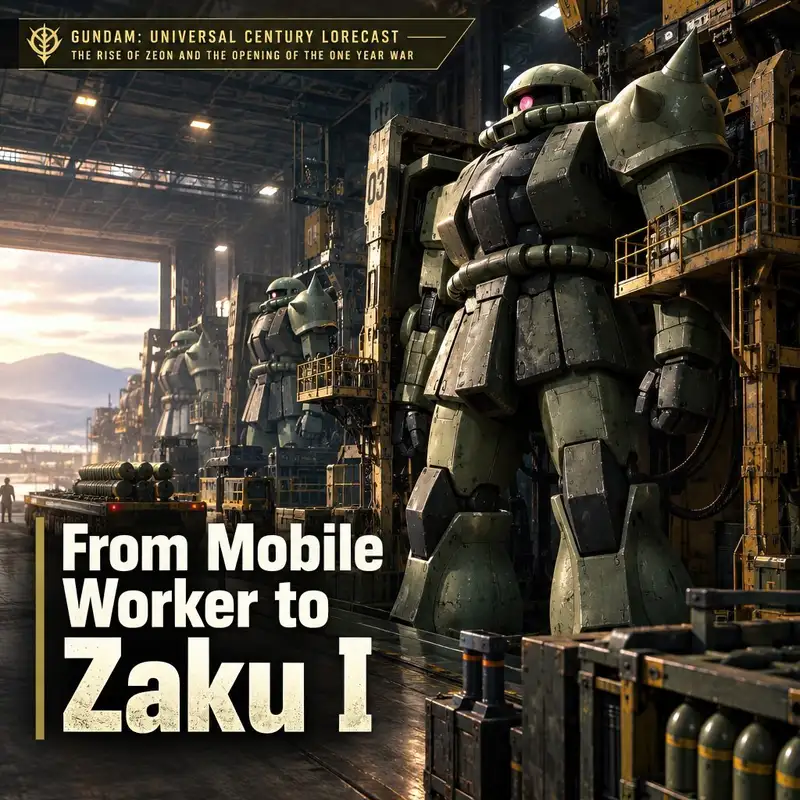
From Mobile Worker to Zaku I
The Bugu was the better performer. Its limb systems received abundant power through external fluid-pulse pipes, and that gave it impressive mobility for its time. But those same pipes sat outside the armor, where damage, maintenance, and production variation could turn performance into liability. The MS-05 Zaku I accepted a less glamorous answer. It moved critical systems inside the machine. It gave up some agility. It became less spectacular in the narrow sense that matters most to a test pilot: how sharply the machine responds when everything is working perfectly.
That compromise was the point. A military does not go to war with a single flawless demonstration model. It goes to war with machines built by different shifts in different factories, operated by pilots of uneven experience, repaired by tired technicians, supplied through uncertain routes, and expected to survive contact with an enemy that is actively trying to find their weak points. The Zaku I mattered because it was designed for that world. It was not the first mobile suit in the development chain shown by Mobile Suit Gundam: The Origin. It was the first design in that chain intended to make the mobile suit a repeatable combat system.
That is a different achievement from building the most agile prototype. It requires engineers to think about armor access, component life, manufacturing tolerances, pilot protection, weapons fit, field repairs, and the awkward fact that every machine eventually has to come home damaged. It requires commanders to think about units rather than individual test pilots. It requires political leaders to decide whether an expensive technical curiosity has become a weapon worth funding. And it requires an industrial system capable of producing more than one impressive example.
To understand why the Zaku I became so important, we have to go back before Zeon had a mobile-suit force, before the familiar green machines became symbols of war, and before the first battles of the Zeon War of Independence. The story begins with a concealed requirement. The Autonomous Republic of Zeon was preparing for a conflict it did not yet openly acknowledge. It needed a way to gain military leverage against the Earth Federation, whose larger population, territory, and industrial resources gave it advantages that Zeon could not simply wish away.
In Universal Century seventy-one, Zeon’s answer was hidden inside an apparently civilian project. Development took place at the Extra Banchi, often called the Dark Colony. Colonel Dozle Zabi supervised the effort. Its public cover was plausible enough on its face: humanoid machinery for lunar resource extraction. The Moon, nearby industrial infrastructure, and the harsh demands of work in vacuum all made advanced labor machines a credible subject for research. A machine built to handle equipment, move debris, and operate in difficult terrain could justify articulated limbs, specialized tools, sealed cockpits, and substantial power systems.
That cover was useful because military development rarely begins with a sign over the door announcing its final purpose. Research programs hide inside industrial contracts, labor needs, transport requirements, mining equipment, and experimental engineering. A machine intended for lunar work could gather genuine data about motion, balance, power consumption, maintenance, and human control. At the same time, those lessons could be applied to weapons. The distinction between industrial capability and military potential is often less clean than governments prefer to admit.
Still, concealment has limits. A research project becomes harder to disguise when it needs security cordons, specialized personnel, protected testing areas, weapons trials, and military sponsorship. The Dark Colony’s civilian explanation should not be mistaken for proof that every worker understood the larger plan. The available record establishes a cover story and a covert military purpose. It does not give us license to invent the knowledge, loyalties, or private fears of the ordinary people who may have supported the surrounding industrial activity. What matters is that Zeon found a way to place weapons development inside infrastructure that could plausibly serve another purpose.
The first major result was the MW-01 Model 01 Early Type, a mobile worker that looked much more like an experiment than a finished weapon. It had a large rear-mounted fusion reactor, an exposed cockpit, work-oriented equipment, a mono-eye sensor, and the rough, provisional appearance of a machine built to answer engineering questions. It was not yet a standard combat vehicle. It was a platform for discovering whether a human pilot could control a large articulated machine under demanding conditions, whether such a machine could carry weapons, and whether its structure could survive the strain of movement and combat.
That last question was especially important. A humanoid machine can look convincing while standing still. It becomes far more difficult when it must move with purpose, fire a weapon, absorb recoil, protect its pilot, and remain controllable after taking damage. The early mobile worker allowed Zeon’s engineers and test personnel to investigate those problems in a single frame. It could test ballistic weapons. It could explore close combat. It could reveal how an articulated body responded when its arms, legs, sensors, power plant, and pilot were all placed under stress at once.
The Earth Federation was exploring advanced armored systems as well. The MW-01 was tested against the Federation’s RTX-65 Guntank Early Type. That encounter should not be treated as a simple contest between old warfare and new warfare. A test between immature machines does not settle the future of an entire military. The Federation’s vehicle represented its own approach to combining heavy weapons, armor, and mobility. Zeon’s worker represented a different hypothesis: that an articulated machine, if it could be made controllable and maneuverable enough, might operate in ways a more conventional armored design could not.
The early tests mattered because they exposed the central problem. The mobile worker had a reactor, but the reactor was too large and too burdensome. It dominated the machine’s form and limited its mobility. A powerful engine is not automatically useful power. If the power source consumes too much volume, shifts the center of mass, complicates armor protection, and leaves little room for fuel, controls, weapons, or maintenance access, then the machine remains an experiment. It may demonstrate a concept, but it cannot yet carry that concept into regular service.
That is the first hard lesson of mobile-suit development. The decisive issue was not whether engineers could make a machine with arms and legs. They could. The issue was whether they could fit a workable power system, control system, protection scheme, and maneuver system into a frame that could actually perform a military mission. The early MW-01 raised the right questions. It did not yet answer them.
Later mobile-worker variants improved the design in practical ways. Pilot protection became better. The arms could accept interchangeable attachments. Shoulder movement improved. Balance improved. The machines were used to investigate how an articulated frame behaved in space, where orientation and motion create a different set of problems from movement on a road or battlefield. These refinements may sound modest beside later mobile suits, but they were the kind of incremental changes that turn a laboratory object into a usable machine.
The exchangeable attachments were particularly revealing. A machine designed to accept different forearm equipment is not merely a machine with interesting accessories. It suggests a growing understanding that the frame must support more than one task. A worker may need a tool for handling debris. A test machine may need a weapon. A military system may eventually need different equipment for different missions. That flexibility also creates a maintenance requirement. Attachments have to be installed, inspected, stored, transported, and repaired. Connections have to survive repeated use. The more interchangeable a component becomes, the more standardization matters.
The late mobile workers also performed ordinary space work, including debris recovery. That kind of labor was useful for more than maintaining the project’s cover. It created operational experience. A machine handling debris in vacuum has to deal with mass, momentum, visibility, reaction forces, and the limits of the pilot’s field of view. Its joints wear. Its tools need adjustment. Its seals and systems must function away from a workshop. The engineers learn from failures that a controlled weapons trial may not reveal. They learn how a pilot becomes fatigued, how equipment shifts under load, and how long a machine can remain useful before maintenance becomes necessary.
Here, the articulated form acquired a real military logic. In space, a machine can use its limbs to assist with attitude control. Later reference material commonly describes this principle as AMBAC, active mass balance auto control. The essential idea is straightforward. Moving limbs can help a machine change orientation without relying entirely on thrusters for every small adjustment. That can be useful when a pilot needs to point sensors, weapons, or armor in a new direction. But it is not a miracle. Limbs do not replace thrusters. They do not eliminate propellant requirements. They do not make collision, drift, or momentum disappear. They give the pilot another set of tools for controlling the machine.
The important development was not that the mobile worker suddenly made space easy. It was that Zeon was learning how an articulated machine might operate in space at all. The research connected pilot input, joint motion, power distribution, attitude control, and task equipment. It began to establish the human and mechanical habits that later mobile-suit units would depend on. Yet the underlying obstacle remained. The machines had become more refined, but their oversized power systems still limited what they could become.
By Universal Century seventy-four, that engineering problem had become a political one. Weapons development exists at the pleasure of institutions. A project can be technically promising and still die if it consumes too much money, too much time, or too much confidence. Gihren Zabi held supreme authority over weapons development, and the mobile-suit program faced the possibility of cancellation because reactor miniaturization remained unresolved. The program had produced motion, experiments, and evidence. It had not yet produced a combat system persuasive enough to guarantee continued support.
For a covert project, this was especially dangerous. Open military programs can appeal to public urgency, visible threats, or legislative momentum. A concealed program depends more heavily on the confidence of a narrow group of sponsors. If those sponsors decide that the work is too costly, too slow, or too uncertain, the engineers do not get another generation of prototypes. Their facilities may be reassigned. Their staff may be dispersed. Their work may survive only as a technical curiosity in someone else’s archive.
For that reason, the reactor issue mattered so much. Miniaturization was not simply a matter of making the machine look cleaner or more elegant. A smaller, more capable reactor created room for armor, controls, fuel or propellant systems, weapons, sensors, and internal mechanisms. It reduced the degree to which the power plant dictated the entire machine’s shape. It made a mobile suit more balanced and more protectable. It also made it more plausible that such a machine could be built in a repeatable form.
Dr. Torenov Y. Minovsky became the decisive technical contributor at this stage. He should not be credited as the sole inventor of the mobile suit. The program had already accumulated years of work in mechanics, pilot control, industrial design, and testing. But his Minovsky-particle-based technology offered the breakthrough that the program required. It made a more compact reactor possible and improved the performance of the fluid-pulse drive system that powered the machine’s movement.
The consequence was a change in the possible design space. Before that breakthrough, the machine’s power system imposed severe limits on maneuverability and layout. After it, engineers could consider a mobile weapon in which mobility, articulated control, protection, and useful payload were no longer mutually exclusive. There were still compromises. There would always be compromises. But the program was no longer trying to force a military role out of a machine fundamentally shaped by an oversized industrial power plant.
The YMS-03 Waff was the proof. It inherited important lessons from the late mobile worker, including exchangeable forearm attachments and the ability to test different equipment. But it was not merely a better work machine. It demonstrated that a humanoid combat machine could move freely in space with a degree of control and responsiveness that made military employment credible. The compact reactor and improved drive system gave the mobile-suit idea its first truly convincing technical foundation.
The Waff was still an experimental machine. Only a small number were produced, and it was not formally adopted as Zeon’s standard weapon. That distinction is crucial. The Waff proved that the concept could work. It did not yet prove that Zeon could organize, train, supply, repair, and replace a mobile-suit force. Those are separate questions, and militaries often confuse them. A prototype can be excellent at proving possibility while being terrible at proving scalability.
A handful of test machines can receive extraordinary attention. They can have specialized technicians, hand-fitted parts, carefully selected pilots, and immediate access to engineers who understand every weakness in the design. A line unit does not live in that world. A line unit has to work with manuals, spare parts, maintenance schedules, ammunition stores, replacement pilots, and commanders who may never have met the original design team. It has to operate when conditions are inconvenient, when a part fails far from the factory, or when the pilot assigned to the machine is competent rather than exceptional.
The Waff therefore represented a technical victory without yet being a complete procurement victory. It showed that compact power, articulated movement, and space maneuver could be integrated into one machine. It also showed Zeon what a mobile suit might become if the design were pushed further toward combat performance. That next step produced the MS-04 Bugu.
The Bugu was built from the data and promise of the Waff, with a stronger emphasis on actual combat capability. It was a high-performance machine. Its external fluid-pulse power pipes supplied substantial energy to the limbs, improving movement and maneuverability. In the narrow arena of machine performance, this was a genuine advantage. A mobile suit that can orient quickly, move sharply, and respond with precision can gain valuable seconds in combat. In close-range fighting, especially under the uncertain sensor conditions associated with Minovsky technology, those seconds can matter.
The Bugu was not a failed design simply because it was not chosen as the main production model. Quite the opposite. Its basic performance remained impressive enough that Ramba Ral continued to operate one while Zeon’s mobile-suit inventory was still small. That fact tells us something important. The Bugu’s replacement was not a verdict that it could not fight. It was a verdict that fighting well and equipping an army are not the same thing.
The external pipes that helped make the Bugu agile also exposed systems that a battlefield would eventually damage. A machine can be protected by armor only where the armor actually covers it. External power lines create vulnerabilities. They can complicate servicing. They can increase the difficulty of manufacturing the machine consistently. They may also create more opportunities for minor damage to produce major loss of capability. A test pilot may accept those risks in exchange for superior handling. A military procurement office has to ask whether thousands of mechanics and pilots can live with them.
There is also the problem of cost, even when exact figures are unavailable. A high-performance prototype often demands tighter tolerances, more specialized labor, more difficult assembly, and more careful maintenance. It may require more time in the factory and more time on the ground between sorties. None of those burdens make the design bad. They make it selective. The Bugu could be valuable as a test platform, an elite machine, or a limited asset for a highly skilled pilot. But Zeon needed something that could form the basis of a service arm.
This was the classic procurement dilemma. The machine that most impresses skilled users is not always the machine that most benefits the force. Armies need weapons that can survive routine handling, tolerate uneven maintenance, and remain useful when operated by people who are still learning. They need a design that can be produced without turning every assembly line into a custom workshop. They need enough commonality that a damaged machine can be repaired with available parts rather than waiting for a specialist component made by a small team.
The Bugu showed what Zeon could achieve at the high end. It also revealed the costs of pursuing peak performance too early. The question was no longer whether a mobile suit could fight. The question was what kind of mobile suit Zeon could afford to build as a system. The answer was the MS-05 Zaku I.
The Zaku I was a redesign for mass production and combat deployment. Its most important choice was not a dramatic weapon or a new maneuvering trick. It was the internalization of the fluid-pulse power pipes. By placing those systems behind armor, the design reduced the vulnerability that had been built into the Bugu’s high-performance arrangement. That did not come free. The Zaku I sacrificed some mobility and maneuverability compared with the Bugu. But it gained protection, a more practical layout, and a better foundation for production and maintenance.
This is easy to misunderstand if the only standard is individual combat performance. The Zaku I was not trying to be a Bugu with fewer flaws and no tradeoffs. It was choosing a different balance. Internal systems are generally harder for an enemy to damage directly. They can be organized around a protected frame. The armor layout can be designed around the machine’s critical functions rather than forced to work around external lines. Maintenance is still demanding, because a mobile suit is a complex machine, but the whole design becomes more suitable for regular service.
Internal volume matters as well. A combat machine needs room for more than a reactor and joints. It needs controls, sensors, cabling, cooling, ammunition arrangements where applicable, pilot protection, access panels, and systems that technicians can inspect. It needs to remain operational long enough to complete a mission rather than merely perform an impressive run near the test facility. A design that cannot accommodate those demands has limited military value no matter how graceful its movement appears.
The Zaku I was therefore the first officially mass-produced and combat-deployed mobile-suit design in this Origin development chain. That phrase requires care. It was not the first mobile suit of any kind. The mobile workers came before it. The Waff came before it. The Bugu came before it. But the Zaku I was the point at which Zeon attempted to transform the concept into a weapon available to organized units rather than isolated experimental crews.
It is also important not to load the early Zaku I with every feature later associated with the Zaku name. Later variants, equipment changes, and the better-known Zaku II belong to later stages of development. The early MS-05 should be understood on its own terms. It was a first-generation production combat machine, still close enough to its experimental ancestors that its limitations remained visible. Its significance lay in the fact that Zeon could begin learning what mobile-suit warfare required at unit level.
Production changed the character of testing. A single Waff or Bugu could tell designers much about performance. A group of Zaku I machines could tell commanders and engineers about coordination, maintenance, weapons handling, pilot workload, command arrangements, recovery problems, and the cumulative strain of operations. That was the value of the Battle of Mare Smythii.
In the Origin branch, Mare Smythii is presented as history’s first battle between mobile suits. It occurred before the Zeon War of Independence. The engagement involved a Zeon force containing one Bugu, operated by Ramba Ral, and four early-production Zaku I machines. The Zaku I test pilots included Gaia, Mash, and Ortega. The Earth Federation forces were attempting to protect Minovsky. The exact larger order of battle is not securely established in the material relevant to this account, and there is no need to invent one. The historical importance of the battle lies in what it tested.
Mare Smythii was not merely a demonstration that a new machine could destroy an older one. It was combat data. The participants were no longer testing only in controlled conditions. They were operating in an environment shaped by low gravity, vacuum, limited visibility, uncertain identification, and the practical demands of maneuver near the lunar surface. Under those conditions, every design claim became more complicated. A joint that works in a workshop may respond differently under combat loads. A weapon mount may prove awkward. A pilot may find that the machine’s balance changes during maneuver. Armor protection may matter in ways that no static test can predict.
The presence of multiple Zaku I machines mattered as much as the presence of the Bugu. Unit operations produce questions that individual trials cannot answer. How do pilots maintain awareness of friendly machines? How do they coordinate when conditions interfere with easy communications? How does a commander employ machines with different performance characteristics? What happens when one machine is damaged? Can another cover it, guide it, or help recover the pilot? How do technicians interpret the damage afterward, and which failures are caused by enemy action rather than by immature design?
The battle also tested the relationship between the superior prototype and the emerging production machine. Ramba Ral’s Bugu could demonstrate the advantages of high maneuverability. The Zaku I pilots could demonstrate whether a more practical design was adequate for combat service. Those were not identical tests. One examined the upper edge of performance. The other examined whether Zeon could begin creating a force.
The lunar setting is important here. It would be a mistake to imagine Mare Smythii as ordinary tank combat conducted with different shapes of vehicles. The machines operated in low gravity and vacuum. Their movement depended on control of momentum, attitude, thrust, and contact with the surface. Visual identification mattered. A pilot could not assume that the battlefield behaved like a terrestrial plain with roads, cover, and familiar horizons. The environment magnified the value of maneuver, but it also magnified the cost of mistakes.
Combat testing does not produce perfect answers. It produces better questions. A battlefield adds enemy action, stress, confusion, damage, and time pressure. That makes the data messy, but it also makes it valuable. Designers can learn how a machine performs when the pilot is not following an ideal test plan. Commanders can learn whether their assumptions about mobility, weapons, and coordination survive contact with an opponent. Institutions can learn which weaknesses matter enough to demand redesign.
The Zaku I’s operational experience exposed several such weaknesses. Compared with the Bugu, it had reduced mobility. Its internal volume remained limited. Its operating endurance was short. Its ability to accept future expansion was poor. These were real shortcomings. They mattered because the Zaku I was expected to do more than a prototype. It had to carry the burden of becoming Zeon’s first standard mobile suit.
But those limitations do not make the Zaku I a failure. They are exactly what a first generation of deployable equipment is supposed to reveal. An isolated prototype can hide problems through careful preparation and specialized support. A production design puts those problems into the hands of units. It forces the military to confront questions about endurance, replacement parts, maintenance access, pilot training, and mission equipment. It reveals where the machine lacks room for growth. It shows whether the original design compromises will still make sense once the weapon is used repeatedly under operational conditions.
The information gathered from the Zaku I therefore had value beyond the immediate performance of the machine. It created an evidence base for redesign. The MS-06 Zaku II did not emerge because Zeon suddenly decided that the Zaku I had been useless. It emerged because the Zaku I had made the mobile-suit concept real enough to expose the next set of requirements. Better mobility, more useful internal capacity, greater endurance, and more room for development were not abstract engineering ambitions. They were problems demonstrated by the first effort to field mobile suits as organized combat machines.
That process is the foundation of force generation. A military capability does not appear at the moment a prototype moves under its own power. It appears gradually, as designs are standardized, pilots are trained, technicians develop procedures, commanders learn what missions the machines can actually perform, and factories learn how to build them consistently. It appears when replacement planning becomes possible. It appears when damaged equipment can be repaired rather than written off as unique. It appears when a weapon system generates its own doctrine, maintenance culture, and industrial rhythm.
The Federation was not blind to advanced armored development. The Guntank Early Type and Guncannon-related approaches show that Zeon was not the only power investigating new ways to combine armor, mobility, and firepower. But the Origin’s development record gives Zeon a particularly coherent mobile-suit chain: concealed industrial machinery, experimental workers, compact-reactor breakthrough, high-performance prototype, first production model, combat testing, and redesign. The strength of that chain was not that every stage was perfect. Its strength was that each stage taught the next one what had to change.
The Zaku I was not the culmination of Zeon’s mobile-suit program. It was the first proof that the program could leave the laboratory. The mobile worker established the industrial and human-control foundation. The Waff solved the compact-power problem that had held the whole concept back. The Bugu demonstrated what the new technology could achieve when performance took priority. The Zaku I made a different choice. It accepted lower peak agility in exchange for protection, maintainability, producibility, and unit-level use.
Tactically, that meant the Zaku I was not as capable as the Bugu in pure maneuver performance. Operationally, it meant Zeon could begin testing mobile suits as a group rather than admiring them one at a time. Industrially, it shifted attention toward standardization, component protection, routine maintenance, and repeatable production. Institutionally, it gave pilots, mechanics, engineers, and commanders the practical experience needed to understand what mobile-suit warfare would demand. Strategically, it opened the possibility of a new form of combat, though it did not guarantee victory in any future war.
The path from mobile worker to Bugu to Zaku I shows that the decisive breakthrough was not the discovery of a perfect humanoid machine. It was the creation of a design that an armed force could actually produce, maintain, train on, repair, and improve. The Bugu demonstrated performance. The Zaku I demonstrated repeatability. Combat experience then turned those compromises into lessons for the next generation. Zeon’s real innovation was therefore institutional as much as mechanical. It learned how to move from a promising machine to organized units, and from organized units toward an entirely new combat arm.