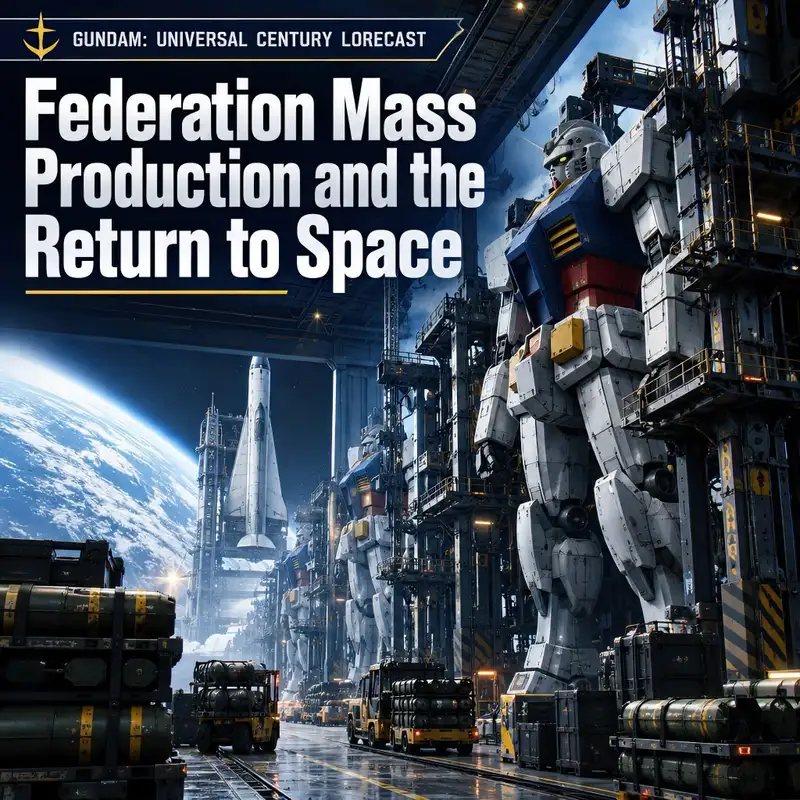
Federation Mass Production and the Return to Space
Far below the forests and rivers of South America, Jaburo was under attack. Zeon amphibious mobile suits moved through the approaches to the Earth Federation’s underground headquarters, while Char Aznable’s force sought openings in the base’s defenses and opportunities to disrupt its military work. The immediate danger was obvious enough. Jaburo housed command personnel, communications, transport routes, workshops, stores, and the protected infrastructure required to keep a government at war alive. But another target mattered just as much. Inside the base, the Federation was preparing new mobile suits in numbers that no longer looked like an experiment.
For Zeon, that prospect was more dangerous than the Gundam itself. The Gundam had already proven that a Federation mobile suit could meet Zeon machines in combat and survive. It was formidable, but it remained one machine aboard one exceptional ship, operated by an exceptional pilot. A production line of GMs represented something else. It meant the Federation might soon field mobile suits that could be issued to formations, supported by technicians, moved by carriers, and replaced after losses. Zeon had not merely discovered a rival weapon. It had discovered that its monopoly on a way of war might be ending.
Jaburo therefore mattered in several ways at once. It was a headquarters, but it was also a military-industrial sanctuary. Its underground location protected personnel and equipment from the kind of sudden blow that had devastated so much of the Earth Sphere during the opening months of the One Year War. It linked political authority to military command, research, repair, and deployment. Destroying or disrupting such a place would not automatically win the war for Zeon, but it could delay the Federation at precisely the moment when delay still mattered.
The Zeon assault also shows that Zeon understood the Federation’s recovery was real. The Principality had begun the war with the advantage of preparation. Its forces had mobile suits, trained pilots, combat doctrine, and commanders accustomed to fighting under Minovsky particle conditions. The Federation possessed far larger aggregate resources, but resources on paper do not become military power by themselves. Factories need plans. Plans need components. Components need transport. Machines need crews, spare parts, ammunition, and a place from which to operate. Before the Federation could exploit its deeper reserves, it first had to recover from strategic surprise.
That recovery had been difficult because Zeon’s early advantage was not merely technological. It was organizational. Zeon had built mobile suits into its military system before the war. Its pilots had experience in close-range, visually directed combat. Its ships and bases supported mobile-suit operations. Its commanders had learned to think in terms of raids, reconnaissance, local maneuver, and sudden concentration of mobile forces. Minovsky particles had degraded the long-range sensors and communications on which older fleet doctrine depended. In that environment, a mobile suit could close distance, identify targets, and bring weapons to bear where a conventional force might struggle to understand what was happening.
The Federation had not entered the war empty-handed, and it was not helpless. But it was unprepared for the operational consequences of Zeon’s mobile-suit arm. It had to absorb losses, defend Earth, rebuild its formations, and develop answers while fighting. Its eventual advantage lay in population, industrial depth, territory, and the ability to mobilize on a scale Zeon could not easily match. Yet those advantages were latent. A government can possess factories and still lack a weapon worth producing. It can possess manpower and still lack trained crews. It can possess a larger fleet and still be unable to move that fleet safely through contested space.
Project V was one answer to that emergency. The Federation’s experimental mobile-suit effort produced the Gundam, Guncannon, and Guntank. These were not a finished army. They were test cases, combat systems assembled under wartime pressure, and evidence that the Federation could challenge Zeon’s technological lead. Each addressed the problem differently. Together, they gave the Federation a chance to learn how its own mobile-suit force might work.
The Gundam became the best known of those machines because it survived long enough to build an extraordinary combat record. Its armor, weapons, mobility, and adaptability gave it an edge in many encounters. More importantly for the Federation, it operated in real combat rather than in a controlled trial. The White Base crew learned how to launch, recover, arm, repair, and command mobile suits while under attack. Federation personnel could observe the strengths and weaknesses of a new type of combat machine under the worst possible conditions: confused intelligence, damaged equipment, limited supplies, inexperienced crew members, and an enemy already skilled in the form of warfare being tested.
Amuro Ray’s role in that record cannot be ignored. His ability to operate the Gundam became central to the White Base’s survival. But Amuro was not a procurement plan. No military institution can sensibly base mass mobilization on the assumption that every new pilot will possess the same reflexes, instincts, resilience, or emerging Newtype sensitivity. A weapon system designed around one extraordinary operator may win isolated actions, but it does not automatically create a force that can hold territory, escort convoys, defend a fleet, or sustain repeated campaigns.
The real value of the Gundam’s experience was therefore not that it offered a perfect machine to copy. It offered evidence. It showed the Federation that mobile suits could be integrated with a carrier, that Federation pilots could learn to operate them, that beam weapons and close combat had practical value, and that the old imbalance with Zeon was not permanent. It also revealed the limits of exceptional equipment. A prototype required skilled mechanics, specialized attention, and a crew willing to improvise. It could be decisive in the hands of the right people, but it could not be everywhere.
That was the problem the GM was meant to address. The RGM-79 GM was not historically important because it duplicated every quality of the Gundam. It was important because it represented an effort to translate prototype experience into a combat machine that could be built and used in larger numbers. That required compromise. A mass-produced mobile suit has to fit the realities of manufacturing, maintenance, training, transport, and repair. It must use components that can be supplied. It must be understandable to mechanics who have not lived beside one experimental machine since the beginning of the war. It must be practical enough that a unit can keep fighting after its first breakdown, its first combat loss, or its first inexperienced pilot makes a mistake.
That distinction is easy to miss because the Gundam is more dramatic. A single famous machine attracts attention. It has a name, a distinctive appearance, and an unusually capable pilot. A standard machine does not carry the same mythic weight. But war is generally decided by what can be organized and repeated. The question is not only whether one machine can defeat an enemy in a duel. The question is whether a government can train crews, issue spare parts, move replacements forward, coordinate formations, and continue fighting after the first generation of veterans has been exhausted.
The GM answered that question imperfectly, but it answered it in a way the Gundam never could. It gave the Federation a path toward standardization. Standardization is not glamorous, but it is one of the foundations of military power. Common equipment allows common maintenance procedures. It permits ammunition, tools, and replacement parts to move through a supply system without every unit demanding a separate solution. It makes training more useful because a pilot transferred from one formation to another is not confronted with an entirely unfamiliar machine. It allows commanders to think in terms of units and formations rather than treating each mobile suit as a rare and irreplaceable artifact.
The television record does not establish a precise total number of GMs, a complete factory map, or a detailed deployment schedule. It does not need to. What it makes clear at Jaburo is that production was underway and that Zeon considered it important enough to attack. That alone reveals the strategic shift. The Federation was no longer relying solely on scattered conventional forces and a small number of experimental machines. It was attempting to create a mobile-suit arm that could operate beyond the walls of one secret base and beyond the hangars of one prototype carrier.
This did not mean every Federation formation was suddenly equipped, experienced, or effective. A military transition is not a switch thrown in a command room. Some crews would be new. Some officers would still be learning what mobile suits could and could not do. Some machines would require repair before they had completed enough sorties to teach their units how to employ them properly. The Federation had to build not merely machines, but a service culture around them. Pilots needed to understand combat under Minovsky interference. Mechanics needed to understand the demands of mobile-suit maintenance. Ship crews needed to launch and recover the machines under pressure. Staff officers needed to plan around their strengths without assuming that every pilot was another Amuro Ray.
The most useful employment of a standard mobile suit did not require it to defeat every Zeon machine one on one. A GM could matter by screening a ship, scouting an approach, reinforcing a defense, escorting a transport, supporting a larger formation, or forcing Zeon commanders to account for Federation mobile suits where none had existed before. Numbers changed the tactical problem even when individual quality remained uneven. A Zeon pilot who had once expected to dominate an engagement against conventional Federation forces now had to consider that the opposing formation might contain mobile suits of its own.
That change also affected morale and command judgment. A force that believes it has no answer to an enemy weapon tends to disperse, hesitate, or cling to fixed defenses. A force that possesses a usable countermeasure gains options. It can attempt a maneuver it would otherwise avoid. It can assign mobile forces to protect vulnerable ships. It can plan an offensive rather than merely wait for an enemy raid. The GM did not make the Federation invulnerable, and it did not erase Zeon’s hard-won experience. It gave Federation commanders something they had lacked at the beginning of the war: a credible means to contest mobile-suit combat on a broader scale.
But mobile suits do not move between theaters by themselves in any strategically useful sense. They depend on carriers, transports, hangars, catapults, repair crews, stores, fuel or propellant, ammunition, medical support, and command arrangements. A mobile suit can defend a ship, but it usually needs that ship to deliver it to the battle. It can win a local encounter, but it cannot sustain a campaign without recovery and resupply. The Federation’s return to space was therefore never simply a story about the GM production line. It was a story about rebuilding the fleet system that could carry a new mobile-suit force into the theater where Zeon remained strongest.
The White Base illustrates this point, though it should not be treated as a typical Federation vessel. It was a prototype carrier, shaped by the same emergency that produced the Gundam. Its crew had learned by surviving. It had become a mobile command platform, a workshop, a shelter, and a launch base for its mobile suits. Its record made it valuable not because every Federation ship could do what it did, but because it demonstrated what a mobile-suit carrier could contribute when its crew had learned to use it under combat conditions.
The larger challenge belonged to the Federation fleet. Earth’s gravity well imposed its own strategic burden. A force on the ground was not automatically available in orbit. Ships and troops had to leave the planet, reach space, avoid interception, find their assigned formations, and then sustain operations after arrival. The Federation could not simply announce that it possessed new mobile suits and expect them to appear at the decisive point. It needed routes, staging areas, escorts, timing, and a plan for what happened if Zeon discovered the movement before the fleet had assembled.
Luna Two mattered in this process because it was a staging point in the Federation’s wider space posture, not merely another location on a map. Reaching it meant connecting Earth-based recovery to operations farther out in the Earth Sphere. From there, the Federation could begin to organize forces for action against Zeon-held positions. The road from Jaburo to Luna Two was not the same as the road from Luna Two to a Zeon fortress, and neither was the same as a ground campaign on Earth. Each required different logistics, different command arrangements, and different risks.
Minovsky particles made those risks sharper. They did not render every sensor blind or every message impossible. Ships still observed, communicated, and fought. But they reduced the reliability of the long-range detection and command systems that had once allowed fleets to operate with greater confidence at distance. Under dense Minovsky conditions, commanders could not assume that headquarters possessed a complete picture. Formations could lose contact. Identification could become uncertain. A force moving on a predictable route might find an enemy waiting where its scouts had failed to see.
This placed a premium on planning before contact. Orders had to be clear enough that subordinate commanders could continue when communications degraded. Forces needed routes, timings, rally points, and a shared understanding of the larger purpose. Visual confirmation, local reconnaissance, and individual initiative became more important. So did deception. If a commander could make the enemy focus on the wrong force, at the wrong place, even for a limited period, that commander could create room for the main body to move.
Zeon faced its own command problem. It knew the Federation was recovering. It had seen the White Base, the Gundam, and the signs of Federation mobile-suit development. It understood that Jaburo was valuable and that a Federation return to space could threaten the strategic position Zeon had built during the war’s opening phase. Yet Zeon could not defend everything with equal strength. It had to maintain pressure on Earth, protect its space routes, defend its established positions, and respond to a Federation force that was becoming more capable by the day. A military can recognize a threat and still lack the forces, intelligence, or time to eliminate it.
The Federation used that dilemma when it prepared to leave Earth. The White Base was ordered ahead of General Tianem’s main force as a decoy. This was not a declaration that the White Base was the whole counteroffensive. It was the opposite. The ship was conspicuous, battle-tested, and already a known concern for Zeon. By sending it forward, the Federation offered Zeon a target likely to draw attention. Behind that target, the larger fleet could move toward Luna Two with a better chance of escaping immediate concentration by enemy forces.
There was risk in the plan. A decoy is not a harmless distraction. It must be credible enough for the enemy to pursue, which means it may have to accept the danger of contact. The White Base and its crew were being used because they could survive a mission that might have overwhelmed a less experienced ship. Their value lay in their combat record, their mobile suits, and their ability to operate without constant direction from a distant headquarters. But even an experienced crew could not guarantee success. The point of the mission was to improve the odds for the main force, not to make danger disappear.
Bright Noa’s command during this period demonstrates the kind of local judgment Minovsky-era warfare demanded. He did not possess a perfect tactical picture. Neither did his opponents. Orders could establish intent, but they could not dictate every maneuver once ships and mobile suits were in contact. The White Base crew had to interpret the mission, manage its own survival, and continue moving when the situation changed. That was not romantic individualism. It was a practical requirement of warfare in an environment where the chain of command could be disrupted by distance, interference, battle damage, and the simple speed at which mobile-suit engagements developed.
The White Base’s breakout against Zeon interception forces was therefore important beyond its immediate drama. Tactically, the ship and its mobile suits survived and forced their way through. The Gundam’s performance mattered in that fight, as it had in earlier battles. So did the experience of the crew and the ship’s ability to keep operating under pressure. Yet the operational meaning of the breakthrough was larger than the survival of one famous carrier. The White Base was buying time and attention for the larger movement behind it.
That is the difference between a tactical success and an operational success. Tactically, the White Base had to defeat or evade the forces directly in its path. Operationally, it had to contribute to the safe movement of the Tianem Fleet. The larger purpose was not glory for the ship or personal victory for its pilots. It was to help the Federation move a rebuilding space force out of Earth’s gravity well, toward an assembly point, and eventually toward a renewed offensive. A ship can win its fight and still fail its mission if the fleet it protects is destroyed. In this case, the decoy action helped preserve the wider movement.
The breakthrough did not establish Federation superiority in space. Zeon retained experienced pilots, established defensive positions, warships, and the advantage of operating closer to the infrastructure it had already developed. Its commanders still possessed the instincts of a force that had spent months fighting mobile-suit warfare while the Federation was learning under fire. The Federation’s new machines and rebuilt fleet could challenge that advantage, but they could not instantly erase it. Zeon remained dangerous because it still had coherent military capabilities, not because the Federation’s recovery was imaginary.
What changed was the range of choices available to the Federation. Earlier in the war, the Federation had been forced to respond to Zeon’s initiative under conditions shaped by Zeon’s mobile-suit monopoly. By moving forces through orbit toward Luna Two, the Federation began to recover the ability to choose where to concentrate strength. It could prepare offensives against Zeon’s fortress network rather than remaining confined to survival, defense, and the liberation of Earth territory. The later offensive against Solomon would demonstrate the consequences of that recovery, but the crucial transition began before the assault itself. It began when the Federation could once again move a fleet into position to attempt such an operation.
This had political significance as well as military significance. Zeon’s early victories had rested partly on its ability to impose costs the Federation could not immediately answer. Mobile suits gave Zeon a tool of coercion, surprise, and operational flexibility. Once the Federation began fielding its own mobile-suit formations, Zeon could no longer assume that technological initiative would remain permanently on its side. The Principality still had political power, military strength, and the ability to inflict terrible damage. But it now faced an opponent that could contest the same domain of warfare with growing industrial support.
The transformation was still incomplete. The Federation’s mobile-suit arm had been created under pressure, and rapid expansion creates weaknesses. Training takes time. Unit cohesion takes time. Experienced maintenance personnel cannot be manufactured as quickly as machines. Commanders accustomed to older doctrine must learn how to coordinate carriers, warships, and mobile suits without wasting any of them. The surviving television record shows a transition in progress, not a perfectly integrated force arriving fully formed.
There was also a limit imposed by time. The One Year War was already entering its final phase. The Federation had enough time to convert potential into a force capable of returning to space, but not enough time to smooth every institutional problem before decisive operations began. That meant uneven readiness, hurried decisions, and reliance on crews such as the White Base that had acquired experience the hard way. The Federation was becoming more capable, but it was not becoming simple, efficient, or wise by default. Mobilization can solve one weakness while creating new stresses inside a military system.
Nor did mass production solve the political failures that had helped make the Universal Century so unstable. A government able to build more mobile suits is not necessarily a government better able to represent colonial populations, restrain its security institutions, or resolve the grievances that armed conflict has exposed. Federation recovery was a military achievement. It proved that a state caught unprepared could reorganize industry, absorb lessons, and return to contested space. It did not prove that the same state had cured its complacency, inequality, or tendency to rely on force when political reform was more difficult.
The GM’s importance lies in that contradiction. It was less spectacular than the Gundam, and it could not reproduce the Gundam’s exact combination of machine performance and pilot skill. But it made a different kind of power possible. It transformed the Federation’s answer to Zeon from an isolated demonstration into a force structure. A GM could be assigned to a unit. A unit could be embarked on a ship. Ships could be gathered into a fleet. A fleet could be supported, moved, screened, and directed toward an operational objective.
The Gundam supplied proof, combat data, and a symbol of recovery. The GM supplied reproducibility. Neither was sufficient alone. The Federation’s return to space depended on the connection between the two, and on everything that followed from that connection: technicians, spare parts, training, carriers, fleet headquarters, staging points, and a deception plan that used the White Base to protect the larger movement. The war was not turned by one machine winning enough battles to frighten Zeon. It was turned when prototype experience became production, production became formations, and formations became a fleet capable of fighting its way back into space.