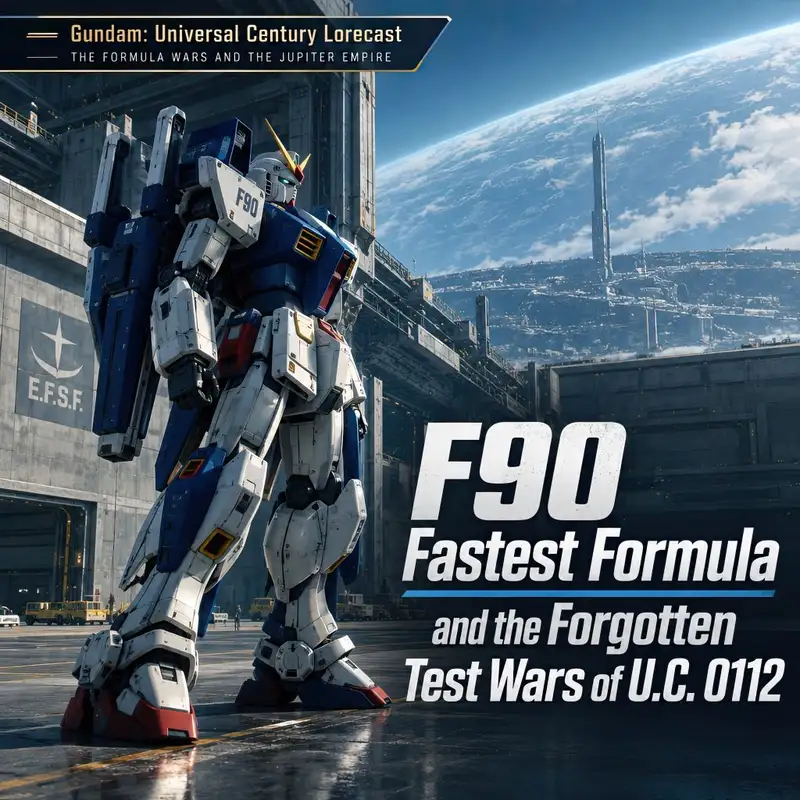
F90 Fastest Formula and the Forgotten Test Wars of U.C. 0112 [Manga]
A test machine is supposed to fail in useful ways. A sensor gives bad data. A hard point cracks under stress. A new control system burdens the pilot more than the engineers expected. Those failures can be logged, corrected, and tested again. What the crews around F90 Unit Two faced in Universal Century one hundred twelve was different. Their machine was being tested for the future of the Earth Federation Forces, but hostile actors were already trying to ensure that future never arrived. The result was a series of engagements that looked like trials on paper and increasingly resembled an undeclared war around a procurement program.
Calling these encounters the test wars is a useful historical description, not an official campaign name. There was no public declaration, no clean front line, and no reassuring boundary between research activity and combat operations. There were controlled exercises, field trials, maintenance schedules, classified data, and a pair of advanced prototypes. There were also surveillance, sabotage, mercenaries, modified older mobile suits, and eventually a mobile armor attack serious enough to damage the very system under evaluation. The F90 was meant to generate evidence about the next generation of Federation mobile suits. Instead, the program became evidence of something more troubling. No military prototype exists outside politics, industrial competition, security arrangements, and the people expected to keep it alive.
The setting was an Earth Sphere officially at peace, or at least eager to describe itself that way. By Universal Century one hundred twelve, seven years had passed since the Mafty Uprising. The Republic of Zeon had already renounced its autonomy, and the Federation could point to the end of the great wars that had defined the previous century. Yet peace in the Federation’s language did not mean that every armed network had disappeared, every grievance had been resolved, or every institution had become reliable. It meant that no openly declared conflict had reached the scale of the One Year War, the Gryps Conflict, or Char’s Rebellion.
The requirement issued in Universal Century one hundred eleven therefore had a practical character. The Federation Forces wanted a next-generation mainstay mobile suit that could be smaller and easier to supply without surrendering the combat performance expected of a modern military machine. That was a difficult balance. Reducing size could save space and simplify transport, but it could also reduce internal volume for equipment, fuel, weapons, cooling, protection, or maintenance access. A compact machine that performed brilliantly once but required rare parts, highly specialized crews, and constant workshop attention would not solve the Federation’s larger problem. It would merely create a new one.
The Strategic Naval Research Institute, usually called the S N R I, offered its answer in the F90. The institute was not simply a workshop of inventive engineers. It was a Federation-associated research organization with an institutional interest in proving that it could shape the next generation of military procurement. If the F90 succeeded, the S N R I would not merely have designed a good prototype. It would have demonstrated that the Federation’s future mobile-suit force could be built around its technical assumptions, its testing methods, and its industrial priorities.
That placed the Formula Project inside a competition. Anaheim Electronics had its own competing design, the M S A twelve twenty. The F90 prevailed in the broader selection process, and that result mattered well beyond the question of which machine had the more impressive performance on paper. A successful design competition could influence future contracts, research budgets, political access, production relationships, and the authority of the institutions involved. It could determine who supplied the Federation’s next generation of machines and who was left trying to recover a lost position.
The Earth Federation Forces assigned two F90 units to its System Command and divided them between Team A and Team B of the Thirteenth Experimental Squadron. This arrangement gave the program a deliberately hybrid character. The squadron was a military organization, subject to military authority and operating Federation equipment. At the same time, it was a research instrument. Its pilots were expected to fly missions, but also to produce observations. Its mechanics were expected to keep machines operational, but also to identify faults and refine procedures. Its exercises were meant to test combat potential without becoming combat operations.
That hybrid identity created an immediate command problem. In a conventional unit, responsibility for risk is at least theoretically easier to trace. A commander receives a mission, deploys forces, and accepts the consequences. In an experimental unit, the situation is more ambiguous. The military customer wants results. The research institution wants data. The program managers want secrecy. The pilot wants a machine that will keep functioning under stress. The maintenance crew wants enough time and resources to prepare it properly. Once a controlled trial begins to attract hostile attention, those interests can collide.
Who owns the danger when a test becomes a security incident? System Command may control the unit. The S N R I may understand the machine. A test director may define the scenario. Yet the person in the cockpit is the one who must make an immediate decision when an unidentified contact appears, when communications become uncertain, or when a supposedly controlled range is no longer controlled. The Thirteenth Experimental Squadron existed at the seam between research and operations. That seam was manageable only as long as everyone agreed that the program could remain insulated from real conflict.
A classified test program depends on more than locked hangar doors. It requires controlled access, reliable identification procedures, secure movement between test locations, communications that can function under the conditions expected in the field, and protection for the technical data generated by each mission. It also requires an accurate understanding of who is watching. A prototype is valuable not only because an opponent might capture it. Its configuration, performance, maintenance patterns, and mission role can all be useful intelligence. Even observing which equipment is installed for a particular trial can reveal what problem the designers are trying to solve.
Team B makes clear why the F90 cannot be understood through the pilot alone. Patsy Angelika operated F90 Unit Two as a freelance pilot affiliated with the Federation Forces and the S N R I. Available character material identifies her as an ensign, but her importance lies less in the insignia than in the work she performed. She was not simply demonstrating a new machine for an audience. She was evaluating it under changing conditions. Every trial required judgment about controls, mobility, weapons, configuration, and the practical burdens imposed by the mission equipment attached to the frame.
A good test pilot is not merely an ace in a new machine. An ace can make almost any system look better than it is, especially in a short engagement. A test pilot has to expose a machine’s weaknesses as well as its strengths. She has to distinguish between a fault in the equipment, a gap in the procedure, a poor configuration choice, and a mistake made by the operator. She also has to survive long enough for the program to learn from those distinctions. Patsy’s role placed her at the point where engineering theory met pilot workload, tactical pressure, and the uncomfortable fact that a military machine cannot be evaluated under conditions of perfect safety.
Help Hayden, Team B’s S N R I mechanic and maintenance authority, was equally central to that process. The F90’s promise rested on modularity, and modularity is never just a matter of attaching equipment to a frame. Every mission pack has to be fitted correctly. Hard points have to be inspected. Connections have to function under vibration, maneuver, and combat stress. Spare components have to be available. The crew needs procedures for diagnosing faults, removing damaged equipment, and preparing the machine for its next role. A configuration that is effective in theory can become a liability if it takes too long to install, requires too much specialized support, or leaves the machine difficult to repair.
Hayden’s work also extended into training. The manga places Liv Angelika, Patsy’s son, in the Team B environment, where Hayden trains him through simulator work. That detail gives the program a human dimension that military histories often lose. Research organizations speak in terms of performance envelopes, personnel pipelines, and future operators. Families experience the same system as a place where work, danger, and secrecy enter the home. Liv was not simply a child standing near impressive machinery. He was being drawn into a classified military environment whose risks became increasingly real.
Liv’s apparent sensitivity and intuition matter to events around Team B, but they should be handled carefully. The story presents signs of Newtype potential, especially in moments of perception and intervention. It does not provide a settled scientific model, nor does it establish a standard capability that the Federation could issue to every future pilot. Newtype phenomena in the Universal Century have repeatedly attracted military interest because commanders want to turn exceptional perception into an operational advantage. The record repeatedly shows the limits of that ambition. An individual’s intuition may be real, consequential, and impossible to reduce to an ordinary technical specification at the same time.
Other personnel around the tests, including Sierra Aira and the F89 pilot Gideon Brondan, help establish the wider testing ecosystem. Their presence reminds us that the project was not a private contest between Patsy and a prototype. It involved comparative trials, simulator work, maintenance teams, commanders, researchers, and supporting pilots. The F90 could not be separated from that environment because the purpose of the program was not to prove that one exceptional operator could make it shine. The purpose was to learn whether a new system could be prepared, operated, and supported with enough consistency to matter beyond a single test team.
The key to the F90 was its use as a test-bed frame for interchangeable mission packs. It is tempting to treat those packs as an alphabetized arsenal, a convenient list of specialized equipment to be admired one letter at a time. That misses their military purpose. The packs were experiments in doctrine. They asked whether one basic mobile-suit frame could be adapted to tasks that would otherwise demand different machines, different support arrangements, or different force structures. The question was not simply whether the F90 could carry more equipment. The question was whether a smaller mobile suit could become the common basis for a flexible, sustainable force.
The E-Type, M-Type, F-Type, K-Type, and other configurations each pointed toward a different operational problem. Some emphasized electronic support or reconnaissance. Others explored combat performance, bombardment, environmental flexibility, endurance, or specialized mission equipment. The exact configuration mattered because each altered what the machine could do and what the crew had to support. A close-combat arrangement demanded different tactical planning from an electronic-support package. A maritime or terrestrial test imposed different recovery problems from an orbital trial. An endurance-oriented configuration might improve one mission while adding equipment, weight, maintenance demands, or pilot workload that affected another.
One of the more revealing controlled trials placed Patsy’s F90 against Gideon Brondan’s F89 in a mock engagement involving the F-Type configuration. The value of this encounter lies in what it does not prove. It does not establish that the F90 was categorically superior because it was newer. Nor does it establish that the F89 was obsolete because it faced a more advanced test-bed. Mock combat is designed to generate information, but its results depend on the scenario, the rules, the machines’ configurations, the pilots’ choices, readiness, and the assumptions built into the exercise.
The encounter instead demonstrates a basic truth about mobile-suit development. Generational labels are a poor substitute for analysis. A new machine may offer advantages in mobility, systems integration, or mission flexibility. An experienced pilot in a different machine may still exploit terrain, timing, weapons, or an opponent’s mistakes. A test scenario may reveal strengths that disappear under real battlefield uncertainty, or weaknesses that can be corrected before mass production. The F90’s value was not that it made the pilot irrelevant. Its value depended on whether the machine could give a trained operator useful options without overwhelming that operator or the crew supporting her.
That distinction becomes sharper when the program moves beyond controlled mock combat. The F90’s M-Type was tested in the Labrador Sea region, where the trial confronted conditions very different from a clean orbital exercise. Terrestrial and maritime operations introduce their own problems of navigation, weather, recovery, infrastructure, security, and collateral risk. A machine operating near land or water cannot be treated as though it is maneuvering through an empty technical diagram. There may be civilian traffic, local facilities, transport routes, and political sensitivities even when the narrative does not establish the exact population or status of the surrounding area.
The point is not that the F90 was expected to perform perfectly everywhere. No serious military test program should assume that. The point was to determine whether the basic frame could be adapted to radically different environments without losing its practical value. A compact mobile suit that functions only in an ideal orbital range is not a general solution to the Federation’s force-structure problem. The Labrador Sea trial tested whether the Formula Project’s flexibility could survive contact with physical conditions, operational uncertainty, and the demands of recovery and support outside the more predictable setting of a controlled space exercise.
Then the trial encountered a mobile armor attack. At that point, the difference between testing a system and defending it began to collapse. A test team can plan around known variables. It can establish safety limits, prepare recovery assets, and compare expected results against recorded performance. A hostile mobile armor introduces an adversary with its own initiative. It forces the pilot and crew to think about survival, identification, escape, weapon employment, and the protection of personnel and equipment. The test data may still be useful, but it is now being gathered under circumstances the program did not choose.
By then, it was becoming increasingly difficult to dismiss hostile intervention as random friction around a sensitive project. Someone had recognized that the F90 program was worth observing, disrupting, or destroying. That did not necessarily mean every adversary understood the Formula Project in full detail. It did mean that the program had ceased to be invisible. Its movement, tests, and value had become known enough for armed interference to become possible. The security failure may have involved surveillance, access, compromised compartmentalization, or some other breach. The available record does not establish precisely how the information moved. What it establishes is that the protective system around the prototypes was inadequate.
The industrial dimension of that threat becomes clearer through Randegger Heavy Industries and its head, Oier Randegger. Their interest in the destruction of the F90 program shows how a procurement dispute could become a matter of armed coercion. This was not a conventional Zeon-remnant campaign, and it should not be described as one. The available material identifies Randegger’s effort as industrial sabotage supported by a separate mercenary organization. That distinction matters because it reveals a different weakness in the late Federation order. Violence did not need to come only from ideological rebels or declared enemies. It could also be purchased, directed, and concealed through private interests operating in the spaces between state authority and commercial competition.
The mercenary organization was G B G, Gleam Black Gun. Its members operated individually modified, black-painted Jim Three mobile suits. The sight of older machines confronting the F90 is another useful corrective to simple narratives of technological succession. A newer prototype may have better systems, but an older platform remains dangerous when it is maintained, modified, piloted by experienced personnel, and employed with intelligence and initiative. The Jim Three was not transformed into a new-generation machine merely by paint or customization. Yet skilled mercenaries using familiar equipment could still threaten a test unit burdened by uncertainty, restricted rules of engagement, and the need to preserve rather than recklessly expend a rare prototype.
G B G’s presence also indicates that armed expertise remained available outside clean chains of public command. The Federation possessed formal military institutions, but it did not possess a complete monopoly on technical knowledge, trained pilots, or mobile-suit maintenance. That was one of the long-term consequences of a century of warfare. The Earth Sphere had produced veterans, surplus equipment, industrial contacts, and networks accustomed to operating in gray areas. In a nominally peaceful era, such people and machines did not vanish. They could be hired, repurposed, and pointed at targets that a corporation or political actor preferred not to attack openly.
For the Formula Project, that meant its vulnerability was institutional rather than merely mechanical. The F90 could be tested against another mobile suit in a planned exercise. It could be inspected for structural flaws. It could be fitted with specialized equipment. None of that solved the question of whether its support organization could recognize a hostile approach early enough, communicate under pressure, secure its personnel, and respond without losing control of classified technology. The attacks demonstrated that the Federation’s modernization effort was being conducted in an environment where the distinction between commercial competition and security threat had become dangerously thin.
The final Team B test brought those pressures together. Randegger Heavy Industries and G B G moved against the program with the mobile armor Tigris as part of the threat. The details that matter are not every exchange of fire or maneuver. The decisive fact is that a test operation became a live defensive action around a rare experimental machine, its pilot, and the people whose knowledge made that machine useful. F90 Unit Two was no longer being judged only by how it performed in an intended scenario. It was being forced to survive an encounter shaped by hostile planning and the failures of the security system around it.
That changed the tactical problem immediately. A test pilot normally evaluates performance while remaining within the structure of a trial. Under attack, Patsy had to operate as a combat pilot whose survival and decisions carried consequences far beyond a score sheet. The machine’s equipment, the condition of its systems, the availability of support, and the choices made by the surrounding team all became part of the engagement. A modular system can provide options, but only if the configuration already fitted to the machine suits the emergency. It cannot summon the ideal mission pack after the enemy has arrived. The crew must fight with the machine it has prepared, not the machine it wishes it had brought.
The confrontation also exposed the limits of prototype value. The F90 was important precisely because it was rare. That made it worth protecting, but it also made it difficult to risk. A mass-produced unit can sometimes be sacrificed if the mission requires it and replacement exists. A test-bed carries data, technical investment, and institutional prestige that cannot be quickly replaced. Damage to Unit Two therefore threatened more than the loss of a machine. It threatened the continuity of a research effort and the confidence of the people expected to carry it forward.
Unit Two was critically damaged in the Tigris crisis. Whether one emphasizes the destruction of the immediate test asset or the broader loss of its operational availability, the historical meaning is the same. The boundary between controlled development and real conflict had been broken. Team B had been forced to function as a combat formation, but it had not been organized solely for that purpose. Its members had to defend themselves while preserving knowledge, managing damage, and confronting the fact that the program’s adversaries were willing to use lethal force to shape the outcome of a procurement struggle.
Liv’s intervention to save Patsy gives the incident its most personal dimension. The event is extraordinary, and the story associates it with his unusual sensitivity. But it should not be converted into a convenient explanation for the outcome, as though Newtype potential resolved the failures of command, security, or preparation. It did not. An individual act of perception or courage may save a life in a crisis. It cannot repair an institutional system that has allowed a child to be exposed to the consequences of a military program under attack.
That exposure deserves to be stated plainly. Liv’s presence in the Team B environment shows how easily military research can treat family proximity and youthful involvement as manageable details until danger becomes real. There is no need to invent a legal inquiry or a formal institutional response to recognize the ethical problem. A child should not have to become part of the emergency solution to a classified weapons program. The fact that he could act does not make the situation acceptable. It reveals how far the supposed safety of the test environment had already eroded.
The aftermath of the Tigris incident marked the beginning of Fastest Formula as an organization connected to this crisis. Precision matters here. The Team B personnel of Universal Century one hundred twelve were not yet the mature, independent Fastest Formula formation seen in later material. Their later operations and expanded structure belong to a subsequent period. But the transition begins here because the program could no longer pretend that research security, test operations, and combat readiness were separate functions handled by separate institutions.
The new organizational logic was unavoidable. A future test unit would need more than a pilot and a machine. It would need security capable of protecting sensitive trials. It would need command relationships clear enough to respond when a test became a combat mission. It would need technicians able to sustain damaged equipment under pressure. It would need procedures for preserving technical data, moving personnel, and recovering what could be recovered after an attack. In other words, it would need to become a more complete military organization precisely because the Federation’s supposedly peaceful environment had proved incapable of keeping military development outside violence.
This was the deeper lesson of the Formula Project. The F90’s value did not reside only in the frame, the reduced size, or the mission-pack architecture. Its value was inseparable from the people who could configure it, inspect it, operate it, repair it, and learn from it. Patsy’s skill mattered because the machine required informed judgment. Hayden’s work mattered because adaptability without technical continuity is merely complexity. The support personnel mattered because no prototype becomes a serviceable weapon system through cockpit performance alone. Even the program’s vulnerabilities became data, though they were acquired at a cost no test plan should have required.
At the tactical level, Team B and F90 Unit Two survived repeated threats through skill, support, and adaptation rather than through some effortless superiority of new technology. At the operational level, the trials became combat validation under conditions no controlled range could fully anticipate. At the strategic level, the project reinforced the Federation’s need for smaller, adaptable mobile-suit systems that could serve across varied environments. At the industrial level, the F90’s selection created stakes high enough for a rival interest to seek destruction rather than accept defeat through normal procurement channels.
The institutional outcome was less flattering. The Federation had recognized a real force-structure problem and commissioned a serious technical response. Yet its divided authority, imperfect security, and dependence on compartmentalized organizations endangered the very program meant to modernize the military. The human outcome was more severe still. A pilot became responsible for far more than testing. Mechanics and support personnel were drawn into combat danger. A family tied to the program found that classified military work could not be sealed off from private life. Liv’s experience showed that the cost of institutional failure is often carried by people with the least power to define the conditions around them.
The forgotten test wars of Universal Century one hundred twelve matter because they reveal what the Formula Project was really testing. It was not simply asking whether F90 Unit Two could defeat another machine in an ideal engagement. It was asking whether the Earth Federation could protect, maintain, command, and learn from a modular postwar weapon system while industrial rivalry and deniable violence pressed against every weakness in its institutions. The F90 pointed toward a new technological era, but the crisis around it showed that modernization had not freed the Federation from the political habits that repeatedly turned military progress into another form of conflict.