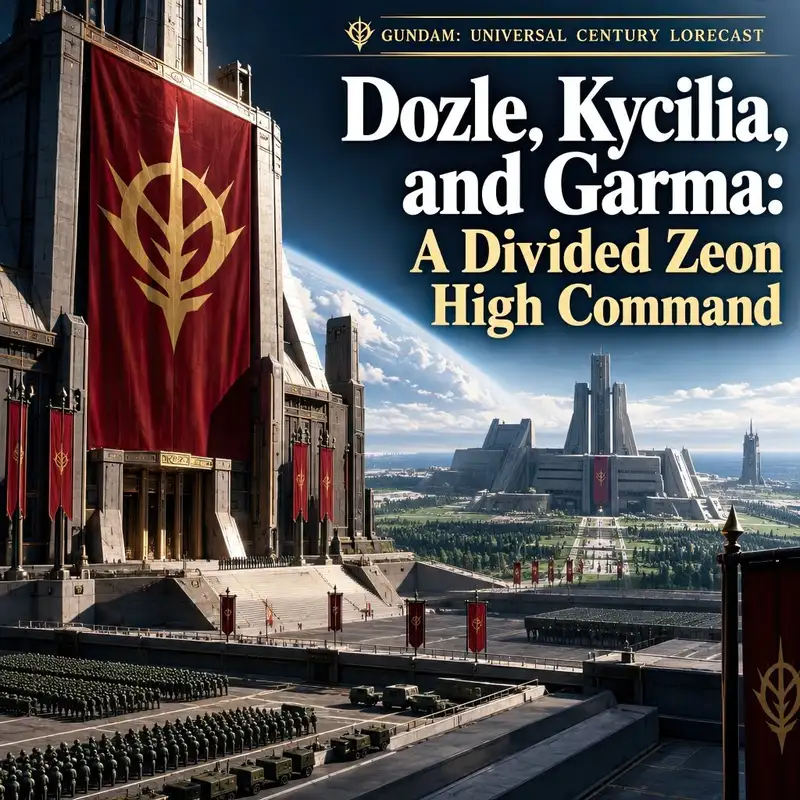
Dozle, Kycilia, and Garma: A Divided Zeon High Command
Garma Zabi’s last attack began as a regional operation against a dangerous enemy ship. White Base had escaped Zeon pressure more than once, carrying the Gundam and a crew that had become increasingly difficult to isolate or predict. Garma had aircraft, mobile suits, local bases, and the Gaw attack carriers that gave Zeon’s Earth forces reach across the North American theater. He also had Char Aznable at his side, a capable officer and a man Garma believed to be his friend. The plan appeared straightforward. Draw White Base into a vulnerable position, bring the carrier force and supporting aircraft to bear, and destroy a Federation vessel before it could reach safer ground. Instead, Garma entered the attack with the most important part of his operational picture compromised. Char was not merely failing to help. He was shaping Garma’s decisions while withholding the support that might have made the attack viable. When Garma’s Gaw was destroyed, Zeon lost more than a local commander. It lost a Zabi.
That distinction mattered because the Principality of Zeon was not governed by a clean separation between state institutions, military commands, and the ruling family. The Zabis were not simply prominent politicians with relatives in uniform. Their authority ran through the state. Their personal disputes could become personnel decisions, operational priorities, propaganda campaigns, and questions of war and peace. Garma’s death therefore exposed a larger weakness. Zeon had fielded a powerful military instrument on Earth, but it had not built a command system able to protect a politically valuable commander from betrayal inside its own ranks. The loss was not caused by family rule alone, nor by Garma’s inexperience alone, nor by Char’s manipulation alone. It came from a system in which trust traveled through personal access and family prestige more reliably than it traveled through independent intelligence, staff scrutiny, or institutional accountability.
The television record does not provide a complete organizational chart showing every office, service branch, and reporting line. It does not support the convenient fiction that Zeon’s military could be divided neatly into color-coded sibling empires. What it does show is more important. Separate centers of power existed in practice. Officers could rise or fall because one Zabi favored them and another distrusted them. Intelligence could be retained inside one command circle rather than shared across the wider war effort. Military losses could be transformed into political theater before commanders had resolved the underlying failure. The state’s most decisive leaders did not merely disagree over methods. They competed over access, influence, prestige, and eventually succession.
Garma’s Earth command illustrates the danger. He was not a decorative prince parked behind a desk. North America was an active theater, and the pursuit of White Base required real military resources. Gaw carriers were not personal limousines with guns attached. They were large air-mobile platforms that depended on pilots, crews, maintenance personnel, fuel, munitions, airfields, ground support, communications, and a network of local Zeon positions. Dopp fighters and mobile suits had to be directed toward an enemy that could move, hide, and fight back. White Base itself was not an ordinary transport. It was a mobile Federation warship carrying a prototype mobile suit that had already disrupted Zeon expectations about what the Federation could field.
Garma therefore had a genuine command problem. He needed to identify White Base’s route, concentrate forces quickly enough to prevent escape, coordinate attacks in an atmosphere where terrain and weather mattered, and avoid exposing his own carriers to the Gundam’s growing combat capability. The operation did not fail because Garma lacked equipment or because the Earth front was militarily irrelevant. It failed because the commander’s judgment was shaped by a relationship he had not learned to question. Char had earned Garma’s confidence. In a healthier military system, confidence in a trusted subordinate would still be balanced by independent reconnaissance, staff challenge, alternate reporting channels, and procedures designed to test a plan before its commander placed himself in the most exposed position. Garma had access to force, but not to a reliable means of verifying the guidance directing that force.
Family patronage made this worse. As a Zabi, Garma possessed political visibility that an ordinary officer could never have had. His victories would reflect on the regime. His presence helped connect military operations on Earth with the ruling family’s claim to national leadership. His status also made it harder to separate personal confidence from professional judgment. A subordinate close to Garma was not simply close to a regional commander. He was close to the ruling house. An officer who challenged Garma’s assumptions risked more than an argument over a tactical plan. In such an environment, deference becomes easy, and independent verification becomes politically awkward.
That does not mean Garma was incapable of command. The television series gives no basis for dismissing every action he took as incompetence. He understood that White Base had to be stopped. He could assemble forces and direct an attack. He recognized the military and political importance of destroying the Federation ship before it became a larger problem. But military maturity is not measured only by the ability to issue orders or fly into battle. It also depends on knowing what one does not know, establishing systems that can challenge a preferred assumption, and recognizing when a trusted adviser may have interests separate from the mission. Garma’s weakness was not merely youth. It was the combination of youth, status, personal trust, and a command culture that gave him too few reasons to doubt the people closest to him.
The civilian dimension was inseparable from this. Garma’s name carried public value because the Zabi regime had made its family into a political symbol. In a dictatorship, the ruling household does not simply govern. It becomes part of the state’s emotional machinery. Public loyalty is encouraged to flow through recognizable faces, family grief, speeches, uniforms, funerals, and stories of sacrifice. That can strengthen morale in the short term. It can also create an unstable system in which the death of one commander becomes a national crisis because the commander was never merely a commander.
Char’s betrayal must be understood as an intelligence and command failure before it is treated as a personal drama. Char exploited Garma’s trust, but he did not create the conditions that made such exploitation possible. He benefited from privileged access. He knew how Garma thought, what Garma expected from him, and how easily personal friendship could substitute for professional skepticism. He operated within a hierarchy that rewarded connections to the Zabi family. He also understood that the aftermath of a failure might be managed politically rather than investigated institutionally. In other words, Char did not merely deceive a friend. He maneuvered inside a state that had blurred the line between private loyalty and public command.
The operation also took place under pressure. White Base was moving through contested territory. Zeon had to act before the ship escaped, gathered support, or reached a more secure route. Rapid operations often force commanders to make decisions with incomplete information. That is a normal military problem. The question is whether the command structure has safeguards against a bad decision becoming irreversible. Garma’s final attack had very few. He committed himself personally, relied on Char’s guidance, and found that the man closest to him had ensured that the support he expected would not arrive in the form he needed.
Tactically, White Base survived and Garma’s force failed to destroy it. At the operational level, Zeon lost a regional commander and allowed the Federation ship to continue its movement through Earth. At the political level, the regime lost a valuable symbol. At the institutional level, the crisis was even more revealing. A senior officer had become implicated in the death of a Zabi commander. That should have triggered a unified security response, a serious inquiry, and a clear determination of responsibility. Instead, the case became another contest among Zabi power centers. The system did not ask only whether Char had failed. It asked which sibling would control him next.
Dozle’s reaction was immediate and personal. Garma was his brother, and the loss was not an abstract entry on an operational report. Dozle held Char responsible for failing to protect Garma. That response reflects both loyalty and a weakness of personal command culture. Dozle wanted accountability, and in a military sense that instinct was reasonable. An officer whose actions contributed to the death of a commander should face scrutiny. But Dozle’s response was driven by family grief as much as by a transparent process. He did not represent a detached institution examining evidence. He represented one branch of the ruling family seeking to punish someone connected to the death of another branch’s favored son.
Kycilia saw an opportunity. Where Dozle saw a compromised subordinate, Kycilia saw a useful officer. She drew Char into her own sphere rather than allowing Dozle’s anger to determine his fate. This was not simply a disagreement over Char’s talent. It was a struggle over personnel, information, and influence. Char’s survival and reassignment demonstrated that an officer’s status could change according to which Zabi patron claimed him. That may produce flexibility in a narrow sense. A skilled officer is not discarded merely because another commander is angry. But it also corrodes trust. If discipline can be overridden by family access, then no one can be sure whether a failure will be investigated, punished, concealed, or converted into another faction’s advantage.
Kycilia’s intervention should not be mistaken for proof that she understood Char’s full purpose. The television series does not present her as omniscient. It does show that she valued capable specialists and was willing to use people whom others dismissed or distrusted. That was one of her strengths. Intelligence organizations, special units, and experimental military programs often depend on personnel who do not fit comfortably within conventional command structures. But the same appetite for useful outsiders can become dangerous when it is not balanced by clear oversight. Kycilia’s ability to recruit Char increased her own leverage. It did not repair the security failure that Garma’s death had revealed.
Degwin’s grief exposed the distance between the sovereign’s formal position and his practical authority. He was still the father of the family and the nominal head of the state, yet he was expected to perform composure for a political system increasingly controlled by others. Kycilia’s pressure that he maintain the image of authority was revealing. The regime needed Degwin’s legitimacy even as the real direction of the war moved beyond him. That is a familiar danger in authoritarian systems. A figurehead remains useful because he represents continuity, but the people making decisions may no longer be accountable to him. The result is not stability. It is a hollowing out of authority from within.
For Zeon’s civilians, Garma’s funeral meant that private mourning was organized into public obedience. They were asked to regard his death as part of a national struggle. Yet they had no meaningful access to the decisions that had placed him in danger, no way to inspect Char’s role, no power to question the family rivalries behind the response, and no control over the war being prolonged in Garma’s name. The state could demand sacrifice because it controlled the narrative of sacrifice. That did not make the sacrifice strategically wise.
Dozle and Kycilia represented two different forms of military leadership within this system. Dozle’s style was visible, direct, and personal. He was associated with the troops and fortresses of the space war. He projected loyalty to subordinates and family alike. He could inspire men and women facing extreme danger because he appeared willing to share their risks. Such leadership has real value. Under battlefield conditions, soldiers often fight harder for commanders they believe will not abandon them. Dozle’s presence gave Zeon’s defensive positions a human center that Gihren’s ideological speeches could not provide.
But personal leadership has limits. It can create strong local loyalty while weakening the broader system if commanders rely too heavily on relationships, intuition, and individual courage. A fortress cannot be sustained by resolve alone. It needs warning, supply, reinforcements, maintenance, transport, communications, and a coherent strategy linking its defense to the wider war. Dozle could command the loyalty of those around him. He could not, by personal force of will, guarantee that Zeon’s separate commands were sharing information or pursuing compatible priorities.
Kycilia’s sphere looked different. She was calculating, politically flexible, and attentive to the military value of intelligence, elite personnel, special operations, and experimental capabilities. She understood that a modern war could not be won solely through massed formations and direct confrontation. Information mattered. So did secrecy, technical advantage, unconventional personnel, and the ability to exploit opportunities before a rival command recognized them. These were genuine military insights. A state fighting across the Earth Sphere needed more than courage and conventional force.
Yet compartmentalization creates its own dangers. Intelligence is valuable because it helps commanders make better decisions. If it becomes a private resource held by one faction, it can make the overall command structure less capable. Secret programs can provide an advantage, but they can also consume resources, distort priorities, and prevent the wider military from understanding what it can actually depend upon. Elite units may achieve spectacular local results, but they cannot substitute for a durable force structure. Kycilia’s independence gave her options. It also made Zeon less unified at the very moment the war demanded greater coordination.
The Battle of Solomon tested those weaknesses on a much larger scale. Solomon was not merely a dramatic fortress floating in space. It was a strategic position, a defensive base, a staging point, and a logistical hub. Its value depended on docking facilities, supplies, personnel, mobile suits, warships, repair capacity, and the ability to receive or dispatch forces under pressure. When the Earth Federation began its offensive against Solomon, the battle became an operational problem of movement and sustainment before it became a contest of individual pilots.
The Federation’s advance required transport, resupply, coordination among fleets, and the movement of mobile suits into a contested environment. The appearance of Columbus transports mattered for that reason. A fleet does not maintain an offensive merely because its warships reach the objective. It must replenish ammunition, support pilots, repair damage, move personnel, and keep the flow of material behind the assault functioning. The Federation had suffered heavily earlier in the war, but by this stage it could bring a broader industrial and logistical recovery to bear. That recovery did not guarantee perfect execution. It did give the Federation more capacity to sustain pressure.
Zeon faced the opposite problem. Solomon could fight fiercely, but it needed reinforcement and specialized equipment delivered at the right time. Papua transport ships carrying components for the Big Zam made that dependency visible. The Big Zam was an extraordinary weapon, but it did not emerge from a hangar fully assembled by force of personality. Its employment depended on industrial production, transport, assembly, crew preparation, and a defensive situation stable enough to use it. The arrival of its components in the middle of a crisis showed both Zeon’s technical ambition and its logistical vulnerability. A weapon can be formidable and still arrive too late to change the campaign.
Dozle assumed personal responsibility for Solomon’s defense. In that decision, his strengths and limitations came together. He did not abandon the fortress when the situation became difficult. He remained with the defenders, directed resistance, and took measures to evacuate personnel as the position became untenable. That willingness to recognize the need for evacuation mattered. It showed that even a commander associated with stubborn defense could see that a fortress was not worth every life simply because it had symbolic value.
The Big Zam inflicted severe local damage. In tactical terms, it demonstrated how a single high-performance system could disrupt an enemy attack and impose sudden costs on forces that had expected a more familiar battle. But a prototype or limited system cannot restore a collapsing operational situation by itself. The Big Zam could destroy targets. It could not reopen supply routes, rebuild lost ships, replace trained personnel, or compel the Federation to abandon its wider offensive. It could not resolve the problem of Zeon’s shrinking strategic depth. It could not make separate Zabi command spheres trust one another.
Here, personal courage reached its limit. Dozle’s resolve gave Solomon’s defense intensity. It did not create the strategic coordination Zeon needed. A fortress defense can buy time, but time is useful only if the larger command system knows what it intends to do with it. Will reinforcements arrive? Is there a line to fall back upon? Can the surviving forces be reorganized? Is there a political strategy for ending the war if the fortress falls? Zeon had no convincing answer. The defense of Solomon became heroic in the narrow military sense and disastrous in the larger one. It imposed costs, delayed the Federation, and demonstrated local fighting power. It did not preserve Zeon’s ability to control the war.
After Solomon, the political center of gravity shifted toward the final defense at A Baoa Qu. By then, Degwin and Gihren were no longer merely different personalities within a functioning regime. They represented incompatible approaches to the question of whether Zeon could survive. Degwin had helped build the Zabi state. He was not an innocent observer suddenly shocked by a war he had never supported. His authority had helped legitimize the regime that brought Zeon to this point. But as the war turned against the Principality, he increasingly sought a way to preserve what could still be preserved.
Gihren had a different calculation. He had invested too much political authority in continued struggle, ideological certainty, and the promise of victory. Garma’s funeral had helped create that problem. By presenting the dead commander as a symbol demanding further sacrifice, Gihren made it harder for the regime to step back without admitting that its sacrifices had not secured the future it promised. Propaganda can sustain resistance, but it can also trap leaders inside their own rhetoric. The more total the public narrative becomes, the harder it is to acknowledge limits, negotiate, or accept defeat.
The widening gap between Degwin and Gihren revealed the final weakness of family rule. A normal state at war may suffer strategic disagreement between civilian leaders and military commanders. It may have bitter debates over negotiation, mobilization, and the use of strategic weapons. But it requires procedures through which those disagreements can be decided without destroying the state itself. Zeon’s ruling family had no reliable separation between political succession and military command. When Degwin considered ending the war, he was not simply proposing a different policy. He threatened Gihren’s control of the regime.
A Baoa Qu was therefore both a fortress and a collapsing capital of power. It was one of Zeon’s last major defensive positions, under direct pressure from the Federation offensive. Ships, mobile suits, command staffs, and surviving political leaders were concentrated around a battle that would determine whether the Principality could continue organized resistance. The military challenge was immense. Defenders had to hold approaches, coordinate units under Minovsky interference, manage damaged vessels, sustain sortie operations, and preserve some command continuity while the enemy pressed forward. But the political challenge was worse. The state was trying to fight its final battle while its ruling family prepared to destroy itself.
Degwin’s attempt to contact General Revil must be understood in that context. It was an effort to seek an end to the war, or at least to open a path away from total destruction. It was not a guaranteed peace settlement. The television series does not show a completed agreement with terms, enforcement mechanisms, or a stable transition plan. Degwin was acting from desperation, fear for Zeon’s survival, and recognition that the war could no longer be directed as before. Still, the attempt mattered. It represented the nominal sovereign trying to reclaim enough authority to prevent the state from dying with the military position.
Gihren’s response was the Solar Ray operation. The Solar Ray was not merely a weapon of immense destructive power. It was an instrument of political seizure. By using it against the force carrying Degwin and Revil, Gihren achieved an immediate military result against the Federation while also eliminating his own father. The destruction of Degwin’s vessel did more than kill the old sovereign. It removed the remaining figure who could claim a higher legitimacy within the Zabi system than Gihren himself.
For that reason, the Solar Ray cannot be analyzed as a normal command decision. A commander may use a strategic weapon to destroy an enemy concentration. Even then, the political and moral consequences are enormous. Gihren used the weapon in a way that fused external war with internal assassination. The enemy was struck, but Zeon’s constitutional center was also destroyed. Any distinction between state policy and personal rule became nearly impossible to maintain. Gihren had not simply taken control. He had demonstrated that no family bond, formal office, or remaining legal restraint would limit his pursuit of power.
The immediate military effect did not resolve Zeon’s larger crisis. The Federation suffered loss and disruption, but it continued the offensive. A Baoa Qu remained under attack. The defenders still needed orders, coordination, reserves, logistics, and a political authority able to make decisions about surrender, resistance, or evacuation. Instead, Gihren had created a succession crisis at the worst possible moment. He had removed Degwin without creating a stable system to replace him.
Kycilia’s killing of Gihren followed from the same logic. It was not simply a sudden act of personal revenge or a theatrical family quarrel. Gihren had shown that he would kill the sovereign to secure his own position. Kycilia had every reason to understand that she could not safely coexist with such a ruler. By killing him, she eliminated a rival and responded to an internal coup. But she did not inherit a functioning state. She inherited a fortress under assault, a military under extreme pressure, an exhausted political order, and a leadership system whose succession had been decided by murder.
This was the final cost of divided authority. Each sibling had built influence, networks, and military access. None had built an institutional order capable of surviving the family’s collapse. Gihren’s death did not produce a disciplined transfer of command. It deepened confusion at the center. Officers and troops could continue fighting, but fighting is not the same thing as conducting coherent defense. A military can sustain local resistance after its political leadership breaks apart. It cannot easily decide what that resistance is for.
Char’s killing of Kycilia in the television sequence completed the destruction of the major Zabi command figures at A Baoa Qu. The event is often remembered through Char’s personal vendetta, and that motive matters. But in the larger military history, Kycilia’s death also removed the final major Zabi power center at the moment Zeon needed continuity most. Her intelligence networks, special personnel, and political instincts could not save the regime once she was gone. The ruler, the dominant strategist, the principal fortress commander, and the remaining rival authority had all been erased in sequence by battle, assassination, or betrayal.
Tactically, Zeon forces did not instantly cease fighting when the family leadership fell. Many units continued to resist. Individual crews still had weapons, commanders, loyalties, and immediate reasons to protect one another. At the operational level, however, command continuity had been shattered. The defenders could not rely on a stable political authority to set priorities or negotiate an end. At the strategic level, Zeon lost the ability to turn resistance into a coherent national defense. At the political level, the regime’s legitimacy collapsed with the family that had claimed to embody the state.
This does not mean family rivalry alone lost the One Year War. That would give the Zabis too much credit for outcomes shaped by far larger forces. Zeon had begun the war with terrible acts of mass violence and conquest. Its early successes could not erase the moral, political, and material consequences of that decision. The Earth Federation possessed greater population, territory, and industrial depth. Once the Federation recovered from surprise, mobilized its resources, developed mobile suits in quantity, and organized sustained offensives, Zeon faced a strategic problem it could not solve through tactical brilliance alone.
The Federation was hardly a flawless opponent. Its political system was unequal, complacent, and often slow to recognize the grievances that had made anti-Federation movements powerful. Its military had been caught unprepared by Zeon’s initial advantage in mobile-suit warfare. But it could recover industrially and replace losses at a scale Zeon struggled to match. It could turn damaged fleets into rebuilt fleets, prototypes into broader development programs, and surviving personnel into the core of a renewed war effort. Zeon could still field dangerous machines and capable commanders. It could no longer assume that local superiority would decide the larger conflict.
Divided Zabi command magnified every one of those pressures. Garma’s death wasted a politically significant commander and revealed that personal trust could override intelligence discipline. Char’s transfer became a factional acquisition rather than a unified security investigation. Dozle’s courage at Solomon could not replace strategic coordination, reinforcement, or industrial recovery. Kycilia’s independent apparatus gave Zeon specialist capabilities, but it could not repair the state’s fractured center. Gihren’s propaganda helped sustain resistance, but it made retreat more politically dangerous. His use of the Solar Ray destroyed not only enemy forces but the legitimacy needed to manage defeat or negotiate survival.
The result was a widening gap between tactical energy and strategic coherence. Zeon still produced determined pilots, skilled officers, innovative machines, and formidable local defenses. Those qualities were real. They should not be dismissed because the state ultimately lost. But military effectiveness at the small scale is not the same thing as national strategy. A pilot can win an engagement. A fortress commander can delay an offensive. An intelligence chief can preserve a useful asset. A propagandist can stiffen morale. None of those achievements can save a regime whose leaders cannot agree on who commands, what information is shared, what political end is being pursued, or whether the state itself is more important than the ambitions of the family ruling it.
Garma’s death showed how patronage could corrupt command judgment. Solomon showed the limits of personal courage and exceptional weapons when logistics and strategic coordination were failing. A Baoa Qu showed that a state built around a ruling family could become leaderless the moment its members treated succession as another battlefield. Zeon’s high command did not fail because it lacked talent. It failed because talent, authority, and responsibility were distributed according to family power rather than organized around the survival of the people and state the family claimed to lead.