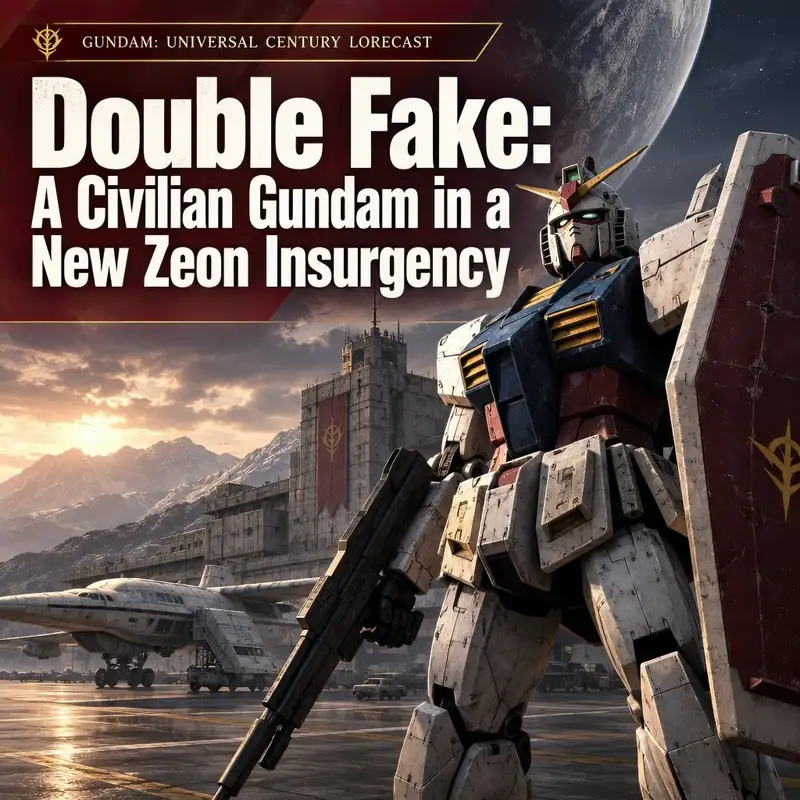
Double Fake: A Civilian Gundam in a New Zeon Insurgency [Manga]
A mobile worker is supposed to make a damaged colony livable again. It is supposed to lift structural members, seal ruptured sections, repair docks, and help restore the routines that make a habitat more than a metal cylinder in space. It is not supposed to become the center of a firefight. Yet at Texas Colony in Universal Century ninety, that is exactly what happens. Darry Neil Guns, a reconstruction worker with an enthusiast’s admiration for the old Gundam, builds and modifies a civilian work machine until it resembles a legend. When armed opponents see it, they do not first see its construction equipment, improvised protection, or civilian origins. They see a Gundam. In that moment, the machine’s most important weapon is not a beam rifle or a superior reactor. It is mistaken identification.
That misunderstanding is the foundation of Double-Fake: Under the Gundam. The manga is set after the First Neo Zeon War and before the later events associated with Char Aznable’s renewed movement. Its setting is not a secret military laboratory, a Federation test fleet, or a battlefield chosen for a formal campaign. It is a reconstruction site in Side Five, inside Texas Colony, where the scars of the One Year War still shape daily life. The colony is a workplace, an industrial project, a home for residents, and a pressure-sensitive habitat whose physical damage carries social and political consequences. Every repair crew is working on infrastructure, but also on public confidence. Every damaged bulkhead is a reminder that the war ended without truly ending.
Texas Colony matters because a colony is never just terrain. Its walls, docks, internal transport routes, repair zones, and life-support systems are the conditions of civilian existence. A battle inside or around such a place cannot be treated like an empty-field engagement. Weapons fire risks damaging systems that workers are trying to restore. Movement is constrained by construction areas and inhabited spaces. Identification is difficult because civilian machines, security forces, contractors, and militants may all be operating in close proximity. A military commander may hold formal authority over a security response, but a contractor’s workers may know the local machinery, access routes, and structural dangers better than anyone in uniform.
Darry works for the Monotone Mouse Corporation, a civilian contractor involved in the colony’s repair and construction effort. His importance comes from that position. He is not introduced as a Federation ace, a graduate of a military academy, or the recipient of a classified weapons program. He is a technician and worker whose practical world is built around making damaged systems function. His interest in the original Gundam gives his machine its appearance and its name, but it does not transform his employer into a military arsenal. The D Gundam begins as a civilian mobile worker, assembled and altered from what is available in a reconstruction environment. It is a product of improvisation, labor, salvage, and enthusiasm.
That origin matters more than any later mechanical designation. The D Gundam is not a hidden continuation of the original Federation Gundam program. It is not evidence that the Federation quietly placed another elite prototype in Texas Colony. Its resemblance to the RX seventy-eight two is visual and symbolic. Darry builds a machine that evokes a famous combat image because the image means something to him. But in a politically unstable colony, symbols do not remain private hobbies for long. A machine that resembles a Gundam can influence the calculations of soldiers, militants, intelligence officers, and civilians who have inherited decades of stories about what a Gundam represents.
The situation in Universal Century ninety makes that possible. The First Neo Zeon War has ended, but the end of a war is not the same thing as the restoration of security. Formal peace can stop a campaign without repairing damaged colonies, restoring trust in government, resolving displacement, or answering the political grievances that armed movements exploit. The Earth Federation remains the dominant legal authority across much of the Earth Sphere, but its authority is uneven in practice. It depends on local administrations, contractors, security formations, transport networks, and the willingness of civilians to believe that rebuilding is worth the risk.
For people living and working in a damaged colony, that faith cannot be assumed. Reconstruction takes time. It requires labor, materials, skilled technicians, transport, money, and protection. It also requires a political settlement strong enough to convince residents that their sacrifices serve a future rather than another temporary emergency. When those conditions are weak, a construction zone becomes vulnerable. It contains valuable equipment, exposed workers, incomplete defenses, and infrastructure whose destruction can create fear far beyond its immediate material cost. It is also an easy target for anyone who wants to demonstrate that the Federation cannot protect its own reconstruction projects.
This is the environment in which Colorde emerges. In the manga, Colorde is an anti-Federation militant organization associated with the New Summer Project. It is important to describe those relationships carefully. Colorde is not simply another name for Neo Zeon. The New Summer Project is not merely a bureaucratic branch of a single army. And the grievances that bring local militants into conflict with Federation authority are not identical to the plans of more powerful forces seeking to use that conflict for their own purposes. The political terrain is layered. That is one reason the security problem becomes so difficult.
A local militant movement may believe it is resisting Federation control, corruption, neglect, or colonial inequality. Some participants may see themselves as defending the dignity of people left behind by postwar politics. Others may be attracted by the opportunity for armed power, local influence, or a cause larger than ordinary life. Still others may simply be pulled into a movement that has become part of the landscape around them. None of that makes attacks on reconstruction workers or inhabited infrastructure harmless. But it does explain why a small organization can recruit and persist even when it cannot defeat the Federation in a conventional war.
Neo Zeon’s role is more calculating. The larger force does not need every local militant to understand its wider objective. It needs instability. It needs confusion about who is directing whom. It needs the Federation to spend time and resources responding to incidents that appear isolated, perhaps even understandable as local unrest, while a more serious operation develops under that cover. This is a familiar logic of manipulation. A powerful sponsor benefits when smaller armed groups remain politically visible but strategically dependent. The smaller group provides local knowledge, plausible deniability, and an immediate source of disorder. The larger organization provides resources, direction, and a purpose that may not be disclosed until it is too late.
For the residents of Texas Colony, the distinction may feel academic at first. A raid is a raid when workers are threatened and repair schedules collapse. A damaged cargo route still delays replacement parts whether the attack was ordered by local militants or shaped by a distant Neo Zeon plan. The people most exposed to violence are often those with the least influence over its political meaning. They are workers trying to complete repairs, residents trying to preserve ordinary life, technical crews trying to keep the colony safe, and families who cannot simply leave because a militant group has decided the reconstruction zone is symbolically useful.
The Earth Federation response comes through Arahas Force, a combat and security formation compelled to deal with the attacks. Arahas has formal military authority. It can bring trained personnel, weapons, command procedures, and the legitimacy of Federation service. But formal authority is not the same thing as practical control. In a working colony, a military formation cannot defend what it does not understand. It needs access to construction zones. It needs accurate information about which sections are structurally vulnerable, where heavy equipment is operating, which routes are open, and what damage a firefight could cause. It needs the cooperation of the people who have spent their days inside the machinery of reconstruction.
That dependence forces Arahas and Monotone Mouse into cooperation. It is not a sentimental partnership. The military needs civilian expertise because the contractor understands the environment. The contractor needs military protection because its workers and equipment are exposed to armed attack. Both sides have reasons for caution. Civilian workers do not necessarily trust the Federation simply because Federation troops have arrived. Soldiers may regard an improvised civilian operation as a source of risk, confusion, or security leaks. Yet neither can do the job alone. The colony’s physical condition makes cooperation a practical requirement before it becomes any kind of political trust.
A construction environment also changes the meaning of combat power. A purpose-built military mobile suit carries weapons designed for battlefield missions, supported by military maintenance, ammunition supply, trained crews, and an organization prepared to recover or replace losses. A civilian mobile worker is built for different tasks. It must manipulate materials, reach difficult repair points, stabilize structures, and operate around fragile infrastructure. Its tools may include equipment useful for cutting, fastening, anchoring, lifting, or sealing. Those tools can become dangerous in close quarters, especially when used by someone who understands the environment. But they do not turn the mobile worker into the equivalent of a frontline combat machine.
The D Gundam’s limitations are therefore central to its story. Its civilian origin means that it does not enter battle with the protection, sustainment, standard armament, or doctrinal support expected of a military mobile suit. Improvised equipment can solve immediate problems, but it also creates new ones. A work tool may be effective against a particular obstacle, at a particular range, in a particular section of the colony. It may be useless outside that setting. A machine built around repair work may be more maneuverable among construction fixtures than an outsider expects, but it remains vulnerable when confronted by dedicated military weapons. Civilian ingenuity can compensate for some disadvantages. It cannot abolish the difference between improvisation and a war machine.
Darry’s advantage is not that he has secretly built a better Gundam. His advantage is that he knows where he is. He understands the workplace, the machinery, and the immediate purpose of the repair effort. He can use equipment in ways a conventional combat pilot might not consider. He can recognize which structures must be protected, which routes are dangerous, and where a hurried attacker may be forced into a bad position. This is the kind of local knowledge that regular military forces often underestimate. It is not glamorous, but it is real combat value. In a damaged colony, knowing which door opens, which crane can move, and which section cannot absorb another impact may matter as much as a more powerful weapon.
Then there is the silhouette. The D Gundam looks enough like the old Gundam to create uncertainty. That uncertainty matters because military forces make decisions under incomplete information. An opponent who believes a legendary Federation-type machine has appeared may hesitate. A pilot may report a Gundam before confirming what kind of machine it actually is. Commanders may assign more caution, more firepower, or more attention to an encounter than the actual threat warrants. A mistaken report can alter the tempo of an operation. It can delay an attack, complicate targeting, and feed anxiety through a chain of command already struggling to distinguish local resistance from a larger Federation response.
Darry understands that he has not recreated that original military system. He has not reproduced the industrial base, the classified research, the test program, or the circumstances that gave the historical Gundam its reputation. But he does not need to. The D Gundam’s visual resemblance is enough to turn inherited memory into a temporary tactical asset. It creates a gap between what the machine is and what people think it might be. In war, that gap can be useful. It can also be dangerous. A false identification may protect a civilian worker for a moment, but it can also make that worker a priority target.
The title Double Fake captures more than the appearance of a civilian mobile worker dressed in the visual language of a Gundam. The machine is a work vehicle performing a combat role, but it is not a conventional combat Gundam. Colorde appears as a local anti-Federation movement, but its operations are entangled with a larger Neo Zeon purpose. Reconstruction presents itself as the return of peace, but it takes place under conditions where civilians still need armed protection to repair their homes. The story’s world is full of identities that are partly real and partly instrumental. The danger lies not in the existence of symbols, but in who gets to use them and toward what end.
As violence around Texas Colony expands, the central problem becomes intelligence. Arahas Force must determine whether it is confronting a local campaign, a broader insurgent network, or a diversion designed to conceal another operation. That distinction cannot be solved by looking at uniforms or slogans. Small groups may have their own real grievances while still receiving support from outside actors. A militant leader may believe in a local cause while being used by someone with a much larger objective. A series of attacks may be tactically effective precisely because each one appears too small to justify a strategic response.
Neo Zeon benefits from this uncertainty. In the manga’s account, the instability surrounding Colorde and the New Summer Project becomes cover for a more organized Neo Zeon effort. The appearance of Illia Pazom and forces associated with the Rewloola signals that Texas Colony is no longer merely dealing with a local security dispute. In this manga branch, Illia represents experienced Neo Zeon direction, a link between scattered postwar unrest and a more disciplined military purpose. Her presence should not be treated as a perfect preview of every later Neo Zeon organization. It matters here because it reveals the difference between political anger on the ground and professional forces prepared to exploit it.
The Federation’s difficulty is not simply that it lacks firepower. It is that it has to allocate attention before it knows where the decisive threat lies. If security forces overreact to local attacks, they may alienate the very civilians whose cooperation they need. If they underreact, militants can damage essential infrastructure and establish control through fear. If they assume every opponent is merely a local rebel, they may miss the larger network behind the violence. If they assume every local grievance is controlled from outside, they will misunderstand why people joined the movement in the first place. Intelligence failure often begins with a desire for one simple explanation.
Alvenica Kiest gives that conflict a human scale. As a Colorde pilot, she stands on the opposite side of Darry’s immediate struggle. But her encounters with him undermine the simplest possible reading of the situation. She is not just an abstract enemy marker on a tactical display. She is part of an armed movement with political claims, internal pressures, and exposure to manipulation. Darry, in turn, is not a standard Federation soldier. He is a worker defending a reconstruction project because the political system around him has allowed that project to become a battlefield. Their contact reveals how quickly official categories can become inadequate.
The value of Alvenica’s role is that it exposes the widening distance between individual participants and the larger design unfolding around them. Political movements often depend on simplified images of the enemy. Federation forces can be described as occupiers or instruments of a distant government. Anti-Federation militants can be described as nothing more than criminals or terrorists. A Gundam-shaped worker can be mistaken for a state weapon. But personal contact complicates these categories. It shows that the person inside the opposing machine may be defending a home, a job, a political belief, or a cause whose leadership has concealed crucial facts.
For any anti-Federation movement, that is a profound test. Opposition to Federation authority does not require acceptance of indiscriminate mass violence. Grievances can be real. Reconstruction can be unequal. Colonial political power can be limited. None of those facts make a colony-drop plan a legitimate extension of resistance. The use of a colony as a weapon does not liberate its people. It reduces them to cargo in someone else’s strategy. The rhetoric of independence, revenge, or historical justice cannot change that basic reality.
Erdesco Baie’s break with the more radical course therefore matters as an operational fracture as well as a moral one. In the manga’s account, he emerges as a Colorde leader unwilling to let the movement become cover for Neo Zeon’s larger atrocity. His cooperation with Arahas is not proof that he has become pro-Federation, nor does it erase the violence associated with his organization. It means that the political coalition around Colorde has reached its limit. A movement that can unite around opposition to the Federation may divide sharply when confronted with a plan that sacrifices the colony itself.
Such fractures are often decisive because insurgencies depend on a shared story. Once members realize they are not fighting for the same objective, command relationships weaken. Intelligence begins to leak. Orders become contested. Former allies become obstacles. The organization may still have weapons, pilots, and local supporters, but it loses the confidence that allows those assets to work together. Neo Zeon’s strategy depends on keeping the local movement useful long enough to support the larger operation. When a moderate faction rejects the mass-casualty plan, the deception begins to fail from within.
The colony-drop threat also changes the priorities of everyone involved. A dispute over reconstruction, security, and political legitimacy is still serious. But the prospect of using Texas Colony as an instrument of mass destruction forces a different kind of calculation. Federation forces must redirect attention toward preventing catastrophe. Civilian workers must decide whether and how to support operations that may put their own workplace at even greater risk. Moderate insurgents must choose whether preserving their political agency is worth breaking with former allies. The immediate question is no longer who controls a repair zone. It is whether the colony survives as a place where anyone can live.
This is where the alliance of necessity takes shape. Arahas Force, Darry and the Monotone Mouse workers, and the anti-radical element within the insurgency do not become natural allies. Their long-term goals remain incompatible. The Federation wants to restore order and prevent a strategic disaster. The workers want to protect their homes, livelihoods, colleagues, and reconstruction effort. The moderates want to prevent their movement from being consumed by a plan that turns its claimed constituency into victims. They cooperate because, for a limited time, those interests converge.
This kind of coalition has practical strengths. Arahas brings military organization, security capability, and access to Federation resources. The workers bring local technical expertise and an intimate understanding of the colony’s repair environment. The insurgent defectors bring knowledge of their own organization, its intentions, and its vulnerabilities. Together, they can see more of the problem than any one group could see alone. But the alliance also has weaknesses. Trust is thin. Information is incomplete. Authority is divided. People who were shooting at one another may suddenly need to share a plan under time pressure.
The D Gundam belongs in this alliance because it is itself an improvised answer to a problem that institutions failed to prevent. Darry did not receive the machine through an orderly procurement system. It was born from a civilian environment suddenly forced to defend itself. Its strengths are local. Its symbolic value is situational. Its effectiveness depends on the people around it, the terrain in which it operates, and the confusion its appearance produces. It is not the decisive weapon of a new military doctrine. It is a reminder that a population under threat will turn available tools into defensive capacity when it believes formal protection is inadequate.
The later development of the D Gundam reinforces that point. The shift from the D Gundam First to the D Gundam Second reflects adaptation under combat pressure. A civilian-origin machine involved in real fighting will be modified, reinforced, and adjusted as experience exposes weaknesses. That does not make every modification an elegant engineering solution. Field adaptation is often driven by urgency. A part is changed because the earlier arrangement failed. A tool is altered because a task became more dangerous. A machine’s role expands because there is no better option available at the moment. Improvisation is valuable precisely because it can respond quickly, but it is rarely free of compromise.
The later Federation-associated D Gundam Third shows a different process. Once civilian improvisation has demonstrated some value, a military institution may attempt to acquire, evaluate, or formalize the lesson. This is not simply a story about the Federation discovering a better Gundam. The institution is responding to a specific experience: civilian labor, local technical knowledge, and battlefield adaptation have produced something worth examining. The Federation can bring resources, testing, standardization, and professional maintenance. It can also strip away the local context that made the original improvisation effective in the first place.
The D Gundam lineage should not be mistaken for a strategic transformation of the Federation’s armed forces. There is no reason to treat later variants as evidence that civilian Gundam-shaped workers became a standard answer to postwar insecurity. The significance is narrower and more revealing. The Federation sees that the boundary between civilian technical capacity and military utility is porous. It learns, or at least has the opportunity to learn, that reconstruction workers possess knowledge and capabilities that formal military institutions cannot easily duplicate. Whether it learns the political lesson is another question.
Texas Colony exposes several levels of outcome. Tactically, local defenders and temporary allies can disrupt an immediate threat. A civilian work machine, used with local knowledge and protected by cooperation, can matter in an environment for which it was not originally designed. Arahas can benefit from technical expertise it does not possess. Insurgent participants can reject an escalation that would destroy the community they claim to defend. These are real achievements, but they are limited. They do not turn the D Gundam into a superior combat system or make the emergency coalition a durable political order.
Strategically, the events at Texas Colony do not settle the Earth Sphere’s political future. Stopping a local colony-drop threat does not eliminate Neo Zeon’s ability to organize, nor does it resolve the grievances that made Colorde’s message viable. It does not restore public faith automatically. It does not transform the Federation into a more responsive government. The most that can be said is that the operation exposes a weakness. The postwar order has left enough anger, insecurity, and damaged infrastructure that a larger force can hide behind smaller conflicts and find people willing to take up arms.
Politically, the story is uncomfortable for every major participant. The Federation possesses legal authority and military power, but it cannot protect reconstruction without relying on civilians whose trust it has not fully earned. Colorde can draw on real anti-Federation resentment, but its internal divisions show how easily a movement can become a vehicle for objectives its members do not share. Neo Zeon can present itself as the champion of spacenoid resistance, yet its willingness to exploit a colony and its people demonstrates the distance between political rhetoric and military practice. No side receives a clean vindication.
Institutionally, the civilian contractor becomes indispensable without becoming secure. Monotone Mouse workers possess machinery, knowledge, and practical capacity that make them essential to the colony’s defense. Yet they do not have the protections, training pipeline, or command structure of a formal military unit. Their militarization is not a triumph of citizen participation. It is evidence of institutional failure. A healthy reconstruction effort should not require workers to take up improvised arms in order to keep their homes from becoming battlefields. When it does, the boundary between public service and survival has already broken down.
Industrially, the D Gundam shows how repair culture can generate military relevance. Workers accustomed to adapting equipment under difficult conditions may create useful solutions faster than a formal procurement system. But their success depends on skills, spare parts, local facilities, and personal initiative that cannot be assumed everywhere. The Federation can study the machine, incorporate elements of its development, and pursue more formal variants. It cannot simply mass-produce the circumstances that made Darry’s original creation meaningful. The most valuable resource was not the Gundam-shaped frame alone. It was the human knowledge embedded in the reconstruction effort.
For civilians, the cost remains direct. They are the ones living inside the habitat whose damage becomes a tactical problem. They are the ones who lose work when construction stops, who face danger when armed groups use repair zones as targets, and who must continue rebuilding after the soldiers and militants have moved on. Their survival depends on infrastructure, but infrastructure depends on political security. That is the deeper connection at the heart of Texas Colony. A broken bulkhead and a broken political settlement are not the same thing, but each makes the other harder to repair.
The D Gundam becomes meaningful because the Earth Sphere in Universal Century ninety has left civilians to rebuild a damaged political world with inadequate protection. Its Gundam shape turns memory into a tactical asset. Its civilian origins turn technical labor into temporary combat power. Its presence confuses opponents because the old Gundam remains more than a machine in public memory. But the deeper lesson is not that anyone can build a Gundam if given enough spare parts. It is that symbols become militarily powerful when institutions are weak enough to let uncertainty govern the battlefield.
Texas Colony survives its immediate crisis through improvised cooperation among people who do not share a common future. Federation troops, civilian workers, and insurgents opposed to the radical plan find enough common ground to prevent a greater disaster. Yet the need for that alliance is the final indictment of the postwar order. Neither Federation security nor anti-Federation insurgency possesses a monopoly on legitimacy, competence, or responsibility. The D Gundam is a fake only in the narrow mechanical sense. In the political sense, it reveals something entirely real: a society still unable to protect the people rebuilding it.