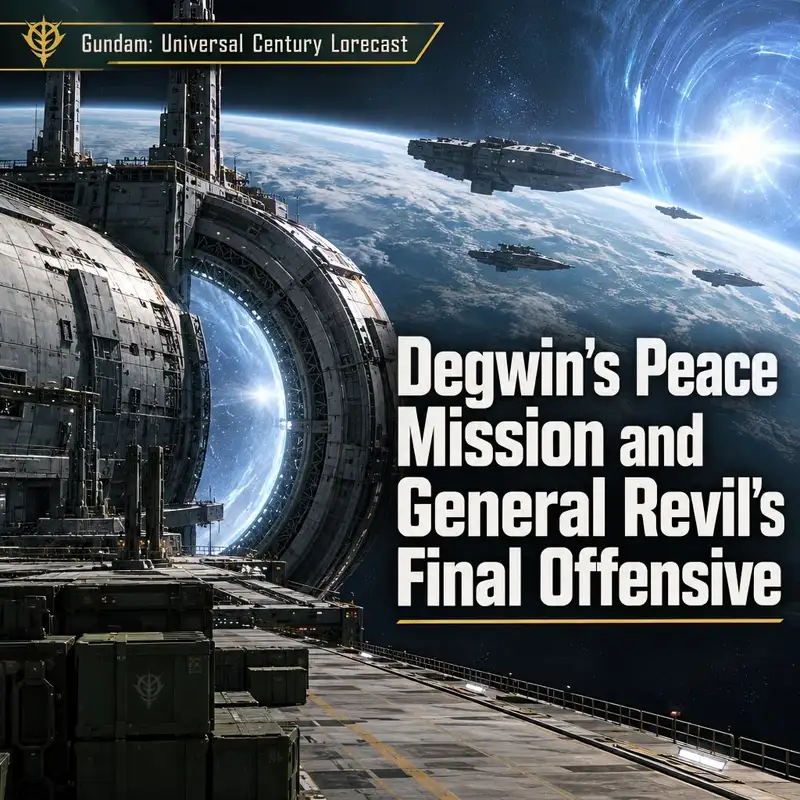
Degwin’s Peace Mission and General Revil’s Final Offensive
Two flagships moved toward one another in the dark between Confeito and A Baoa Qu. One was the Great Degwin, carrying the sovereign of the Principality of Zeon. The other was the Phoebe, the flagship of General Revil, the senior Earth Federation commander directing the final offensive of the One Year War. Neither vessel approached for a conventional exchange of fire. Degwin was seeking contact. Revil was preparing to break through Zeon’s last great defensive barrier and open the way toward Side Three. Yet their meeting placed the political head of Zeon beside the operational head of the Federation at the most dangerous possible moment. Far from the rendezvous, Gihren Zabi had prepared a third participant. The Solar Ray was not a warship, not a mobile armor, and not a conventional fortress gun. It was a colony transformed into a strategic weapon. When it fired, diplomacy and command concentration became one target.
That moment explains much of the war’s final crisis. By late Universal Century seventy-nine, both sides understood that the conflict was nearing a decision. The Federation had recovered from the disasters of the war’s opening months. Zeon, despite retaining formidable forces and extraordinary weapons, no longer held the strategic initiative it had seized at the beginning of the conflict. Degwin’s mission and Revil’s offensive were competing answers to the same question. Could the war end through negotiation before it reached Side Three, or would it end only after one side imposed military defeat on the other? Gihren’s answer was neither compromise nor orderly defense. He used the Solar Ray to destroy the proposed channel for peace, kill his own father, eliminate Revil, and cripple the Federation attack. It was a devastating tactical success. It was also evidence that Zeon’s political command had become more committed to preserving power than to preserving the state.
The Federation’s position had changed dramatically since the early phase of the One Year War. Zeon’s mobile suits, its preparedness for Minovsky-era combat, and its willingness to employ mass violence had produced a shock that the Federation initially struggled to answer. But surprise is not the same thing as strategic permanence. The Federation retained a far larger base of population, territory, industry, labor, and military infrastructure. Its recovery did not come from one commander, one ship, or one remarkable mobile suit. It came from factory output, fleet reconstruction, new mobile-suit forces, training pipelines, transport networks, replacement crews, and the ability to turn surviving institutions toward a long war.
Those advantages did not make the Federation consistently wise, humane, or unified. Its government remained burdened by complacency, inequality, bureaucratic failure, and the political conditions that had helped create colonial resentment in the first place. But by the war’s end, it had regained the capacity to conduct sustained offensive operations. The capture of Solomon was a central expression of that recovery. The fortress had been a major Zeon forward position, an obstacle on the route toward Side Three, and a base from which Zeon could project power. Once it fell, the Federation renamed it Confeito and used it as a staging area for the final advance. A captured fortress was never merely a trophy. It was docks, maintenance space, defensive cover, supply storage, communications infrastructure, and a forward anchor for fleets that otherwise had to operate farther from support.
For Zeon, the loss of Solomon narrowed the map. A Baoa Qu remained a powerful fortress and the final major military barrier before the homeland. But its value was partly a sign of how constrained Zeon had become. A state that must place its final hopes in a single fortress is no longer choosing among many good options. It is trying to make one remaining position carry the weight of an entire strategic system. A Baoa Qu could concentrate defenses, support mobile suits, shelter ships, and force an attacker into close combat. It could not replace the operational depth Zeon had lost. It could not restore a forward fortress. It could not create new trained crews or repair all the political damage caused by a war that had consumed soldiers, civilians, colonies, and confidence in equal measure.
This was the setting in which Degwin Sodo Zabi moved toward Revil. Degwin was not an innocent elder suddenly horrified by a war for which he bore no responsibility. He was the sovereign of the Principality of Zeon and patriarch of the family that ruled it. The state he presided over had turned a movement shaped by Spacenoid political grievance into a dictatorship. Its war had included invasion, occupation, colony gassing, and mass death on a scale that cannot be softened by later military desperation. Degwin’s decision to seek peace did not erase that record. It did, however, matter. A compromised ruler can still recognize that a war has become ruinous. A late effort at restraint can still be politically significant, especially when it comes from the formal head of a government approaching military defeat.
Degwin’s mission was an admission that the war had reached the doorstep of Zeon’s homeland. The Federation was not merely raiding an outer defensive line. It had captured Solomon and was preparing to force the route toward A Baoa Qu and Side Three. Whatever Degwin hoped to achieve through contact with Revil, the mission reflected an understanding that continued fighting risked more than the loss of military installations. It threatened Zeon’s civilian population, its political survival, and the remaining structure of the state itself. He was not presenting a fully documented peace settlement to the audience, and the television record does not establish every term he might have sought. What it establishes is more basic. Degwin wanted to stop the war’s momentum before it carried the Federation into the heart of Zeon territory.
That mission also revealed the limits of his authority. In a formal sense, Degwin remained the sovereign. In practical terms, Gihren had accumulated decisive control over the war effort. This is a recurring weakness of authoritarian systems. Titles, constitutions, and family hierarchy may describe where authority is supposed to rest. War, security institutions, classified programs, and control over armed force can create a different chain of command altogether. By the final days of the One Year War, Gihren did not merely advise his father on military affairs. He directed the central instruments of Zeon’s defense and had positioned himself to determine whether peace would be considered at all.
Gihren’s position should not be reduced to simple irrationality. He understood the military value of a concentrated strike against the Federation. He understood that the attackers had momentum, that their fleet would have to approach A Baoa Qu through predictable operational space, and that the destruction of senior command could disorganize even a larger force. He also understood that a negotiated settlement could limit his own freedom of action. If Degwin opened direct contact with Revil, the war might move from a contest of weapons to a contest of legitimacy, surrender terms, responsibility, and political succession. That was dangerous terrain for a leader whose authority depended increasingly on continued mobilization and control of the military machine.
The Solar Ray gave Gihren a means of changing the situation by force. It could destroy an enemy concentration in a single blow. More importantly, it could destroy the political conditions under which Degwin might restrain him. Gihren’s decision was therefore both an external operation and an internal seizure of power. He targeted the Federation fleet, but he also targeted Zeon’s sovereign. He removed the man with formal authority to negotiate and demonstrated that practical command belonged elsewhere. In another state, such an act might be described as a coup. In Zeon, family rule, military command, and state authority had become so entangled that the coup was carried out through a strategic weapons strike.
Kycilia Zabi complicates any simple picture of Gihren’s control. She commanded Zeon’s Mobile Assault Force and possessed her own military and political weight. Her intelligence apparatus, her forces, and her personal ambitions made her an independent center of power within the Zabi system. She was not simply another officer waiting for Gihren’s orders. The approach to A Baoa Qu was therefore not a unified Zeon defense directed by one unquestioned command authority. It was a fortress defense conducted within a ruling family whose members held overlapping institutions, competing loyalties, and different visions of what Zeon should become if it survived. That division would matter greatly in the battle to come. Even before the firing of Solar Ray, it meant that Zeon was trying to defend its homeland while its leadership was also fighting over the future of the regime.
Across the line, General Revil represented a different kind of historical irony. Earlier in the war, Revil had been captured after the Battle of Loum and later returned to the Federation. His assessment that Zeon was not invincible helped stiffen Federation resolve at a moment when a negotiated settlement might otherwise have seemed attractive. The exact language attached to his public message varies across versions and translations, but its effect is clear enough. Revil argued that Zeon’s apparent strength concealed exhaustion and limitation. That argument mattered because it challenged the assumption that the Federation had already lost. Yet Revil should not be made into a solitary architect of victory. His political influence helped sustain resistance, but the Federation’s recovery depended on institutions much larger than one man.
By the time of Operation Star One, Revil was directing the Federation’s final offensive against A Baoa Qu. The operation was not simply an attack by famous mobile-suit pilots. It was a fleet undertaking on a vast scale. Ships had to move from Confeito toward the fortress, maintain screening formations, identify threats under Minovsky conditions, launch and recover mobile suits, manage damaged vessels, coordinate fire, protect supply lines, and preserve enough command coherence to force passage through Zeon’s defenses. The Federation had to anticipate fixed defenses, Zeon ships, mobile-suit formations, and the possibility of a counterattack from forces operating close to their own base. A Baoa Qu’s defenders enjoyed the advantages of preparation, repair facilities, familiar approaches, and interior lines of movement. The attackers possessed momentum, but momentum is not immunity.
The name Star One reflected the intelligence problem as well as the operation’s ambition. The Federation did not need every participant to know every detail of the ultimate objective. Compartmentalization could reduce the chance that a captured crewman, intercepted transmission, or careless conversation would reveal the full plan. In a Minovsky environment, command and control already depended heavily on local initiative, visual identification, prearranged orders, and imperfect communications. Operational security was therefore not a bureaucratic luxury. It was a practical effort to deny the enemy a clear picture of where and when the Federation intended to concentrate force.
But secrecy has limits. A Baoa Qu was the final major obstacle before Side Three. Zeon did not need an enemy briefing packet to understand that a Federation fleet operating from captured Solomon would eventually come toward that fortress. The question was not whether an offensive was coming. The question was how it could be disrupted, delayed, or broken before the attackers reached the defensive zone in sufficient strength. Gihren’s answer was to strike before the conventional battle fully developed. Rather than rely entirely on the fortress and the fleet, he would use a weapon designed to make the approach itself fatal.
The Solar Ray was extraordinary because of what it required. It was a colony-scale laser installation, built by converting inhabited space infrastructure into a strategic weapon. A colony cylinder was not an empty tube drifting in space, waiting for an officer to assign it a military role. It was a habitat. It contained life-support systems, industrial structures, transportation, homes, and a population with its own needs and political existence. Transforming such a place into an instrument of mass destruction required engineering on an immense scale. It required power, structural alteration, security, control over access, and the ability to point the weapon along a usable firing geometry. It also required secrecy, because a project this large could not be concealed merely by classifying a memo.
The human cost cannot be reduced to a technical footnote. The Solar Ray’s construction and preparation involved the evacuation, displacement, or endangerment of people whose home had been appropriated for war. The available record does not support a simple claim that every resident faced the same fate or possessed the same knowledge of the weapon’s purpose. But the political meaning is unmistakable. Zeon converted civilian infrastructure into a strategic firing platform at the moment when its own leadership was claiming to defend the homeland. The colony became part of the war not because its residents had chosen that role, but because the state had the power to impose it.
This was also not a capability that could be casually reproduced. The Solar Ray was not a standard naval gun enlarged to absurd dimensions. It was an exceptional concentration of infrastructure, specialized preparation, political authority, and industrial effort. Its existence demonstrated that Zeon still possessed dangerous technical capacity. It did not prove that Zeon could rebuild the broader force structure necessary for a long war. A state can construct one extraordinary weapon while losing the contest of replacement. It can still lack ships, pilots, mechanics, ammunition, trained officers, secure routes, and stable command. The distinction matters because the Solar Ray’s brilliance as a weapon could conceal the fragility of the political and military system that depended on it.
In military terms, the weapon was designed to turn Zeon’s worsening conventional position into one decisive opportunity. A fortress battle favors the defender, but a defender facing a stronger industrial opponent cannot rely on favorable terrain forever. The attacker can replace losses, rotate units, bring up new formations, and learn from failed attempts. Zeon needed to reduce the Federation’s available strength before that strength reached A Baoa Qu in full. The Solar Ray offered a way to do so. It could impose losses too severe for ordinary defensive fire to achieve in a single engagement. But even such a weapon needed a target. It needed intelligence, timing, and an enemy force dense enough to justify its employment.
That is where Degwin’s peace mission became the firing solution. The Great Degwin moved toward Revil’s flagship because the sovereign of Zeon sought contact with the commander of the attacking Federation force. The Phoebe represented more than a single ship. It was a command node, a place where senior officers, staff personnel, communications systems, and political authority converged. Revil’s presence gave the rendezvous weight. Degwin’s presence made it extraordinary. Exact hour-by-hour details of their approach are not securely established by the television dialogue, and there is no need to invent a precise clock to understand the danger. The essential fact is that the two ships came close enough for Gihren to treat them as a single opportunity.
The meeting concentrated political and military leadership in a way that battlefield conditions rarely permit. Under Minovsky interference, fleets cannot depend on perfect long-range surveillance and instantaneous centralized control. That makes flagships, staff officers, prearranged plans, and trusted subordinate commanders especially important. A commander may not see every part of the battle, but the commander’s presence still matters. Destroying a flagship can mean more than removing one person. It can eliminate communications personnel, disrupt orders, fracture situational awareness, and force every surviving formation to ask whether the mission still stands. By bringing the Great Degwin alongside the Phoebe, the peace approach created the densest and most politically valuable target of the campaign.
Gihren exploited that fact without hesitation. He did not merely ambush an enemy commander. He used a diplomatic approach to kill his own sovereign and remove the immediate possibility of sovereign-led negotiation. The Solar Ray strike was therefore not only ruthless. It was politically absolute. It declared that there would be no pause for bargaining, no restoration of Degwin’s authority, and no separate peace path outside Gihren’s control. In choosing the target, Gihren made the war continue. In choosing to include his father, he made it his war alone.
When the Solar Ray fired, the result was catastrophic. The Great Degwin and the Phoebe were destroyed. Degwin Sodo Zabi died. General Revil died. A major portion of the Federation force was caught in the strike and lost with them. Later summaries differ over exactly how much of the attacking fleet was destroyed. Some describe roughly a third of the force, while others suggest a still greater share. The precise proportion is less important than the operational reality. The Federation suffered losses on a scale severe enough to disrupt its approach, destroy senior command, and threaten the entire offensive.
The attack was a genuine tactical success. It removed the Federation commander most closely associated with the final push toward Zeon. It inflicted concentrated losses before A Baoa Qu’s defenders had to fight the full attacking strength at close range. It demonstrated the destructive power of the Solar Ray and justified, in narrow military terms, the effort Zeon had invested in preparing it. Any historical assessment that denies the strike’s effectiveness simply fails to take the event seriously. Gihren had found a vulnerable moment and used an exceptional weapon with terrible precision.
But tactical success does not settle a war. Revil’s death created confusion, yet it did not erase the Federation’s command structure. An offensive of this scale could not depend entirely on one man issuing orders from one bridge. Surviving officers retained their ships, their formations, their crews, and their mission. The loss of the Phoebe forced them to regroup under conditions of incomplete information and shock. They had to determine what had been destroyed, what communications remained, which units could still maneuver, and whether the route toward A Baoa Qu was still open. That was not a trivial recovery. It was the difference between an army that collapses when its leader falls and one that can continue because planning, authority, and purpose exist beyond a single flagship.
The Federation’s institutional depth mattered here. It had lost experienced personnel and valuable ships. Those losses were not abstract. Every destroyed vessel contained crews, technicians, junior officers, medical personnel, pilots, and support staff whose knowledge could not be replaced immediately. Every damaged formation faced the practical problems of rescue, recovery, fuel, ammunition, communications, and morale. Yet the Federation could absorb a blow that might have shattered a smaller force because it had developed strategic depth over the course of the war. It had industrial capacity behind it. It had additional officers. It had a wider pool of ships and personnel. Most importantly, it had already committed itself to the conclusion that Zeon’s remaining defenses had to be broken.
That commitment had costs. Continuing after the Solar Ray did not mean the Federation was unaffected or morally purified by resilience. It meant that the operation’s surviving commanders judged that retreat would allow Zeon time to recover its defenses, reorganize its political leadership, or find another way to prolong the war. They moved forward because the strategic logic of Star One remained. A Baoa Qu still stood between the Federation and Side Three. The destruction of Revil made the operation harder. It did not remove the reasons the operation had been launched.
For Gihren, this was the limit of the Solar Ray’s achievement. The strike had delayed and disorganized the attacker. It had made A Baoa Qu more defensible in the immediate sense. It had destroyed a possible negotiator and the enemy’s most senior field commander. What it could not do was restore Solomon to Zeon control. It could not rebuild the fleet assets already lost in the war. It could not produce seasoned pilots and crews by decree. It could not create new shipyards, reopen lost routes, or repair the strategic imbalance between Zeon’s shrinking resources and Federation mobilization. A weapon can alter a campaign. It cannot, by itself, recreate the conditions of a viable national strategy.
The political cost was even greater. Degwin’s death eliminated the formal sovereign at the very moment Zeon needed a coherent authority capable of deciding whether the state would fight, negotiate, surrender, or attempt to preserve its civilian population through some other means. Gihren had gained practical control, but control is not the same as legitimacy. He had demonstrated that he could command the Solar Ray. He had also demonstrated that no one within the ruling structure was safe if they obstructed him. That may impose obedience in the short term. It does not create trust among rival commanders, family members, officials, or citizens who now understand that the state’s supreme weapon can be used against its own political head.
The resulting situation around A Baoa Qu was not one of restored Zeon unity. It was a final defense conducted by exhausted forces under increasingly fractured leadership. Zeon still possessed determined soldiers, capable commanders, formidable mobile suits, and a fortress built for hard fighting. Those assets were real. So were its shortages, its casualties, its divided authority, and the burden of defending the homeland after a war of aggression had failed to secure a stable political order. The Solar Ray bought time and inflicted terrible damage. It did not resolve the internal contradictions that had brought Zeon to that point.
The civilian meaning of Gihren’s decision deserves equal attention. The Solar Ray was born from the conversion of a colony into a weapon. Its firing killed not only the famous men aboard the Great Degwin and the Phoebe, but untold members of their crews and the surrounding Federation formations. It guaranteed that the war would proceed into another major battle at A Baoa Qu, where more soldiers and civilians would face the consequences of decisions made far above them. Degwin’s mission did not absolve him of his government’s crimes. But it did recognize something Gihren chose to ignore. A war fought at the edge of Side Three would not remain an abstract struggle over military honor or family succession. It would determine the safety of the people living under Zeon rule.
Gihren’s claim to defend Zeon therefore carried a bitter contradiction. He was willing to use a colony as a weapon, kill the sovereign of his own state, and foreclose negotiations in order to preserve his authority over the final phase of the war. That was not merely hard strategy. Hard strategy can involve painful choices between bad options. This was a choice to make continued military control more important than the political survival of the community in whose name the war had been fought. Degwin had helped construct the system that enabled such a choice. Gihren revealed what that system had become when no restraint remained.
Why, then, did a genuine attempt to end the One Year War become the opening move of its final battle? Because diplomacy and offensive action had converged at the same strategic point. Degwin understood that Zeon could no longer safely sustain the war. Revil understood that the Federation had reached the moment when it could force a decision. Both men approached the end of the conflict from different directions, and neither represented a simple moral answer to the war they had helped shape. Degwin came from the dictatorship that had launched it. Revil came from the force preparing to carry victory into Zeon’s homeland. But their meeting recognized that the war’s end was now at hand.
Gihren turned that recognition into a massacre. The Solar Ray destroyed the peace mission and struck the Federation offensive at its command center. It removed Degwin, Revil, and a major portion of the attacking fleet in one operation. It proved that Zeon remained capable of catastrophic violence. Yet it did not prove that Zeon had regained strategic control. The Federation survived because its offensive rested on more than Revil’s presence. Zeon weakened itself because its ruling system had allowed military authority and personal ambition to outrun political control.
The surviving Federation fleet continued toward A Baoa Qu. That advance was not a clean triumph, and it did not erase the terrible cost of the Solar Ray strike. It showed something more severe. Destruction alone could not solve the political crisis that had produced the war. Zeon still had a fortress and an extraordinary weapon, but it no longer had unified leadership capable of turning either into a durable peace.