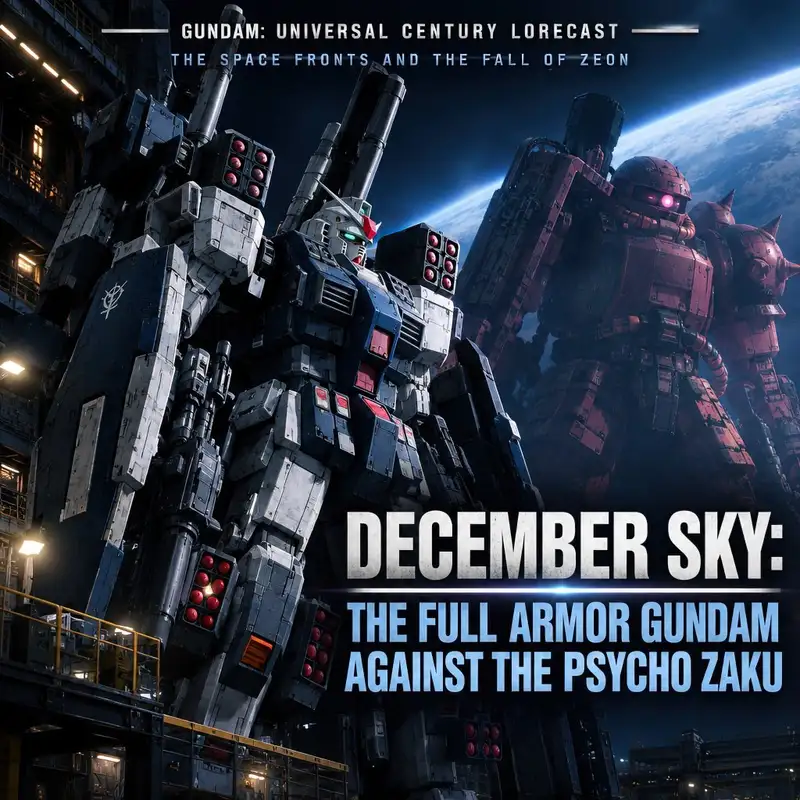
December Sky: The Full Armor Gundam Against the Psycho Zaku [Thunderbolt Continuity]
The Thunderbolt Sector is not open space. It is the wreckage of a civilian world turned into a killing ground. Fragments of the former Side Four colony group known as Moore drift among shattered warships, broken habitat structures, and the remains of the people who once lived there. Electrical discharges leap through the debris, giving the sector its name. Pilots cannot treat this as empty vacuum. Every approach route is narrowed by wreckage. Every burst of speed risks collision. Every piece of cover may conceal a sniper, a mine, or the remains of a home.
That physical reality matters because Moore was not destroyed merely to create dramatic terrain for a mobile-suit battle. It had been a political community, an industrial community, and a homeland. Its destruction produced refugees, survivors, grief, and a field of debris that outlived the attack itself. The final phase of the One Year War is fought inside that aftermath. The wreckage shapes sensors, movement, communications, morale, and memory. It also gives both sides a reason to believe that ordinary military methods are no longer enough.
In Mobile Suit Gundam Thunderbolt: December Sky, the Full Armor Gundam and the Psycho Zaku are the most visible answers to that problem. One is a Federation prototype built to protect a pilot behind layers of armor, shields, propulsion, and firepower. The other is a Zeon experiment that makes a wounded pilot’s altered body part of the machine’s control system. Their duel matters because neither weapon exists in isolation. Each is the product of an institution trying to generate decisive combat power in a battlespace where ordinary command, ordinary machines, and ordinary human bodies have already been broken.
The Earth Federation Forces enter the sector through the Moore Brotherhood. Formally, its objective is clear enough. Zeon holds the Thunderbolt Sector, and the Federation wants that force removed. Clearing the area would reopen routes, deny Zeon a fortified position, and restore some measure of control over the ruins of Moore. But the unit’s real purpose is more complicated than a line in an operations order.
Many members of the Moore Brotherhood are survivors of the destroyed colony group. Their military mission is inseparable from the loss of their homes and families. They are not simply deployed to a distant front. They are fighting through the remains of their own world. That gives the formation determination, local knowledge, and a powerful sense of shared identity. It also creates danger. A force built around grief can fight with exceptional resolve, but grief can distort judgment. It can make an operational objective feel like personal revenge. It can make withdrawal look like betrayal. It can make the destruction of the enemy seem more urgent than the preservation of one’s own people.
Across the debris field, Zeon relies on the Living Dead Division. The name is deliberately unsettling, and it should be. This is not merely a unit with an unfortunate nickname. It is a formation built around personnel who have lost limbs and now use prosthetics. Its personnel are soldiers, technicians, survivors, and research subjects at the same time. Zeon has found military value in people the war has already mutilated. The division’s existence is therefore both a tactical adaptation and an institutional statement about how far the war has gone.
The Living Dead Division operates from the Dried Fish, using concealed firing positions, long-range weapons, and intimate knowledge of the wreckage. Its defenses include Big Gun emplacements, mobile suits positioned for ambush, and firing lanes prepared in advance. In a sector where long-range sensors and communications are degraded, that local preparation has immense value. The division does not need to see everything. It needs to know where an enemy is likely to go, where a mobile suit must slow down, where debris creates a blind angle, and where a target has few options for escape.
The Thunderbolt Sector magnifies the military effects of Minovsky-particle interference without making every sensor useless or every commander blind. Radio traffic becomes unreliable. Long-range tracking becomes uncertain. Forces cannot assume that headquarters sees the same battle they see. Visual confirmation, short-range coordination, prearranged plans, and personal experience become more important. In that environment, a crew that knows the terrain can turn wreckage into a defensive network.
Daryl Lorenz is the Living Dead Division’s most effective expression of that network. He is an experienced Zeon sniper who has lost both legs in the war. That injury is not a simple mark of heroic sacrifice, nor is it a magical source of combat skill. It places him inside the institutional world of the division, where disabled veterans are gathered, studied, and employed in specialized roles. Daryl’s abilities come from training, composure, and an understanding of the debris field that ordinary Federation pilots do not yet possess.
He studies movement through the sector as though it were a map of currents and choke points. A mobile suit moving through wreckage cannot accelerate freely in every direction. It must avoid collision, preserve line of sight, and account for the relative motion of debris. A pilot under fire may choose the same cover that another pilot chose before. Daryl understands these habits. He reads probable routes, predicts where an opponent will expose itself, and works with the division’s prepared positions to turn uncertainty into opportunity.
This is why the Moore Brotherhood’s first encounters with the Living Dead Division are so costly. The Federation has mobile suits, warships, and the determination of people fighting for their homeland. But determination is not the same thing as situational awareness. The Zeon defenders have turned the ruins of Moore into a prepared defense. They know where they can shoot, where they can withdraw, and where the enemy will struggle to coordinate.
Io Fleming changes that balance, at least for a time. He is not simply a Federation hero sent to solve a difficult campaign. He is an aggressive and highly capable pilot whose personal identity is increasingly tied to combat. He uses jazz as a private soundtrack and signal of self-definition amid the violence around him. It gives him rhythm, confidence, and distance from fear. But it also reveals something more troubling. Io is not merely enduring war. He is finding a form of release inside it.
That does not make him unique in military history. Combat can be terrifying, traumatic, and addictive in the same person, sometimes in the same hour. The intensity of survival, the clarity of immediate action, and the feeling of mastery can become powerful precisely when everything else has been destroyed. December Sky understands this contradiction. Io’s music is not there to make the battle stylish. It is part of the psychological armor he builds around himself.
Io breaks through the sniper screen by combining aggression with opportunity. He makes use of captured information and a commandeered Rick Dom to penetrate the Living Dead Division’s defensive system. The operation works because he does not simply charge blindly into the wreckage. He exploits what he has learned about Zeon positions and then acts before the defenders can fully reorient. His maneuver exposes firing positions, disrupts the careful rhythm of the sniper network, and gives the Moore Brotherhood evidence that the sector’s defenses can be penetrated.
But Io’s success does not destroy the system that produced Daryl’s advantage. The debris remains. Communications remain unreliable. The Federation formation is still dependent on a command ship, technical personnel, and pilots who can keep their bearings under pressure. Zeon still has prepared positions, experienced survivors, and a research program seeking a more decisive answer. One pilot can break a screen. He cannot, by himself, make a fractured force coherent.
The Federation’s response is revealing. Rather than solve the broad command-and-control problem of the sector, it concentrates greater capability in Io’s hands. He receives the Full Armor Gundam, a Thunderbolt-specific prototype built for the particular brutality of this battlefield. It should not be confused with standard Federation equipment or treated as evidence that the entire Earth Federation Forces has solved mobile-suit procurement. This is an exceptional machine for an exceptional mission.
The Full Armor Gundam is designed to survive and strike in a heavily contested debris field. It carries an unusually large weapons load, including twin beam rifles, rocket launchers, missile pods, a major beam cannon, spare energy packs, and multiple shields. It also carries additional thrusters to give it the mobility needed to maneuver around wreckage while hauling that armament. Taken as a list, those features can sound like excess for its own sake. In practice, they answer several related operational problems.
The first problem is exposure. A mobile suit entering a prepared sniper field cannot assume that one shield, one armor layer, or one evasive maneuver will be enough. The Full Armor Gundam’s redundant defensive equipment gives Io more chances to survive the first hit, and sometimes the second. Its armor and shields are not invulnerability. They are time. They buy seconds in which a pilot can maneuver, identify a threat, return fire, or reach cover.
The second problem is persistence. A normal mobile suit may be forced to choose between carrying enough weapons for a short engagement and remaining agile enough to escape. The Full Armor Gundam tries to carry the answer to several tactical situations at once. It can suppress firing positions, engage mobile suits, strike ships or installations, and continue fighting after part of its loadout has been spent or destroyed. This makes it useful for a penetration mission, where the pilot may not have a convenient opportunity to return to the carrier for a fresh weapon or a quick repair.
The third problem is local independence. In the Thunderbolt Sector, a pilot may lose contact with escorts or command. The Full Armor Gundam therefore gives Io the means to operate at a greater distance from immediate support than an ordinary machine might. But that independence is limited. It exists only because support has already been concentrated behind the machine. The Beehive provides launch facilities, intelligence, maintenance, recovery, energy supplies, ammunition, spare parts, medical care, and the technicians who keep the Gundam operational.
Cornelius Kaka and the other personnel around the Beehive matter for this reason. A prototype is not a self-contained miracle. It is a maintenance burden with a pilot inside it. Every shield fitted, energy pack loaded, weapon repaired, and sortie prepared represents labor that remains mostly invisible once the machine enters combat. The Full Armor Gundam extends Io’s tactical reach, but it does so by drawing heavily on the ship and crew behind him.
That distinction is important because the Federation’s broader assault is increasingly fragile. Reinforcements arrive, including inexperienced teenage pilots. Their presence reflects a late-war manpower problem. The Federation can add bodies and machines to the fight, but it cannot instantly create cohesion, judgment, or familiarity with an environment like the Thunderbolt Sector. A mobile suit is not combat power merely because it is present. Its pilot has to navigate, identify friend from foe, receive orders, conserve weapons, understand the mission, and act without becoming a hazard to the rest of the formation.
The young reinforcements are not evidence that they lack courage. They are evidence that courage is not enough. They enter a battlefield that punishes hesitation and poor coordination. The wreckage limits visibility. The defenders know the routes. Communications are degraded. A pilot who loses formation may become isolated within seconds. A pilot who fires without a clear picture may endanger friendly forces. A pilot who pursues a target too far may drift into a prepared ambush.
The Federation has numerical presence, but numerical presence is not the same thing as a coherent assault force. The Moore Brotherhood needs pilots who understand its procedures, officers who can adapt under pressure, and ships that can keep damaged machines and wounded personnel moving through the battle. Instead, it must carry inexperienced replacements into a highly specialized fight. This is one of the war’s less glamorous realities. Nations can build or requisition machines faster than they can produce seasoned crews.
Captain Claudia Peer has to manage this imbalance while preserving the offensive. She commands the Beehive and carries responsibility for the people aboard it, the operation’s timing, the value of Io’s prototype, and the emotional strain inside the Moore Brotherhood. She cannot simply hold Io back because he is reckless. His skill is too valuable. Nor can she allow the entire formation to become dependent on one pilot’s initiative. A command built around an exceptional ace can achieve remarkable local results, but it becomes vulnerable when that ace is out of position, damaged, or simply fighting a battle that command cannot fully see.
Zeon’s answer to the Full Armor Gundam comes through the Reuse P Device project. This is not merely an effort to mount more weapons on a Zaku. It is an attempt to reduce the delay between a pilot’s intention and a mobile suit’s movement. The project seeks a closer, more direct relationship between body and machine. In the Thunderbolt Sector, where small fractions of a second may determine whether a pilot clears wreckage or collides with it, that promise has obvious military appeal.
Karla Mitchum is associated with the project, and her position complicates any simple story about scientific detachment. She works within a coercive political environment, shaped in part by pressure directed at her family. The project’s technical personnel are not all free actors standing outside the war. Some are trapped by it, some benefit from it, and some become its administrators. J. J. Sexton represents the harsher side of that system, treating Living Dead Division personnel as experimental material in a program designed to extract military value from their injuries.
The Reuse P Device is a specialized interface. It uses Daryl’s remaining bodily signals to control the High Mobility Zaku with exceptional responsiveness. The system is not psycommu. It is not psycho-frame. It is not a general Newtype technology, and it does not establish that Daryl has supernatural awareness. Its significance lies elsewhere. It makes the machine respond more directly to the pilot by integrating his altered body into the control system.
For Daryl, that means the device offers something that ordinary prosthetic adaptation cannot. It gives him a way to operate at a level that the war has otherwise denied him. The film does not ask the audience to dismiss that opportunity. His skill, anger, pride, and desire for agency are real. A system that allows him to fight again can feel like liberation. But the project’s central moral fact is that it demands more loss from him in order to provide that capacity.
Daryl undergoes further amputation so that he can interface fully with the experimental machine. This is not a neutral medical procedure. It is an institutional decision to make his mutilation useful. The war first takes away parts of his body. Zeon’s research apparatus then tells him that the path back to relevance runs through surrendering more of it. The device gives Daryl power, but it does not restore his autonomy in any simple sense. It converts his body into a strategic resource.
The Psycho Zaku therefore cannot be understood as an ordinary High Mobility Zaku with extra weapons. Its capabilities depend on surgery, customized prosthetics, specialist technicians, experimental integration, and a pilot whose relationship to the machine cannot be separated from trauma. It also requires the Dried Fish, research personnel, maintenance capacity, weapons supply, and a command structure willing to risk a scarce pilot and a rare system in combat. Like the Full Armor Gundam, it is a concentrated solution. It can produce extraordinary local effect, but it is not easy to build, field, or replace.
The two machines represent different forms of military exploitation. The Full Armor Gundam places layers between pilot and danger. It surrounds Io with armor, shields, fuel, weapons, and propulsion. It treats him as a highly capable combatant who must be protected long enough to deliver overwhelming firepower. The logic is external reinforcement. Give one pilot enough equipment to penetrate a defensive line and survive the response.
The Psycho Zaku takes the opposite path. It removes the separation between pilot and machine. Instead of adding layers around Daryl, it makes his damaged body an increasingly direct component of the weapon system. The logic is internal integration. The machine becomes more responsive because the pilot has been altered to meet its demands. One system protects a human being through equipment. The other extracts performance by reducing the boundary between human being and equipment.
Neither approach is humane simply because it is technologically impressive. The Federation’s prototype concentrates immense resources around one aggressive pilot while the rest of the formation struggles with cohesion and replacement. Zeon’s program gives a wounded veteran extraordinary combat capability while treating further bodily sacrifice as a requirement of service. Both sides have found ways to make individuals more dangerous. Neither has found a way to make the war less destructive.
The political meaning is equally uncomfortable. The Moore Brotherhood channels the loss of a destroyed homeland into an offensive that promises recovery, justice, or revenge. Its members are not wrong to mourn Moore. They are not wrong to resent the force occupying its ruins. But an institution can use real grief as fuel for a mission without resolving what that grief has done to its people. Zeon, meanwhile, channels wounded veterans into research projects that promise dignity through renewed usefulness. The promise is powerful because it addresses a genuine loss. The exploitation lies in making military service the price of that restored purpose.
These systems collide during the final operation, and the duel between Io and Daryl cannot be separated from the larger battle around them. The Federation is not sending the Full Armor Gundam into empty space for a controlled test. The Moore Brotherhood is assaulting the Living Dead Division’s positions in an effort to break Zeon control of the sector. At the same time, Daryl and the Psycho Zaku are directed against the Beehive and the Federation formation that sustains Io’s operations.
The Living Dead Division still has the advantages of prepared defenses and local familiarity. The Psycho Zaku adds something different: mobility, rapid response, and the ability to carry and employ a heavy weapons load while moving through terrain that would overwhelm a less capable pilot-machine combination. Its attack disrupts the Federation’s already strained formation. Reinforcements who lack experience become more vulnerable when the operation loses its rhythm. Units cannot simply concentrate fire when they cannot easily establish where friendlies, wreckage, and threats are moving at the same time.
The Beehive becomes central to the operation because it is far more than background scenery. It is the Moore Brotherhood’s command node, recovery platform, maintenance base, medical center, and material lifeline. It is where damaged pilots return, where technicians prepare the Full Armor Gundam, where orders are assembled from incomplete information, and where the unit’s surviving community continues to exist. Losing the Beehive is not merely losing a ship. It means losing the structure that allows the Moore Brotherhood to operate as an organized force.
Claudia Peer’s position becomes especially tragic in that context. She is not simply a captain witnessing a dramatic attack. She is responsible for holding together a formation whose mission, identity, and emotional stability are all under strain. Her authority rests on more than rank. It rests on the ability to give the survivors of Moore a purpose that does not consume them entirely. As the battle turns against the Beehive, that task becomes nearly impossible.
Graham’s breakdown is part of this collapse. His resentment is rooted in the destruction of Moore and the loss of his family. That grief is real. But grief does not excuse the decisions that follow. His conduct represents a specific failure of command and moral restraint, not the character of every Federation officer in the sector. The point is not that trauma makes cruelty inevitable. The point is that an institution already under pressure can become more dangerous when officers allow private fury to replace discipline, responsibility, and judgment.
The destruction or loss of the Beehive unravels the Federation operation at several levels. The ship’s loss weakens command, interrupts recovery, destroys technical support, and removes the physical space where the Moore Brotherhood’s survivors could regroup. Moore was destroyed once as a civilian homeland. Now the force organized around its memory is shattered in the same debris field. The war does not simply leave ruins behind. It recruits survivors into new formations and then destroys those formations in turn.
Inside this wider collapse, Io and Daryl engage one another. The duel is prolonged, violent, and visually spectacular, but it should not be treated as a clean laboratory comparison between Federation and Zeon engineering. Both machines arrive after earlier fighting. Both pilots carry the effects of accumulated stress, damage, and mission pressure. The battlefield itself is full of wreckage, unstable lines of sight, and threats beyond the immediate opponent. Neither man is fighting under equal conditions, and neither machine is operating with the calm support of a test range.
The Full Armor Gundam demonstrates why the Federation built it. It absorbs punishment that would destroy or disable a less protected machine. Its redundant weapons and defensive layers allow Io to keep fighting through damage and loss of equipment. Its additional thrusters give it the maneuverability to bring heavy firepower into positions that a slower armored platform might never reach. It is not simply powerful. It is designed to remain dangerous after the battle has already gone wrong.
The Psycho Zaku demonstrates a different kind of advantage. Daryl’s direct interface gives the machine exceptional responsiveness. Its mobility allows it to exploit momentary openings, change vectors rapidly, and use the debris field as more than cover. It can carry heavy weapons and bring them to bear with a fluidity that forces Io to react rather than dictate the engagement. But this performance cannot be detached from the extraordinary medical and technical system that makes it possible.
Neither machine emerges as an uncomplicated victor. The Full Armor Gundam’s protection is not infinite. Armor can be stripped away. Shields can be destroyed. Weapons can be expended. Thrusters can be damaged. The Psycho Zaku’s responsiveness does not make it invulnerable, and its pilot is not a machine. Daryl’s ability to operate at such intensity carries physical and psychological burdens that the specifications of the Zaku cannot describe.
What the duel reveals is not that one side has discovered the definitive mobile suit. It reveals how both sides have reached a point where decisive performance depends on systems too demanding to scale easily. The Federation can build a heavily armed prototype and assign it to a pilot like Io. Zeon can build an experimental interface and place it in the hands of Daryl. But neither can create thousands of identical pilots, technicians, ships, surgeons, mechanics, and support crews merely by possessing the plans.
The personal rivalry between Io and Daryl matters because both men are being shaped by the same war in different ways. Io’s aggression and fascination with combat make him exactly the kind of pilot the Full Armor Gundam needs. Daryl’s persistence, skill, and refusal to be discarded make him exactly the kind of test subject the Reuse P Device program can use. Each man finds agency through the machine. Each man also becomes more deeply entangled in the institution that has turned his pain, talent, and anger into military capability.
The immediate outcome offers no clean resolution. Daryl survives and escapes with Zeon reinforcements. Io is captured alongside surviving Federation personnel. The Federation does not secure the decisive victory that the assault was meant to produce. The destruction of the Beehive leaves the Moore Brotherhood without the command and support structure that made its offensive possible. The sector has consumed another formation built around people who believed they were fighting to reclaim a lost home.
The struggle over the Dried Fish reinforces the same point. Surviving Federation personnel seize the vessel, but the remaining Zeon personnel resist capture and prepare to destroy it rather than submit. The battle has reached a stage where surrender, imprisonment, and survival all become difficult to accept. For men and women who have been told that their value lies in dying for a cause, living as prisoners can feel like another kind of defeat. That is not an admirable conclusion. It is evidence of how thoroughly war has narrowed their imagination.
Tactically, both prototypes inflict severe damage. At the mission level, the Federation fails to secure a clean and durable success. Operationally, the Moore Brotherhood’s structure collapses with the Beehive. At the technical level, each side has seen the other’s exceptional system, but observation is not the same thing as replication. A damaged prototype, an injured pilot, and a chaotic battlefield do not yield an easy industrial lesson.
The human outcome is harsher still. The wounded remain wounded. The captured remain at the mercy of the enemy. The dead do not return because one side scored a tactical success. Moore remains a graveyard, even when its survivors try to turn it into a battlefield of redemption. The Living Dead Division’s personnel remain proof that a state can recognize sacrifice while still treating sacrificed people as material to be reused.
December Sky is not fundamentally asking whether the Full Armor Gundam or the Psycho Zaku is the better machine. It is asking what kind of war produces machines like these. The Federation answers the Thunderbolt Sector by wrapping one pilot in enough weapons and protection to break through a fortified line. Zeon answers by making a wounded veteran’s body part of an experimental control system. Both approaches are technically impressive. Both are militarily understandable. Neither restores the destroyed colony community that created the sector.
The duel matters because it exposes the limits of technological substitution. Better armor cannot repair broken command relationships. More weapons cannot replace trained cohesion. A direct-control interface cannot make human exploitation humane. A prototype can win a local engagement, but it cannot by itself sustain a campaign, govern a population, or give meaning to the losses that produced it.
Io and Daryl can both hate what the war has taken from them while still finding identity, clarity, and release in combat. That is the contradiction their institutions exploit. The Full Armor Gundam and the Psycho Zaku do not solve the tragedy of the Thunderbolt Sector. They are its most sophisticated expression.