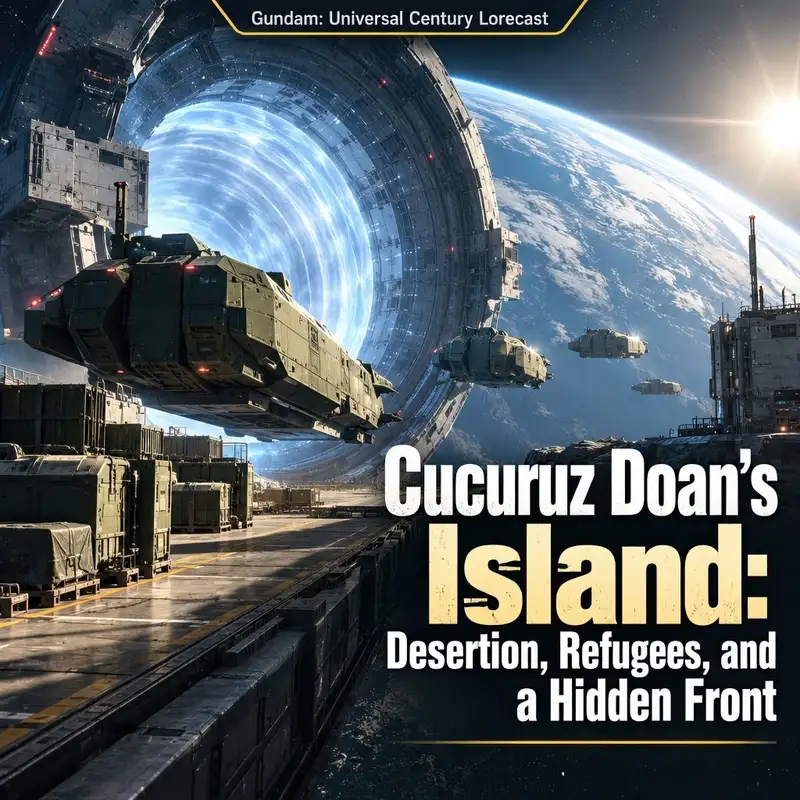
Cucuruz Doan’s Island: Desertion, Refugees, and a Hidden Front [Alternate Retelling]
White Base approaches an island that its orders describe as uninhabited and suspicious. That combination should already make a commander uneasy. An empty island in wartime is rarely empty in the ways that matter. It may hold a weather station, a fuel cache, a listening post, a wrecked transport, a concealed gun battery, or people who have fallen outside every official report. In this case, it holds all the contradictions of the One Year War in miniature. There are cultivated fields, frightened children, a deserter maintaining a damaged Zaku, and a buried Zeon installation whose value reaches far beyond the shoreline.
The film places White Base after its defense of Jaburo and before the Federation’s major offensive toward Odessa. The ship is moving toward Belfast for resupply, which means it is not wandering through a quiet rear area. It is operating within the buildup for a larger counteroffensive against Zeon’s Earth-based position. Ships need fuel, ammunition, spare parts, repairs, and new personnel before an offensive. Pilots need rest, intelligence updates, and somewhere to send damaged machines. White Base has rarely enjoyed any of those things in abundance.
Its mission to investigate the Island of No Return therefore carries a familiar military logic. The Federation cannot leave a possible Zeon remnant on a route of movement. A small enemy force can observe shipping, guide air attacks, disrupt logistics, shelter infiltrators, or preserve a weapons site for later use. Clearing such positions is rarely glamorous, but it can determine whether a major campaign begins with secure communications and reliable supply lines, or with hidden threats waiting behind the front.
The trouble is that a clearance mission often begins with an assumption. The assumption here is that the island is primarily terrain. It is a place on a map, a possible enemy location, and a problem to be solved before White Base continues toward Belfast. The Federation’s reporting does not account for a civilian settlement because it does not know one exists. It does not account for a former Zeon officer because desertion is difficult for any centralized military to track, especially when the deserter has good reasons to avoid radios, ports, and established supply networks.
Amuro Ray enters that uncertainty in the R X seventy-eight zero two Gundam. His task appears straightforward. Locate the source of the suspected activity, identify it, and neutralize it if necessary. Instead, he encounters Cucuruz Doan in a modified Zaku. The encounter matters because it immediately overturns White Base’s assumptions. There is an armed Zeon-connected presence on the island, but it is neither an ordinary garrison nor a conventional remnant force waiting for extraction.
Doan defeats Amuro in close combat and separates him from the Gundam. It is tempting to read that moment as a simple contest between machines, or as an argument that a Zaku can outperform the Federation’s most famous prototype. The film does not support either conclusion. Doan has surprise, local knowledge, familiarity with the island’s terrain, and the discipline of a veteran pilot fighting in a place he has studied for a long time. Amuro is investigating an unknown area under incomplete intelligence. Those are not equal conditions.
The terrain matters. Vegetation, slopes, cliffs, coastal approaches, and concealed structures all reduce the value of raw performance if a pilot does not know where an enemy can emerge or disappear. A powerful mobile suit still has to see, identify, and engage its opponent. The Gundam’s capabilities do not provide Amuro with a complete picture of the island. Doan’s Zaku, meanwhile, is not operating as a standard issue machine in a regular unit. It is the weapon of a man who has adapted his fighting style, maintenance habits, and defensive plan to one small piece of ground.
The immediate tactical result is serious. Amuro is missing. His Gundam is no longer under White Base control. A routine reconnaissance and clearance mission becomes a search-and-rescue problem. For Bright Noa and the White Base crew, that means more than concern for a gifted pilot. Amuro is a central part of the ship’s combat power, and the Gundam is an irreplaceable prototype whose loss would have military and political consequences. A missing pilot is also evidence that the original mission estimate was wrong.
Then Amuro wakes among the people the mission did not see. There are children on the island, roughly twenty of them, living with Doan in an improvised settlement. Their presence changes the meaning of everything that came before. The island is no longer merely a possible enemy position. It is a civilian refuge, however fragile. Any Federation attempt to clear the island by force now risks harming people whom its own intelligence had failed to identify. Any Zeon attempt to reclaim the site carries the same danger.
Cucuruz Doan is a former Zeon mobile-suit officer and the former commander of the Southern Cross Corps. He deserted, but the film does not present desertion as a clean escape from war. Doan has rejected continued service to Zeon’s military system, yet he remains surrounded by that system’s consequences. He knows how to fight. He knows how to maintain a Zaku. He understands how forces approach an objective, how soldiers search ground, and how commanders classify a site that has gone silent.
His desertion is therefore an act of refusal, but it is not disarmament. He does not throw away the Zaku and walk into the sea. He keeps it operational. He watches the approaches to the island. He drives away intruders. He hides what must be hidden. He remains willing to use violence when he believes it is necessary to protect the children. That is the film’s central moral tension. Doan rejects the war’s purpose and methods, but he cannot protect people from the war simply by declaring himself outside it.
A deserter carries more than a uniform into exile. He carries training, habits, enemies, guilt, and knowledge. Doan’s military experience is what makes the island viable in the short term. He can recognize a threat before the children can. He can repair the machine that deters armed visitors. He can make decisions under pressure. But those same skills keep him tied to the military world he rejected. His former comrades remember him. Zeon command still has an interest in his location. The Zaku that protects the island also announces that someone there can fight.
The children are not an organized insurgency, and they are not a symbolic backdrop for an adult soldier’s redemption. They are displaced survivors who have built routines because routines are necessary for survival. They work, learn, tend the settlement, help with food production, and understand that strangers may bring danger. Those responsibilities do not make them miniature soldiers. They make them children living under emergency conditions, doing the practical work that formal institutions have left undone.
Their community has food, shelter, labor, and some measure of discipline. It has someone who acts as guardian and defender. What it does not have is secure status. Neither the Federation nor Zeon has created a dependable system around them. There is no recognized local authority with the resources to protect them. There is no reliable evacuation plan. There is no visible relief organization, no permanent medical system, and no guarantee that the next armed force to arrive will distinguish a child’s home from an enemy position.
That absence matters because survival is not the same as security. A field can be cultivated, a roof can be repaired, and a meal can be shared, but none of that creates legal protection from an air attack, a mobile-suit sweep, or a commander who decides that the island’s strategic value outweighs its residents. Doan has made the settlement livable. He has not made it safe in the larger sense. The children live in a jurisdictional vacuum created by war, displacement, and the failure of both states to account for those caught between their forces.
The island’s daily life is also a logistical achievement, though a precarious one. Food has to be grown or gathered. Livestock requires care. Tools wear out. Buildings need repair. Water, medicine, clothing, and spare parts do not appear because someone wants them badly enough. The children’s labor helps sustain the settlement, but that fact should not be romanticized. A community of displaced children doing adult work is evidence of resilience. It is also evidence that adults and institutions have failed them.
Doan’s Zaku belongs in that logistical picture. It is not simply a battered relic waiting for a dramatic duel. It is a field-maintained defensive system. Its condition depends on Doan’s technical knowledge, whatever components he can preserve or adapt, and the ability to keep its failures from becoming fatal. The machine has value because it can create uncertainty for anyone approaching the island. A force that knows there is an experienced mobile-suit pilot nearby must plan differently. It may send scouts, bring more machines, use aircraft, or delay its movement until it understands the threat.
Deterrence, however, is expensive when it rests on one aging machine and one exhausted defender. Doan cannot maintain a supply chain by himself. He cannot manufacture replacement parts. He cannot provide full medical care, secure communications, or reliable transport for twenty children. His Zaku can discourage a patrol. It cannot create a humanitarian system. It can win time, and time is often the most valuable resource available to people hiding from a war. But time is not a permanent settlement.
The film makes that contradiction visible without reducing Doan to either a saint or a hypocrite. He is a man who has chosen to protect children from military violence through concealment, preparation, and the readiness to use force. That is not pacifism in its purest form. It is a defensive ethic formed under conditions where unarmed vulnerability is not a theoretical concern. Yet it also carries a danger. The refuge depends on a single armed man remaining capable, healthy, alert, and morally disciplined. No community should have to rest on such a narrow foundation.
For White Base, Amuro’s disappearance forces a rapid reassessment. Bright must consider the loss of a pilot, the loss or capture of the Gundam, the possibility of a hostile Zeon force, and the danger of acting against civilians who were not in the original estimate. Sleggar Law and the rest of the crew are drawn into a mission whose categories keep changing. It begins as possible remnant clearance. It becomes recovery. Then it becomes intelligence assessment. Finally, it becomes a confrontation with a strategic threat that neither side has fully understood.
White Base also cannot assume that its formal authority resolves the problem. The crew is a military organization, not a refugee agency. It can rescue, transport, defend, and report. It can decide not to fire into a civilian settlement. But the film does not give the ship a ready-made answer for what should happen to displaced children after the battle. That uncertainty is important. A force may be morally correct to prevent an attack, yet still lack the institutional capacity to repair the social damage that made the attack possible.
The island’s deeper military significance comes from what lies beneath it. It contains a concealed Zeon missile installation. That hidden infrastructure is the reason the Island of No Return has never truly been outside the war. The film presents the site as a strategic threat capable of supporting coercive bombardment against major Federation interests and population centers. Some descriptions of the installation emphasize nuclear-capable missiles. The exact number, yield, range, and targeting system are not securely established by the film, and they do not need to be for the strategic point to be clear.
A missile site does not need to be large enough to win a war by itself to matter. It can threaten a city, a harbor, a staging area, or a political leadership at the wrong moment. It can force an enemy to divert ships and aircraft. It can complicate an offensive by making commanders fear that their rear areas are vulnerable. Strategic coercion works by altering decisions before a weapon is launched. The possibility of attack can become a weapon in its own right.
M’Quve understands the installation in precisely those terms. His interest is not the island’s children or its farming community. It is the leverage provided by a concealed strategic asset. He seeks to use the threat of bombardment to pressure the Federation and interfere with its broader advance, including the political and military pressure around Gibraltar. The island becomes valuable because its buried infrastructure can influence events far away. Geography matters in war, but infrastructure often matters more. A remote island can become a center of gravity if it contains the means to threaten a larger campaign.
That logic is ruthless because the people living above the installation are not the intended targets, but they are still exposed to its danger. The children are endangered by the base’s existence, by Zeon’s effort to reclaim it, and by any Federation attempt to disable it. They occupy the same ground as a weapon built to threaten others. The film does not need to show a missile striking a city to establish the moral problem. The threat has already militarized the island and turned a refuge into potential collateral damage.
The installation also reveals a failure of centralized command. M’Quve knows the site has strategic value, but he does not control it in practice. Its communications have gone silent. A former subordinate has remained on the island, sabotaged or redirected its purpose, and built a civilian refuge around the very infrastructure Zeon expects to use. Headquarters possesses the plan. Doan possesses the terrain. In wartime, those are not the same thing. A command can own a base on paper while lacking any reliable understanding of its condition.
To regain control, Zeon sends the Southern Cross Corps. The unit is not an ordinary ground patrol. It is a specialized formation with a direct personal connection to Doan. Egba Atler now commands the corps that Doan once led. Selma Livens, Wald Ren, Yun Sanho, and Danan Rashica form the other principal members of this hunting force. Their mission combines several objectives that do not always reinforce one another. They must investigate the silent installation, restore Zeon control, eliminate a deserter, and preserve the unit’s own honor.
Egba’s anger toward Doan gives the operation an emotional charge that formal orders alone cannot explain. Desertion is not merely a personnel matter for a unit that once followed the man who left. It can be experienced as betrayal, abandonment, humiliation, or a challenge to the authority of those who remained. Yet the film does not make every member of Southern Cross equally simple in outlook. Some reactions to Doan carry more hesitation or curiosity. That difference matters because military cohesion is never only about uniforms and orders. It also depends on how people interpret loyalty.
The Southern Cross Corps brings customized high-mobility ground Zakus, along with a Fat Uncle transport and Luggun reconnaissance support. These assets show that the operation has planning behind it. The unit can move personnel and equipment, scout the area, and employ mobile suits designed for surface maneuver. But its support also reveals its limits. Specialized machines require transport, maintenance, communications, and intelligence. Their mobility gives the corps reach across the island. It does not give them immunity from bad information, difficult terrain, or the personal tensions embedded in their mission.
The contrast with Doan is deliberate. Southern Cross arrives as a military unit connected to a larger command structure. It has multiple pilots, specialized machines, transport, reconnaissance, and an assignment from above. Doan has one modified Zaku, a settlement to protect, local knowledge, and no secure line of resupply. The first force possesses institutional backing. The second possesses familiarity and a defensive purpose. Neither advantage is absolute. The island becomes dangerous because those strengths collide around civilians and buried weapons.
Once Southern Cross arrives, the battle cannot be understood as a series of individual duels. The central operational problem is control of the missile site. Zeon needs access to the installation and the ability to use it. Doan needs to deny that access. White Base needs to recover Amuro, protect the Gundam, determine the nature of the threat, and prevent the island’s inhabitants from being crushed between two armed forces. Every fight on the surface is shaped by that larger contest over buried infrastructure.
The island’s terrain makes indiscriminate firepower a poor solution. Vegetation can conceal movement. Cliffs and narrow approaches can restrict maneuver. Shorelines create obvious arrival routes but also vulnerable positions. Underground facilities offer cover and concealment, yet they can become traps if civilians are nearby or if a battle damages entrances, power systems, or access routes. A mobile suit is powerful, but it is not a precision instrument merely because it has a skilled pilot. The more civilians and fragile structures occupy the area, the more tactical choices carry political and moral consequences.
Amuro’s role in the final confrontation is important because he has seen the island from inside. He is no longer approaching it as an unexplained Zeon contact on a mission board. He has met the children. He has seen Doan’s settlement. He understands that the island contains both a military threat and people who have no safe distance from it. That knowledge does not make every decision easy, but it changes what responsible force requires. Identifying a target is only the beginning. A commander and pilot must also understand what else exists around it.
Doan’s knowledge is different. He knows the island’s military history and its immediate vulnerabilities. He knows that the installation cannot simply be ignored while Zeon still wants it. He knows that hiding the children is not enough if armed forces can arrive at any time. His goal is not to conquer ground or hold a formal line. It is to keep the island from being used. That is a narrower objective than winning the war, but it is also more achievable. A defender does not need to destroy every enemy force. He may only need to deny them the one thing they came to seize.
The film’s resolution turns on that denial. Doan has prevented the missile system from functioning as Zeon intended. The planned launches are redirected or neutralized rather than allowed to become strategic bombardment. In the film’s visual language, a weapon intended to impose fear is deprived of its coercive purpose. This is not a general One Year War practice, and it should not be mistaken for an easy method of disarming strategic missiles. It is the result of Doan’s unusual access to the installation, his local control, and the particular circumstances of this island.
The significance is larger than the mechanics of sabotage. M’Quve’s plan depends on the assumption that a hidden weapons site remains an obedient extension of central command. Doan proves otherwise. The site is isolated, its communications have failed, and the people physically present have changed its purpose. Strategic systems are never only launchers, warheads, and maps. They depend on technicians, guards, codes, supply, discipline, and people willing to carry out orders. Remove enough of those human links, and even an imposing weapon becomes politically useless.
Both armies have misunderstood the island. The Federation sees a possible remnant position and fails to see a civilian community. Zeon sees a strategic asset and fails to see that its former commander has built an alternative order on the ground above it. Neither mistake is trivial. Federation intelligence nearly turns a humanitarian problem into an enemy-clearance operation. Zeon’s command treats a living settlement as irrelevant because it is focused on the installation beneath it. The children are invisible to both systems until events force them into view.
The immediate tactical outcome is clear enough. Amuro survives. The Gundam is recovered. Southern Cross is defeated or broken as an assault force, and Zeon is denied the use of the installation. White Base completes a mission that has expanded far beyond its original assignment. But tactical success should not be confused with a complete solution. The island remains damaged by the war that produced its hidden base and displaced its children. The fact that the missiles do not achieve their intended purpose does not restore homes, families, or public institutions.
At campaign scale, White Base has spent time and accepted risk while moving toward a larger Federation offensive. That cost matters. Major campaigns are shaped by such interruptions. A ship en route to resupply cannot casually lose a key pilot or leave a strategic threat unresolved behind it. Yet the crew’s decision to engage the situation rather than treat it as a simple target reflects sound judgment. Operations do not occur on empty maps. A force that ignores civilians and incomplete intelligence may achieve a narrow mission result while creating a wider disaster.
At the strategic scale, Zeon loses a coercive option. The Federation avoids a potential strike or threat against vulnerable areas connected to its advance. But neither side has solved the political conditions that made the island possible. Strategic success is often measured in terms of assets denied, routes secured, and enemy plans disrupted. Those measures matter. They do not measure whether displaced children now have a durable future, whether a deserter can escape the reach of his former command, or whether the next supposedly empty place has been properly understood.
Doan’s refuge survives the immediate crisis, but it does so through contingency. It has been protected by concealment, by his skill, by the children’s discipline, by the limits of enemy intelligence, and finally by the intervention of White Base. None of those conditions can be guaranteed forever. The film leaves that uncertainty intact. A battle can end, an installation can be denied, and an assault force can be driven away. The work of resettlement, guardianship, medical care, education, and political recognition remains harder, slower, and far less dramatic.
Doan eventually leaves with White Base, while the children remain tied to the sanctuary he created. That departure is not a triumphant resolution. It is another expression of the island’s fragility. The man who made protection possible cannot remain its only foundation forever, especially once the larger war has identified the island and exposed its strategic importance. His departure acknowledges that a sanctuary built around one armed guardian cannot become a permanent answer to displacement.
That is why Cucuruz Doan’s Island is more than a story about an old Zaku fighting a Gundam. The Zaku represents the war’s residue, kept alive by repair work, memory, and necessity. The missile installation represents the war’s strategic logic, which treats remote terrain as useful so long as it can threaten someone else. The children represent the human cost that neither category can explain away. They are not terrain, not infrastructure, and not an afterthought to be dealt with once the shooting stops.
Doan’s desertion matters because it creates a moral refusal inside Zeon’s military system. He refuses to keep serving its violence, and he uses the skills he once employed for war to shelter those the war has discarded. But desertion is refuge, not escape. He can deny armies access to one island and one weapons site. He cannot make the island truly separate from the political, military, and humanitarian collapse that created its children in the first place.