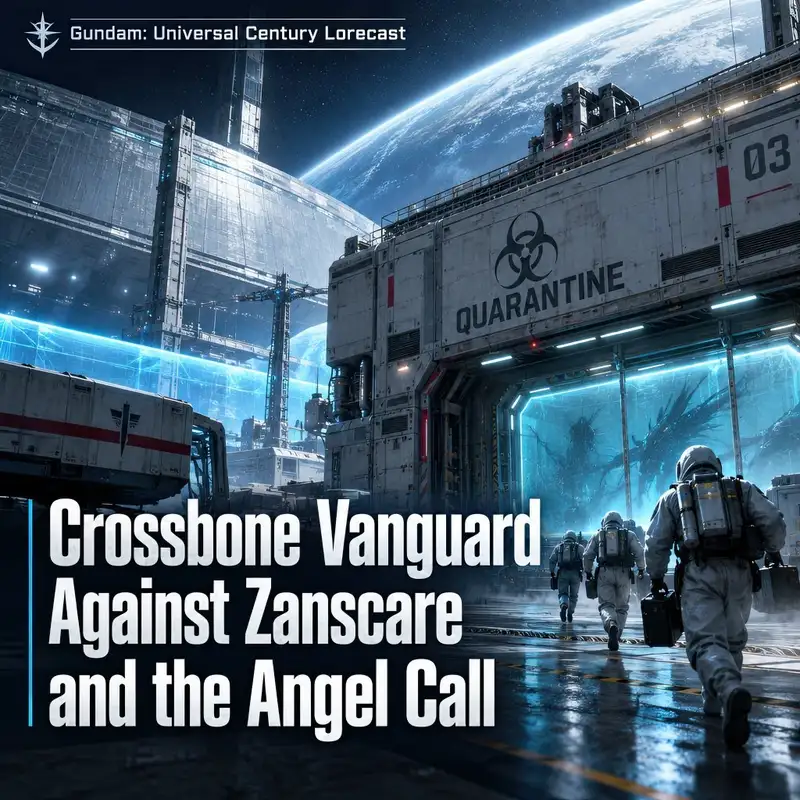
Crossbone Vanguard Against Zanscare and the Angel Call [Manga]
A warship can be dangerous after it has lost its guns, its engines, and most of its crew. In the Angel Call crisis, that was the point. A contaminated ship was no longer merely a damaged military asset waiting to be boarded, salvaged, or finished off. It was a moving quarantine breach. Destroying it could create debris. Recovering survivors could expose another vessel. Allowing it to dock could carry the threat into a colony, a hospital ship, a civilian port, or a transport lane crowded with people who had no part in the war. The question was not simply whether it could be shot down. The question was whether anyone could stop it without spreading the danger farther.
That danger was Angel Call, an extraterrestrial microorganism described in the manga as lethal to humans. The precise biology is deliberately less secure than the military consequences. The available record does not support a reliable account of its transmission cycle, incubation period, treatment, or survivability under every condition. What matters is that the people confronting it believed it could move through the infrastructure of war. Ships, mobile suits, wreckage, cargo, rescue teams, and ports all became possible routes of exposure. In the same crisis, Angel Halo offered Kizo something different but equally terrible: the ability to impose mass psychological suppression before the pathogen completed the work. One weapon could reduce resistance. The other could turn helplessness into extinction.
This is the military problem at the center of Mobile Suit Crossbone Gundam: Ghost. The manga does not present a clean battle line between two conventional armies. It presents a late Universal Century emergency in which political fragmentation, classified research, special units, mobile infrastructure, and civilian vulnerability have become inseparable. The machines matter. The pilots matter. But the decisive issue is whether a small force can understand the nature of the threat before a warlord turns an already brutal conflict into a system for killing entire populations.
For that reason, Font Bo matters. He enters the story not as a decorated pilot or the product of an elite military academy, but as a student living on Side Three. His involvement begins through information connected to Angel Halo. In another era, a civilian with an interest in machinery and networks might have remained a spectator, trading speculation and technical observations far from the battlefield. In Ghost, that boundary fails quickly. Information leaks out of official channels, and the person who notices the leak becomes vulnerable.
Font’s first importance is analytical. He sees systems as systems. He recognizes that machines have operating assumptions, that weapons have technical dependencies, and that impressive equipment can still possess weaknesses. This does not make him an effortless genius or a conventional ace waiting to be discovered. It makes him useful in a crisis where established military doctrine is poorly suited to the problem. Experienced commanders can understand fleet movement, mobile-suit combat, and political risk. Researchers can understand part of the biological danger. Font’s value lies in connecting details that specialists, constrained by their own roles and assumptions, may overlook.
His civilian perspective is also politically significant. Military organizations often treat secrecy as a source of control. Yet secrecy is never absolute. It produces fragments, rumors, suspicious gaps in public information, and technical anomalies that someone outside the system may recognize. Font’s online investigation demonstrates the weakness of compartmentalization. It also demonstrates the cost. Once he becomes associated with knowledge that powerful people want hidden, he cannot simply return to ordinary life.
Curtis Rothko rescues him and brings him into the orbit of Serpent’s Tail. Curtis is the identity used by Tobia Arronax, now blind but still active as a veteran commander and pilot. His blindness is not presented as a sentimental obstacle overcome by willpower alone. He continues to operate through specialized sensory support, hard-earned experience, and the capacity to judge people and situations under pressure. More importantly, he understands that Font is not valuable because he can be turned immediately into another expendable combatant. Font is valuable because the crisis requires people who can think across the usual boundaries between intelligence, engineering, political authority, and combat.
That need defines Serpent’s Tail. It is a Jupiter Republic special unit, not the original Crossbone Vanguard of the Cosmo Babylonia era. The distinction is not trivial. The earlier Crossbone Vanguard was tied to a different political project, a different period, and a different military organization. Ghost does not simply revive that force intact. Serpent’s Tail inherits people, memory, technology, and symbols from the broader Crossbone tradition, then adopts the Crossbone Vanguard name during the Angel Call crisis.
That name provides legitimacy, but it does not erase history. It signals continuity of purpose and experience rather than uninterrupted institutional existence. In a fragmented late Universal Century, symbols matter because regular authority has become unreliable. A familiar name can rally allies, reassure civilians, or persuade uncertain combatants that a force has a moral purpose beyond private profit. But symbols can also obscure responsibility. Calling a small special unit the Crossbone Vanguard does not give it the resources of a state, the legal authority of a formal military command, or the ability to govern a region after the fighting ends.
Serpent’s Tail operates in the difficult space between those realities. It has an official relationship with the Jupiter Republic, but it also needs the flexibility of a deniable force. Teteness Dogatie, ruler of the Jupiter Republic, has both a political interest and a responsibility in preventing Angel Call and Angel Halo from becoming instruments of mass killing. Jupiter cannot ignore the danger, especially given the manga’s connection between Jupiter-linked development and Angel Halo’s earlier purpose. Yet an open Jupiter intervention in the Earth Sphere carries diplomatic and military consequences. The Republic cannot casually commit itself to a major war far from its own centers of power.
Belle Bernadette Dogatie adds another layer of political significance. Her connection to the Jupiter Republic’s leadership and to the Crossbone legacy makes her more than a passenger in a military adventure. In a conflict shaped by contested legitimacy, personal ties can become channels of authority, suspicion, and negotiation. But they do not make the political problem disappear. The Republic can authorize action. Curtis can direct an operation. Belle can represent a connection to Jupiter’s governing order. None of them can compel every Zanscare unit, League Militaire formation, contractor, or civilian government to cooperate.
For that reason, Serpent’s Tail functions as a special unit rather than an army. It can move quickly, investigate dangerous material, and act before a conventional coalition forms. It can also be denied, isolated, and overwhelmed. Small units are useful precisely because they can operate where large institutions hesitate. Their weakness is that their success often depends on rare people, rare equipment, and a very narrow margin for error.
The most important piece of equipment in that margin is the Manzana Flor, the vessel whose name can be translated as Apple Blossom. It is an experimental Minovsky-drive ship and the mobile base of Serpent’s Tail. Its strategic value is not that it can dominate a fleet action through superior gunfire. It cannot replace a battle fleet, occupy territory, protect every civilian route, or absorb unlimited losses. Its value is mobility.
The distance between Jupiter-linked space and the Earth Sphere is not merely a line on a map. It is a strategic problem involving time, route planning, political access, fuel and support, intelligence, and the ability to arrive before a crisis changes shape. A conventional force may possess more ships and more weapons, yet still be too slow, too visible, too politically constrained, or too poorly informed to intervene at the decisive moment. The Manzana Flor gives Serpent’s Tail a way to appear where the normal response system cannot.
That kind of mobility is powerful, but it comes with cost. An experimental vessel needs skilled technicians, specialized maintenance, secure supply, and a crew able to operate under conditions for which ordinary doctrine may offer little guidance. A ship carrying rare pilots and rare machines becomes a concentrated target. If it is lost, the force does not merely lose transport capacity. It loses command space, repair facilities, communications, medical support, stores, and the ability to recover damaged mobile suits.
The Manzana Flor therefore represents a familiar late Universal Century pattern. Scarce technology allows a small force to act above its numerical weight. It also makes that force fragile. The ship’s speed and reach let Serpent’s Tail respond to Angel Call. They do not make Serpent’s Tail immune to infiltration, seizure, attrition, or political isolation. Mobility can create opportunity. It cannot create mass.
Kizo understands that distinction, even if he applies it in the service of destruction. He begins as a Zanscare lieutenant general and commander associated with the Golden Eggs special unit. He possesses access to military resources, technical formations, and the authority that comes with high rank. But he does not remain simply a Zanscare commander carrying out Zanscare policy. As the crisis develops, he breaks with the main Zanscare leadership and declares El Zanscare, converting access to state power into the foundation of his own private regime.
Kizo’s worldview is built around usefulness. In his conception, strength and utility justify survival, while weakness justifies disposal. That outlook has roots in his own history of abandonment, patronage, resentment, and elite political connections. Those experiences help explain his appetite for control. They do not excuse it. Personal injury does not transform biological warfare into a legitimate response to political failure. Kizo is dangerous because he turns grievance into doctrine and doctrine into administrative practice.
His plan is not merely to win a battle or even to defeat Zanscare’s enemies. Angel Halo offers mass psychological incapacitation. Angel Call offers lethal biological danger. Kizo’s innovation is to combine them. First, Angel Halo would reduce a population’s capacity to resist, flee, organize, or even understand what was happening. Then Angel Call could be introduced into that helpless human environment. The result would not be ordinary conquest. It would be an attempt to erase the political problem by erasing the people who might oppose him.
The scheme is monstrous, but it is not just the fantasy of an isolated madman in a cockpit. It depends on institutions. Kizo needs access to warships, mobile suits, special units, technical support, transport routes, and information channels. He benefits from the ambiguity surrounding Angel Call’s custody. He benefits from the fact that Angel Halo already exists as a strategic instrument. He benefits from the inability of damaged governments and divided militaries to agree on a response before he acts.
This is how state power becomes private rule. A commander acquires exceptional tools under one political authority, then uses those tools to create another. The transition can happen quickly when command loyalty is personal, oversight is weak, and the threat is too secret for public scrutiny. El Zanscare is not simply a new flag. It is the seizure of military capacity by a man who believes that possession of force proves the right to decide who lives.
Kizo’s most consequential weapon is not his personal mobile suit, Midas. It is his conversion of ordinary military movement into contagion logistics. A warship is supposed to carry crews, weapons, supplies, and mobile suits. A mobile suit is supposed to extend military force into contested space or terrain. Under Kizo’s plan, both become delivery platforms for Angel Call. The logistical system itself becomes the weapon.
That changes every operational calculation. In ordinary combat, a commander may seek to disable enemy ships, capture equipment, recover pilots, inspect wreckage, and exploit abandoned stores. In a contamination crisis, those sensible military habits become dangerous. Boarding parties become exposure risks. Salvage becomes a possible transmission route. Refugee traffic becomes a vulnerability. A damaged mobile suit drifting toward a civilian lane may be more threatening than an intact one that remains under observation.
The Circus unit and its Thousand Custom machines enter the story from this world of specialized warfare. Circus is not a standard Zanscare formation, and it is not a resistance group. It is a high-risk technical unit built around unusually complex custom machines and the pilots capable of operating them. In Kizo’s struggle, its members become entangled in a conflict larger than any straightforward contract, test program, or elite combat mission.
The name Thousand Custom captures the basic problem. These are not machines designed to become the common equipment of a national force. They are specialized systems, shaped around exceptional capabilities and exceptional demands. That can produce tactical advantages. It can also produce maintenance burdens, limited interoperability, unique pilot requirements, and a tendency to mistake individual excellence for institutional strength.
Midas is the clearest example. Its Midas Touch Flash System can interfere with opposing machines through their sensors, computers, and control architecture. In the right encounter, that gives Kizo a formidable local advantage. A pilot who cannot trust the response of a machine’s systems is not merely facing superior firepower. That pilot is facing a breakdown in the relationship between human judgment and mechanical action.
But the system is not magic. Its effect depends on the configuration and vulnerability of the target. It relies on technical assumptions. It can surprise an opponent, disrupt a formation, and create a temporary dominance in combat. It cannot feed a population, hold a territory, cure contamination, or make Kizo’s political project legitimate. It cannot solve the basic problem that his entire plan depends on terror and extermination rather than consent.
The same caution applies to the machines fighting against him. Ghost Gundam, X-zero Full Cloth, Death Phiz, and the other exceptional mobile suits in the crisis are mission-specific tools. They are not evidence that either side can field such capabilities across an entire war. A rare machine may decide an encounter. It may protect a ship, open a route, or expose a technical weakness. But it cannot substitute for the larger system of maintenance, intelligence, crew training, transportation, and political authority required to sustain a campaign.
That becomes painfully clear once Kizo begins using contaminated ships and machines as part of his operational method. The final struggle is not a clean fleet engagement with two formations meeting at a known point in space. It is a quarantine operation conducted under combat conditions. The Crossbone force and its allies must identify which assets are contaminated, prevent those assets from escaping toward populated routes, deny Kizo the use of Angel Halo, and maintain enough command coherence to keep fear from producing its own catastrophe.
That last task is easy to underestimate. Biological danger attacks trust as much as bodies. A crew that does not know whether another ship is safe may refuse rescue. A colony authority that receives incomplete warnings may close its ports too late or panic too early. A military unit that suspects contamination may fire on allies rather than risk contact. Every delay in verification creates pressure. Every unclear order invites improvisation. Every improvised action can create another route for the threat to spread.
This is where the presence of local and parallel League Militaire elements matters, but only within limits. Ghost overlaps the broader Zanscare War, and League Militaire forces can provide support in parts of the struggle. Yet this is not a retelling of Uso Ewin’s campaign from Victory Gundam. The Crossbone operation occupies its own manga theater, its own chain of events, and its own set of participants. The League Militaire is one part of a wider resistance to Kizo’s escalation, not a device for collapsing every Zanscare-era story into one seamless campaign map.
For civilians, the distinction between a military route and a civilian route is often less clear than commanders prefer. Colonies depend on docks, maintenance crews, cargo handling, medical facilities, food shipments, and transport schedules. Ships carry military personnel, but they also carry workers, technicians, passengers, families, and supplies. A contaminated route threatens the ordinary systems that keep people alive in space. The danger is not abstract. It reaches into airlocks, clinics, cargo bays, settlement traffic, and the crowded infrastructure of inhabited space.
The Crossbone force therefore cannot define victory as the destruction of Kizo’s mobile suits. It has to define victory as the removal of Angel Call from accessible human space. That requirement leads to the most severe solution available: sending the Manzana Flor, along with the biological threat it carries, onto a solar trajectory.
The plan is not a casual act of self-sacrifice, and it should not be treated as one. The Manzana Flor is a rare strategic asset. It represents an experimental transport capability that the Jupiter Republic cannot easily replace. It is also a home, command center, workshop, medical space, and refuge for the people aboard it. Sending it toward the Sun means accepting the destruction of a valuable ship and the possible loss of its crew because every lesser containment measure leaves too many paths for Angel Call to return.
That is the logic of irreversible disposal. In a normal military operation, commanders prefer recovery. They want to reclaim ships, preserve equipment, rescue personnel, and return assets to service. Against a threat whose full properties cannot be trusted, recovery may be the greater risk. The solar trajectory is chosen because it closes the chain of custody permanently. It denies Kizo, Zanscare, Jupiter, the Federation, and any future scavenger the chance to reclaim Angel Call for study, profit, revenge, or war.
Even that solution remains vulnerable because Kizo understands the value of the ship. He seizes the Manzana Flor before the disposal plan can be completed, restoring the crisis at the point when containment appears within reach. This is not simply a dramatic reversal. It demonstrates the central weakness of any technical solution. A containment procedure is only as secure as the people, systems, and political authority protecting it. If an enemy can capture the platform carrying the threat, the platform becomes another weapon.
The final confrontation between Font and Kizo turns on that principle of technical judgment. Font does not defeat Midas by proving that raw courage always overcomes superior machinery. He studies the Midas Touch Flash System and recognizes that its effect depends on specific technical pathways. The countermeasure comes from understanding the mechanism well enough to deny it the conditions it requires.
The details matter less than the method. Font sees that a system advertised through its overwhelming effect is still a system. It has inputs, assumptions, limits, and points of failure. Kizo treats Midas as proof that he stands above ordinary opponents. Font treats it as a machine built by people, operating through an architecture that can be analyzed. That difference is decisive.
It is also an appropriate end to Font’s development. He does become a combatant, because the crisis leaves him no safe distance from violence. But he does not become important by transforming into a conventional ace whose personal skill resolves every problem. His contribution remains intellectual and practical. He understands that machines are not merely symbols of power. They are systems embedded in other systems. If their assumptions are exposed, their power can be limited.
Kizo is defeated. Midas and Ghost Gundam are effectively lost in the struggle. The immediate tactical victory is costly, as victories in this era often are. Rare machines do not vanish without consequence. Their loss represents vanished expertise, destroyed maintenance capacity, broken supply chains, and people who cannot simply be replaced by ordering another unit from a production line.
Yet the central mission succeeds because the contaminated vessel’s trajectory continues toward the Sun. Angel Call is removed from reachable inhabited space. Kizo fails to unite Angel Halo’s psychological coercion with Angel Call’s exterminatory potential. The immediate threat to colonies, transport routes, and civilian populations is contained.
That is a real victory, but it is not a cure for the late Universal Century. At the tactical level, Font and his allies defeat Kizo and overcome the situational advantage of Midas. At the mission level, they prevent Angel Call from remaining available as a weapon. At the operational level, the Manzana Flor’s extraordinary mobility allows a small Jupiter-linked force to intervene across a dispersed and politically fractured theater. At the strategic level, Kizo fails to establish Angel Halo and Angel Call as a combined system of planetary extermination.
The political results are more ambiguous. Jupiter preserves some measure of responsibility and legitimacy by acting against a danger connected to its own technological history. But that action also exposes how much late Universal Century security depends on exceptional individuals and special units rather than durable public institutions. Zanscare’s fragmentation deepens as Kizo’s El Zanscare project reveals the danger within its own military culture. A state that empowers commanders through fear, secrecy, and ideological absolutism creates the conditions under which one of those commanders may decide that the state itself is no longer necessary.
The intelligence lesson is equally severe. The decisive failure was not simply that an enemy possessed a dangerous weapon. It was that dangerous knowledge moved through divided institutions faster than responsible authority could respond. Compartmentalization delayed coordination. Defection turned research into military leverage. Partial information made it difficult to distinguish ordinary movement from a biological attack. The people who prevented catastrophe succeeded because they assembled a clearer picture of the system than Kizo’s victims could see at first.
The industrial lesson is more restrained. Experimental ships, rare mobile suits, and advanced control systems can shape a campaign, especially when they are used by experienced people for a narrowly defined mission. But scarcity is not strength by itself. The Manzana Flor’s value made its possible loss devastating. Ghost Gundam and Midas were powerful, but neither represented a reproducible answer to the wider war. Advanced machines may create moments of decision. They do not replace legitimate command, trained institutions, resilient logistics, or political restraint.
For civilians, the outcome is both salvation and indictment. The immediate catastrophe is prevented. Colonies and transport routes are spared from a threat that could have moved through the very infrastructure on which their lives depended. But they were endangered in the first place because the political systems around them tolerated secrecy, militarized dual-use technology, and armed factions whose authority outran their accountability. The people most at risk were not the commanders who treated Angel Call as leverage. They were the crews, workers, families, patients, and colony residents who would have had the least warning and the fewest means of escape.
Serpent’s Tail succeeds because it refuses to treat Angel Call as an ordinary weapon or Kizo as an ordinary enemy commander. Curtis, Font, Belle, and their allies recognize that the crisis cannot be solved by winning a duel alone. They have to contain knowledge, deny movement, protect civilian routes, expose technical assumptions, and destroy an asset that no responsible power can safely retain.
That is what the Angel Call crisis reveals about late Universal Century warfare. Military mobility, covert research, civilian infrastructure, and political collapse had fused into one system of risk. Angel Halo could have turned fear into obedience. Angel Call could have turned obedience into extinction. Their defeat prevents that outcome, but it also exposes the deeper failure of the age: humanity had built technologies capable of moving whole populations across space while leaving its political institutions too divided, too secretive, and too compromised to keep those technologies from becoming instruments of annihilation.