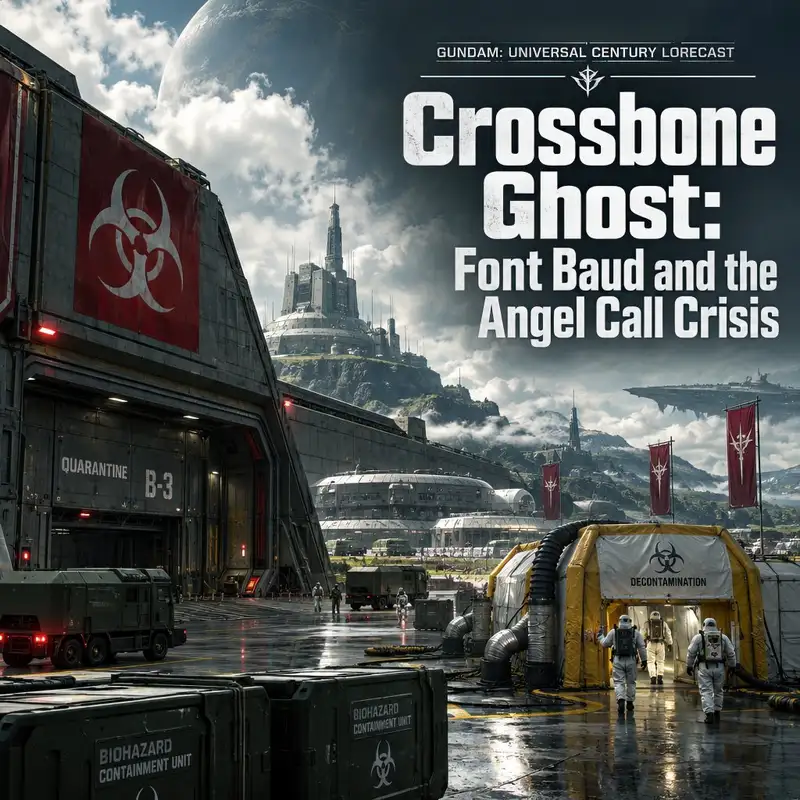
Crossbone Ghost: Font Baud and the Angel Call Crisis [Manga]
A small website disappears from Side Three’s networks. One moment, it contains a student’s notes on mobile suits and a freshly decrypted set of files connected to the Zanscare Empire’s Angel Halo plans. The next, the site is gone. Not blocked, disputed, or buried under official denials. Erased. For Font Baud, a high-school student with more curiosity than institutional protection, that deletion is the first indication that he has crossed from hobbyist research into an active intelligence crisis. The important fact is not that he published something classified. Classified data leaks constantly in fractured political systems. The important fact is that someone moved quickly enough to prove the information still mattered, and dangerous enough to prove that Font himself had become part of the problem.
Font is not introduced as a soldier, a government agent, or a celebrated Newtype. He is a young civilian who knows mobile suits, understands databases, and has developed the habits of a person who believes difficult information can be made useful if it is organized clearly enough. That is an admirable instinct in ordinary circumstances. It is also a perilous one when the material concerns a weapon program concealed across military, political, and corporate boundaries. Font decrypts information connected to Angel Halo and posts what he finds because he sees a puzzle. The organizations pursuing him see a breach. Their concern is not merely what he has revealed. It is what he may still be able to uncover, identify, or connect.
The concealed danger is Angel Call, an extraterrestrial pathogen associated in the manga’s history with an old Crossbone Vanguard transport vessel. During an earlier Jupiter conflict, that transport disappeared while carrying supplies toward the Mother Vanguard. Years later, a Jupiter Foundation research ship found the damaged vessel drifting in the Saturn region. The wreck carried more than the remains of a lost mission. Investigation identified a microorganism linked to a meteorite associated with the ship. It was not treated as an ordinary terrestrial disease, nor as a laboratory accident that could be understood through familiar medical procedures. It was something alien to the systems built to protect human life.
Angel Call is depicted as rapidly lethal. Infection causes the human body to break down in a grotesque and catastrophic fashion, reducing victims to liquefied remains. The manga does not present the organism as a weapon that can be handled casually by trained troops in sealed uniforms. It is a contamination hazard whose effects threaten every enclosed environment through which it might pass. A ship’s cabin, a mobile-suit cockpit, a laboratory, a transport container, a colony docking port, and a medical ward all become possible points of failure. The pathogen is dangerous because it kills. It is strategically terrifying because human civilization in the Earth Sphere depends upon enclosed, interdependent habitats where contamination can travel faster than authority.
The distinction matters. A conventional strategic weapon can be secured, maintained, aimed, and withheld. Its custodians may be reckless, brutal, or criminal, but they can at least imagine a chain of command and a threshold for use. Angel Call defeats that logic. Possession does not equal control. A faction that acquires the pathogen must store it, transport it, study it, defend it, and prevent accidental exposure among its own personnel. It cannot easily threaten an enemy without also threatening its crews, its scientists, its supply routes, and the civilian populations living near its facilities. The weapon has no stable rear area. It turns the owner’s own infrastructure into part of the target set.
In an open battlefield, soldiers can retreat, disperse, or abandon contaminated ground. In a colony or spacecraft, such options are much narrower. Air circulation, water reclamation, medical care, docking procedures, cargo transfer, and civilian traffic create a web of dependencies. The very systems that keep large populations alive in space can make biological containment more difficult. A colony cylinder is not an empty target marker. It is a pressurized city, an agricultural system, a transport network, and a political community. An outbreak would not remain a military issue for long. It would become a crisis of life support, evacuation, public trust, and panic.
For that reason, Angel Call cannot be understood as just another prohibited weapon in a long history of Universal Century atrocities. The Earth Sphere has already known colony gassing, nuclear attacks, mass bombardment, forced displacement, and experiments conducted on vulnerable people in the name of military advantage. Angel Call belongs to that landscape of institutional cruelty, but it introduces another problem. Its users cannot reliably confine its consequences to a designated enemy. It is less a sword than a fire in a sealed habitat. The faction that lights it may discover that the doors, ventilation systems, and escape routes all lead back to its own people.
The first people to reach Font are not representatives of a stable public authority. They are Curtis Rothko and Belle. Curtis is blind, a Jupiter operative, and the practical field leader of Serpiente Tacon. His blindness is not treated as evidence that he is helpless, nor as a sentimental obstacle to be overcome by courage alone. He works through specialized systems, training, experience, and the disciplined awareness of a professional who understands that information arrives through more than one channel. He recognizes Font’s value quickly. Font may not know the entire Angel Call story, but he has demonstrated that he can penetrate protected systems and understand information that other people have failed to secure.
Belle accompanies Curtis, and her presence changes the human texture of the operation. She is not merely a mascot placed beside hardened operatives to make them seem gentler. Her perceptions and her importance to the unfolding crisis are real, though the manga does not reduce them to a simple, fully explained system of Newtype ability. In a setting crowded with laboratories that seek to classify exceptional people and armies that want to turn them into assets, Belle’s role carries a warning. Not every human capacity should be treated as a technical resource, and not every child caught in a military operation can be understood through a personnel file.
Curtis offers Font protection in exchange for his help. It is not an entirely free choice. Once Font’s website has been erased and armed pursuers are moving, the distinction between recruitment and rescue becomes uncomfortable. Font is extracted from Side Three aboard the Jupiter Foundation vessel Manzana Flor. In a few hurried movements, he changes status. He is no longer a student following a strange data trail. He is a protected intelligence asset, carried by an organization with its own agenda, guarded because of what he knows, and endangered because others have begun to calculate his value.
The pursuit makes clear that the crisis has already passed beyond Zanscare’s ability to conceal it. The Circus, also rendered as Thoucus in some discussion of the manga, enters the contest as a specialized combat and mercenary force. Its people are not ordinary line troops carrying out a simple imperial order. They are operators working in the space between state policy, private ambition, and strategic profiteering. Jack Friday and the mobile armor Desphys demonstrate the kind of threat such formations can pose. A small number of highly capable combatants can have enormous operational effect when the object of the campaign is not territorial conquest, but the seizure, transfer, or destruction of a single strategic asset.
The market value of Angel Call rises as knowledge of it spreads. That phrase, market value, is important. A biological hazard does not become less dangerous because someone describes it in commercial language. It becomes more dangerous. Once the pathogen is treated as an asset, every secretive actor can imagine a buyer, a patron, a hostage negotiation, a research contract, or a political bargain. This is proliferation in its most unstable form. The issue is no longer whether one government possesses a terrible weapon. The issue is whether several weakly connected organizations can pursue that weapon at once, each convinced that the others must not get there first.
The competing actors do not form two clean sides. Zanscare elements pursue their own objectives, but Vice Admiral Kizo and the Golden Eggs operate as a distinct power center whose interests cannot simply be collapsed into those of central Zanscare authority. The Circus seeks advantage through its own specialized means. Curtis and Serpiente Tacon serve the Jupiter Foundation, though their mission moves beyond the ordinary boundaries of Jupiter Republic authorization. Font, Belle, crews, technicians, and local civilians are caught between organizations that describe Angel Call in terms of security, research, deterrence, or profit, while all of them face the same basic fact. None has demonstrated a safe way to possess it.
The Jupiter Foundation recognizes that ordinary procedures cannot contain the Angel Call problem. Tetenith Dogatie concludes that waiting for full Jupiter Republic authorization would leave the field open to Zanscare factions, mercenary forces, and anyone else willing to gamble with an extraterrestrial pathogen. Her answer is to authorize Serpiente Tacon to act independently and to revive the name Crossbone Vanguard. The decision has military logic. A flexible, deniable force can move more quickly than a government that must coordinate across political boundaries. It also has political cost. Emergency organizations often become powerful precisely because normal institutions cannot respond in time.
The revived Crossbone Vanguard is not simply the same institution that carried that name in earlier conflicts. Names survive because they offer legitimacy, memory, and a ready-made operational identity. But an old name does not automatically reproduce an old command structure, political purpose, or social base. In Ghost, the Crossbone Vanguard functions as an improvised operational instrument under Jupiter Foundation sponsorship. It is a force assembled for a specific emergency, not a restored state. That makes it adaptable. It also leaves its authority blurred. Who supervises it? Who sets its limits? Who bears responsibility if it destroys a facility, compromises a neutral area, or chooses civilian risk over strategic delay?
Those questions cannot be dismissed because the mission is urgent. In fact, urgency makes them more important. Angel Call creates a search-and-denial campaign. The objective is not to occupy territory, capture a capital, or force a conventional surrender. It is to identify where the pathogen is, prevent its transfer, deny it to rival actors, and eventually eliminate it. Such missions are exceptionally difficult because success often looks like nothing happening. A shipment does not arrive. A laboratory never receives its sample. A buyer is denied access. A contaminated site is destroyed before a population understands how close it came to disaster. The public may never know the scale of the danger, while the people conducting the operation may never receive clear legal or political validation.
The campaign moves through lunar, terrestrial, and space-based theaters, including a Jaburo-related phase. These locations are not merely a parade of familiar Universal Century names. Each is valuable because Angel Call transforms ordinary infrastructure into strategic terrain. A lunar facility can become a research site, a rendezvous point, or a transfer station. An Earth installation can offer access to industrial resources, transport networks, and hidden storage. A colony route can become a corridor for evacuation, interception, or smuggling. Jaburo matters not only because of its historic reputation, but because any secure military location may attract actors seeking protection, access, or plausible deniability.
The operational problem is therefore one of movement and denial. Whoever controls the next docking point may control the next intelligence lead. Whoever reaches a damaged vessel first may gain records, samples, or survivors. Whoever protects a technician may gain access to a containment system that another faction cannot reproduce. Mobile-suit engagements occur throughout this campaign, but they are not the campaign’s true objective. A duel may secure an extraction. An interception may prevent a transfer. A damaged enemy machine may preserve evidence. An escort operation may keep a civilian ship from becoming a hostage platform. The combat matters because of what it permits or prevents beyond the battlefield.
Font becomes central to this struggle because the campaign cannot be won through firepower alone. He understands systems. He can move through data, connect technical fragments, interpret machine behavior, and improvise when formal procedures fail. Those skills are not glamorous in the traditional ace-pilot sense, but they are precisely what an intelligence-driven containment mission requires. In a conventional battle, a commander may want the fastest pilot, the strongest formation, or the heaviest firepower. In the Angel Call crisis, the force that understands what it is looking at gains an advantage that cannot be measured by armor thickness or reactor output.
Over time, Font’s relationship with the Phantom places him more directly inside the fighting. The Phantom is not a standard machine representative of ordinary late Universal Century military capability. Its systems and later transformation into the Ghost Gundam emerge from exceptional circumstances, specialized technology, and the severe requirements of the crisis. Font does not become important because a remarkable mobile suit grants him effortless superiority. He becomes important because he is one of the few people able to understand, adapt to, and employ complicated systems while the situation changes around him. That is a different kind of combat effectiveness, and it comes with a different kind of burden.
The Ghost Gundam should not be read as evidence that every late-era force possesses the same capabilities. Like many extraordinary machines in the Universal Century, it is an exceptional solution sustained by unusual resources, technical knowledge, and a narrow operational context. Such machines can influence an event. They do not automatically establish a fleet doctrine or a reproducible industrial program. A force cannot build its long-term strategy around a weapon that only a few people can maintain, understand, or operate safely. The Ghost matters because the Angel Call crisis is itself exceptional. It is a tool shaped by an emergency, not a template for ordinary war.
Curtis’s own methods reinforce that point. His auditory sensor interface allows a blind operative to function in mobile-suit combat through a specialized relationship between equipment, training, and perception. But adaptation is not invulnerability. Unfamiliar machines, changing conditions, and technological surprise can still disrupt even a highly developed method of situational awareness. The manga’s combat systems matter most when they reveal this relationship between human limits and technical adaptation. Equipment can compensate for a vulnerability. It cannot abolish risk, uncertainty, fatigue, or the possibility that the enemy has built something the user was never trained to interpret.
Font’s technical gifts create another danger. A young person who can see systems clearly may begin to trust calculation more than judgment. The Angel Call crisis presents choices that are brutally easy to express in abstract terms. Save this ship or contain that site. Preserve these personnel or deny the enemy a sample. Accept a smaller loss now or risk a larger catastrophe later. Such calculations are part of command. A responsible commander cannot avoid them. But they become morally dangerous when the people represented by the numbers disappear from view.
Font enters a state of overextended rationality, a kind of runaway calculation in which sacrifice begins to look like an acceptable variable so long as the strategic outcome appears sound. This is not merely a moment of personal instability. It is the logic of Angel Call reflected back upon the people trying to stop it. The pathogen reduces human beings to biological material. A cold operational mindset can reduce them to expendable inputs. Both forms of thinking treat lives as things to be managed after the real objective has been chosen. The crisis tests whether Font can prevent catastrophe without adopting the same dehumanization that made the catastrophe possible.
His withdrawal with Belle and his encounter with Seabook Arno, living under an assumed civilian identity, matter because they interrupt that process. This is not a cameo inserted merely to celebrate old connections in the Crossbone manga line. Seabook’s importance in this moment is practical and ethical. He represents the accumulated knowledge of someone who has survived earlier conflicts, carried responsibility, and learned that technical ability does not excuse a failure to recognize the people affected by one’s decisions. Font needs more than better information. He needs a framework for deciding what information is for.
The correction is not sentimental. It does not mean that every life can be saved, that hard choices vanish, or that an operation against Angel Call can proceed without danger. It means that command must not become an exercise in declaring certain people already lost because they complicate the plan. A military organization that abandons that principle may still achieve an immediate objective, but it will reproduce the political and moral conditions that generated the threat in the first place. Font’s recovery is therefore part of the operational story. It changes how he understands the mission, his allies, and the meaning of success.
That change becomes urgent when Zanscare turns toward an extreme answer. As containment becomes more difficult, the temptation is to destroy the contaminated area by overwhelming force, including nuclear delivery. On a tactical map, this can appear straightforward. If the pathogen cannot be captured safely, incinerate it. If the site cannot be secured, erase the site. Yet a nuclear strike against a biological hazard in a contested environment is not a clean solution. It introduces questions of dispersal, incomplete intelligence, collateral damage, infrastructure destruction, political escalation, and the fate of anyone still operating near the target.
The nuclear option is attractive because it seems to restore certainty. It replaces difficult containment with a single irreversible act. But certainty is often an illusion produced by distance. A commander may know that a weapon can generate immense heat and destruction. That does not mean the commander knows exactly what will happen to every contaminated material, every shelter, every transport route, or every civilian caught within the affected area. The fact that Angel Call must be destroyed does not automatically validate every means of destruction. A weapon powerful enough to eliminate the threat may also erase the evidence, kill the people attempting to contain it, and spread panic across already fragile political systems.
Font sorties to prevent the nuclear attack, and the Phantom undergoes its decisive transformation into the Ghost Gundam during this phase of the crisis. The transformation has dramatic value, but its historical meaning lies in the problem it addresses. The operation needs speed, resilience, specialized capability, and a pilot who can make decisions in a rapidly collapsing situation. Font is not simply defending a target because it is important to him personally. He is preventing a solution that may destroy Angel Call at unacceptable human and political cost, while preserving enough operational space to attempt a more controlled incineration.
The destruction problem remains severe. Angel Call must be subjected to conditions that prevent its survival, but the operation must also avoid accidental transfer, fragmentation, and exploitation by factions trying to seize a last advantage. This is why the final phase is not a conventional victory parade. The campaign has become a hazardous destruction mission conducted under fire. The people involved must manage hostile mobile suits, unreliable intelligence, damaged equipment, competing chains of command, and the possibility that any delay could permit the pathogen to move again. The weapon is not defeated when an enemy formation retreats. It is defeated only when the possibility of its use has been eliminated.
Vice Admiral Kizo’s Midas-led formation turns that final phase into a contest over control of the destruction mission itself. Midas possesses a disabling optical or flash-based system capable of immobilizing or disrupting opposing mobile suits. The importance of such a system is not that it makes Midas universally stronger than every opponent. Its importance is situational. During a time-sensitive operation, a localized disruption of sensors, movement, or coordination can be enough to break a formation. Machines that cannot move or see properly become obstacles. Pilots who lose their bearings become vulnerable. An escort mission can fail in moments if the force protecting the objective loses the ability to act together.
The countermeasures are therefore collective. Specialized sensors, adaptation, communication, and coordinated attacks allow Font’s side to preserve enough capacity to continue. This is one of the most useful military lessons in the crisis. Exceptional machines matter, but they do not operate alone. Somebody must identify the threat. Somebody must maintain the equipment. Somebody must cover a damaged ally. Somebody must keep the destruction mission moving while combat formations try to impose their own priorities. When allies are wounded and systems begin to fail, the difference between heroism and operational competence becomes very small. Both require people who understand that the mission is larger than their own survival or reputation.
Kizo’s forces and the remaining Circus elements show why Angel Call has become impossible to stabilize as a bargaining chip. Even at the point when destruction is clearly necessary, factions continue to compete for control, revenge, advantage, or influence over the outcome. Their behavior is not irrational in the narrow sense. Each knows that whoever controls the final operation may control the evidence, the political narrative, and the surviving technology. But the combined effect is strategically irrational. Every attempt to gain a private advantage prolongs the danger to everyone. The pathogen has turned competition itself into a delivery system for catastrophe.
Font’s role in the final struggle is important precisely because he has learned not to treat the other people involved as disposable pieces. He must make tactical choices. He must fight. He must accept that no plan survives intact once hostile forces and uncertain systems collide. But he no longer confuses efficiency with responsibility. That distinction is what separates a destruction mission from an atrocity. The objective is not to prove that one faction deserves Angel Call more than another. It is to ensure that no faction can use it, study it into a new weapon, or threaten civilians with its existence.
The manga resolves the immediate crisis with the destruction of Angel Call. The pathogen is denied to the competing organizations that sought to possess it. Hostile formations are defeated or neutralized sufficiently for the operation to be completed. At the tactical level, this is a victory achieved through hard fighting, technical adaptation, and the willingness of damaged forces to continue. At the operational level, it is a successful denial campaign. The organism is not transferred into a stable arsenal, a private laboratory, or a coercive political program. The campaign prevents the threat from becoming a permanent feature of the late Universal Century balance of power.
At the strategic level, the result is more limited, and more meaningful. No government, faction, corporation, or mercenary formation gains a controllable biological deterrent. That matters because Angel Call could never have been a stable deterrent in the first place. It offered the appearance of decisive power while making its owner vulnerable to the same destruction threatened against others. Its elimination prevents a new spiral of secret research, countermeasures, blackmail, and preemptive violence. It removes one possible instrument of mass killing from a political order already too willing to treat civilian populations as leverage.
Font Baud’s achievement is not that he becomes an invincible pilot or that the Ghost Gundam solves a problem no other force could touch. His achievement is that he learns what the crisis demands of anyone entrusted with power. A weapon system cannot be judged only by whether it works. It must be judged by whether any human institution can control its consequences, protect the people exposed to it, and remain accountable for the choices made in its name. Angel Call fails that test completely. Font survives the crisis because he learns not merely how to fight for control of a terrible weapon, but why no one should be allowed to control it at all.