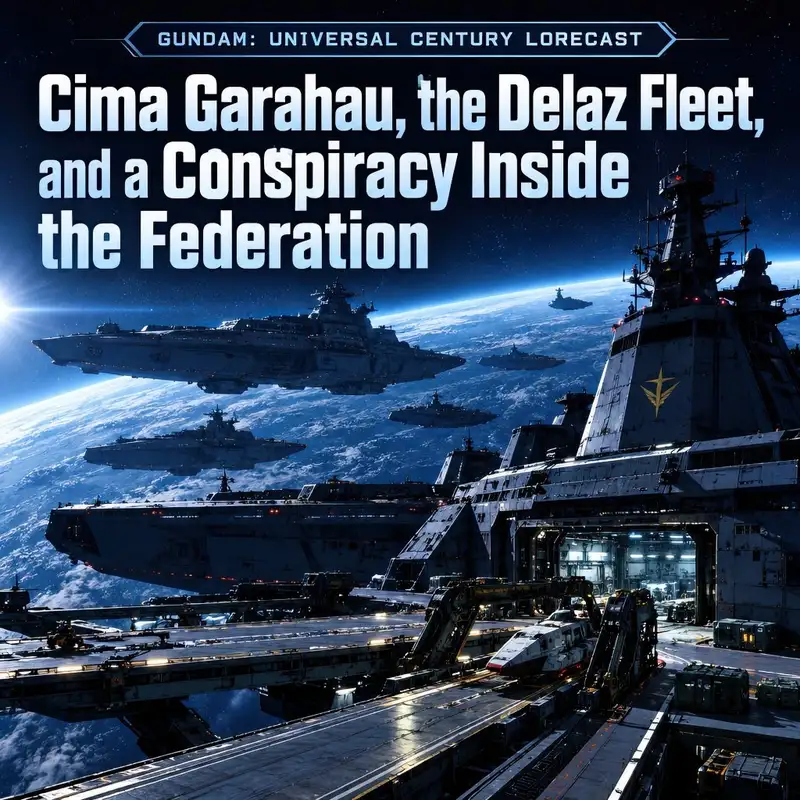
Cima Garahau, the Delaz Fleet, and a Conspiracy Inside the Federation
The Birmingham appeared to be under attack. To the officers aboard the Albion, the picture was simple enough. A senior Federation flagship had entered a suspicious encounter with ships commanded by Cima Garahau, a former Zeon officer now associated with a dangerous remnant force. In a war shaped by Minovsky interference, incomplete sensor data, and short decision windows, waiting for perfect confirmation could mean watching a friendly command ship die. Albion launched its mobile suits and moved to intervene.
Tactically, that decision was reasonable. Strategically, it was disastrous. The Birmingham was not simply caught in an engagement. Admiral Green Wyatt had arranged covert contact with Cima. The Federation officer and the Zeon remnant commander were conducting a meeting neither side could acknowledge openly. Albion did not know that. Its crew had been pursuing Anavel Gato and the stolen Gundam GP02A through an increasingly confused campaign. They had already learned that higher headquarters was withholding information, redirecting priorities, and treating their mission as an inconvenience to more senior political concerns. When they saw Cima’s ships around the Birmingham, they interpreted the scene through the information available to them.
The fighting interrupted the contact. South Burning recovered documents connected to Operation Stardust, proof that the Delaz Fleet was preparing something far larger than an isolated raid or a theft of experimental equipment. But the discovery came at a cost. Burning was killed after his damaged GM Custom exploded, and whatever intelligence arrangement had existed between Wyatt and Cima was shattered in the chaos. The Albion had exposed a conspiracy, but it had also damaged one of the few channels through which the Federation might have understood it.
That incident captures the central problem of the Delaz Conflict. The Federation possessed fleets, shipyards, industrial capacity, political legitimacy, and the resources of Earth itself. The Delaz Fleet possessed none of those advantages. Yet the remnant force repeatedly seized the initiative because it understood its own plan, while the Federation’s institutions were divided by secrecy, rivalry, and fear of political embarrassment. Cima Garahau stood in the middle of that divide. She was useful to every faction, trusted by none, and ultimately protected by no one.
It is tempting to describe the Delaz Conflict as one vast hidden plot. The OVA record does not support that conclusion. It shows something more plausible, and in some ways more troubling. It shows several conspiracies operating at once, each with its own objective, and none fully controlled by the others.
The first was Cima Garahau’s personal bargain. Cima wanted survival. She wanted security for herself and for the personnel who had remained with her after the One Year War. Her position was precarious from the beginning. She commanded ships, experienced crews, and mobile suits, but those assets did not give her a state, a legal status, or a reliable source of resupply. She could serve Delaz, bargain with Federation officers, conduct piracy, acquire equipment through unofficial channels, and still remain one defeat away from becoming expendable. Her dealings with the Federation were an attempt to convert military usefulness into political protection.
The second conspiracy was Operation Stardust itself. Aiguille Delaz and his followers organized a genuine remnant offensive. They stole the nuclear-equipped Gundam GP02A, targeted the Federation fleet at Konpei Island, seized a colony, and drove it toward Earth. Their purpose was not simply revenge. Delaz wanted to demonstrate that Zeon’s defeat had not ended the political struggle over space. He intended to humiliate the Federation, revive Zeon sentiment, and prove that a smaller force with ideological discipline could still strike at the center of Earth Sphere power.
The third conspiracy was inside the Federation. Senior officers and political brokers maneuvered around the crisis, withheld information, protected their own authority, and later used the disaster to reshape the Federation’s security system. That does not prove they invented Operation Stardust. The OVA does not establish that Green Wyatt, Gene Coliny, Jamitov Hymem, or any other Federation figure arranged Gato’s theft of the GP02A or deliberately allowed the nuclear strike to happen. It does establish covert contact, compartmentalized intelligence, institutional rivalry, and a political response that rewarded hardliners after the disaster.
The distinction is operationally important. A state need not create an attack in order to exploit it. It need only fail to prevent the attack, conceal the reasons for that failure, and then present the resulting fear as evidence that its preferred solution was necessary all along.
Cima was valuable because she commanded one of the few organized forces available to Delaz outside his immediate ideological circle. She had been a Zeon lieutenant colonel during the One Year War, and by Universal Century eighty-three she led the formation commonly called the Cima Fleet from the Lily Marlene. It was an experienced naval and mobile-suit force, hardened by defeat and sustained in the unstable space between demobilization, piracy, remnant politics, and outright survival.
That experience was not easily replaced. Delaz could recruit loyalists, appeal to resentment, and draw strength from the memory of Zeon’s wartime cause. What he could not easily manufacture was trained personnel, operating ships, commanders accustomed to independent action, and crews who could function without a secure industrial base behind them. A remnant force survives by keeping machinery operational, finding ammunition and propellant, maintaining hulls, feeding crews, and moving through ports where official recognition is absent. It survives through contacts, secrecy, intimidation, and opportunism. Cima’s fleet brought those capabilities.
But Cima’s value was inseparable from the reason she was distrusted. She was practical. Delaz understood that she had not joined his cause out of pure ideological loyalty. Gato distrusted her openly, and with reason. Cima’s loyalty was always conditional because her survival depended on preserving options. She could not afford to stake the future of her force entirely on Delaz’s vision of Zeon revival. Delaz needed her ships, but no commander likes depending on a subordinate who is already negotiating an exit.
This made Cima’s position less secure, not more. A conventional military officer may gain protection through a clear chain of command, legal status, and institutional procedure. Cima had none of those safeguards. Her authority rested on personal control over a force that had to remain useful enough to be courted, but never threatening enough to be treated as an equal. Delaz regarded her as a necessary asset. Federation officers regarded her as a possible intelligence source. Her own crews regarded her as their commander and provider. Those relationships overlapped, but they did not create a durable political home.
Cima also had access to equipment and channels beyond ordinary remnant improvisation. Her acquisition of the Gerbera Tetra through an unofficial transaction demonstrates that postwar military power was not neatly divided between Federation arsenals and Zeon remnants. Contractors, intermediaries, unofficial brokers, and hidden supply routes all mattered. Yet access to a high-performance mobile suit was not the same thing as security. A machine can improve a commander’s bargaining position. It cannot guarantee that an admiral, a general, or an ideologue will keep a promise when the strategic situation changes.
The Delaz Fleet’s operation depended on such unstable relationships because it was not a government with territory, population, taxes, and a sustainable military economy. It was a Zeon remnant force attempting to create political effects through concentrated acts of violence. Its strategic problem was straightforward. It could not defeat the Earth Federation in a prolonged conventional war. It could not match Federation production, replace major losses indefinitely, or hold Earth against the Federation’s larger resources. So it needed an operation that would make numerical weakness irrelevant for a decisive moment.
Cima understood better than Delaz and Gato that a remnant operation built around spectacle could consume the people carrying it out. Delaz saw Operation Stardust as a demonstration of historical will. Gato saw it as a mission of loyalty and honor. Cima saw its practical danger. Every phase depended on irreplaceable assets. The GP02A had to be stolen, maintained, armed, and delivered. Gato had to remain alive and capable. Delaz had to preserve command unity. Axis support had to remain available. The colony had to be captured and controlled. Cima’s fleet had to cooperate despite its commander’s uncertain loyalty. A force built on so many narrow points of failure could produce a dramatic blow. It could not absorb much uncertainty.
That was why Cima sought contact with the Federation. Her meeting with Admiral Green Wyatt was not an act of sudden loyalty to Earth. It was a bargaining effort between enemies who each hoped to use the other without becoming responsible for the other. Cima possessed information. She had access to Delaz’s operations, understood the disposition of remnant forces, and knew enough about the coming attack to make herself valuable. Wyatt, as a senior Federation commander, represented access to the political and military protection she lacked.
The OVA confirms that their contact was covert. It confirms that the Birmingham met Cima’s force in secret. It confirms that Albion’s intervention disrupted the encounter. It does not provide a complete transcript of the bargain. We do not know every promise made, every condition demanded, or every limit Wyatt placed on the arrangement. We should resist the urge to fill that silence with a neat intelligence thriller. Cima may have expected amnesty, protection, payment, recognition, or merely a chance to avoid being destroyed with Delaz. Wyatt may have expected warning, operational details, access to remnant networks, or a controlled defection that would damage Delaz’s force. The evidence establishes contact and mutual utility. It does not establish a fully documented treaty.
Nor does it establish that Wyatt commanded the Federation’s entire response. He was a senior officer, but the Federation was not a single mind. Albion had its own operational chain. Vice Admiral John Cowen was associated with the Gundam Development Project and with the mission pursuing Gato. Political actors above and around military commands had their own interests. Information could be classified, shared selectively, delayed, or interpreted through different institutional agendas. An intelligence source who believes she is dealing with the Federation may in fact be dealing with one faction of the Federation, one admiral’s network, or one temporary arrangement that cannot survive a change in political conditions.
That was Cima’s fundamental weakness. She sought safety by becoming useful, but usefulness is not the same as protection. A source is valuable only while the information flows. A deniable ally is valuable only while deniability is convenient. Once the crisis changes, both can become liabilities. Cima had leverage, but she did not have a constituency that would defend her openly.
The Albion’s intervention exposed the danger of compartmentalization. The ship’s crew did not disrupt Wyatt’s meeting because they were reckless or politically naïve. They acted as professional officers and pilots confronting an apparent threat to a Federation flagship. Their problem was that no one had given them the context required to distinguish an enemy encounter from a clandestine intelligence exchange. In a Minovsky environment, where long-range communication and surveillance are degraded, local commanders must make decisions with fragmentary information. That gives initiative to officers on the scene. It also makes the larger system dependent on clear intent, timely intelligence, and command relationships that do not contradict one another.
The Federation had the material strength to defeat the Delaz Fleet. What it lacked was unity of purpose. Its postwar institutions carried the habits of a vast wartime bureaucracy into a period when political leaders wanted normality, military officers wanted resources, contractors wanted programs, and rival factions wanted control of the story the public would hear. The Gundam Development Project sat directly inside those tensions.
The project had produced advanced machines for the Federation, including the GP02A. It represented technical ambition, military modernization, and a readiness to continue developing powerful weapons after the One Year War. Anaheim Electronics served as a contractor and technical partner, but the company should not be mistaken for the hidden author of every decision. Contractors can shape military options through their expertise, facilities, and political connections. They cannot remove responsibility from the officers and civilian authorities who authorize programs, deploy weapons, and decide what to conceal after failure.
Vice Admiral Cowen stood within one institutional camp. He was connected to the project and to Albion’s pursuit of Gato. That association made him vulnerable once the stolen GP02A became a political embarrassment. The Federation could not easily admit that it had developed a nuclear-capable mobile suit, lost it to a Zeon remnant, failed to recover it, and then suffered a nuclear attack on a major fleet concentration. A government facing that record can conduct an honest investigation. It can identify procurement failures, intelligence failures, command failures, and political responsibility. Or it can suppress the record, isolate blame, and allow more powerful figures to redefine the crisis.
Gene Coliny and Jamitov Hymem represent the latter political current. The OVA presents them as senior power brokers involved in the post-conflict reorganization of Federation authority. Their maneuvering against Cowen demonstrates that the response to Stardust was also a struggle over who would control the Federation’s security apparatus. The available evidence does not prove that they created the crisis. It does show that they were prepared to benefit from it.
That is an old pattern in civil-military politics. A security failure creates a demand for explanation. Leaders can explain it as the product of narrow mistakes that require reform, oversight, and accountability. Or they can describe it as proof that the nation faces an existential threat requiring more force, fewer restraints, and a new elite institution. The second explanation often has great appeal because it is emotionally simple. It identifies danger, offers a visible remedy, and avoids examining the officials who allowed the earlier system to fail.
The colony phase of Operation Stardust made the human cost even clearer. Delaz did not seize a neutral chunk of industrial material. He seized a colony. A space colony is an inhabited political community, a pressure vessel, a transportation hub, an economic system, and a life-support environment built to sustain people far from Earth. Its residents depend on air, water, power, gravity systems, agricultural production, maintenance crews, and an intricate web of ordinary work that war planners often overlook until they destroy it.
Turning such a habitat into a weapon required more than rhetoric. It required ships to capture and control it, personnel to manage its movement, technical knowledge to alter its course, and enough security to prevent interference from its inhabitants or outside defenders. It required the Delaz Fleet to maintain cohesion while the Federation mobilized against it. The operation was massive precisely because the colony was not an inert projectile. Its scale made it militarily useful, but it also made the act morally indefensible.
The Delaz Fleet used confusion as part of the weapon. Federation commanders initially misread the colony’s intended target and therefore misjudged the response window. This was not simply a matter of one bad map reading. A moving colony, orbital routes, possible targets, interception opportunities, and the risk of fragments all created a complex operational problem. The Federation had to determine where the colony was heading, assemble forces, deploy an interception system, and act before the object entered a trajectory that could no longer be stopped. Delaz’s operation exploited the fact that large institutions often respond slowly when the enemy’s intent is uncertain.
The colony’s eventual impact in North America was aimed at agricultural infrastructure. That target reveals the operation’s logic. Delaz did not need to destroy the Federation government in one blow. He needed to create a crisis with long-term civilian consequences. Damage to food production threatens more than crops. It affects distribution, prices, migration, public confidence, and the capacity of a government to claim it can protect the population. Military planners may describe such a strike in strategic language. Families experience it through shortages, displacement, uncertainty, and the realization that distant warfare has entered the systems that keep ordinary life possible.
Cima’s relationship with the colony operation became increasingly untenable. She had joined an operation whose scale made every participant hostage to Delaz’s political vision. A commander can preserve autonomy while conducting raids, moving contraband, or bargaining with rival officers. It is much harder to preserve autonomy when attached to an operation that has seized an entire colony and turned it toward Earth. At that point, the military force is no longer simply a remnant fleet. It is the mechanism of a mass-casualty operation. Every ship supporting it becomes part of the crime, and every subordinate becomes vulnerable to being sacrificed for the mission’s symbolism.
Cima had wanted leverage. Delaz’s plan gave her less and less room to use it. The more successful Stardust became, the more Gato and Delaz could treat survival as secondary to ideological completion. Cima’s practical instincts, once an advantage, now marked her as an obstacle.
Her break with Delaz near the climax should not be mistaken for a clean moral transformation. Cima did not suddenly become a Federation loyalist, and her opposition to Delaz did not erase her participation in the operation up to that point. She had cooperated with the Delaz Fleet because she believed it might provide a path to survival. She had also pursued secret contact with Federation officers because she understood that Delaz’s cause might destroy her. When those options collided, she chose the course that might still leave her force alive.
That choice was both rational and desperate. Cima moved against Delaz and attempted to seize control of the situation before the operation could proceed entirely on his terms. Her action exposed the fault line inside the remnant force. Delaz had accepted a commander he could use but not trust. Cima had served a leader whose ideological ambitions threatened to consume her fleet. Gato, by contrast, remained committed to Delaz’s mission with a clarity that left little room for negotiation.
When Gato killed Delaz, the act did not end Operation Stardust. It clarified it. Delaz had been the political organizer and public voice of the operation, but Gato carried its operational and ideological momentum forward. The death of the commander did not cause the remnant force to collapse into confusion because Gato did not treat the mission as a policy open to revision. He treated it as an obligation that had to be completed.
For Cima, that was the final proof that she could not regain control merely by changing sides at the last moment. Her betrayal had disrupted Delaz’s command structure, but it could not undo the machinery already in motion. The colony continued toward Earth. Gato retained the will and capability to press the operation. Federation forces still struggled to coordinate their response. Cima had escaped one chain of command only to find herself trapped inside the consequences of the larger plan.
There is a harsh lesson in that sequence. Betrayal can be a political tool, but it is not automatically an escape from responsibility or danger. Cima had built her position through bargaining, concealment, and calculated disloyalty because those were the methods available to a commander without a state. Yet those methods also ensured that no side would ever regard her as secure. Delaz expected betrayal. Gato despised it. Federation officers could use it, but could not openly embrace it. Her usefulness made her indispensable in the short term and disposable in the end.
The final effort to stop the colony brought together forces that had no real political reconciliation. Federation units and Cima’s forces opposed the Delaz Fleet because, at that moment, they faced the same immediate danger. That was operational cooperation, not trust. Cima did not become absolved because her guns were pointed at Gato. The Federation did not become unified because it accepted help from a former Zeon commander. Each side was acting within a narrowing crisis.
The Solar System Two represented the Federation’s attempt to use overwhelming technology to solve a problem that earlier failures had allowed to become nearly unmanageable. The weapon was intended to destroy the colony before it reached Earth. In theory, this was the moment when the Federation’s superior resources should have mattered most. A remnant fleet could conceal itself, exploit surprise, and strike a concentrated formation. It could not easily match the industrial and military resources required to deploy a strategic interception system.
But powerful systems are also vulnerable to disruption. Gato attacked the control ship, reducing the Solar System Two’s effectiveness. The colony was damaged, but not destroyed. The Federation had assembled a massive response, yet it had concentrated too much hope in a system whose success depended on a limited number of critical components and a stable operational environment. This was not a failure of courage among the crews involved. It was a failure of contingency planning under pressure. The Federation had allowed the crisis to advance until the final defense required near-perfect execution.
The colony reached North America. The immediate military contest ended with the Delaz Fleet broken, Gato lost, and the Federation still standing. But survival is not the same thing as success. The Federation had failed to prevent the theft of a nuclear weapon. It had failed to integrate intelligence about the remnant threat. It had suffered the destruction at Konpei Island. It had failed to destroy the colony completely. It had endured an attack on civilian and agricultural infrastructure that would shape the postwar environment long after the wreckage stopped falling.
Tactically, Federation forces defeated the surviving remnant threat. Operationally, they failed to stop the central objective of Operation Stardust. Strategically, the Federation remained materially dominant, but its claim to postwar competence was badly damaged. Politically, however, the crisis created opportunities for those who believed the answer to institutional failure was more centralized coercive power.
That was the grim irony of Operation Stardust. Delaz sought to revive Zeon’s political cause through violence against the Federation. Instead, his operation helped create the conditions for a new Federation security apparatus that would turn its power against Spacenoids in the name of preventing another Zeon resurgence.
The Federation’s response after the Delaz Conflict was not a transparent accounting of failure. The record of the Gundam Development Project and the conflict was suppressed. The political logic was obvious. Publicly acknowledging the full sequence would have exposed the Federation’s military leadership to difficult questions. Why had a nuclear-capable prototype been developed? How had it been stolen? What had senior officers known? Why had intelligence channels been fragmented? Why had the naval review remained vulnerable? Why had the final interception failed? And why had a colony been allowed to reach Earth?
Suppressing those questions protected institutions in the short term. It also distorted the lessons available to the public and to the military itself. A government that hides the causes of failure can still identify an enemy. It can still build forces. It can still issue medals, reassign blame, and announce reforms. What it cannot do is honestly distinguish between the threat it faced and the weaknesses it created.
Cowen’s marginalization was part of that political process. The Gundam Development Project had become a liability, and those associated with it could be treated as responsible for the embarrassment. Meanwhile, hardline figures gained influence by framing Stardust as proof that the Federation required a more aggressive and specialized anti-Zeon organization. The Titans emerged from that environment.
The Titans were not simply an administrative adjustment or a neutral counterterrorism force. Their creation reflected a political choice. Federation leaders had seen a remnant attack expose real vulnerabilities. Rather than confront the fragmented authority, procurement failures, secrecy, and political complacency that helped create those vulnerabilities, they empowered an elite formation with a broad anti-Zeon mandate. The danger was real. The remedy was not politically innocent.
Emergency institutions often begin with a promise of efficiency. They will act where ordinary bureaucracy hesitates. They will identify enemies before those enemies strike. They will restore discipline, confidence, and deterrence. Yet when such organizations are built from fear, secrecy, and a demand for internal enemies, their mission can expand far beyond the specific threat that justified their creation. The Titans would become an instrument not merely against armed remnants, but against the wider Spacenoid population and against dissent within the Federation’s own political order.
The cover-up does not prove that the Federation created Operation Stardust. The creation of the Titans does not prove that every Federation leader wanted the disaster. It proves something more specific. It proves that powerful people inside the Federation could convert a genuine security failure into a justification for their preferred form of control. Delaz supplied the terror. Federation hardliners supplied the institutional answer. Civilians and political opponents would pay for both.
Cima Garahau’s place in this history is tragic because she understood the danger of being used, but never found a way to escape it. She was neither a simple villain nor a hidden heroine. She was a commander shaped by the wreckage of Zeon’s defeat, leading people who had little reason to trust the institutions around them. She sought survival through leverage because ideology, law, and ordinary military loyalty offered her no secure future. Delaz needed her capacity. Wyatt needed her intelligence. Her own crews needed her leadership. But none of those needs translated into a relationship of rights, protection, or lasting trust.
Her final actions against Delaz were an attempt to reclaim agency in an operation that had become too large and too murderous to survive on her terms. That attempt did not erase her earlier role. It did reveal the limits of a political world in which every alliance is deniable and every subordinate is expendable. Cima tried to make herself valuable to every side. In doing so, she became dangerous to every side as well.
Operation Stardust succeeded as far as it did not because the Delaz Fleet was stronger than the Federation. It succeeded because a smaller force exploited secrecy, symbolism, and an opponent unable to share information or accept responsibility. The Federation could build more ships, field more personnel, and deploy more advanced systems. It could not make those advantages decisive while its commanders worked from different pictures of the same war and its political leaders treated accountability as a greater danger than failure.
The colony’s descent made that failure impossible to confine to military history. It was not only an attack on fleets, fortresses, or officers. It struck the systems that sustained civilian life. It damaged agricultural capacity, threatened food security, and reminded the Earth Sphere that colonies were not distant abstractions. They were homes whose destruction could be used to terrorize populations below.
The Federation’s answer was to bury the record and empower the Titans. That choice ensured that the Delaz Fleet’s assault would not remain only a remnant operation from the last war. It became part of the foundation for the next cycle of repression, resistance, and violence.