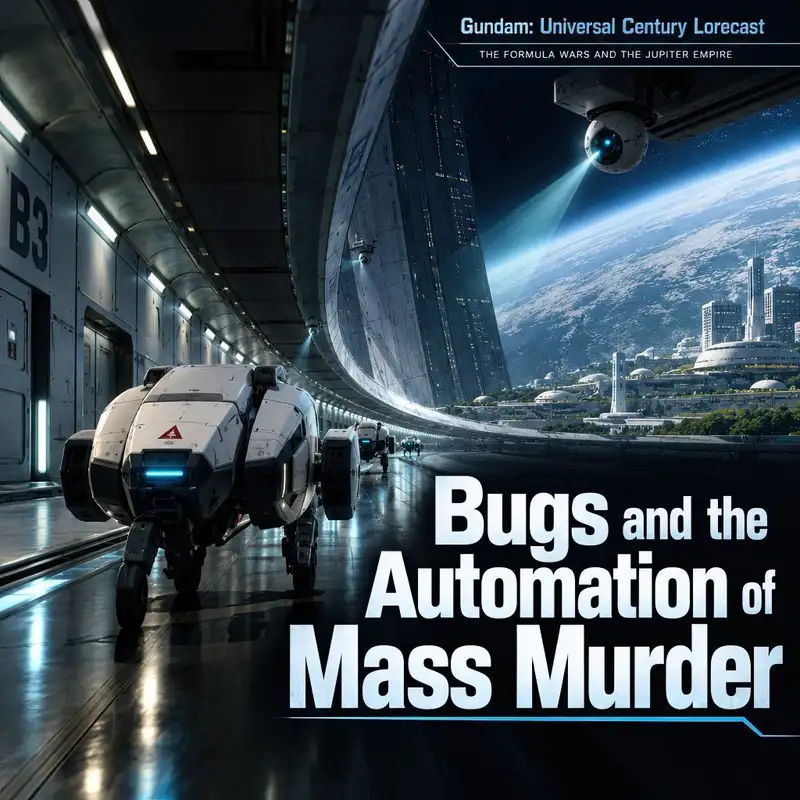
Bugs and the Automation of Mass Murder
A colony’s fusion infrastructure exists to sustain life. It provides power for homes, transit, industry, environmental control, and the innumerable systems that keep an artificial world habitable. At Frontier I, on March thirtieth, Universal Century one hundred twenty-three, that same infrastructure was drawn into a killing operation. From the Crossbone Vanguard flagship Zamouth Garr came unmanned weapons designed to enter buildings, find human bodies by heat and breath, and destroy them. This was not a battle for a fortress or a clash between fleets. It was a military command using the machinery of a civilian habitat to help hunt the people living inside it.
The weapons were called Bugs. The name sounds almost trivial, perhaps deliberately so. A Bug is small, impersonal, and easy to dismiss until it enters a place where people cannot escape it. The Crossbone Vanguard did not deploy them against an armored column, a ship formation, or a hardened military base. It deployed them into an inhabited colony. Their significance lies not only in what they could destroy, but in what their use required commanders to decide. A sensor can identify body heat. A machine can follow carbon dioxide from human respiration. Neither can decide that a frightened family, a wounded civilian, or a hiding child is a lawful target. That decision remained human.
By Universal Century one hundred twenty-three, the Earth Federation had survived repeated wars, rebellions, and political crises, but survival was not the same as health. Its authority remained broad on paper. Its ability to protect distant colonial populations had become less convincing. The Crossbone Vanguard exploited that weakness during its assault on Frontier Side. Frontier IV fell under attack, and civilians fleeing the violence reached Frontier I. Among them were Seabook Arno, Cecily Fairchild, and other survivors who would become caught between the Vanguard’s political project and the Federation’s inadequate response.
The Federation’s weakness mattered because it created an opening for conquest. It did not cause the massacre that followed. A failing security system may leave civilians exposed, but exposure is not responsibility for the attack. The Crossbone Vanguard chose its methods. Its commanders selected targets, controlled ships, directed mobile suits, and activated weapons. The Federation’s slow reaction helps explain why Frontier I lacked a coherent defense. It cannot explain away why a force claiming to build a better order treated an inhabited colony as a clearance problem.
The resistance around the training ship Space Ark reflected that weakness. It was not a properly organized expeditionary fleet arriving with secure supply lines, layered defenses, and a clear operational plan. It was a loose and improvised combination of Federation personnel, civilians, surviving military figures, and young people thrust into roles for which few had been prepared. The F91 gave this group a powerful mobile suit, and Seabook’s ability as its pilot would matter in later fighting. But one advanced machine did not turn Space Ark into a complete military formation, and it did not provide colony-wide protection against weapons already moving through civilian structures.
The distinction is important. Mobile suits are designed to fight other military systems. They can engage warships, mobile armors, armored vehicles, and enemy mobile suits. They can defend routes, break through defenses, and create local opportunities. They are far less useful when the threat is dispersed through homes, corridors, public buildings, and utility spaces where civilians are hiding. A colony defense force can prepare for a raid at a dock, a landing near a military installation, or a mobile-suit assault against a transit route. It has a much harder task when small unmanned weapons are already inside the habitat, moving among the people it is supposed to protect.
The Crossbone Vanguard’s political language gave its conquest a grander purpose. Meitzer Ronah, the movement’s founder, advocated what he called Cosmo Aristocracy. His argument was that humanity needed rule by a cultivated elite, people of superior character and breeding who could supposedly govern with more wisdom and discipline than the decayed institutions of the Earth Federation. From this doctrine would come Cosmo Babylonia, a new political order intended to replace Federation decline with aristocratic responsibility.
That promise deserves to be taken seriously enough to test. Cosmo Aristocracy was not merely a military slogan. It made a claim about who should rule and why. It argued that political authority ought to rest with those most fit to exercise it. Such a doctrine stands or falls on its treatment of people who cannot defend themselves against the state. A government cannot demonstrate superior judgment merely by winning battles. It must show restraint, accountability, and a capacity to recognize the humanity of those placed under its power.
Cecily Fairchild was central to that political image. As Meitzer Ronah’s granddaughter, and later as Berah Ronah, she was meant to embody the legitimacy and refinement of Cosmo Babylonia. Her position was not simply a matter of family lineage. She was a public symbol through which the new regime could claim continuity, dignity, and a future beyond the Federation’s failures. That made the Bug operation especially revealing. A movement that needed Cecily as the face of cultivated rule was also being driven by military methods that treated civilians as biological traces to be located and removed.
Meitzer’s doctrine and the conduct of the Crossbone Vanguard’s military arm must not be collapsed into one simple intention. The animated record does not establish that Meitzer personally authorized the massacre at Frontier I. Nor does it conclusively establish how much he knew about the wider Rafflesia Project associated with Iron Mask. That uncertainty matters. It prevents a convenient answer in which every atrocity is simply assigned to the movement’s founder. But uncertainty about Meitzer’s knowledge does not make the command failure less serious. It makes it more serious. A political leader who cannot control, restrain, or even fully observe the most destructive activity of his own armed force has built an order with a dangerous gap at its center.
That gap was occupied by Carozzo Ronah, known as Iron Mask. He was Meitzer’s son-in-law, Cecily’s father, and the commander of the Crossbone Vanguard’s military arm. He possessed practical control over the weapons and personnel that made conquest possible. Iron Mask was not just an officer carrying out a political program designed elsewhere. He was a military leader with his own methods, ambitions, and vision of population control. The Bugs were among the clearest expressions of that vision.
In any military organization, formal authority and practical authority can diverge. A civilian leader may establish broad policy while a commander controls the means of violence. That arrangement can work only when orders are bounded, oversight is real, and subordinates understand that some actions are forbidden even when they appear expedient. At Frontier I, those restraints failed or were absent. Iron Mask could direct a weapon system against civilians without visible political accountability. The decision did not require a public declaration, a debate, or even the participation of ordinary Crossbone Vanguard troops. It could be made within a small command circle.
Gile Kruger served as the operational executor of that decision aboard Zamouth Garr. His role matters because mass violence is rarely carried out by one person alone. A commander may conceive a policy, but someone must prepare the system, manage deployment, oversee power connections, and translate intent into action. Gile treated Frontier I’s population as a technical problem. The language associated with the operation reduces a living community into an area to be cleared, a collection of detectable bodies, and a timetable for removal. That is how administrative killing begins. People are not first seen as neighbors, citizens, workers, or families. They are defined as obstacles.
The Bugs themselves were purpose-built for that kind of operation. The parent Bug was a disc-shaped unmanned weapon equipped with a high-speed chainsaw. It deployed smaller child Bugs fitted with small lasers and explosive devices. The children could enter buildings and attack people inside them. The available official description identifies body heat and carbon dioxide from respiration as the means by which the system detected human presence. In practical terms, the weapon did not need a frightened operator to search each room, force open every door, or identify a victim face to face. It could move through enclosed civilian space and treat signs of life as targets.
That does not mean the Bugs should be described as fully autonomous in the modern sense. The record establishes unmanned killing weapons. It does not provide a complete technical account of their programming, their supervision, their target-selection rules, or the degree of human control maintained after deployment. There is no need to invent a sophisticated artificial intelligence, a networked swarm, or a detailed algorithmic doctrine that the film does not establish. The horror is already clear without embellishment. The system could detect human presence and attack it. Its commanders had decided that this was what it was for.
The distinction between capability and intent is essential. A heat sensor is not inherently a murder weapon. Carbon dioxide detection has obvious uses in rescue work, life-support monitoring, security, and emergency response. A remote platform can enter a fire, a toxic area, or a damaged section of a colony where human responders might be endangered. The Bug system became an instrument of mass murder because it combined detection with weapons and because Iron Mask’s command directed it against a civilian population. The machine could find a person. The regime decided that finding a person was sufficient reason to kill.
Ordinary soldiers are not automatically humane, and military units can commit atrocities. But direct violence often contains forms of friction that can limit, delay, expose, or complicate killing. Troops become tired. They fear retaliation. They may refuse orders, hesitate, misunderstand instructions, or recognize victims as people rather than abstractions. They leave witnesses. They must enter homes, cross thresholds, confront wounded civilians, and live with what they have done. Commanders who order mass killing through regular troops must also rely on discipline, concealment, intimidation, and the willingness of many individuals to participate.
Automation removes some of that friction. It does not remove responsibility. It changes where responsibility is concentrated. The person operating or maintaining a weapon may be physically distant from those it kills. The commander can receive reports instead of screams. The political leader may be able to claim ignorance. The process becomes easier to describe in technical language: detection, deployment, clearance, suppression, containment. Yet every part of that process remains a human decision. Someone designs the system. Someone funds it. Someone transports it. Someone connects it to power. Someone gives the order to activate it. Someone chooses not to stop it.
At Frontier I, the Bug operation converted civilian life into data. A resident’s body heat became a signal. Breath became an emission. A building became a search volume. The interior of a home became a kill zone. This was not merely cruelty on a larger scale. It was a form of social engineering through military means. The colony’s inhabitants were not being defeated as an enemy army. They were being processed as a population that Iron Mask’s command considered disposable.
For civilians, the terror was not abstract. A colony is a sealed environment. Even in peacetime, its people depend on infrastructure they cannot simply abandon. Transit corridors, apartment blocks, schools, hospitals, workshops, and commercial spaces are linked to the systems that provide air, power, water, and gravity. During an attack, movement becomes dangerous. Hiding places become traps. Fires and explosions carry consequences beyond a single room. A weapon entering buildings does not merely threaten the people in its immediate path. It creates panic across a habitat whose residents know that damage to any part of the structure may endanger many more.
The Bugs also demonstrate that advanced weapons are never simply independent machines. They depend on an operational system. Zamouth Garr was not a passive transport. It functioned as the flagship and launch platform for the Bug operation. Its detachable bow section, the Gal-Brau, required external electrical power connected to Frontier I’s fusion facilities. That detail changes the military analysis. The Bugs were not an improvised weapon released from an ordinary mobile suit. They were part of a ship-launched colony-clearing system, dependent on access to infrastructure, technical preparation, and command control.
The Crossbone Vanguard first had to gain enough access to Frontier I to use the colony’s own power network. That required naval presence, local control, personnel able to make the connection, and sufficient security to conduct the operation. It also required the confidence that the political and military consequences would be acceptable. The Bugs may appear small, but their use rested on a large organization: a flagship, a command staff, engineers, power infrastructure, weapons technicians, guards, and an armed force capable of exploiting the chaos they created.
This dependence places limits on what the weapon could do. The Bugs were terrifyingly effective against civilians without meaningful protection, but the record does not establish that they could clear any colony automatically, operate indefinitely, or be deployed at will across the Earth Sphere. They needed transport, power, maintenance, access, and an environment in which their targets could be found and attacked. Their strategic importance did not come from magical self-sufficiency. It came from the fact that a state-like military organization had assembled the conditions necessary to use them against a trapped population.
There is a grim bureaucratic logic in that arrangement. A colony’s fusion systems are among the foundations of civilian survival. By tying the Bug operation to those systems, the Crossbone Vanguard turned life-supporting infrastructure into part of the attack. That does not mean the colony itself became guilty or hostile. Infrastructure has no moral agency. But control of infrastructure gave Iron Mask’s command power over civilians who depended on it. In war, ports, rail lines, power plants, water systems, and communications networks often become military objectives. At Frontier I, the relationship became even more perverse. The machinery that made settlement possible helped enable extermination.
The immediate military effect was severe. The Bugs disrupted and destroyed vulnerable defenders while spreading fear among civilians. Cosmo Eges’s defense force was destroyed after Space Ark departed. The attack showed the weakness of a force attempting to protect dispersed residents with limited mobile suits and improvised organization. A mobile suit can destroy a Bug when it can find one. It cannot be everywhere at once. Conventional defenses can guard a dock, a command post, or a key corridor. They struggle against small weapons moving through a city-sized habitat whose population is already in flight.
Berghito Pirie’s death stands as one personal measure of the attack’s cost. Later complete editions alter aspects of how parts of the fighting are presented, but the essential point remains unchanged. The Bug operation was not a sterile demonstration of technology. It killed people who were trying to survive a collapsing defense. The film does not provide a secure complete casualty count, and there is no need to manufacture one. The absence of a reliable total does not make the violence less real. Mass killing does not become less significant because the dead cannot be neatly entered into a table.
At the tactical level, the Bugs gave the Crossbone Vanguard a powerful advantage against unprepared local resistance. They inflicted casualties, dispersed defenders, and made ordinary civilian movement dangerous. At the operational level, they helped suppress opposition during the conquest of Frontier Side. But tactical and operational effectiveness are not the same as political success. Killing or terrorizing a population can break immediate resistance. It cannot create trust, consent, or durable legitimacy. A regime may seize a colony and still fail to govern it in any meaningful moral sense.
The Crossbone Vanguard’s own ranks reveal that point. Zabine Char, a senior commander, objected to the indiscriminate killing of civilians. He was not presented as a democratic reformer or a universal opponent of war. He belonged to the Vanguard and accepted its armed struggle against the Federation. His objection does not erase the organization’s responsibility for conquest. It does, however, matter that an experienced officer recognized a line that Iron Mask had crossed. The Bug operation was not simply normal military practice within the Vanguard, accepted without question by everyone who wore its uniform.
Zabine’s response was direct. He shot Gile Kruger, the officer carrying out the operation aboard Zamouth Garr. That act is morally significant, but it must be understood in its limits. It came after the system had been deployed. It did not restore those already killed. It did not prove that the Crossbone Vanguard possessed a functioning mechanism for preventing atrocities before they occurred. Nor did it establish broad institutional opposition within the movement. One commander’s refusal to participate is not the same as an organization capable of restraining its own leaders.
Still, the incident exposes a fracture in command culture. Cosmo Aristocracy claimed to value discipline, hierarchy, and superior judgment. Yet a force built around those principles produced an officer who treated civilian extermination as a practical task and another officer who concluded that the order was beyond military necessity. The disagreement was not over a technical detail. It was over the basic purpose of armed force. Was the Crossbone Vanguard fighting to establish a new political order, or was it simply clearing away human beings who stood in the path of its leaders?
That question returns to Cecily. As the intended symbol of Cosmo Babylonia, she represented the political legitimacy that Iron Mask’s methods were destroying. Her rejection of his violence was more than a daughter’s conflict with her father. It identified a contradiction at the core of the movement. A state that claims a superior elite should govern humanity must distinguish between rule and extermination. It must recognize that the people under its authority are not raw material for political design. Iron Mask discarded that distinction.
Cecily’s position also illustrates how authoritarian movements use lineage and symbolism. A family name can be made to stand for continuity, dignity, and national purpose. But symbols cannot repair a system whose practical power rests with unaccountable violence. Cosmo Babylonia could present itself as an alternative to Federation stagnation. It could promise order, competence, and a higher political culture. Once its military command used automated weapons to hunt civilians through their homes, that promise became impossible to separate from terror.
The issue was not simply that Iron Mask was personally cruel. Personal cruelty matters, but it does not explain how a weapon like the Bugs is developed, transported, maintained, and deployed by an organized force. His authority rested on a military structure willing to provide him with a flagship, technical support, weapons specialists, and the secrecy necessary to carry out the operation. Elite ideology became especially dangerous because it narrowed the circle of people presumed qualified to decide the fate of everyone else. The fewer people who must be consulted, the easier it becomes to call mass murder efficiency.
Reference material associated with the F91 record describes a reported Frontier I population and presents the possibility of clearing it within a matter of days. Those figures should be treated carefully. They reflect the operation’s own language and later companion material, not a securely verified demographic census or combat assessment. What matters is the mentality behind the estimate. It imagines an inhabited colony not as a political community but as a quantity to be reduced on a schedule. In that view, the measure of success is not whether civilians are protected or persuaded. It is whether they can be removed quickly enough.
This is where automation changes the moral and operational character of the violence. An ordinary occupation force must confront the difficulty of controlling people. It requires patrols, checkpoints, intelligence networks, administrators, interpreters, supply systems, collaborators, and at least some attempt at political management. The Bugs offered something different. They did not govern. They did not interrogate, negotiate, recruit, or distinguish between supporter and opponent. They could only detect human presence and attack it. They were therefore suited not to legitimate rule but to removal.
That limitation reveals the failure of Iron Mask’s strategy. A colony cannot be reduced to physical infrastructure. It is a society of residents, labor, memory, families, skills, and institutions. Even a regime that successfully kills or frightens large numbers of people has not solved the problem of governance. It has merely demonstrated that it can destroy the human foundation on which governance depends. The Crossbone Vanguard could capture territory. It could establish symbols of Cosmo Babylonia. But it could not prove that aristocratic rule was superior by treating the governed as targets.
The Bug attack also shows why technological advantage should not be confused with strategic wisdom. The Crossbone Vanguard had sophisticated mobile suits, capable warships, disciplined officers, and a political program that exploited Federation weakness. Yet none of those assets answered the central political question. Why should the people of Frontier Side accept the authority of Cosmo Babylonia? The Bugs answered with fear. Fear can compel movement. It can break local resistance. It cannot provide a convincing answer to legitimacy.
Iron Mask’s later use of Rafflesia makes clear that the Bugs were not an isolated lapse in judgment. After the massacre at Frontier I, he employed Rafflesia against Federation forces and the F91. The scale and technical form of the weapon differed, but the command logic was related. First, automated weapons were used to remove civilian obstacles. Then a larger specialized system was used against armed opposition. In both cases, Iron Mask sought not merely to win a conventional engagement but to impose a new human order through overwhelming and selective violence.
Official companion material associates the Rafflesia Project with far broader ambitions, including a reported objective of eliminating most of humanity and possible future employment against the Moon and Earth. The film itself leaves the full strategic program less completely documented. It is therefore better understood as stated or reported project intent rather than as a fully established plan ready for execution across the Earth Sphere. But even in that cautious form, the implication is stark. Iron Mask’s objective was not limited to defeating a particular Federation force. It involved population restructuring on a catastrophic scale.
The F91’s defeat of Rafflesia stopped Iron Mask’s immediate attempt to carry that project forward. Seabook’s skill, the F91’s capabilities, and the circumstances of the final engagement all mattered. But the defeat of one specialized weapon does not erase the institutional lesson of the Bugs. A regime does not become safe merely because its most extreme commander is defeated in battle. The systems that enabled him, the assumptions that protected him from scrutiny, and the political culture that allowed an elite circle to decide who deserved to live remain part of the historical problem.
The Crossbone Vanguard’s conquest of Frontier Side therefore has to be understood at several levels. Militarily, it exposed the Federation’s slow response and the vulnerability of colonial defenses. Operationally, it showed how a small, disciplined force could exploit surprise, mobility, and advanced systems against a larger but unprepared state. Politically, it revealed that Cosmo Aristocracy’s promise of superior rule could be captured by commanders who interpreted human beings as material for a purified order. For civilians, it meant that the place designed to keep them alive became part of the mechanism used to hunt them.
The Bugs were tactically effective because they attacked people who had little ability to fight back. That is not evidence of military genius. It is evidence of a weapon matched to defenseless targets. They assisted the immediate suppression of resistance, but they could not create stable rule. They exposed a movement whose formal political leader either did not know enough, could not intervene, or lacked the means to restrain the military specialist acting in its name. None of those possibilities is reassuring. Each describes an authority structure incapable of protecting civilians from its own armed power.
Their deeper significance lies in the way they make responsibility easy to evade. A commander can speak of systems. An operator can speak of procedures. An engineer can speak of performance. A political leader can speak of incomplete information. Yet the victims remain dead because people arranged a machine to find them and authorized it to attack. Automation can make killing more persistent, more scalable, and more psychologically distant. It cannot provide judgment. It cannot create restraint. It cannot make an atrocity less human.
The Bugs reveal the regime behind the weapon. They show that the most dangerous feature of automated warfare is not a machine’s ability to detect a human being. It is the decision by those in power that detection alone is enough to justify killing.