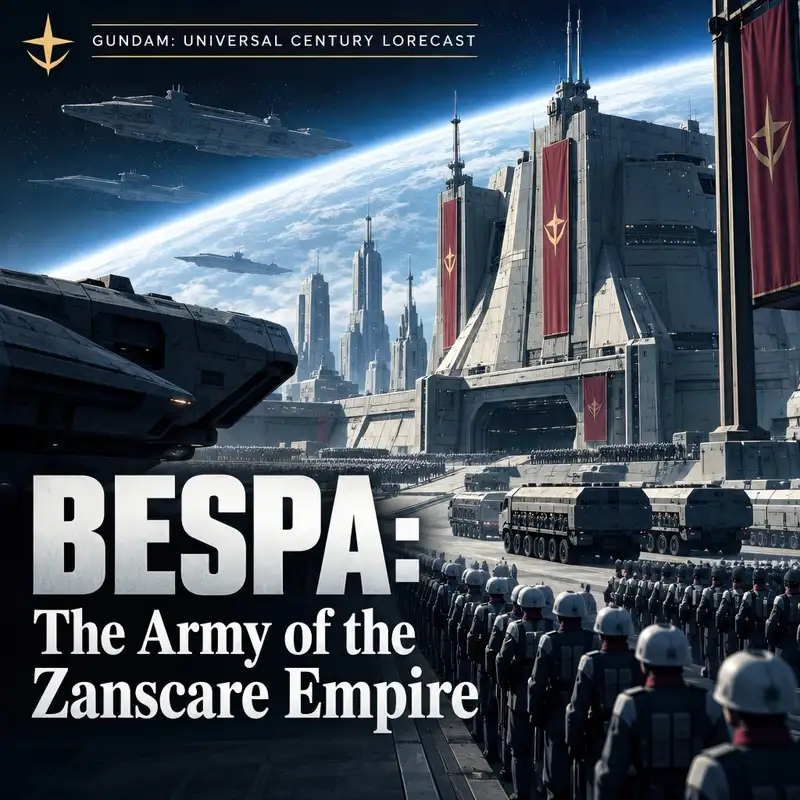
BESPA: The Army of the Zanscare Empire
The Zanscare Empire spoke in the language of maternal peace. Its public face was Queen Maria Pure Armonia, a ruler presented as compassionate, spiritual, and devoted to human reconciliation. Yet the empire that invoked her name also displayed guillotines, conducted public executions, occupied Earth communities, and sent mobile-suit patrols through towns that had little say in who ruled them. BESPA, the military arm of Zanscare, existed to make that contradiction work. It was not merely an army defending a young colony state. It was the instrument through which Zanscare tried to turn ideology into authority, fear into order, and military movement into political control.
That made BESPA more than a collection of late Universal Century mobile suits. It was a military-industrial system. It had test units, ground formations, fleets, specialized weapons, technicians, political officers, transport networks, and commanders with very different ideas about what the empire should become. It could test machines in combat, move forces between space and Earth, sustain occupation, and eventually construct a fortress intended to reshape human behavior itself. The question is not whether BESPA was capable. It plainly was. The real question is why that capability did not produce a durable empire.
BESPA therefore served two masters, though only one of them usually made the decisions. It served Maria as the public embodiment of the empire. It served Kagatie as the machinery of coercion. That arrangement could function while the regime was advancing. It became far more dangerous when military officers, fleet commanders, and political insiders began to recognize that Kagatie’s objectives were no longer simply independence, security, or imperial expansion. They were becoming a project of domination so complete that ordinary politics would no longer be necessary.
Zanscare found its opportunity in that gap. It arose in Side Two, centered on the Amelia colony, and built itself into a state before the Federation could produce a coherent answer. The television series shows the results of that process more clearly than its administrative beginnings. Later reference material offers a partial explanation for how a relatively new empire could field such sophisticated military forces. It links BESPA to a Side Two armament and patrol complex, including elements associated with the Strategic Naval Research Institute.
The exact institutional transfer is not fully explained by the television record, and it would be too simple to say that an entire Federation research institution became Zanscare’s army. The more useful interpretation is narrower. Zanscare appears to have inherited, seized, absorbed, or recruited from a military and industrial environment that already possessed trained personnel, development practices, technical infrastructure, and access to late Universal Century weapons research. A new state did not need to invent every reactor, beam shield, control system, and production method from nothing. It needed enough facilities and expertise to turn existing knowledge into a military program.
That mattered enormously. BESPA did not emerge as a peasant militia with a few captured machines. It could produce and deploy specialized equipment. It could develop machines for space combat, atmospheric operations, reconnaissance, interception, ground assault, and long-range attack. It could support fleets and test formations. It had a credible development pipeline. That is not the same as unlimited production capacity. The series does not provide secure totals for factories, machines, trained pilots, or replacement crews. But it does establish that Zanscare possessed enough industrial depth to sustain a major war rather than merely begin one.
The Federation’s early failure was therefore not proof that BESPA had become universally superior. It was proof that the Federation had allowed a dangerous political and military problem to mature. The Earth Federation government, its military services, and its local commands were not one seamless body. Central hesitation, regional weakness, and uneven readiness created openings that Zanscare could exploit. BESPA’s technology gave it tools. Federation paralysis gave those tools time and space to matter.
Earth became the first major proving ground. For BESPA, the invasion of Europe was not simply an effort to seize terrain. It was a test of whether a colony empire could project force down a gravity well, sustain mobile operations, suppress local resistance, and establish political control over communities with their own infrastructure, histories, and loyalties. Landing mobile suits was only the beginning. An occupation required secure routes, maintenance areas, fuel and propellant, ammunition, communications, medical support, intelligence, and troops capable of distinguishing a hostile fighter from a frightened civilian.
The Yellow Jackets were central to that early effort. They should not be treated as the whole of BESPA. They were a specialized, elite, and experimental formation associated with the invasion of Earth and the testing of new equipment under combat conditions. In the Eastern European fighting around areas such as Largane, Point Kasarelia, and Uwig, the Yellow Jackets performed the missions expected of a force designed to seize initiative. They scouted, pursued, bombarded, probed defenses, hunted resistance groups, and supported the wider effort to establish Zanscare authority.
Their use demonstrates an important feature of BESPA doctrine. The empire did not expect one standard mobile suit to solve every operational problem. Late Universal Century miniaturization and compact high-output systems made specialization more practical. A machine could be adapted for a particular environment or mission without necessarily becoming an enormous and unaffordable project. The Zoloat served as a space-oriented production machine. The Zolo and related designs reflected the need for gravity-capable operations. The Tomliat and Zollidia showed further efforts to adapt mobile-suit systems to Earth’s atmosphere, terrain, and operational demands.
The point was not that one machine was simply better than another. A mobile suit optimized for space, high-altitude movement, surface pursuit, or ground assault would carry different maintenance burdens, equipment needs, and tactical strengths. BESPA understood that Earth was not a single battlefield. European towns, forests, roads, underground facilities, and mountain approaches demanded different methods than open space around Side Two. The empire’s equipment reflected that understanding.
But specialized equipment also created specialized vulnerabilities. Every new machine required trained pilots, spare parts, technical manuals, recovery capability, and commanders who understood what it could and could not do. Experimental units were especially exposed. Testing a machine in combat accelerated development by placing it under real pressure. It also placed sensitive equipment in unstable territory, where a damaged suit might be captured, a pilot might be isolated, or a patrol might be drawn into terrain it did not understand.
The Shokew incident illustrates that problem. The Shokew was a BESPA test machine, and its loss of control during the early fighting was more than an embarrassing setback for a local unit. Uso Ewin’s capture and operation of the machine showed what could happen when a sophisticated weapon system entered a resistance war without secure control of the battlefield around it. A machine could be technically advanced and still become a liability if the force operating it could not protect its personnel, maintain communications, or prevent an opponent from exploiting confusion.
Uso’s individual ability matters in the story, but it should not be mistaken for proof that the League Militaire possessed better training or better equipment than BESPA. It did not. The League began as a resistance organization, not a conventional army with a secure industrial base and a standardized order of battle. Its strength came from other sources. It used concealed facilities, local knowledge, civilian networks, underground workshops, improvised logistics, and mobility. It survived by refusing to meet every Zanscare formation on the terms Zanscare preferred.
That made the early war difficult for BESPA in a way that maps and machine inventories cannot fully show. A resistance group did not need to destroy an empire’s entire force. It only had to preserve itself, deny easy control, gather intelligence, and make occupation expensive. A hidden hangar, a sympathetic village, a tunnel system, or a local guide could matter more in a specific fight than a mobile suit’s nominal performance. BESPA could destroy visible targets. It had far more difficulty destroying the social networks that allowed resistance to reappear after a raid had ended.
The Shokew also exposed a command problem. In Minovsky conditions, communications and long-range detection were already constrained. Commanders could not assume that every patrol, test unit, or mobile-suit team remained visible to higher headquarters. A force spread across occupied territory needed local initiative. But local initiative created risk, particularly in an authoritarian system where officers were expected to deliver results and where failure could carry political consequences. The more a regime demanded perfect control, the more dangerous it became for subordinates to report uncertainty honestly.
BESPA’s occupation methods made that problem worse. The guillotine was not simply an instrument of punishment. It was political warfare. Public executions were intended to demonstrate that Zanscare could identify enemies, punish defiance, and decide who belonged within the empire’s moral order. The regime used the language of justice and purification, but the military purpose was intimidation. It aimed to isolate resistance groups from the population by making assistance dangerous and by convincing ordinary people that opposition would bring immediate, visible consequences.
That is a familiar coercive logic. It is also usually self-defeating over time. Terror can suppress open activity. It can compel obedience at a checkpoint. It can make a community hesitate before offering food, shelter, or information to a resistance cell. But it also teaches people that neutrality may be impossible. When occupation forces treat legal status, residence, or association as grounds for suspicion, workers, families, illegal residents, refugees, and local officials all become vulnerable. A regime may gain compliance while losing legitimacy.
For the civilians caught in BESPA’s campaigns, the distinction between military and political power often disappeared. Mobile suits could appear in a town as patrol vehicles, weapons platforms, symbols of authority, or instruments of collective punishment. A roadblock could interrupt food distribution. A sweep could separate families. An execution could turn a public square into a warning. The presence of advanced combat machines did not make occupation more efficient in any humane sense. It made coercion more immediate.
Mariaism intensified the contradiction. The empire invoked maternal care while enforcing obedience through armed force. Maria’s public image gave Zanscare a language of compassion, but BESPA’s actions repeatedly revealed the regime’s underlying assumption that peace meant the absence of resistance, not the presence of political consent. That distinction shaped the entire war. Zanscare did not merely want to defeat the League Militaire. It wanted to define opposition itself as illegitimate.
The League Militaire, in turn, gained a cause that was both military and social. It was not free of danger, improvisation, or internal strain. Resistance movements rarely are. But BESPA’s coercive methods gave the League access to recruits, information, shelter, and moral credibility that a purely military opponent might not have provided. Every occupied community was a potential source of resistance intelligence. Every act of public terror could turn an uncertain civilian into someone willing to hide a machine, misdirect a patrol, or carry a message.
As the war expanded, BESPA could no longer treat Europe as an isolated counterinsurgency problem. The fighting moved through Gibraltar and beyond the atmosphere into broader operations around Side Two and Zanscare-controlled space. The empire had to defend its own territory, protect transport routes, support fleets, and confront opponents who were becoming more organized. That transition revealed the breadth of BESPA’s force structure.
BESPA fielded fleet formations, mobile-suit carriers, interceptors, reconnaissance units, ground-attack machines, specialized test systems, and fortified positions. Its military was not built around a single famous prototype or one ace pilot. It was built around the idea that modern warfare required different tools for different environments. The Zoloat, Zolo, Tomliat, and Zollidia each illustrate part of that approach. They are not simply names in a development chart. They reflect the empire’s attempt to create systems suited to space, gravity, mobility, and battlefield role.
The Zanneck represents an even more specialized direction. Official material identifies it as a prototype designed for extremely long-range attack. Its significance lies less in any precise performance figure than in the operational idea behind it. A force with an effective long-range strike system could threaten ships, formations, and infrastructure from positions that ordinary mobile-suit units might struggle to reach. It could complicate an enemy’s planning, force dispersal, and create new demands for scouting and interception.
Yet the Zanneck also illustrates why technical sophistication could not solve BESPA’s political and operational problems by itself. A specialized prototype depended on the right pilot, the right support, and the right tactical circumstances. It needed protection, maintenance, targeting information, and command discipline. A weapon designed for extraordinary range could not provide local security in an occupied town. It could not replace infantry, mechanics, transport crews, or a political settlement. It expanded options. It did not remove constraints.
The same was true of beam shields, beam rotors, compact reactors, and other late Universal Century systems. These technologies made certain missions more practical. Beam shields improved survivability under particular conditions. Beam rotors enabled forms of atmospheric movement and combat that earlier mobile suits could not easily sustain. Smaller and more capable machines could operate from different ships and facilities. But every system still depended on pilots, technicians, supply lines, transport, recovery, and command.
A mobile suit damaged in battle still had to be recovered. A beam weapon still required a functioning machine and trained crew. A pilot still had to identify friend from foe in a confused Minovsky environment. A carrier still needed to launch and retrieve its machines. A force still needed ammunition, replacement parts, and somewhere secure to repair combat damage. BESPA’s variety gave it flexibility, but it also imposed a burden of maintenance and coordination. Complexity can make an army formidable. It can also make failure spread quickly once its supporting institutions begin to fracture.
BESPA’s greatest escalation did not solve that problem. It magnified it. The Motorad campaign brought some of the empire’s most distinctive ground forces into the war. The Adrastea and Lysithea-type vessels, with their immense land-going wheels and battle-bike formations, were military systems designed to move through terrestrial defenses with speed, protection, and immense psychological impact. They were not merely bizarre machines built for spectacle. Their form had practical value. They could carry troops and equipment, press through rough ground, create mobile firepower, and overwhelm lightly defended positions.
But their political use turned military mobility into something more sinister. The so-called Earth Clean Operation was not a neutral security measure. Its title concealed the reality of coercion directed at people, settlements, and infrastructure. It treated parts of Earth not simply as hostile territory to be defeated, but as a space to be purged and remade. That language is important. It revealed that the campaign was no longer primarily about holding routes, defeating enemy formations, or establishing negotiated control. It was about demonstrating that Zanscare could impose its will on populations it considered expendable or obstructive.
The Motorad formations were suited to intimidation. Their movement was visible. Their scale was difficult for civilian communities to ignore. Their battle bikes and mobile suits extended their reach beyond the main columns. Their presence transformed roads and open terrain into corridors of military power. A force like that could break through local defenses and make resistance feel futile, at least for a time.
But terror has limits as a method of control. A campaign that destroys communities may deny the enemy shelter in the short term, but it also destroys the political foundation of occupation. Roads, farms, workshops, homes, and local institutions are not merely objects on a battlefield. They are the infrastructure through which civilians survive and through which any occupying authority must eventually govern. If a regime treats that infrastructure as disposable, it may win ground while making the ground impossible to administer.
Arbeo Pippiniden became one of the major commanders associated with BESPA’s fleet and Motorad operations. His role shows that the campaign cannot be reduced to one leader’s cruelty or ambition. Large operations require staff work, transport, maintenance, supply, crews, and subordinate commanders. The Motorad campaign represented an institutional escalation. BESPA had acquired the ability to coordinate large mobile formations across Earth and connect them to the wider war in space.
That achievement was real. So was its strategic failure. The campaign demonstrated that Zanscare could move, strike, and intimidate. It did not demonstrate that Zanscare could build loyalty. Instead, it deepened the war’s political stakes. The League Militaire was no longer simply defending hidden facilities or isolated communities. It was fighting an empire whose methods made surrender look less like peace than submission to permanent vulnerability.
The Earth Clean Operation also exposed a deeper problem in Kagatie’s strategy. A state can use military force to secure a political objective. It can defend a population, compel an adversary to negotiate, or seize critical terrain. But force becomes strategically incoherent when the objective is no longer political control in any recognizable sense. By treating opposition as contamination rather than disagreement, Kagatie transformed military operations into ideological ritual. BESPA’s soldiers were asked to carry out missions that could destroy the very society the empire claimed it would lead.
That distortion was visible within Zanscare’s command structure. Kagatie, Maria, Chronicle Asher, Tassilo Vago, Fuala Griffon, Pippiniden, and other senior figures were not interchangeable parts of one unified machine. Maria provided symbolic legitimacy. Kagatie exercised practical control. Chronicle was a senior officer and capable pilot whose career reflected the strain between professional military identity, personal ambition, loyalty, and a regime that kept pushing its forces toward more extreme goals.
Chronicle’s importance lies not in presenting him as a lone dissenter or a simple villain. He represented a type of officer common in authoritarian systems: someone capable, proud, and deeply invested in the institution, yet increasingly trapped by the political direction imposed from above. Professional military competence does not automatically create political independence. A commander may understand operational reality and still remain loyal to a state whose objectives have become destructive. The institution gives him rank, identity, comrades, and purpose. Breaking with it is not easy.
Fuala Griffon reveals another side of BESPA’s military culture. Her Newtype-associated abilities made her valuable to the regime, but Zanscare’s treatment of exceptional people was not a model of enlightened military personnel management. It was exploitation. The empire sought to turn rare human capabilities into strategic advantage, while the individuals carrying those capabilities remained subject to manipulation, trauma, pressure, and unstable loyalties. Fuala was not simply a superior pilot inserted into the order of battle. She was a person whose value to the state was repeatedly defined by what the state could extract from her.
That is a recurring failure in Universal Century military institutions. They often imagine that an extraordinary pilot, a Cyber Newtype, or a psycommu system can compensate for broader institutional weakness. It cannot. Exceptional people can alter a battle, protect a ship, or create opportunities that ordinary units cannot. They cannot make a fractured command structure coherent. They cannot create trust inside a system built on fear. And they cannot guarantee obedience when the political leadership itself has lost sight of any limited and achievable objective.
Tassilo Vago’s opposition to Kagatie shows how severe that fracture became. His resistance did not emerge from nowhere. It reflected the growing realization that Kagatie’s hold over Maria and the state was leading Zanscare toward catastrophe. Even within a regime built on authoritarian discipline, there were limits to what its leaders would accept. The effort to control human beings through escalating terror, ideological manipulation, and ultimately Angel Halo created divisions that no amount of formal hierarchy could conceal.
Minovsky-era warfare already made command difficult. Fleets and mobile-suit units had to operate with incomplete information. Communications could be disrupted. Local commanders had to interpret broad intent and make decisions without constant direction from headquarters. BESPA faced those ordinary military difficulties while also dealing with secrecy, ideological policing, elite competition, personal loyalties, and uncertainty over who truly spoke for the empire. An army can survive disagreement. It has much more difficulty surviving a situation in which political authority, military command, and moral legitimacy all point in different directions.
The Earth Federation’s eventual reentry into the conflict changed the balance, but it should not be described as the sudden restoration of a healthy old order. The Federation had not solved the weaknesses that allowed Zanscare to rise. Its response was late, uneven, and shaped in significant part by field-level decisions. General Mubarak Stern and Federation space forces joined the League Militaire because the war had reached a point where Zanscare threatened interests that could no longer be ignored.
That intervention mattered because it combined different strengths. Federation forces brought ships, trained formations, military infrastructure, and resources that the League Militaire could not generate on its own. The League brought local knowledge, combat experience, adaptability, and a willingness to fight in places where regular forces had hesitated or failed. Neither side was sufficient alone. Together, they made it harder for BESPA to isolate resistance groups, defeat opponents in sequence, or rely on the Federation’s political fragmentation.
This was not a clean alliance between a virtuous resistance and a redeemed Federation. The Federation’s earlier neglect remained part of the story. Its weakness had created the strategic opening that Zanscare used. But military history often turns on such imperfect coalitions. Formerly separate actors recognize that they face a common threat, combine resources, and create operational possibilities that neither could achieve independently. BESPA had been dangerous in part because its enemies were divided. It became vulnerable when that division narrowed.
In the final campaign, BESPA formations continued to fight hard. Their defeat should not be explained by saying that their machines were inferior or that one opposing pilot defeated an entire empire. Individual mobile-suit battles mattered, as they often do in the Universal Century, but BESPA’s collapse occurred across several levels at once. Tactical units could still inflict losses. Fleet commanders could still maneuver. Specialized weapons could still threaten enemy forces. None of that restored a unified political purpose.
Operationally, BESPA lost the ability to coordinate defense across its major systems. The pressure on Angel Halo, the destruction and disruption of key formations, the weakening of the Motorad forces, and the breakdown of command relationships made it increasingly difficult to turn local resistance into an organized defense. A military can survive battlefield losses if it retains cohesion, reserves, logistics, and a credible command structure. BESPA was losing all of those at the same time.
Strategically, Angel Halo failed to compel victory. Its purpose had been to impose a form of peace by overwhelming the will of those who opposed Zanscare. Instead, it became the focal point around which Zanscare’s enemies united. The fortress did not dissolve the political conflict. It clarified it. Federation forces, League Militaire fighters, and even elements within Zanscare could see that Kagatie’s project threatened not merely a rival government, but the possibility of human political agency.
Politically, Maria’s authority and Kagatie’s regime failed together, though they had never been the same thing. Maria had been the empire’s symbolic center. Kagatie had been its practical architect. Their association gave Zanscare strength while it was expanding, because it combined spiritual imagery with decisive coercive power. But when the coercion became unmistakable and the ultimate purpose of Angel Halo came into view, the arrangement could no longer sustain itself.
Institutionally, BESPA could not survive the collapse of the political structure that directed it. This does not mean every officer, pilot, technician, or crew member vanished with the empire. Military institutions are made of people, and individuals can survive a state’s defeat. But BESPA as a coherent imperial system depended on Zanscare’s command hierarchy, industrial base, ideological legitimacy, and strategic objectives. Once those failed together, the army’s machines and remaining formations could not preserve the empire by themselves.
The civilian consequences outlasted the battlefield. Occupation, terror, executions, forced movement, damaged communities, and the threat posed by Angel Halo could not be erased by the destruction of a fortress or the collapse of a command structure. Military victory can end an immediate campaign. It cannot automatically repair political trust, rebuild destroyed infrastructure, or undo the lessons civilians learned under occupation. The Zanscare War was another reminder that people are not terrain to be captured and reset after the shooting stops.
BESPA proved that a weakened federation could be challenged by a smaller state with inherited military capacity, specialized technology, disciplined formations, and ruthless political will. It could invade Earth, defeat or outmaneuver fragmented opponents, build fleets, deploy advanced mobile suits, and create weapons of extraordinary reach. Those were real achievements of military organization, industry, and planning.
But BESPA’s final failure showed the limits of military power when it is directed by a political system that confuses fear with legitimacy and obedience with peace. It could seize territory. It could terrorize communities. It could make resistance costly. It could not build an order that people had reason to accept.