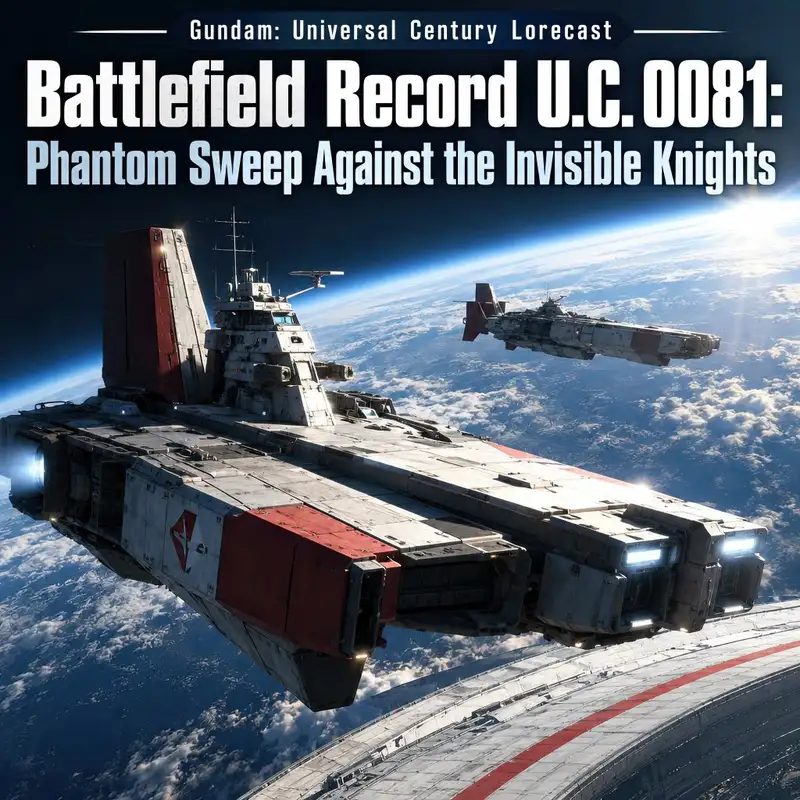
Battlefield Record U.C. 0081: Phantom Sweep Against the Invisible Knights [Game]
At Augusta, the first warning of danger is the destruction of the warning system itself. Federation defenders are not merely protecting four radar dishes from a Zeon raid. They are trying to preserve the ability to see what is coming next. By this point in Universal Century eighty-one, Phantom Sweep is already pursuing a stolen Efreet Nacht, a rare machine whose electronic-jamming equipment complicates detection and identification. That pursuit is important, but it is also exactly the sort of problem the Invisible Knights want the Federation to focus on. While one specialized mobile suit absorbs attention, another element attacks the infrastructure that tells commanders where to send reinforcements, what route an enemy force may take, and whether a distant alarm is a feint or the beginning of a larger operation. The remnant force is not literally invisible. Its real weapon is uncertainty.
That distinction defines Mobile Suit Gundam: Battlefield Record U.C. 0081. This is not the story of Zeon rebuilding a conventional army capable of fighting the Earth Federation head-on. Nor is it simply a sequence of mobile-suit engagements between familiar machines. It is a postwar security campaign. A small force of Zeon holdouts turns scattered weapons, surviving personnel, local concealment, intelligence gaps, and access to strategic infrastructure into leverage against a much larger state. The question is not whether the Invisible Knights can conquer Earth. They cannot. The question is whether they can make the Federation discover that winning the One Year War did not mean it had secured the peace.
The game frames that question through two survivors of A Baoa Qu. Hugues Courand, later the field commander of Phantom Sweep, and Erik Blanke, leader of the Invisible Knights, both carry the losses of the final battle of the One Year War into the conflict of Universal Century eighty-one. Their rivalry is not born from a fresh dispute over a border or a newly discovered resource. It grows from survivors who have outlived the people around whom they built their military identities. That gives the campaign emotional force, but it also creates a command problem. Grief can sharpen a commander’s determination. It can also distort judgment, make compromise look like betrayal, and turn death in combat into an attractive substitute for living with defeat.
The Earth Federation Forces responded in part by creating Phantom Sweep, a special unit intended to hunt down scattered Zeon resistance across Earth. Courand leads the formation in the field. Darrell Godwin is associated with its establishment, while Liang Mao serves as a senior operational presence in its campaigns. The unit includes pilots, support personnel, and technicians drawn into a difficult kind of postwar warfare. Their assignment is not to seize one decisive fortress or defeat one identifiable fleet. It is to protect routes, defend installations, recover stolen equipment, pursue raiders, and prevent small incidents from connecting into something larger.
That is a demanding mission even for a government with the Federation’s resources. A major army can concentrate against a known enemy front. A postwar security force must be prepared for attacks on many fronts at once. It must protect cities under reconstruction, bases with damaged defenses, transport corridors, communications facilities, research sites, airfields, and launch infrastructure. It must also decide how much force to commit to each alarm. Commit too little, and an enemy raid may become a breakthrough. Commit too much, and the enemy has successfully fixed troops in the wrong place while another cell attacks elsewhere.
Phantom Sweep exists because the Federation’s ordinary security apparatus cannot instantly cover every vulnerability left by the war. The unit’s mobility is an answer to slow response times, uneven readiness, and the practical difficulty of moving forces across a recovering planet. But a special unit is not a political settlement. It can pursue armed opponents. It cannot, by itself, repair damaged trust between Earth and the colonies, settle the loyalties of veterans, or make the Federation’s postwar authority feel legitimate in every place where the war has left resentment behind. A rapid-response force is useful. It is also evidence that the larger system is still under strain.
Erik Blanke’s Invisible Knights are built to exploit that strain. They are not presented as an intact Zeon regiment that somehow escaped the end of the war with its full chain of command, supply service, and industrial base intact. They are a remnant formation. Their personnel include wartime survivors, operators, mechanics, and younger recruits who have attached themselves to the cause after the war. Their cohesion comes less from standard organization than from shared experience, personal loyalty, memory of defeat, and a belief that Zeon’s political cause has not been resolved by the Federation’s victory.
That gives the Invisible Knights genuine strengths. They can move lightly. They can select targets. They can draw upon old contacts, surviving equipment, hidden positions, and captured supplies. They do not need to hold every road or defend every base. They need only create enough disruption to make the Federation spend its strength reactively. A force that attacks a convoy, then disappears into difficult terrain, is imposing a cost far beyond the value of the supplies it captures. It forces the state to assign escorts, investigate local networks, reinforce depots, guard communications, and move units that would otherwise be available elsewhere.
Their weaknesses are just as important. The Invisible Knights have no secure industrial system capable of replacing losses indefinitely. They cannot afford a prolonged battle of attrition against the Federation. Their equipment must be repaired with whatever parts, workshops, and technicians they can keep hidden or seize. Their ammunition, fuel, propellant, medical care, and transport are all precarious. They depend on concealment and tempo. If forced into open conventional warfare against concentrated Federation strength, they are vulnerable. Their strategy therefore depends on transforming local survival into operational mobility before the Federation can bring its superior resources to bear.
The game’s Earth campaign moves through deserts, mountains, jungle terrain, urban areas, and military facilities. What matters is not to memorize each location as another battlefield on a map. The variety of terrain reveals the Federation’s problem. Security cannot be organized around one simple front line. Desert routes demand mobility, fuel planning, and long-distance reconnaissance. Mountain passages restrict movement and create natural ambush points. Jungle operations complicate observation and maintenance. Urban fighting introduces civilians, infrastructure, political symbolism, and the difficulty of using heavy weapons without turning a security operation into further damage to a recovering society.
In Libya, Syria, Odessa, the Khyber Pass, Belfast, the Ural region, Augusta, and other areas, the Invisible Knights can use the geography of a recovering world against the Federation’s larger but more cumbersome system. A raid against a communications facility does not need to destroy an entire command structure. It only needs to delay the circulation of reliable information. An attack against supplies does not need to starve the Federation’s whole military. It can force a local commander to postpone movement, reduce patrols, or request reinforcement. A strike near a major city does not need to capture that city. It can expose the uncomfortable fact that peacetime security is not yet secure.
New Yark is particularly revealing in this respect. The rebuilt city carries political meaning. It is not merely another urban objective. Reconstruction is a statement by the Federation that the catastrophe of the One Year War is over, that institutions have returned, and that ordinary life can resume. An attack near such a place threatens infrastructure and civilians, but it also attacks the credibility of that promise. A government trying to demonstrate that it has restored order cannot easily dismiss violence in a rebuilt city as a minor military incident. The physical target and the political target are connected.
For that reason, a small remnant force can matter without ever approaching strategic parity with the Federation. The Invisible Knights do not need to destroy the Federation’s capacity for war. They need to make Federation strength slow, dispersed, uncertain, and politically defensive. Their raids force the state to answer questions that should have been settled after the armistice. Who controls the roads? Which depots remain vulnerable? Which former Zeon personnel have accepted the new order? Which communities will report insurgent activity, and which will remain silent? Where does military pursuit end and civilian policing begin? Those are not questions that can be answered with a single superior mobile suit.
The seizure of the Efreet Nacht shows how specialized technology can magnify these problems. The machine is not valuable simply because it is rare or because it performs well in a battle. Its electronic-jamming capability affects the conditions under which a battle begins. It can interfere with detection, target identification, and communications. It introduces doubt. A sensor contact may be incomplete. A message may arrive late or not at all. A unit may hesitate because it cannot confirm whether it has found the enemy, a friendly force, or a decoy. In a campaign against dispersed raiders, that hesitation can be decisive.
The name Invisible Knights should not be taken too literally. The Efreet Nacht does not make its pilots vanish from the physical world. It does not produce perfect stealth, and it does not render every Federation sensor useless. The point of electronic disruption is not magic. It is friction. It makes the enemy’s picture of the battlefield less reliable. It complicates command and control. It creates opportunities for concealment, ambush, withdrawal, and deception. In a conventional battle between large formations, jamming may be only one factor among many. In a remnant campaign, where the smaller force needs only a narrow opening, it can be extraordinarily useful.
The theft also has an intelligence value. A stolen experimental or specialized machine demands attention. The Federation has to ask who took it, how the security failure occurred, what the machine can reveal to the enemy, and where it may be used next. Recovering the Efreet Nacht becomes a legitimate priority. But priorities consume attention, and attention is finite. The Invisible Knights can use the stolen machine as both a combat asset and a diversion. While Phantom Sweep pursues the visible problem, Erik’s wider organization gains time to prepare the less visible one.
This is also a reminder that rare machines should not be mistaken for standard capability. The Efreet Nacht is a specialized asset. Its presence does not mean either the Federation or the remnants can deploy electronic warfare equipment at that level across every theater. Nor does its effectiveness mean that jamming alone decides the campaign. The machine matters because it is employed within a network of raids, infiltrators, supply seizures, and attacks on infrastructure. Technology is most dangerous when it supports a coherent operational purpose. In this case, the purpose is to deny the Federation a clear understanding of where the decisive threat will emerge.
That purpose becomes clearer at Augusta. The attack on the base’s four large radar dishes is not simply an attempt to inflict damage on a Federation installation. Radar and communications systems create warning. They help track incoming aircraft and launches, coordinate defensive responses, authenticate reports, route reinforcements, and distinguish a local alarm from a strategic movement. In a world still shaped by Minovsky-era limits on long-range detection and communications, no sensor system provides perfect awareness. That makes the remaining systems more important, not less. Every reliable source of warning becomes a military asset.
Augusta therefore represents a preparatory target. The Invisible Knights are attacking the Federation’s ability to recognize and respond to the next phase of their operation. Damaging radar does not win a war by itself. It does not create a new government, secure a supply chain, or defeat a major fleet. But it can create a window. If warning is weakened, an escape route may remain open longer. If reinforcement routing is confused, defenders may arrive late. If a base’s air-defense network is degraded, a later attack may face less organized resistance. A small force survives by creating windows and moving through them quickly.
There is also a civilian dimension to this kind of attack. Strategic installations are often located near the communities they are intended to protect or support. A radar station may be military infrastructure, but its destruction can weaken the defense of nearby population centers, transport routes, and emergency services. The boundary between military target and civilian consequence is rarely clean in a recovering society. The Invisible Knights are seeking military advantage, but the risk created by their method extends beyond uniformed personnel. That matters because their rhetoric invokes Zeon’s postwar claims and Spacenoid grievance while their operations increasingly depend on coercion directed at Earth-based infrastructure.
The campaign’s counterintelligence crisis emerges through Cherie Allison. Cherie serves as a Federation test pilot attached to Phantom Sweep, but her connection to Erik’s orbit is eventually exposed. Her presence inside the unit is not merely a personal betrayal inserted into the story for drama. It reveals the vulnerability of postwar institutions that are expanding, reorganizing, and trying to absorb technical personnel while still sorting through wartime loyalties. The Federation needs experienced pilots, mechanics, engineers, and specialists. It cannot rebuild its security structure without people. Yet every new assignment carries the question of what history, allegiance, or hidden connection that person brings with them.
Infiltration works when an organization has access to information it should not possess. Cherie’s position offers insight into Phantom Sweep’s equipment, procedures, movements, and assumptions. More importantly, her exposure gives the Federation a clearer view of the Invisible Knights’ intentions. Courand’s decision to disable her machine and capture her for interrogation is significant. He does not treat the encounter only as an emotional confrontation. He recognizes that a captured infiltrator may reveal the direction, scale, and timetable of an operation. In counterinsurgency and special operations, intelligence often matters less as a final answer than as a chance to redirect force before an enemy’s next move becomes irreversible.
Yet intelligence alone is not enough. Information must arrive in time, be believed by the correct people, and be connected to an available force capable of acting on it. A commander may know an enemy intends to escape, but still lack sufficient troops at the relevant port or airfield. A warning about a strategic objective may be accurate, but still fail if it is treated as one possibility among too many. The Invisible Knights understand this. Their campaign does not depend on keeping every detail secret forever. It depends on keeping the Federation uncertain long enough that its responses arrive separately rather than as one concentrated blow.
Cherie’s later return during the operation around Aden is one of the game’s harshest reminders that these networks are held together by families as well as ideologies. She dies while saving Courand and kills her own brother in the process. The event should not be romanticized as a cleansing sacrifice or a heroic answer to divided loyalty. It is evidence of how deeply the One Year War has entered private lives. The postwar struggle turns former comrades, relatives, and survivors into instruments of opposing organizations. No intelligence victory can undo that cost. Courand gains information and survives, but the campaign continues to consume people who were already damaged by the first war.
Aden Spaceport is the point where the Invisible Knights’ operation changes scale. Until then, the remnants are dangerous largely because they can move across Earth, raid installations, and exploit gaps in local security. At Aden, they seek high-lift vehicles. These are not scenery. They are logistics. A high-lift vehicle can move personnel, equipment, and the possibility of continued operations out of the reach of ordinary ground pursuit. It gives a force trapped within one theater a route into another. For a remnant organization, launch access is not simply an escape. It is transformation.
The Federation understands the danger and attempts to stop the seizure of the high-lift vehicles. But the operational significance of failure is greater than the local tactical engagement. If a remnant force reaches space, the geographic conditions that made it containable on Earth no longer apply in the same way. Ground security forces cannot simply follow. The pursuit now requires orbital and lunar-capable transport, ships, trained crews, intelligence on new routes, and the ability to defend infrastructure beyond the planet. The Invisible Knights have not gained equality with the Federation. They have gained room to maneuver.
For that reason, control of launch infrastructure matters so much in the Universal Century. Earth’s gravity well is a barrier, but it is also a gate. The side that controls the gates determines who can move from the surface into orbital or lunar operations. A force that captures a launch vehicle has acquired more than transport. It has acquired access to new targets, new sanctuaries, and new political possibilities. The Federation’s inability to close that gate at Aden demonstrates how a small organization can turn a series of raids into an operational breakthrough.
The lunar phase of the campaign centers on mass-driver infrastructure. By this point, the Invisible Knights are no longer trying merely to evade pursuit. They are trying to convert survival into strategic coercion. Their use of a Musai-class cruiser and divided forces is important because it multiplies the Federation’s decision problem. More than one objective is threatened. One engagement may be a diversion while another force approaches the target that actually matters. Defenders must decide where to concentrate, which report to prioritize, and whether they can protect several critical sites without exposing each one in turn.
A divided-force operation is risky for the attacker as well. It reduces the strength available at each point. It can complicate communications and make mutual support difficult. The Invisible Knights accept those risks because they cannot win by gathering every asset into one obvious formation. Their advantage lies in making the Federation defend against several possibilities. If the defenders concentrate too soon, they may be drawn away by a feint. If they spread out, they may be too weak at the decisive point. The remnant force is using maneuver and uncertainty to compensate for its lack of numbers.
The Federation’s response includes the Thoroughbred and the RX-78-7 Seventh Gundam. Both are important, but neither should be treated as a magical answer to the crisis. The Seventh Gundam represents specialized postwar development and technological recovery. It is a mission-specific asset, not evidence that every Federation unit has suddenly received equivalent equipment. The Thoroughbred matters even more broadly. It is a transport, a command platform, a mobile-suit support ship, and eventually a source of decisive fire support. It carries the people, machines, communications, maintenance capacity, and weapons needed to bring force to the lunar objective.
That support system is what gives the Federation its eventual chance to stop the operation. Courand and Erik may occupy the emotional center of the game, but neither commander fights alone. A mobile suit requires recovery, repair, ammunition, propellant, targeting information, and a chain of command. A ship requires crew discipline, navigation, damage control, supply, and the ability to remain operational under pressure. The difference between an individual duel and a military outcome is often found in those less glamorous systems. The Thoroughbred’s role makes clear that the final crisis is not resolved by personal skill alone.
Operation Varuna’s Tears is the culmination of the Invisible Knights’ strategy. The plan is to reactivate a lunar mass driver and use it to send mass ammunition toward Earth. Augusta is identified as the intended first target because of its air-defense network. The operation therefore ties together the earlier phases of the campaign. The theft of the Efreet Nacht creates uncertainty. The attacks on radar infrastructure weaken warning. Cherie’s infiltration exposes the Federation’s internal vulnerability. Aden provides the route to space. The lunar diversions divide the defense. Each action is limited on its own. Together, they create the possibility of strategic bombardment.
The political objective is not conventional victory in the old sense. Erik’s force cannot occupy Earth or compel the Federation’s surrender through battlefield attrition. Instead, Varuna’s Tears seeks leverage. The threatened destruction is intended to pressure both the Earth Federation and the Republic of Zeon by demonstrating that postwar arrangements remain vulnerable. The Invisible Knights want their cause to become impossible to ignore. This is the logic of coercive violence. A smaller actor attacks something politically valuable and hopes that fear, embarrassment, or public pressure will produce concessions that military strength alone could never obtain.
But strategic terror has a central contradiction. It may force attention, yet attention is not legitimacy. A movement can possess real grievances. Spacenoid exclusion, the brutality of the One Year War, the humiliation of defeat, and the failures of Federation governance are not imaginary. But attacking Earth-based infrastructure and exposing civilian communities to bombardment does not transform a remnant force into a credible political representative. It instead risks confirming the Federation’s claim that security requires harsher measures. Violence can create leverage in the short term while destroying the political support needed for a durable settlement.
The mass driver also demonstrates that infrastructure is never merely background. A facility designed for transport or industrial use can become a weapon when placed under military control. For that reason, its defense is a strategic responsibility. Yet the existence of such a weapon does not mean its effects can be reduced to a technical calculation. The game does not securely establish the final impact of the projectile in the Zeon-side route. It would be irresponsible to invent a confirmed outcome, casualty figure, or damage assessment. What matters is the threat itself. A mass-driver launch toward Earth is an act of coercion against a populated world, not just another attack on a military target.
The Federation-side conclusion presents one answer to the crisis. Courand defeats or kills Erik, then prepares for a suicidal attack on the mass driver. His impulse is understandable in the context of his losses. He has spent the campaign pursuing an enemy who embodies the unfinished violence of A Baoa Qu. But the planned sacrifice is not what resolves the mission. The Thoroughbred destroys the installation, preventing Courand’s death and ending the immediate threat. That intervention matters because it is an institutional correction to personal fatalism. Courand’s willingness to die is not a strategy. Coordinated support, concentrated firepower, and a functioning command structure are what save the operation.
The Zeon-side conclusion must be kept separate. In that route, Erik succeeds in firing the damaged mass driver toward Augusta before Federation forces surround him. The game leaves the immediate situation unresolved. The projectile’s final impact is not securely shown in the available record, and Erik’s ultimate fate remains uncertain within that route. These conclusions are route-dependent outcomes from an interactive narrative. They are not pieces of one seamless history that can be combined for a cleaner ending. The contrast is still useful. One route emphasizes the Federation’s ability to stop the system before launch. The other emphasizes how narrow that margin of success may have been.
Both endings return to the same human problem. Courand and Erik are commanders shaped by a war that has ended on paper but not within them. Erik turns loss into a program of continued resistance and coercive retaliation. Courand repeatedly risks turning his own loss into a desire for self-destruction. Neither response offers a stable political future. The invisible danger in the campaign is not only the jamming system, the infiltrator, or the hidden route to the Moon. It is the persistence of institutions and individuals who remain organized around a war they cannot leave behind.
Phantom Sweep proves that a capable state can eventually contain a remnant threat when it combines intelligence, mobility, naval support, specialized forces, and concentrated power at the decisive point. The Federation does not defeat the Invisible Knights because one prototype is simply stronger than another machine. It succeeds, where it does succeed, by connecting information to transport, transport to command, command to fire support, and fire support to the strategic objective. The Thoroughbred, the pursuit of the high-lift vehicles, the defense of infrastructure, and the identification of the mass driver’s role all matter as much as the final confrontation between the two commanders.
Yet the campaign also exposes the limits of that strategy. The Invisible Knights can disrupt. They can frighten. They can exploit a postwar system that is still fragile. But they cannot replace their lost industrial base, sustain a conventional war, or turn threatened mass violence into durable legitimacy. Their cause remains dependent on the same conditions that make remnant warfare possible: secrecy, improvisation, captured supplies, personal loyalty, and the hope that one dramatic blow will change the political order. Those are tools for creating crisis, not for governing a society after the crisis has begun.
Battlefield Record U.C. 0081 is therefore not a story about invisible knights defeating a giant state through superior machines. It is a story about a giant state discovering that its strength has weak points. The Invisible Knights become dangerous because they understand that security is made of routes, radar, personnel records, launch sites, ships, maintenance, timing, and public confidence. Phantom Sweep can stop them only when those elements finally converge at the decisive point. The campaign’s enduring warning is simple: a state can win a war, destroy an enemy army, and still fail to secure the peace.