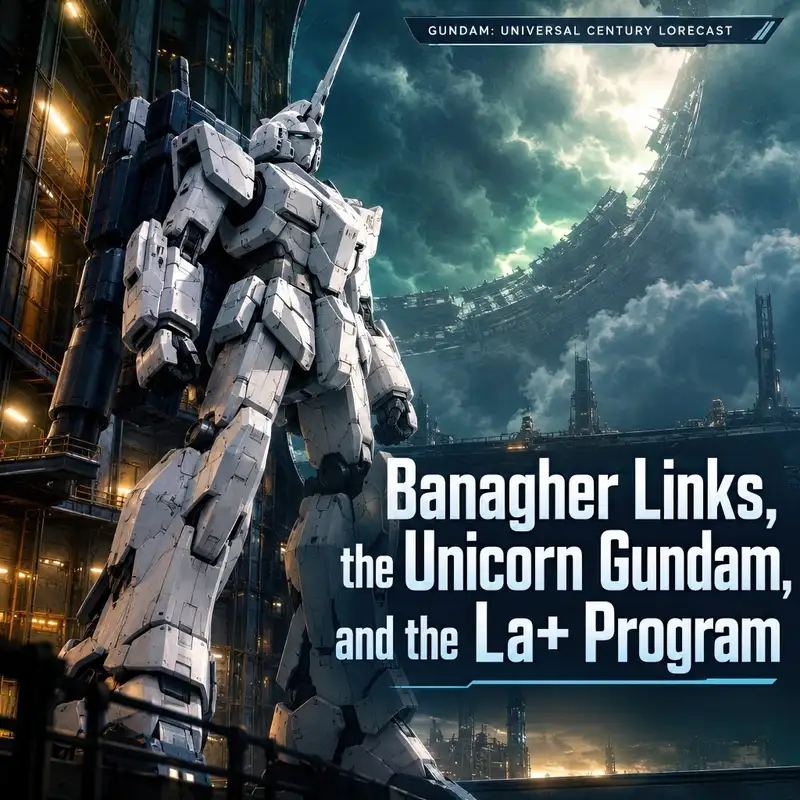
Banagher Links, the Unicorn Gundam, and the La+ Program
Industrial Seven was built to make things. It housed factories, docks, technical schools, freight traffic, workers, families, and the routine machinery of a colony economy. Then, in Universal Century ninety-six, it became a battlefield because several powerful institutions were chasing a secret whose contents most of them did not fully know. The Vist Foundation intended to transfer Laplace’s Box to the Sleeves. The Earth Federation moved to prevent that transfer. Anaheim Electronics had interests bound up in the machinery at the center of the transaction. And Audrey Burne, a young woman traveling under an assumed public identity, came to stop the exchange because she believed it could start another war.
Banagher Links entered that crisis as a student at Anaheim Industrial Technical School. He was sixteen, untrained for combat, and employed in the practical, unglamorous work of recovering debris with a civilian mobile suit. That work mattered. In a colony, debris is not scenery. It threatens docks, windows, traffic lanes, pressure hulls, and the people who depend on all of them. Banagher understood space first as a place where damaged equipment had to be recovered before it damaged someone else’s life. He did not begin with a soldier’s map of objectives and enemy forces.
That civilian perspective matters because Industrial Seven was not an empty arena where military machines could settle a private argument. The attack forced ordinary residents into evacuation, confusion, and danger. Habitats, industrial modules, transit routes, and docking areas suddenly became part of a contested operational environment. The combatants had missions, but the population had no vote on whether its home would become the ground over which those missions were fought.
The immediate prize was not a fortress, a mineral field, or a fleet anchorage. It was information. Laplace’s Box had acquired a near-mythical reputation because it was said to contain something capable of shaking the Earth Federation’s legitimacy. That uncertainty gave it power. The Federation feared what disclosure might do. The Sleeves believed possession could give them political leverage. The Vist Foundation had guarded it for generations. Audrey feared that any attempt to use it as a bargaining weapon could turn a constitutional secret into the trigger for another round of bloodshed.
Banagher was not recruited through a military academy, selected by a chain of command, or prepared by a formal intelligence service. He was swept into the fight because he met Audrey and chose to help her. That decision put him beside people carrying secrets far larger than either of them understood. Before the night was over, a civilian debris worker would be placed in the cockpit of one of the most sensitive military prototypes in the Earth Sphere. The strange part was not simply that Banagher could operate it. The stranger part was that the entire design of the operation required him to make choices that governments, fleets, corporations, and political movements could not make for him.
The history behind that burden began almost a century earlier. In Universal Century one, the inauguration of the new calendar was marked by an attack on the Laplace space station. The attack killed the Earth Federation’s prime minister and helped bury evidence connected to the founding political order of the Universal Century. Syam Vist, who had been involved in that violence, came into possession of the object later known as Laplace’s Box.
That is the inheritance Banagher receives. Not merely a father he barely knew, not merely a machine, and not merely a buried political record. He inherits a system built by people who believed that history could be released safely only through a carefully managed test. The problem is that history does not remain under its custodians’ control. By Universal Century ninety-six, the Box had become too important to too many armed actors. Every effort to manage its release also became an effort to control the person chosen to carry it.
Cardeas Vist stood at the center of that problem. As head of the Vist Foundation, he was attempting to arrange the transfer of the Box to the Sleeves. On the surface, that decision looked like a political transaction. The Sleeves were a Neo Zeon remnant seeking leverage against the Federation, and a secret capable of damaging Federation legitimacy was valuable currency. But Cardeas was not simply handing over a document. He was setting a succession plan in motion.
His choices were contradictory. He had spent Banagher’s life at a distance, leaving the boy without the preparation, explanation, or stable relationship that such a burden demanded. Then, during a violent attack on Industrial Seven, Cardeas revealed Banagher’s parentage and placed the Unicorn Gundam in his hands. It was an inheritance delivered under fire. There was no time for Banagher to evaluate the mission, study the political stakes, or refuse with informed consent. Cardeas gave his son responsibility at the exact moment when responsibility was hardest to carry.
There was also a deliberate logic to the decision. If Cardeas had simply transferred the Box to the Sleeves, it would have become a tool of the Sleeves. If he had delivered it to the Federation, it would have disappeared into the same system that had concealed it. If he had entrusted it to Anaheim, corporate interest would have shaped its use. By assigning the Unicorn to Banagher, Cardeas made the process harder to seize outright. The key was no longer a file cabinet, a vault code, or a single location. It was a person moving through a battlefield.
That did not make Cardeas’s decision clean or humane. He used his son as part of a political mechanism. He gave Banagher a weapon he did not know how to use and a mission he did not understand. The surrounding forces were organized, armed, and accustomed to classified conflict. Banagher had none of their institutional support. Yet Cardeas’s choice also denied those institutions a simple solution. No fleet commander could force the complete program forward merely by taking possession of the Gundam. No political leader could claim the Box without passing through the human being at the center of the machine.
The Unicorn Gundam turned that burden into a physical problem. Banagher could not carry the secret in a briefcase. He had to operate a highly specialized prototype in combat, survive pursuit by forces that wanted to capture or destroy it, and decide whom to trust while knowing almost nothing about the larger plan. The machine gave him capability, but capability came with exposure. Once Banagher entered the Unicorn’s cockpit, he stopped being merely a civilian caught in a crisis. He became an objective.
The RX-zero Unicorn Gundam was an experimental machine from the Universal Century Project. It was not a standard Federation mobile suit, and it should not be treated as evidence that the Federation had solved the problem of Newtype warfare across its armed forces. The project produced only a very limited number of RX-zero units. Its technology demanded specialized engineering, close maintenance support, unusual pilot compatibility, and political secrecy. This was not a machine a regular unit could simply request through an ordinary procurement channel.
Its defining feature was the extensive use of psycho-frame. In the animated record, psycho-frame allows an unusually direct interaction between pilot intent and machine response. That responsiveness can be decisive in a fast, confused engagement, especially under Minovsky conditions where long-range sensors and communications are degraded. But it also places a heavy burden on the pilot. A machine that responds closely to fear, anger, urgency, and perception can intensify all of those states. It does not make judgment easier. It makes the consequences of judgment arrive faster.
The Unicorn’s most famous system is the Newtype Destroyer, or N T D. Its name is blunt because its purpose is blunt. N T D was designed as an anti-Newtype combat system. It responds to conditions associated with Newtype activity and is intended to counter psycommu-equipped threats, including remote weapons that can attack from multiple directions. In military terms, it was an attempt to regain control in an environment where a skilled Newtype pilot might disrupt normal assumptions about reaction time, awareness, and engagement geometry.
Still, the Unicorn did not float above ordinary military realities. It needed a carrier, a hangar, technicians, ammunition, recovery arrangements, and people capable of keeping an experimental machine functional after combat damage. Its pilot could be exhausted, injured, frightened, or overwhelmed. The machine’s exceptional responses did not eliminate the need for command decisions, maintenance labor, or logistics. A prototype can seem invincible in a moment of crisis because it concentrates resources that ordinary units never receive. That does not make its performance reproducible.
N T D explains why the Unicorn could fight. It does not explain why it could lead Banagher toward Laplace’s Box. That was the purpose of the La+ Program, a separate function installed in the first Unicorn. Confusing the two systems misses the central design of the machine. N T D was a combat architecture. La+ was a political and intelligence architecture.
La+ was a staged route. At prescribed locations and under particular conditions, the program revealed subsequent coordinates. Rather than placing the route to the Box in one accessible database, the program divided it into steps. Each step required the Unicorn to reach a location, activate the relevant condition, and continue to the next point. The route passed through places loaded with historical and political meaning, including the Laplace monument and the Torrington area, before ultimately leading back toward Industrial Seven and Megallanica, the colony builder connected to the Vist Foundation.
The program’s military logic was clear. Compartmentalization protects a secret. If one actor captures a partial clue, that actor does not automatically possess the destination. If one location is compromised, the entire route is not necessarily exposed. In a political struggle where the Federation, the Sleeves, the Vist Foundation, and other interests are all trying to control information, a staged route prevents a simple seizure of the prize.
But La+ did more than protect coordinates. It made the pursuit of the Box an operational journey. The pilot had to move through sites tied to the Earth Sphere’s history of authority, war, and exclusion. Banagher could not reach the final truth while remaining isolated from the political consequences surrounding it. The program did not provide him with a complete philosophy. It did not contain an artificial conscience that judged his actions for him. It created a sequence of conditions in which his own decisions became unavoidable.
At first, Banagher had very little control over that journey. He could activate the Unicorn, but he could not command the fleets moving around him. He could make immediate decisions in the cockpit, but he did not know who had ordered the attack, what the Box contained, or why his father had chosen him. He was pushed from one confrontation to another by forces with more weapons, more information, and more formal authority. The route was his, but control of the route was constantly contested.
Banagher’s early combat performance should not be mistaken for completed mastery. He did not become a trained ace the moment the Unicorn responded to him. His effectiveness came from a combination of immediate necessity, the machine’s extraordinary responsiveness, emerging Newtype sensitivity, assistance from those around him, and the confusion of a crisis in which experienced combatants were also working with incomplete information.
The first real lesson of his combat experience was not that he was powerful. It was that power made him responsible for people he could see. Banagher’s instinct was repeatedly protective. He wanted to save Audrey. He wanted to stop immediate destruction. He reacted to danger as something happening to persons, not as a series of abstract contacts on a tactical display. That instinct could be naive. It could place him at risk or lead him to act without understanding the broader situation. But it also preserved something the institutions around him had lost: the refusal to treat every human being in the operational area as a disposable obstacle.
His early survival was therefore not proof that the system worked as intended. It was proof that a dangerous system had found a compatible pilot under emergency conditions. The difference is important. A successful test does not equal an effective doctrine. The Federation could not turn every civilian with unusual sensitivity into a Unicorn pilot. The Vist Foundation could not guarantee that Banagher’s compassion would remain intact under repeated coercion. And Banagher himself could not rely on instinct alone once the political stakes became clearer.
The moment he became the Unicorn’s pilot, every major actor began to classify him. To some, he was Cardeas Vist’s son. To others, he was the key to the Box. To military officers, he was an untrained operator of a restricted prototype. To the Sleeves, he was a potential source of leverage. To researchers and security personnel, he was a possible Newtype asset. To people who cared about him, he was a frightened boy placed in an impossible position. None of these descriptions was entirely false. None was sufficient.
After the confrontation involving Full Frontal and Marida Cruz, Banagher and the Unicorn fell into the hands of the Sleeves and were taken to Palau, the resource satellite that served as their stronghold. Capture changed the immediate military situation, but it did not simplify the political one. The Sleeves had the pilot and the machine, yet they did not automatically possess the meaning of either. They still needed the route, the information, and the ability to turn discovery into political advantage.
Palau also demonstrated how little Banagher was allowed to know. Under Minovsky conditions, communication is often fragmented. But the deeper problem was compartmentalization. The Federation concealed information because disclosure threatened its position. The Sleeves withheld information because Banagher was an asset they hoped to use. The Vist family had built its entire strategy on selective revelation. Banagher could not assemble a coherent strategic picture because almost every institution in the conflict believed that a fully informed Banagher would be harder to control.
The Federation’s interest was containment. From its perspective, the Box represented a threat to the stability of the existing order. That concern was not purely imaginary. Disclosure could create a major political crisis, especially after the wars and repression that had already damaged trust between Earth and the colonies. But containment also meant preserving an institution’s ability to decide which truths the public was permitted to see. The Federation’s security logic was inseparable from its fear of losing control over the narrative of its own legitimacy.
The Sleeves sought leverage. Their political language drew on spacenoid grievance and the long history of Earth’s unequal authority over the colonies. Those grievances were real. Yet the Sleeves were not simply a civic reform movement seeking open debate. They were an armed remnant organization attempting to convert the Box into strategic advantage. Their leaders understood that legitimacy could be used as a weapon. A secret constitutional clause might shift negotiations, mobilize supporters, weaken the Federation, or create conditions for a new political settlement under terms favorable to them.
Banagher was caught between these approaches. One side wished to suppress the truth because it might destabilize the system. The other wished to expose it because destabilization could be useful. Neither position began with the question Banagher gradually came to ask: what happens to ordinary people when powerful institutions turn history into another instrument of coercion?
Audrey Burne provided the first serious counterweight to both sides. When Banagher met her, he knew her as Audrey, not as the political figure whose identity would later become central to the crisis. Her immediate purpose was to prevent the transfer of Laplace’s Box because she feared the consequences of putting it in the hands of the Sleeves. She did not arrive at Industrial Seven to seize the secret for herself. She arrived to stop a transaction that could accelerate the Earth Sphere toward war.
Audrey’s caution was not cowardice. She understood that disclosure, however morally compelling, could not be separated from the balance of forces surrounding it. A truth revealed during a crisis may become a pretext for mobilization. A document intended to expand political possibility may instead harden factional identities. She recognized that the Box could create leverage, and she feared what armed men would do with that leverage.
Full Frontal approached the problem differently. He saw the Box as a means to reshape the political relationship between Earth and space. In his view, the existing order had reached a point of stagnation, and the revelation could force the Federation to accept a new arrangement. That analysis recognizes a genuine structural problem. The Earth Sphere had repeatedly failed to create a political order capable of treating colonial populations as equal participants. But Frontal’s method was strategic pressure. He treated the Box as leverage and Banagher as a necessary component in the process of obtaining it.
This is where Banagher’s agency becomes politically important. He is not outside the conflict, pure and untouched by its realities. He pilots a weapon. He is connected to the Vist family. He is dependent on military forces for survival. He can be angry, frightened, and manipulated. But he increasingly refuses the premise shared by the major institutions around him: that people can be reduced to useful functions. He objects when Marida is treated as a weapon. He resists being treated as a key. He challenges the idea that a political future can be purchased with another generation’s suffering.
The existence of the second RX-zero unit, the Banshee, makes the distinction between weapon and program especially clear. Like the Unicorn, the Banshee carries the N T D system. It belongs to the same restricted family of anti-Newtype machines and demonstrates the military side of the project. A system designed to detect, pursue, and counter Newtype threats can be separated from the La+ route entirely.
The Banshee does not carry La+. That difference is more important than any comparison of armor, weapons, or combat performance. The Banshee shows that the anti-Newtype weapon can be taken into a framework of control. Its capabilities can be directed by institutions that regard Newtypes, pilots, and political dissidents as problems to be contained. The machine itself does not create that policy, but it can make the policy more dangerous by giving it exceptional force.
The Unicorn, by contrast, contains both the same dangerous combat potential and the additional route toward political disclosure. That does not make it morally pure. It remains a machine designed for violence, built through secrecy, and operated under conditions that place immense strain on its pilot. But La+ prevents the first unit from being only an anti-Newtype instrument. It links the machine’s military capability to a journey through the hidden history of the Earth Sphere.
The comparison does not make Banshee an evil version of Unicorn. Machines do not possess political morality on their own. The distinction lies in institutional purpose and human use. A state can take a weapon system and employ it to preserve control. A private foundation can take a weapon system and use it to stage a political test. Neither choice is free of danger. What Banagher discovers is that the machine’s meaning depends on whether the pilot can resist being absorbed into the purpose others have assigned.
That resistance grows gradually. Banagher’s journey through the La+ route exposes him to the costs of secrecy and the costs of militarized revelation. He encounters Federation officials who speak the language of order while defending systems built on concealment. He encounters the Sleeves, whose critique of Federation stagnation is powerful but whose methods are shaped by armed leverage. He witnesses the Vist family’s attempt to direct history from behind inherited wealth and private knowledge. He meets people such as Marida, whose life reveals what happens when human potential is treated as state or military property.
Marida’s experience is especially important because it prevents Banagher from treating Newtype ability as a simple gift. The Universal Century repeatedly converts unusual human perception into a military resource. Research institutes, military commands, and political movements seek to identify, enhance, direct, and exploit people who may possess it. The language changes from one institution to another, but the pattern remains. The person becomes valuable because a machine or organization can use what the person feels, sees, or anticipates.
Banagher’s own status is often questioned in similar terms. His compatibility with the Unicorn and his apparent sensitivity invite speculation about what may have been done to him or prepared for him. But the animated record does not establish him as a Cyber Newtype or as a product of definitive drug-based enhancement. What it does establish is that he develops as a Newtype and that the adults around him are quick to interpret his abilities through the categories they already understand: asset, experiment, heir, weapon, threat.
His Newtype sensitivity expands his experience, but it does not give him complete knowledge. He can perceive others more deeply. He can feel fear, pain, and connection across distances that conventional communication cannot bridge. He can respond through the Unicorn in ways that astonish observers. Yet none of this makes him infallible. He still misjudges people. He still lacks information. He still struggles to translate empathy into practical political action. Newtype awareness may narrow emotional distance, but it does not dissolve ideology, trauma, command structures, or material interests.
The psycho-frame deepens that burden. In moments of extreme stress, the Unicorn’s response can seem to exceed ordinary expectations of pilot-machine interaction. The screen record presents extraordinary phenomena, but it does not offer a settled scientific model that turns them into routine engineering. These events should be taken seriously as part of what is shown, while remaining exceptional. They are not a button that Banagher can press whenever he needs a solution. They emerge from circumstances of stress, connection, intention, and technology that the institutions around him do not fully understand.
That uncertainty is one reason the Unicorn is so politically dangerous. A machine whose most remarkable effects cannot be reliably reproduced is difficult to place inside normal doctrine. Commanders can order it into battle, but they cannot guarantee its response. Researchers can study its systems, but they cannot reduce every human interaction to a technical specification. Political leaders can claim it as a symbol, but symbols become unstable when they reveal truths their owners wanted hidden.
As the route progresses, Banagher learns that authority is not the same as wisdom. Cardeas had authority within the Vist Foundation, but he failed his son by withholding preparation until the moment of crisis. Syam had the long view of a century, but he still attempted to manage the future through private control of information. Federation officials possessed legal power and military force, but their concern for stability was tied to a history of concealment. The Sleeves possessed a compelling critique of colonial inequality, but their desire for leverage could turn people and truth alike into instruments.
Banagher does not escape these systems by becoming detached from them. He must move through their ships, bases, prisons, battles, and family legacies. He depends on other people, including people whose motives are mixed or whose institutions have committed serious harm. His growth lies in learning to judge without pretending that he can stand outside history. He begins by wanting to protect someone in immediate danger. He gradually reaches a broader conclusion: protecting people requires resisting the systems that make their lives expendable for the sake of political control.
Banagher’s contribution is not that he alone understands every implication of the Box. He does not become a constitutional scholar, a fleet commander, or a political leader with a complete program for Earth Sphere reform. His importance lies elsewhere. He refuses to accept that the revelation must be used as a pretext for annihilation, revenge, or domination. He insists, imperfectly but persistently, that the people affected by history cannot be treated as acceptable losses in the effort to correct history.
For that reason, La+ needs more than a bloodline, a psycho-frame response, or a coordinate sequence. Blood may connect Banagher to Cardeas and the Vist inheritance, but inheritance alone cannot guarantee judgment. Psycho-frame compatibility may allow him to operate the Unicorn, but technical ability does not establish moral responsibility. Coordinates may lead him to the Box, but a route cannot decide what the truth should mean. The program depends on a person who can reject the narrow uses assigned to him.
Banagher Links becomes the human key to La+ because every institution around him tries to define him before he can define himself. The Vist Foundation sees an heir. The Federation sees a threat to be contained. The Sleeves see leverage. Military organizations see a pilot and a Newtype asset. The Unicorn’s systems see a compatible operator. Banagher becomes central only when he begins to refuse reduction to any one of those roles.
The Unicorn Gundam reveals the contradiction at the heart of the program. It is an anti-Newtype weapon, built by institutions anxious about forms of perception and political possibility they cannot fully control. It is also the vehicle through which a hidden political truth is made difficult to monopolize. Its combat power can protect, threaten, and destroy. Its psycho-frame can deepen connection while imposing unbearable strain. Its symbolism can strengthen Federation mythology while exposing Federation concealment. It is both warning and possibility.
La+ does not solve the Universal Century’s crisis. It does not abolish inequality, end militarism, or guarantee peace between Earth and space. What it does is prevent Laplace’s Box from becoming immediately and automatically another weapon in someone else’s hands. By forcing the route through a pilot who must confront the human consequences of every institution’s plan, it creates a narrow opening for political choice.
That opening is fragile. Truth can still be buried, exploited, distorted, or converted into another reason for war. But Banagher’s journey establishes the standard by which the revelation must be judged. Historical truth has value only if it enlarges the space in which people can act without being sacrificed to another faction’s ambition. Access to the truth is not enough. The harder task is finding the political courage to act on it without creating more victims.