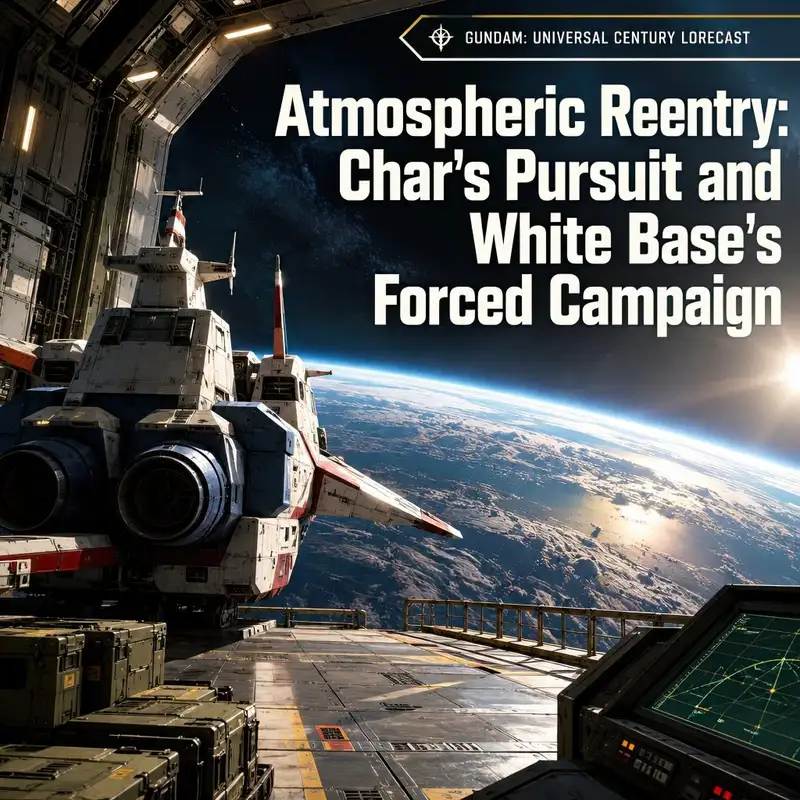
Atmospheric Reentry: Char’s Pursuit and White Base’s Forced Campaign
White Base had only minutes before the atmosphere made its next decision irreversible. The ship was descending toward Earth with experimental mobile suits in its hangars, refugees in its compartments, and a crew that had learned too much too quickly since Side Seven. Reentry capsules were separating. Navigation had to be settled. Defensive stations had to be manned by people who were still becoming sailors and soldiers under fire. Then Char Aznable’s Zakus closed in.
This was not an ordinary space engagement in which either side could disengage, regroup, and try again. White Base was approaching a point where its course, speed, and heat protection would decide whether it reached Earth at all. Char’s force faced the same clock. His mobile suits could not remain outside the atmosphere indefinitely and expect a safe return. The attack was measured in seconds, not merely ammunition or distance. In that narrow interval, Char found the vulnerability that would turn White Base’s intended movement toward Jaburo into a forced campaign through Zeon-held North America.
The civilians aboard made the situation more complicated still. White Base was a warship, but it was also an improvised refuge. The people aboard required air, food, water, shelter, medical attention, and some assurance that military necessity would not simply erase their status as civilians. That did not make the ship less valuable as a target. It made its loss more consequential. A successful Zeon attack would not only destroy a Federation prototype force. It would kill or strand people who had already been displaced by the opening violence of the war.
White Base’s destination was Jaburo, the Federation headquarters deep beneath the surface of South America. Reaching it would place the ship, its surviving personnel, and its experimental mobile suits inside a major Federation stronghold. It would offer repair facilities, command authority, supply, intelligence, and the chance to transfer the Gundam program from desperate field survival into a broader military structure. But first, White Base had to descend from orbit. It could not simply point its bow toward Earth and improvise once gravity began pulling harder.
Atmospheric entry is a commitment. A spacecraft approaches the upper atmosphere at enormous speed. Its path must balance speed, angle, and heat. Enter too sharply, and thermal stress and structural strain can become catastrophic. Enter too shallowly, and the craft may fail to descend as intended. A vessel cannot casually reverse direction once it has entered the critical part of that approach. It must manage its motion, protect its hull, and preserve enough control to arrive somewhere survivable.
That made the transition dangerous even before Char appeared. White Base had to coordinate its own descent with the movement of a Salamis cruiser and the launch of reentry capsules. The Salamis was not descending with White Base for a long ground operation. Its capsule contributed to the descent plan, while the cruiser itself was intended to return toward Luna Two. The capsule, the ship, and the mobile suits all had different roles and different limits. A disruption at the wrong moment could leave personnel exposed, destroy equipment, or scatter the surviving force across a hostile planet.
Char understood that White Base was vulnerable because its route was predictable. He did not need to know every detail of the ship’s internal condition. He only needed to recognize that a vessel entering the atmosphere had less freedom to maneuver than one operating in open space. The ship was committed to a descent. Its crew was occupied with reentry. Its mobile suits could not be launched without creating an additional recovery problem. Its defensive systems were being operated under pressure by personnel who had not been trained together for long.
His objectives were direct. Destroy or capture White Base. Destroy the Federation mobile suit that had already demonstrated unusual combat value. If possible, prevent the ship from reaching Earth under its own control. Yet Char’s attack was constrained by the same physical reality that made it attractive. His Zakus had only a very short interval before they too would be forced to begin their own descent or risk being consumed by atmospheric entry. The operation could not become a leisurely pursuit. It had to be a strike built around timing.
White Base answered the attack as a carrier fighting for its life. The Gundam had to be launched, but launching it created another deadline. Amuro Ray could not remain outside the ship indefinitely. He was given a strict return limit because the Gundam’s mission was not independent conquest of the battlefield. Its purpose was to protect White Base through the transition into the atmosphere. If the Gundam survived but could not return, White Base would lose one of its most valuable weapons. If White Base was destroyed, the Gundam would have nowhere to land, rearm, repair, or receive direction.
Bright’s command during the engagement was shaped by the emergency around him. He had to keep White Base on a viable reentry path while directing defensive fire and deciding when the Gundam could be risked. He had to make judgments without full information and without the institutional depth that a mature combat group would normally possess. The point is not that Bright was uniquely unprepared. The point is that White Base itself was an emergency formation. The Federation’s planned system had been disrupted at Side Seven, and the survivors were now improvising under conditions no peacetime training schedule could fully prepare them for.
Mirai’s role was equally practical. Navigation during reentry was not background work. It was the difference between an arrival and a disaster. Every evasive action had to be weighed against the ship’s descent. Every delay affected the broader plan. The crew operating weapons had to defend the vessel while avoiding the illusion that firepower alone could solve the problem. Missile and machine-gun fire could drive off attackers or complicate their approach, but it could not create more time before entry. It could not restore a damaged system by force of will. The calendar of the battle was written by orbital motion.
The Salamis capsule became one of the points where that pressure showed most clearly. Char’s force did not need to destroy White Base outright to damage the Federation plan. Attacking the capsule could disrupt the descent, scatter the force, and increase confusion among a crew already divided between ship control and combat. Damage to the capsule was a reminder that the operation involved more than a single famous mobile suit. White Base was part of a fragile collection of ships, launch systems, personnel, and evacuation arrangements. Weakness in one component could threaten the rest.
Amuro’s engagement with Char unfolded within that larger emergency. The Gundam had to fight while White Base continued descending. Char’s Zakus threatened the ship and its associated capsule while Char himself pressed the mobile-suit confrontation. The battle became a contest over time as much as position. Amuro could not simply pursue every enemy. Char could not remain long enough to make the fight decisive. White Base could not wait for a perfect tactical result. Its crew needed the Gundam to delay or disrupt the attack long enough for the ship to survive entry.
The television version of this operation gives the Gundam an emergency means of surviving reentry: heat-resistant film stored in the mobile suit’s lower torso. That detail matters because it reveals both the ingenuity of the immediate solution and its limits. The procedure was not evidence that the Federation had developed a standard, reusable method for ordinary mobile suits to conduct full atmospheric reentry intact. The intended emergency logic involved separating the Gundam’s components and returning as a Core Fighter. The system was designed around survival and recovery, not routine independent deployment from orbit.
Amuro’s ability to remain with the complete Gundam through reentry was therefore an exceptional field success. It demonstrated what a highly capable prototype and a determined pilot might accomplish in a crisis. It did not prove that the Federation could now drop intact mobile suits through the atmosphere as a normal doctrine. A prototype surviving one dangerous event is not the same as a force structure. It says nothing by itself about how many machines could be built, how many pilots could repeat the maneuver, how often the equipment could be reused, or whether field units could maintain it.
Char, meanwhile, had reached the end of his own window. He ordered withdrawal. This was not an admission that the attack had achieved nothing. White Base had been damaged, its descent had been disrupted, and its planned route had been compromised. But Char had failed at his central tactical aim. White Base remained intact enough to continue. The Gundam was still operational. His own force could not remain outside the atmosphere simply to pursue a result that the clock had made increasingly unlikely.
Crown did not withdraw in time. He continued fighting after the viable return window had closed and failed to reach the Komusai. His death is easy to remember as one more casualty in a dramatic aerial sequence. It deserves a more sober reading. Crown was killed by a combination of combat pressure, a missed withdrawal order, and the unforgiving limits of reentry. In space operations, a few seconds can separate a difficult recovery from the loss of a pilot and machine. There was no heroic tactical advantage in remaining too long. There was only the closing of the atmosphere around him.
Crown’s death also shows why Char’s operation was not a clean success. Char had identified a real weakness and exploited it aggressively. But he lost a subordinate, failed to destroy White Base, and could not prevent the Gundam from surviving. His force imposed damage and disruption, yet it did not secure the decisive result. The difference between a raid that creates trouble and an operation that achieves its objective can be very large. White Base was hurt, but it was still moving.
The operational consequence was more important than the immediate exchange of fire. White Base did not continue cleanly along its intended path toward Jaburo. Char’s attack forced the ship into an altered descent over Zeon-controlled North America. That redirection transformed its mission. What had been a dangerous transfer of personnel and experimental equipment became an isolated survival campaign inside enemy-held territory. White Base had reached Earth, but it had reached the wrong part of Earth under the wrong conditions.
Every practical requirement of war now became more immediate. The ship required repairs after reentry and combat damage. Its weapons required ammunition. Its mobile suits required maintenance after both space and atmospheric operations. The crew needed rest and medical care. The civilians needed food, air, shelter, and some form of safety. Navigation became route selection through enemy territory rather than simply guidance toward a planned landing point. Intelligence meant finding out where Zeon forces were, where Federation assistance might exist, and which movements would expose the ship to aircraft, armor, or mobile suits.
Garma Zabi inherited this problem. As commander of Zeon’s North American forces, he had the formal responsibility to deal with an unexpected Federation vessel moving through his territory. That responsibility was military and political. White Base carried advanced Federation equipment, had already survived Char’s pursuit, and represented a challenge to Zeon’s control of the region. Destroying it would be a legitimate operational success. Failing to do so would reflect badly on a commander who was also the youngest member of the ruling family.
Garma had meaningful assets. He could draw on Zeon’s regional infrastructure and on forces suited to operations under gravity. Gaw carriers gave his command mobility and striking power. Dopp aircraft could search, harass, and attack. Zakus could engage White Base’s mobile suits or strike at the ship itself. Magella Attack tanks and other ground forces gave Zeon options across terrain where mobile suits were not the only useful weapon. The occupation system also gave Garma access to local communications, bases, and information networks that White Base lacked.
His weakness was not the absence of forces. It was the gap between formal authority and reliable judgment. Garma operated beside Char, a man with more direct experience against White Base and the Gundam. Char could offer useful tactical knowledge, but he also had motives Garma did not understand. Garma’s political position encouraged him to value decisive personal success. He wanted to prove himself to the Zabi family and to the wider Zeon war effort. That ambition did not make him irrational. It did, however, make him more vulnerable to a trusted subordinate or associate shaping the information on which he acted.
White Base’s campaign through North America was therefore a contest of movement. The ship could not stay still. Zeon could not allow it to move freely. The Federation vessel needed to find routes, conceal itself where possible, launch and recover its mobile suits, and avoid expending its limited strength in every encounter. Zeon needed to use its regional control to identify the ship, bring multiple arms to bear, and force it into an engagement on unfavorable terms.
The character of combat changed after the descent. In orbit, White Base’s immediate problem had been timing, reentry geometry, and an enemy strike force operating near the edge of its own survival window. On Earth, terrain and atmosphere mattered. Aircraft could attack from above. Ground forces could use roads, bases, and prepared positions. Mobile suits had to function under gravity rather than in free fall. White Base’s own weapons remained important, but the ship also depended on the Gundam, Guncannon, Guntank, and Core Fighter operations to keep enemy forces from closing in and overwhelming it.
Amuro’s effort to contact Federation forces showed that White Base’s isolation was strategic, not merely personal. The ship was not refusing help out of pride. It lacked dependable connection to the system it was trying to reach. The Federation existed on Earth, but that did not mean every isolated unit could immediately draw on its resources. Headquarters, local forces, communications, and transportation were all separated by distance, enemy control, and the practical disruptions of war. A nation can possess immense resources and still fail to make them available where they are needed.
The refugees aboard White Base made this isolation more difficult. Military planners often speak of passengers, dependents, or evacuees as though those terms settle the matter. They do not. People need care. They become ill, frightened, exhausted, and separated from family. They have opinions about the forces carrying them and the places where they may be taken. They can become a burden on a ship’s supplies, but describing them only as a burden misses the political reality. White Base was responsible for people whose survival had become inseparable from its own.
The temporary cease-fire and refugee departures during this campaign reveal those pressures. For a brief period, the conflict could not be treated as a simple contest between White Base and Garma’s military formations. Civilians had to be moved. Their immediate safety created obligations that neither side could entirely ignore. The pause did not end the campaign, and it did not eliminate Zeon’s broader political control of the region. But it showed that armed forces operate among people whose needs can interrupt, constrain, and expose the limits of military plans.
The cease-fire also demonstrated how fragile humanitarian arrangements can be in a war shaped by propaganda and mistrust. A local pause may allow civilians to leave immediate danger, but it does not repair the larger political order that created the danger. White Base remained under pursuit. Zeon still held the surrounding territory. The refugees were not magically restored to secure homes simply because they stepped off a warship. They remained people displaced by a conflict whose leaders had treated colonies, cities, and populations as instruments of strategy.
Amuro’s resistance to continued combat belongs in that same context. He was young, exhausted, and repeatedly placed in situations where the survival of the ship appeared to depend on him returning to the cockpit. It is not necessary to invent private motives to understand the strain. The Gundam may have been an advanced machine, but its pilot was still a human being subjected to fatigue, fear, responsibility, and the pressure of being treated as indispensable. White Base could not function if every crisis was solved by ordering the same person back into battle without regard for the cost.
That pressure extended across the ship. Bright had to make hard decisions because he had no reliable luxury of rest or reinforcement. Mirai had to continue navigating through danger. Ryu Jose and the other pilots had to fly and fight in support of a force whose procedures were still developing. Kai Shiden and Hayato Kobayashi were part of a crew that had been pulled from civilian life or incomplete training into a military crisis. Their uneven confidence was not a weakness of character. It was evidence of a state forced to mobilize people faster than it could prepare them.
While White Base struggled to preserve itself and its passengers, Char’s relationship with Garma changed the meaning of the campaign. The reentry attack had delivered White Base into Garma’s command area. That was already a partial tactical success for Char. The ship had been diverted, damaged, and isolated. Garma now had the opportunity to destroy it with local forces. But Char was not satisfied with the destruction of White Base alone. The North American campaign also gave him access to Garma, to his trust, and to the political vulnerabilities of the Zabi family.
Char’s final intervention was not merely a dramatic act of betrayal between two officers. It was an intelligence and command failure. Garma had authority, troops, aircraft, and a regional command structure. What he lacked was reliable understanding of the intentions of the man advising him. Char possessed privileged access because Garma considered him a friend and a valuable subordinate. That trust allowed Char to shape Garma’s approach to White Base. In military terms, he turned insider knowledge and personal confidence into a weapon.
The deception worked because Garma was not a passive figure being pushed toward death. He chose to pursue White Base. He chose to place himself at the center of the operation. His need for a decisive victory made him willing to accept an aggressive approach. Char did not create Garma’s ambition, but he understood it and used it. The result was a fatal mismatch between Garma’s formal command authority and his actual control of the information guiding his attack.
White Base exploited the opportunity created by that approach. The immediate tactical result was the destruction of Garma’s attack and Garma’s death. For the ship’s crew, this was not an abstract political development. It removed the commander directing the most immediate regional pursuit. It allowed White Base to remain alive and continue moving toward Jaburo. But the result had several layers, and each tells a different story.
On the battlefield, White Base defeated the immediate threat. Its crew and mobile suits survived another engagement against a force that had tried to destroy or capture them. At the mission level, the ship remained capable of continuing its journey. The experimental mobile suits had not been lost. The people aboard had not been abandoned in Zeon-held territory. Those were significant achievements for a force that had entered the atmosphere under attack.
At campaign scale, however, the result was larger than a single battle. Zeon’s North American pursuit lost its commanding figure at a moment when White Base was already difficult to contain. Garma’s death did not erase every Zeon asset in the region, but it disrupted the coherence of the effort against White Base. Regional infrastructure, aircraft, and ground forces are useful only when command can direct them toward a coherent purpose. The loss of a commander can create hesitation, rivalry, confusion, and a need to reestablish authority while the enemy continues moving.
At the intelligence level, Char had demonstrated how vulnerable a command system can become when trust is exploited from within. Garma’s forces had local advantages. They knew their own territory. They had access to bases and aircraft. They could move through an occupied region more easily than White Base could. Yet none of those advantages protected Garma from false guidance at the decisive moment. A command structure can possess ample weapons and still fail if its leader is being steered by someone whose political objectives are concealed.
Politically, Garma’s death was even more consequential. He was not merely a regional officer. He was a Zabi, a member of the family that ruled the Principality of Zeon. His death could be presented as a personal tragedy, a military loss, and a call for renewed unity. Gihren Zabi could use the event to mobilize public emotion and reinforce the image of a family sacrificing for the state. In wartime politics, grief can become propaganda quickly, especially when the dead person is tied to the ruling structure.
That did not mean Garma’s death strengthened Zeon in every respect. Propaganda can rally a population, but it cannot replace a lost commander or repair broken trust inside the military. Dozle Zabi held Char responsible for failing to protect Garma. Char’s immediate position suffered as a result. He was removed from the Space Attack Force and displaced from the direct pursuit of White Base. His revenge had succeeded, but it had not produced a clean personal victory. He had damaged the Zabi family, yet he had also damaged his own standing within the Zeon military system.
This is why Char’s role in the campaign resists a simple label. He showed real tactical skill during the reentry attack. He identified a moment of vulnerability and nearly converted it into the destruction of White Base. He also understood Garma well enough to manipulate him into a fatal position. But his actions were driven by more than Zeon’s strategic interests. The destruction of White Base would have been a military success for Zeon. Garma’s death served Char’s private political revenge. Those objectives overlapped only temporarily, and the difference between them shaped the outcome.
White Base’s survival should not be mistaken for proof that the Federation had suddenly mastered the war. The ship remained damaged, isolated, and dependent on unusual equipment and exhausted people. Its successes came through improvisation, the ability of its crew to learn under pressure, the value of experimental mobile suits, and failures within the enemy command structure. None of those factors guaranteed an easy route to Jaburo. The Federation still had to transform one surviving ship and a handful of prototypes into part of a wider war effort.
Yet White Base’s survival did preserve something important. The ship carried the Gundam program forward at a moment when the Federation needed to understand how mobile suits could be used, supported, and improved. It carried personnel whose experience in space, reentry, and ground combat would matter beyond the immediate campaign. It carried evidence that advanced machines required more than technical brilliance. They required crews, carriers, repair systems, command judgment, and institutions capable of learning from crisis rather than merely celebrating survival.
Atmospheric reentry exposed that truth with unusual clarity. The Gundam could not protect White Base without White Base launching and recovering it. White Base could not enter the atmosphere safely without navigation, heat protection, and a crew able to manage damage. The refugees could not be treated as invisible cargo without weakening the moral and political basis of the force carrying them. Zeon’s local superiority could not guarantee victory when its command relationships were vulnerable to personal ambition and deception.
Char’s pursuit therefore achieved less and more than it first appeared. It failed to destroy White Base. It failed to eliminate the Gundam. It cost Char a subordinate during the reentry battle and eventually cost him his immediate operational position after Garma’s death. But it did divert White Base into North America. That diversion created the forced campaign. The forced campaign placed Garma in direct responsibility for a dangerous Federation ship. And that responsibility gave Char the access and circumstances he needed to turn a difficult territorial-defense operation into a fatal political trap.
Atmospheric reentry transformed White Base from a damaged ship attempting a transfer to Jaburo into an isolated combined-arms force compelled to fight its way through occupied territory. Char identified that vulnerability and exploited it with real tactical skill, but his pursuit did not destroy White Base. Instead, it delivered the ship into Garma’s command area, where Char’s personal revenge turned a difficult territorial-defense operation into a fatal political trap.