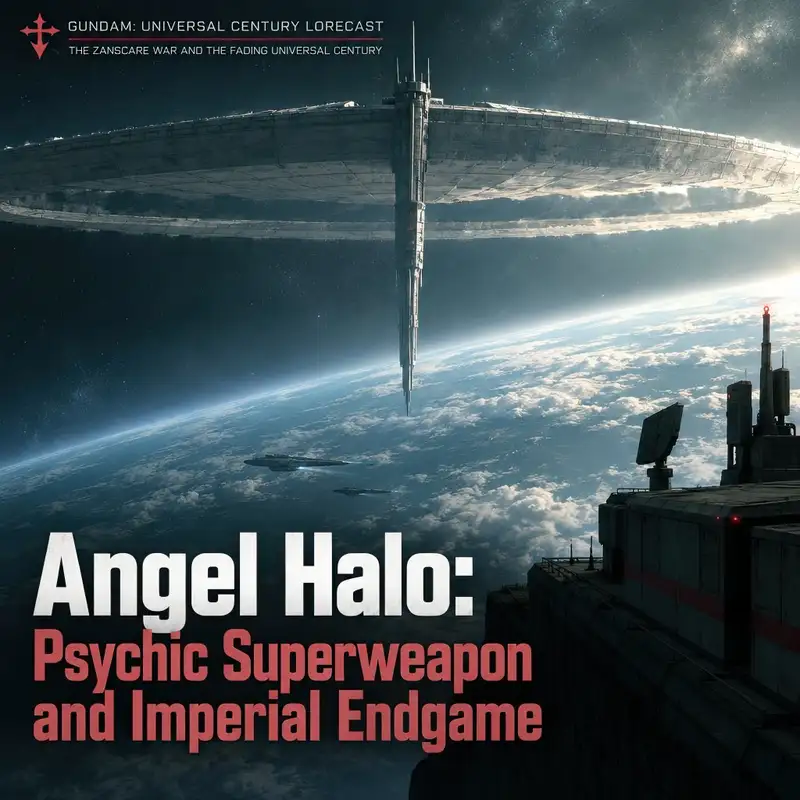
Angel Halo: Psychic Superweapon and Imperial Endgame
Queen Maria Pure Armonia enters the Key Room as Angel Halo begins a test operation. On the surface, the scene appears to fulfill the promise of Mariaism. A queen identified with maternal compassion is about to project peace through a vast ring-shaped installation built at the end of a brutal war. But the effects are not peaceful in any ordinary political sense. Uso Ewin is caught in Maria’s projected thoughts and overwhelmed by visions and disorientation. He does not experience a negotiated end to conflict. He experiences helplessness. Shakti Kareen’s voice helps draw him back, but the test has already revealed the contradiction at Angel Halo’s center. Zanscare called this a path toward harmony. In practice, it was a weapon that could reach into perception, motivation, and the ability to act.
The distinction matters. Angel Halo was not simply a larger mobile armor, a more destructive cannon, or an advanced version of a familiar psycommu weapon. Its purpose was not primarily to destroy ships or defeat an enemy formation through firepower. It was designed to alter people. It could sap the will to fight, induce sleep, produce hallucinatory experiences, and threaten a regression of human life into passivity. The military target was therefore not armor, propulsion, or command headquarters. It was the human mind, and through the mind, the political capacity to resist.
This made Angel Halo a political program embodied in infrastructure. Its rings, Key Room, psychickers, escorts, and fleet defenses were all parts of a single idea. Zanscare’s leadership had concluded that peace could be imposed by neutralizing the aggression, independence, and consciousness that made conflict possible. The result was an imperial endgame that used the language of care to justify control on an unprecedented scale. To understand why Angel Halo existed, it is necessary to move away from the installation itself and toward the regime that believed it needed such a weapon.
Angel Halo depended on an apparatus capable of turning an ideal into a military system. The installation was built around the Key Room, the place from which a central psychic presence could influence the larger structure. Its ring-like body housed a network of people identified in the series as psychickers. Their minds were not incidental to the weapon. They were its essential human infrastructure. Angel Halo did not operate like a missile launched at a target. It functioned through the amplification and coordination of human sensitivity.
The exact technical mechanism remains unresolved in the television record. The series shows an installation capable of projecting thought and exerting a broad psychological influence. It shows people falling asleep, losing the will to fight, suffering visions, and becoming vulnerable to regression-like effects. It does not provide a complete scientific model that can be reduced to a manual, a power rating, or a reproducible formula. The number of psychickers involved, the exact dimensions of the structure, and the full architecture of its systems are not securely established by the animated record. Those uncertainties are important because Angel Halo is not presented as an ordinary machine with a transparent technical logic.
What is clear is that Zanscare built a weapon whose power came from the organized use of human beings. The psychickers were not merely operators sitting at consoles. They formed an organic amplification network. In military terms, this made Angel Halo less like an autonomous strategic weapon and more like a command-and-control system that used living minds as its active medium. The regime claimed to be building peace, yet its instrument depended on placing a population of sensitive people inside a structure designed to override the agency of millions more.
Kagatie’s association with the Jupiter sphere helps explain how such a project could be assembled and moved beyond ordinary public scrutiny. But the series does not support a precise industrial ledger of factories, construction schedules, or transport tonnage. What matters historically is the political and logistical fact of concentration. Angel Halo gathered specialized human resources, advanced equipment, and command authority into a single strategic project. Such concentration creates power, but it also creates vulnerability. A weapon intended to reshape humanity still had to be protected, supplied, controlled, and moved into position.
Angel Halo’s intended movement toward Earth turned it into both Zanscare’s greatest strategic instrument and its largest operational liability. A conventional fleet can disperse, maneuver, withdraw, and regroup. A massive installation carrying a human psychic network cannot disappear into the background. It needs escorting forces, secure command arrangements, time to function, and enough political coherence to keep its operators working toward the same objective. Every hour spent preparing or moving Angel Halo gave its enemies an opportunity to identify, approach, and attack the system supporting it.
For the Earth Federation Forces and the League Militaire, the final campaign was therefore more than an effort to win a fleet battle. Their objectives overlapped but were not identical. They had to prevent Angel Halo from reaching Earth. They had to break the Zanscare military screen around it. They had to keep open a route for a penetration mission. And they had to recover Shakti, who had become central to the weapon’s operation without consenting to its purpose. The final assault combined fleet action, mobile-suit combat, ship-to-ship engagement, rescue, and desperate local initiative.
The League Militaire could not simply send Uso and the V2 Gundam into Angel Halo and expect one exceptional pilot to settle the matter. The installation was protected by Zanscare forces, and its movement toward Earth created a time problem. Even a successful attack on the center might leave a damaged strategic structure descending toward the planet. The defenders did not need to defeat every Federation or League ship. They only needed to preserve Angel Halo long enough for its effects to become decisive.
Before the external assault could fully develop, however, Zanscare’s own command system began to break apart. Tassilo Vago, a senior officer with his own ambitions and grievances, turned against Kagatie. His revolt was not a democratic alternative to Zanscare rule. Tassilo was not attempting to dismantle the machinery of terror or return political authority to the people endangered by Angel Halo. He was conducting a palace coup, driven by suspicion, rivalry, and the chance to seize power while the regime was under military pressure.
Tassilo’s rebellion mattered because it exposed the secrecy on which Angel Halo depended. He revealed enough of the concealed purpose behind the weapon to shake Maria’s faith in the project. The queen had believed that Angel Halo could transmit a peaceful influence. She had not been treated as a fully informed political decision-maker. Kagatie had used her image and her beliefs as part of the weapon’s legitimacy while withholding the destructive implications of its intended employment.
This was not simply a personal betrayal. It was a command failure. Angel Halo required unified political direction, disciplined military protection, and confidence among the people operating it. Instead, Zanscare had divided formal authority from practical authority. Maria possessed the symbolic role. Kagatie controlled the state. Tassilo controlled military forces of his own and saw an opening to displace his former superior. Chronicle Asher remained tied to the state, to Maria, and to a military sense of duty that could not resolve the political contradictions surrounding him. The more the leadership concealed from one another, the less capable it became of acting as a coherent command.
In a conventional campaign, a coup can disrupt communications, split units, and confuse orders. Around Angel Halo, the effect was even more severe. The weapon’s strategic value depended on a claim to moral unity. It was supposed to embody a higher peace beyond ordinary political conflict. Instead, its own ruling circle was fighting over access to the queen, control of the military, and the meaning of the weapon itself. Zanscare was attempting to impose harmony on the Earth Sphere while its leadership could not sustain trust inside one command structure.
Maria’s removal made the truth unmistakable. Once her conscience became inconvenient, she could be set aside. Her nominal sovereignty had never been the source of Angel Halo’s real authority. The project belonged to Kagatie’s state, and the state required a compliant figure at its center. Shakti was placed in the Key Room as Maria’s replacement. The substitution was militarily useful because Shakti possessed the sensitivity needed for the system. Politically, it was an act of hostage-taking.
Shakti’s presence did not mean that she endorsed Zanscare’s project. Her desire was to stop violence, not to administer an empire by suppressing thought. The distinction between those aims is the heart of Angel Halo’s tragedy. Peace can mean the absence of immediate fighting because people have reached some degree of consent, security, and political accommodation. Or it can mean silence enforced by fear, exhaustion, and the destruction of the ability to choose. Kagatie treated those two meanings as interchangeable. Shakti did not.
By replacing Maria with her daughter, Zanscare also revealed the emptiness of its own maternal symbolism. The regime had presented Mariaism as a politics of care. But when the woman at the center of that ideology resisted the weapon’s true purpose, her daughter became an instrument in her place. The state did not protect the family it invoked. It exploited family bonds to preserve control. Maria’s moral authority was useful only until it threatened Kagatie’s plan. Shakti’s vulnerability was useful precisely because she could not freely consent.
The civilian stakes of Angel Halo were correspondingly vast. Its threat was not limited to uniformed combatants at the front. A weapon that induces sleep, weakens the will, and produces regression-like effects threatens the social life of entire communities. It threatens people who cannot defend themselves with a mobile suit or flee aboard a warship. It threatens children, families, workers, institutions, and the basic continuity of human life. The series does not establish a precise global casualty forecast, nor does it require one. The danger lies in the intention to transform a population without its consent.
As Angel Halo’s influence expanded, the series also showed that psychic sensitivity was not a simple battlefield advantage. Uso’s heightened sensitivity made him especially vulnerable to the weapon’s effects. His awareness allowed him to perceive more than an ordinary pilot might, but it also exposed him to experiences that could disrupt judgment and action. This is a recurring problem in the Universal Century. Exceptional perception can provide warning, connection, and tactical awareness. It can also create overload, trauma, and an opening for institutions that want to exploit the mind.
The battle involving Fuala Griffon makes this point from another angle. As Angel Halo’s influence reaches farther, Fuala’s combat judgment is affected by her perception of Marbet Fingerhat’s pregnancy. In an ordinary staff analysis, pregnancy would not appear on a weapons-effect chart. Yet Angel Halo’s influence is not ordinary firepower. It reaches into emotion, memory, empathy, and perception. Fuala’s concentration breaks, and she is defeated. The event does not establish that every sensitive pilot will react in the same way. It demonstrates that a weapon directed at the mind produces uneven and deeply personal effects.
That unpredictability is one reason Angel Halo could not become a stable instrument of military doctrine. Zanscare could aim it at populations and formations, but it could not treat human consciousness as a uniform material. The very qualities the regime hoped to exploit varied from person to person. Fear, attachment, memory, grief, and empathy did not disappear under centralized control. They became part of the battlefield. A commander can estimate fuel, ammunition, and the number of available ships. He cannot calculate the meaning of a child, a mother, or an old wound in the mind of every person caught inside a psychic field.
The series calls the people within Angel Halo psychickers, but it does not define them as identical to earlier Newtypes or explain their relationship to every previous research program in the Universal Century. That restraint should be preserved. Angel Halo is not routine psycommu doctrine scaled upward. It is a late-war system with its own human and political logic. It turns sensitivity into infrastructure, then attempts to use infrastructure to solve a political problem that no machine can actually solve.
Mental coercion shaped the final campaign, but it did not eliminate conventional warfare. Fleets still had to approach, defend, maneuver, absorb damage, and maintain enough cohesion to continue fighting. Mobile suits still had to penetrate defenses. Ships still had to carry crews, recover machines, coordinate attacks, and survive under fire. The final battle around Angel Halo is not a series of isolated duels. It is a combined assault against a strategic installation protected by an empire whose conventional power is weakening but remains dangerous.
The Jeanne d’Arc fleet pressed its attack against Tassilo’s forces while the wider Federation and League Militaire operation closed on Angel Halo. This fleet pressure had a clear operational purpose. It fixed defenders in place. It forced Zanscare commanders to divide attention between the external threat and their internal revolt. It disrupted the protective system around the installation. And it opened opportunities for smaller units to move toward the center. No single ship or mobile suit could perform all of these tasks. The campaign required pressure at multiple scales.
The Motorad formation remained one of Zanscare’s conventional defensive tools. Its presence underlined the fact that even an empire pursuing psychic domination still depended on ships, formations, crews, and physical weapons. Angel Halo could weaken resistance, but it could not escort itself. It needed people willing and able to defend it. Once those defenders were divided by political collapse and battered by fleet action, the superweapon’s supposedly transcendent power became tied once again to ordinary military realities.
Tassilo’s final actions showed how completely the coup had failed to create an alternative political order. Maria appealed to Uso to stop him. Tassilo responded by shooting the queen whose moral authority he had tried to use as a shield. He had not liberated Maria from Kagatie’s manipulation. He had merely demonstrated that her life and legitimacy were expendable to anyone seeking control of Zanscare. Uso’s destruction of the bridge of the Schubatten killed Tassilo and sank the vessel. It was a tactically decisive act against an immediate threat.
But destroying Tassilo did not restore Maria, repair Zanscare’s legitimacy, or reunify its command. The queen was dead. The symbolic heart of Mariaism had been destroyed by a senior figure within the regime that claimed to exist in her name. This was the political consequence of Angel Halo’s secrecy. Kagatie had built a system that required Maria’s image while denying Maria meaningful authority. When crisis came, the result was not loyalty. It was betrayal, murder, and competing claims to the machinery of power.
With both internal and external defenses degraded, the battle narrowed toward the Key Room. This did not make the operation simple. The closer the League Militaire came to Angel Halo’s center, the more carefully it had to distinguish between destroying a hostile system and rescuing the people trapped inside it. A conventional fortress can sometimes be neutralized by overwhelming fire. Angel Halo could not be treated so casually. Its human network, its captive central figure, and its position relative to Earth made indiscriminate destruction a dangerous answer.
Uso’s V2 Gundam was critical in this phase because it could penetrate where larger formations could not. Its mobility and survivability allowed Uso to reach the interior defenses and move toward Shakti. But the V2’s importance should be understood in mission terms. It was not a solitary solution to a strategic crisis. It was the instrument of a rescue operation made possible by the fleet battle outside, by the League Militaire’s willingness to hold open an approach, and by the accumulated failures of Zanscare’s own command.
Katejina Loos, in the Gottratan, and the Neneka Corps served as local defenders attempting to block that approach. Their role was tactically meaningful. They did not need to reverse the entire war. They only needed to delay Uso long enough for Angel Halo to continue operating and moving toward Earth. Yet Katejina’s actions in this late phase were increasingly driven by fixation and hatred rather than by a coherent operational calculation. A force can still be dangerous when its leadership is unraveling, but it becomes less capable of matching tactical violence to strategic purpose.
Uso reached the center and recovered Shakti. That was a major mission success, but it did not immediately end the crisis. Angel Halo began descending toward Earth. This is the problem with attacking a strategic system in motion. Removing the hostage and breaking into the command center can destabilize the weapon without rendering it harmless. A damaged installation can become more dangerous if it continues along a course that no longer has coherent control behind it.
The final phase therefore became a race between physical descent, collapsing defenses, and the rapidly diminishing ability of the League Militaire to impose control on events. The force opposing Zanscare had already endured a long war. It did not possess unlimited ships, pilots, or replacement crews. Its losses around Angel Halo were severe. The destruction of the Shrike Team was not merely another tragic tally in a war already full of them. It demonstrated the human cost of forcing open a route to the center of an imperial weapon.
The Shrike Team had operated as a combat unit within a larger struggle, not as a collection of symbols waiting for a final sacrifice. Their loss showed the limits of courage as a military resource. Courage can hold a position, cover a withdrawal, or create a few more minutes for a rescue. It cannot replace ships, trained personnel, maintenance capacity, or the strategic depth that a small resistance force lacks. By the time of the Angel Halo battle, the League Militaire was fighting not because it had found a clean solution, but because every available solution carried an intolerable cost.
The Reinforce Junior’s final action made that exhaustion visible. Its elderly crew deliberately rammed a Zanscare battleship, destroying the Motorad formation. Tactically, the attack worked. It removed a dangerous defensive element and helped open space in a battle where time mattered. Operationally, it disrupted Zanscare’s ability to maintain a coherent screen around Angel Halo. But it also revealed the condition of the force making the attack. A damaged ship, crewed by people who had already been asked to bear more than a normal military system should demand, was used as a weapon because less costly options were running out.
There is no need to romanticize that decision in order to recognize its importance. The ramming attack was an act of courage, but it was also evidence of institutional scarcity. Resistance movements and improvised military coalitions often survive through local initiative and sacrifice. Those qualities can be decisive in a crisis. They are not signs of a healthy replacement system. The Reinforce Junior’s destruction helped save others, but it did not make the loss acceptable in some abstract accounting. It was the price paid by people when war had narrowed their choices to survival or self-destruction.
The conventional battle could open a path and break defensive formations. It could not fully control what Angel Halo had become. Shakti returned to the Key Room, not to resume the state’s plan but to try to stop the weapon. Her response was prayerful and personal. It did not resemble an officer entering a command console with a tested shutdown procedure. The series presents the resulting change in Angel Halo’s behavior through a warm vibration that alters the crisis without offering a final technical explanation.
That event should not be reduced to a standard system effect. It is not presented as a reproducible procedure available to any pilot, operator, or future government. Nor is it evidence that every extraordinary psychic event in the Universal Century follows one settled metaphysical rule. The series shows Shakti acting from a desire to end violence, and it shows Angel Halo responding in a way that escapes Kagatie’s intended control. What exactly happens at the deepest level remains unresolved.
Its political meaning, however, is clear. Kagatie’s system depended on imposed mental control. It relied on reducing psychickers to components, Shakti to a hostage, Maria to a symbol, and entire populations to objects that could be pacified from above. The decisive intervention came from a person who rejected the role assigned to her. Shakti did not defeat Angel Halo by mastering Kagatie’s purpose more effectively than he did. She acted against that purpose. The weapon began to fail because the human being at its center would not become the instrument the state required.
This is the weakness hidden inside every project of total control. It can centralize authority, terrorize dissent, and make extraordinary demands on people trapped within it. But it cannot turn consent into a mechanical input. The more it attempts to do so, the more it depends on coercion, secrecy, and the unreliable loyalty of people who know they are being used. Angel Halo was meant to eliminate the unpredictability of human agency. Instead, it was undone by agency.
As the installation broke apart, Uso still had to fight his way toward Shakti. His final confrontation with Chronicle Asher occurred within the collapse of the system both men had been drawn into. Chronicle remained one of Zanscare’s principal military figures, but he had never been able to resolve the contradiction between personal loyalty, military duty, and the political corruption surrounding Angel Halo. His defeat was therefore more than the loss of one capable combatant. It marked the end of a military structure that could no longer claim a coherent objective beyond its own survival.
Uso defeats Chronicle while trying to reach Shakti, and the V2 Gundam recovers the Key Room. Angel Halo does not complete its descent as Zanscare intended. It breaks apart. At the tactical level, the defenders are defeated, the center is reached, and Shakti is recovered. At the operational level, the descent is prevented from becoming the mass coercive catastrophe Kagatie had planned. The fleet battle, the penetration mission, the ramming attack, and Shakti’s intervention all contribute to that result. None alone explains it.
At the strategic level, Zanscare loses its final coercive instrument and with it the ability to impose its version of peace on the Earth Sphere. The empire’s military defeat is tied directly to its political failure. Angel Halo was supposed to compensate for conventional weakness by making resistance psychologically impossible. Instead, the project accelerated the collapse of the regime that built it. Its secrecy alienated the queen whose authority it required. Its true purpose encouraged factional revolt. Its human dependence created a point of moral and operational vulnerability. Its enormous scale made it impossible to protect without a functioning state behind it.
The political failure was equally profound. Mariaism could have been understood as an appeal to compassion in a violent age. Under Kagatie, it became the language used to justify enforced passivity. Maria’s death exposed the gap between the ideal and the regime. A state claiming to protect humanity had sacrificed its own queen, imprisoned her daughter inside a weapon, and prepared to deprive people across Earth of the ability to act as political and moral beings. That was not harmony. It was obedience without consent.
Zanscare’s institutional collapse also demonstrates the limits of authoritarian centralization. The regime had concentrated power in Kagatie’s hands while using Maria as a legitimizing figure. That arrangement could function while subordinates accepted the illusion that authority was unified. Under pressure, the illusion failed. Tassilo revolted. Military loyalties divided. The queen became a hostage. Command relationships fractured. The empire’s greatest weapon required trust and coordination at precisely the moment its political system had made both impossible.
The human wreckage remained after the military outcome was decided. Katejina survived the war severely impaired, a reminder that the end of a regime does not restore the people damaged by its violence. Shakti survives, but not untouched by what Zanscare demanded of her. Uso survives the final battle, but survival in this war is not the same thing as returning to an undamaged life. The people lost aboard the Reinforce Junior, the Shrike Team, and countless other units do not become less important because Angel Halo failed.
Angel Halo demonstrates that Zanscare’s imperial endgame was never a path to peace. Kagatie took Maria’s promise of compassion and converted it into a system that demanded silence, obedience, and the reduction of human beings to components in a psychic machine. The weapon failed not because coercion lacked power, but because no state can create durable harmony by destroying the agency that makes moral and political life possible.