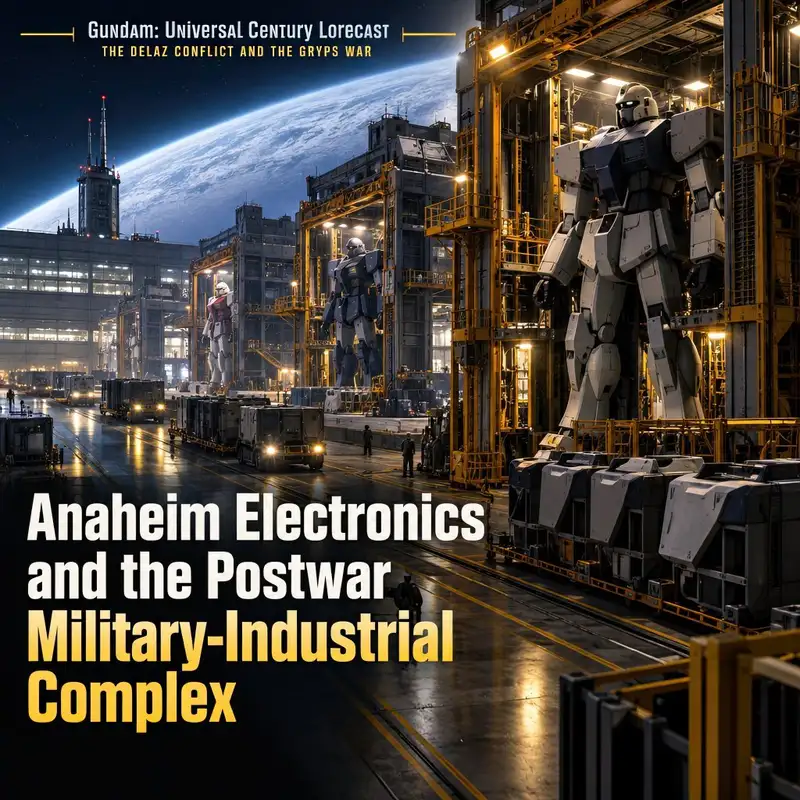
Anaheim Electronics and the Postwar Military-Industrial Complex
The Gundam GP02A was supposed to be a classified answer to a postwar military problem. Instead, in Universal Century eighty-three, it became evidence that the war had not really ended. Built for the Earth Federation’s Gundam Development Project by Anaheim Electronics, the machine was designed to carry a nuclear weapon. When the Delaz Fleet seized it, the theft did more than place a dangerous prototype in hostile hands. It exposed a system in which a victorious government was still preparing for extreme war, a civilian contractor was building weapons of exceptional political sensitivity, and a Zeon remnant force could convert one security failure into a crisis for an entire fleet.
That is the proper place to begin the history of Anaheim Electronics after the One Year War. Not with a corporate logo, not with a list of mobile suits, and not with the claim that Anaheim secretly ruled the Earth Sphere. The company did not command the Federation military, issue orders to the Anti-Earth Union Group, direct Londo Bell, or dictate the objectives of Neo Zeon. Governments, admirals, commanders, and political movements made those decisions. But Anaheim became indispensable because it could do things that the postwar political order repeatedly struggled to do for itself. It could preserve technical knowledge, assemble skilled labor, translate military demands into machines, and maintain working relationships across institutions that distrusted one another.
The phrase military-industrial complex is an analytical one, not an official title for a formal conspiracy. The Universal Century does not show Anaheim sitting above every government as an invisible sovereign. What it shows is more plausible, and in some ways more troubling. It shows governments retaining formal authority while relying on industrial organizations to produce the tools of security. It shows military commands demanding advanced systems under urgent conditions. It shows classified projects shielding both technological innovation and institutional embarrassment. And it shows each crisis creating the demand for the next contract, the next laboratory program, and the next machine that promised to solve a political problem through military means.
Official reference material associates Anaheim’s postwar growth with the acquisition or incorporation of Zeon-related technical expertise. That does not mean every Zeon engineer, research center, or manufacturing line simply became Anaheim property. The surviving record does not support such a tidy transfer. Zeon’s wartime industrial system had been large, divided among multiple firms and organizations, and deeply affected by defeat. Some personnel disappeared into other institutions. Some expertise was captured, purchased, inherited, or repurposed. Some remained beyond Anaheim’s reach. But Anaheim was well positioned to benefit from the dispersal of knowledge that followed the war.
Its advantage lay in consolidation. Mobile-suit development requires more than a promising design team. A contractor needs metallurgical knowledge, reactor expertise, propulsion specialists, weapons engineers, test facilities, manufacturing capacity, access to materials, trained mechanics, and customers able to pay for the final product. It also needs the less glamorous systems that determine whether a machine reaches combat in usable condition: spare parts, maintenance documentation, transport equipment, simulator time, pilot conversion training, and repair personnel who understand what happens after the machine is damaged.
For that reason, Anaheim should not be described as the inventor of everything important in postwar military technology. The Federation had its own arsenals and development programs. Zeon successor groups retained technical traditions of their own. Specialized laboratories pursued systems that were not simply corporate products. The more accurate description is that Anaheim became unusually effective at integrating knowledge. It could take inherited technology, Federation requirements, pilot feedback, captured data, and commercial resources, then turn them into systems that armed organizations could actually deploy. In an era of fractured authority, that ability was worth a great deal.
The Gundam Development Project demonstrates both the value and the danger of that position. The Federation approved the project during the postwar reconstruction period, and Anaheim served as its contractor. The resulting machines were not a normal procurement family in the sense of a standard military program meant for broad, routine service. They were advanced, classified, and politically sensitive systems built to test distinct concepts. Their importance lay not only in what they could do in combat, but in what their existence revealed about Federation priorities after a war supposedly concluded.
The GP01 represented advanced conventional mobile-suit development. It was a high-performance machine intended to push the Federation’s mobile-suit capability forward. The GP02A embodied a much darker requirement. Its purpose was to deliver a nuclear weapon by mobile suit. This was not merely a technical experiment. It indicated that somebody within the postwar Federation security system believed a mobile suit could serve as the delivery platform for a strategic weapon. The GP03 went in another direction, becoming a massive armed-base system designed for major defensive or area-denial operations. Each system addressed a different military problem. Together, they showed a military establishment still searching for decisive technological answers to insecurity.
The problem with exceptional prototypes is that they often sit at the point where military usefulness and political danger overlap. A machine like the GP02A can be defended in narrow operational terms. It offers a delivery method that may be difficult for an opponent to anticipate. It exploits the mobility and flexibility of a mobile suit. It can be tied to deterrence arguments, contingency planning, or the belief that a postwar enemy must never again gain the initiative. But those arguments do not make the weapon politically neutral. Nuclear capability creates obligations of command, security, authorization, custody, and restraint that are far more demanding than simply building an impressive machine.
Anaheim built the GP02A, but the company did not create the strategic environment in which the Federation approved such a weapon. Federation authorities authorized the program. Military institutions established requirements. Security systems were responsible for preventing an adversary from taking possession of it. The distinction matters because the Delaz Conflict is sometimes compressed into a simpler story: Anaheim made a dangerous machine, and disaster followed. The corporation’s responsibility is real. A contractor that produces a weapon of mass destruction cannot pretend that it bears no moral or political burden for the result. But responsibility was distributed. The people who approved the weapon, protected it poorly, stole it, and used it all made separate decisions.
The Delaz Fleet understood the weapon’s value immediately. A stolen prototype is dangerous, but it is not automatically decisive. It must be supplied, operated, protected, armed, and brought to a target. The GP02A became strategically significant because it was incorporated into a broader remnant operation. Delaz’s forces combined deception, mobile-suit action, fleet maneuver, and political theater. The nuclear strike was not an isolated duel between rival Gundams. It was part of Operation Stardust, an effort to demonstrate that Zeon’s defeat had not eliminated its capacity for organized violence or its power to destabilize the Federation.
The operational result was devastating. The nuclear weapon inflicted catastrophic losses on Federation naval forces, while the larger operation moved toward a still broader political and strategic objective. What the Delaz Fleet achieved was not the conquest of the Earth Sphere. It did not possess the industrial base, manpower, or territorial control necessary for that. What it did achieve was disproportionate disruption. It exposed gaps in Federation readiness, damaged public confidence, and created a crisis that powerful actors within the Federation could use to argue for stronger internal security institutions.
This is the first major lesson of Anaheim’s postwar history. Industrial capability can amplify political failure, but it does not replace political decision-making. Anaheim’s prototype gave the Delaz Fleet an opportunity. Federation weakness in oversight and security made that opportunity possible. Delaz’s own leadership chose to turn the opportunity into mass violence. And Federation political leaders responded not by openly confronting every failure that had made the crisis possible, but by protecting the institutions whose credibility had been damaged.
After the Delaz Conflict, the Federation suppressed or erased records connected to the Gundam Development Project. That act deserves attention not because it proves Anaheim controlled the government, but because it shows the political uses of secrecy. A public accounting would have raised uncomfortable questions. Why had a victorious government commissioned a nuclear-capable mobile suit? Who approved it? How had a Zeon remnant stolen it? Why had the Federation fleet been vulnerable? Which commanders ignored warnings, and which officials had protected a classified program from scrutiny?
Suppressing the record did not erase the material consequences of the crisis. Ships had been lost. Personnel had been killed. The Federation’s authority had been shaken. The broader political environment had changed. But secrecy could narrow the field of responsibility. It could make failure appear as an isolated incident rather than the product of a system. It could protect careers, preserve procurement relationships, and prevent public debate about the direction of postwar rearmament. That was useful to the Federation’s institutional leadership. It was also useful to a contractor whose most controversial work remained hidden behind classification.
Still, it is important not to take one further step without evidence. Anaheim benefited from the continuation of classified military programs, but the available record does not establish that Anaheim ordered the suppression of the Gundam Development Project. The Federation had its own reasons to bury embarrassment. A state does not need corporate instruction to protect its legitimacy, its senior officers, or its preferred narrative of postwar control. The company’s influence rested partly on access to that secretive environment, not on proven ownership of it.
The political consequence was severe. Secrecy did not end the arms economy that had helped create the crisis. It weakened public accountability while preserving the systems that generated advanced weapons. The Federation emerged from Operation Stardust more suspicious, more internally divided, and more willing to empower security structures that promised order. The rise of the Titans grew from that atmosphere. The Federation’s answer to instability was not to resolve the grievances, inequality, and political alienation that had made the Earth Sphere combustible. It was to build stronger instruments of coercion.
That choice created new customers, new enemies, and new opportunities for industrial intermediaries. By Universal Century eighty-seven, the Gryps Conflict had transformed the postwar landscape again. The Titans had become a powerful Federation security organization, but they were not the whole Earth Federation Forces. Their authority rested on emergency politics, military access, and the fear generated by renewed unrest. Their brutality, including repression against colonies and opponents, created resistance. The Anti-Earth Union Group emerged as a coalition opposed to the Titans, drawing together military defectors, political dissidents, Federation officers, and supporters who did not possess a state’s complete industrial base.
The Anti-Earth Union Group needed more than courage and political legitimacy. It needed ships, mobile suits, ammunition, fuel, repair facilities, intelligence networks, trained technicians, and secure routes through a hostile strategic environment. A resistance organization can seize weapons. It can capture a ship. It can recruit experienced pilots. But maintaining advanced equipment requires a deeper infrastructure. Damaged mobile suits need replacement parts. Beam weapons require power systems and technical support. Transformable designs require specialist maintenance. A carrier cannot function on revolutionary conviction alone. It needs crews who can keep launch systems, life support, communications, medical facilities, and hangars operating under pressure.
Anaheim’s support for the Anti-Earth Union Group must be understood in that context. It did not turn the company into the movement’s sovereign patron, and it does not prove that Anaheim shared every political objective of the group. The Anti-Earth Union Group opposed Titan repression, but it was also a military customer with urgent requirements. For Anaheim, supporting it offered commercial opportunity, political access, and a hedge against a Federation security apparatus that might not remain dominant. In a fractured system, a contractor that could maintain relationships with more than one center of power gained resilience.
The Argama illustrates how that relationship worked in practice. It was not simply a ship carrying famous pilots and exceptional mobile suits. It was a mobile military community. Its combat effectiveness depended on its bridge crew, mechanics, technicians, pilots, hangar personnel, medical staff, intelligence support, and the political networks that kept it supplied. Advanced machines mattered, but only because they could be launched, recovered, repaired, armed, and directed. Anaheim’s significance was not limited to delivering a machine at the beginning of a battle. It lay in helping provide the industrial continuity that allowed an irregular political-military coalition to keep fighting.
This did not make Anaheim neutral. Commercial flexibility is not political innocence. A company that supplies weapons to a resistance movement may help that movement survive against repression. It may also deepen an arms race, prolong conflict, and create new dependencies after the immediate emergency has passed. Anaheim did not have to command the Anti-Earth Union Group in order to influence its options. The choice of what machines could be built, repaired, improved, or replaced shaped what missions could be attempted and what risks commanders were willing to accept.
The Zeta Project is perhaps the clearest example of Anaheim functioning as a center of military-industrial learning. The Zeta Gundam was jointly developed by Anaheim and the Anti-Earth Union Group. Its development drew on technical knowledge from more than one source, including the Gundam Mark Two’s movable frame and the transformation technology associated with the Methuss. This was not a clean sequence in which one machine simply replaced another according to a neat line on a chart. It was a wartime process of adaptation. Captured equipment, transferred knowledge, engineering experimentation, pilot experience, and operational urgency all shaped the result.
The movable frame mattered because it represented a different approach to mobile-suit construction and mobility. A machine built around such a system could gain flexibility and performance, but those advantages brought engineering complexity. Transformation added another layer of compromise and possibility. A transformable mobile suit could address certain operational needs involving speed, atmospheric or space movement, and changing engagement profiles. But transformation systems are not free capability. They impose demands on maintenance, structural integrity, pilot workload, training, and repair. A mechanism that works beautifully in a test environment can become a burden when a ship’s technicians must service it after repeated combat sorties.
For that reason, the Zeta Gundam should not be treated as a simple triumph of corporate engineering. It was a high-performance response to a specific strategic moment. The Anti-Earth Union Group needed systems capable of challenging Titan forces that often possessed stronger formal resources. Anaheim could help turn technical opportunity into a combat machine, but the machine remained dependent on rare skills, specialized support, and a political movement operating under severe pressure. Its importance lay in the process that produced it as much as in its performance. It showed how quickly a contractor could absorb new information and convert it into military capability when a customer had an urgent need.
The same process also reveals the limits of the idea that technological superiority settles wars. Advanced systems can create local advantages, especially when operated by exceptional pilots and supported by competent crews. They can also consume resources that broader force structures need. A military organization cannot build its entire strategy around a small number of complex prototypes unless it has the industrial depth to sustain them. The Anti-Earth Union Group required both elite systems and ordinary military capacity. It needed machine parts, transport, crews, and machines that could be understood by more than a handful of specialists.
Anaheim’s work with Karaba and the GM Three points toward that broader level of rearmament. Karaba, operating largely on Earth, faced its own organizational and logistical problems. Ground forces require supply routes, repair sites, fuel or propellant, ammunition, local intelligence, and some relationship with the civilian population around them. A useful mobile suit in that context is not necessarily the most extraordinary machine available. It may be the system that can be produced in sufficient numbers, maintained by ordinary units, supported with available parts, and integrated into an existing training structure.
The GM Three therefore matters differently from the Zeta Gundam. Its significance is not that it represented a singular technological leap or a pilot-specific solution. It demonstrates Anaheim’s role in the transition from exceptional wartime projects toward more widely useful force development. Standardization matters. A military gains more from a machine that can be repaired, armed, and operated across many units than from a brilliant design that remains confined to one elite team. That does not mean standard equipment is politically harmless. It means its influence is systemic rather than theatrical.
The end of the Gryps Conflict did not produce a stable settlement. The Titans were broken as a dominant force, but the Federation was not renewed in any deep institutional sense. The Anti-Earth Union Group and Karaba had proved that organized resistance could challenge Federation repression, yet neither could simply replace the entire political order. The Earth Sphere remained armed, divided, and dependent on institutions that had learned to answer crisis with another round of military development. Anaheim’s customer base did not disappear because one faction fell. If anything, political fragmentation made an adaptable contractor more useful.
By Universal Century ninety-three, the Earth Sphere faced Char’s Rebellion. The immediate political circumstances had changed, but the pattern remained familiar. Federation institutions struggled to address the strategic and ideological challenge presented by Neo Zeon. Londo Bell operated as a Federation military formation, not as an Anaheim private force. It had its own command relationships, operational responsibilities, ships, pilots, and political limitations. Yet when Amuro Ray required a new high-performance mobile suit, Anaheim’s lunar facilities became central to the effort.
The ν Gundam was built by Anaheim for Amuro and Londo Bell. Its development illustrates a different kind of contractor relationship. Amuro’s experience and design input mattered. A pilot with his record could identify operational needs in ways that a distant procurement office might not. Londo Bell needed a machine suited to the threats it expected to face. Anaheim possessed the industrial capacity to build and support the system. The Federation remained the formal political and military authority, even if its leadership was often compromised, divided, or slow to recognize the scale of the danger before it.
The ν Gundam’s psycho-frame technology also demonstrates why advanced military research cannot be reduced to a catalogue of parts. Psycho-frame was not simply another armor material or control component. It was associated with Newtype-related capability and a field of research that remained incompletely understood, politically sensitive, and difficult to reproduce. Installing such technology in a mobile suit created potential advantages in responsiveness and interface, particularly for a pilot like Amuro. It also tied the machine to a history of research in which human perception, military ambition, and technological experimentation were repeatedly entangled.
Anaheim’s role in that process was substantial, but it was not ownership of the operation. The company built the machine. Amuro influenced its design. Londo Bell employed it in combat. Federation authorities held legal responsibility for the military force, even when those authorities failed to exercise their responsibilities effectively. This division of labor is exactly what made Anaheim powerful. It could shape the material possibilities of war while avoiding the full formal burden of commanding it. But the same division also allowed governments to obscure their dependence on private expertise when politically convenient.
The events surrounding Char’s Rebellion make clear that no contractor, however capable, can manufacture a solution to a political crisis by producing a better mobile suit. The ν Gundam could help one pilot meet an extraordinary threat. It could not repair the Federation’s failure to build a legitimate relationship with its colonies. It could not resolve the environmental, social, and political grievances that Char exploited. Nor could it make psycho-frame phenomena predictable, controllable, or morally clarifying. Exceptional technology may change the shape of a battle. It does not automatically create a durable political order afterward.
By Universal Century ninety-six, Anaheim had become woven into the civilian and industrial fabric of the Earth Sphere as well as its military economy. Gundam Unicorn presents this connection through Industrial Seven, technical education, corporate-family relationships, and the struggle over classified history. Banagher Links is a student at an Anaheim technical school. That detail matters because it places Anaheim within a broader social world. The company is not only an executive board, a weapons laboratory, or a supplier of famous machines. It is also associated with schools, workers, engineers, colonies, and young people entering technical professions shaped by the demands of a militarized economy.
Industrial Seven is therefore not just a backdrop for mobile-suit combat. It is an industrial community, a place where corporate power, colonial life, technical labor, and political secrecy overlap. The people who live and work in such places are not all designers of weapons or participants in elite conspiracies. They are students, mechanics, administrators, transport workers, families, and residents whose futures depend on institutions they may not control. The military-industrial system persists because it is embedded in ordinary economic life. Weapons programs support jobs and technical education. They also make civilian communities vulnerable when the secrets built into their infrastructure become targets.
The Vist Foundation complicates this picture further. In the Unicorn account, the foundation is deeply connected to the political legacy of Laplace’s Box and to the Unicorn program. Martha Vist Carbine’s connection to the Carbine family places her within overlapping networks of inheritance, corporate influence, and elite authority. But it would be a mistake to collapse all of those institutions into one entity. The Vist Foundation is not simply another name for Anaheim Electronics. Martha is not Anaheim personified. Family connection, financial influence, and corporate access can create powerful relationships without establishing direct control over every decision made by a foundation, a government ministry, or a military command.
That distinction is important because the Unicorn program sits at the intersection of technology and legitimacy. The Unicorn Gundam was not only a military project. Its psycho-frame systems, the surrounding secrecy, and the political struggle over Laplace’s Box gave it significance beyond ordinary procurement. The machine became entangled with questions about the founding promises of the Universal Century, the political status of Spacenoids, the future of the Republic of Zeon, and the legitimacy of the Federation itself. In such a setting, classified technology could become a tool of leverage, inheritance, deterrence, or political coercion.
Anaheim’s proximity to that world gave it influence, but not omniscience. The company could provide industrial capacity, facilities, technical education, research support, and relationships with powerful customers. It could not fully control what Laplace’s Box meant once it entered open political conflict. It could not dictate the actions of the Sleeves, the Federation government, or every person connected to the Vist Foundation. Corporate power is often strongest when it shapes the available choices before a crisis begins. It is less absolute when events escape the institutions that tried to contain them.
The psycho-frame research associated with the Unicorn program also exposes the moral problem at the center of Anaheim’s history. Research into Newtype-related technology repeatedly promised a way to bridge the gap between human perception and machine response. It also repeatedly encouraged institutions to treat extraordinary human potential as a military resource. The Universal Century offers no evidence that psycho-frame phenomena can be reduced to a predictable industrial formula. Extraordinary events occur, observers interpret them differently, and later organizations attempt to exploit what they do not fully understand. The result is a cycle of research driven as much by fear and ambition as by scientific clarity.
In Universal Century ninety-seven, Gundam Narrative shows that this cycle had not ended. The Narrative Gundam is identified as an Anaheim-produced psycho-frame test machine. Its existence reflects a familiar pattern. A technology associated with extraordinary and poorly understood events remains too valuable, too dangerous, and too politically charged for institutions to abandon. Instead, military and corporate actors continue to test, contain, pursue, and repurpose it. The language may shift from development to recovery, from deterrence to containment, or from research to security. The underlying dependency remains.
The Phoenix Hunt demonstrates how fragmented that dependency had become. Federation forces, Luio and Company, surviving political factions, and technical interests all approached the Phenex and related psycho-frame technology with different objectives. Some sought control. Some sought security. Some sought profit, influence, or the prevention of an adversary gaining access. These were not all parts of one unified plan. They were competing institutions operating in the same strategic space, each trying to manage a phenomenon that exceeded ordinary military planning.
That fragmentation is the key to understanding Anaheim. The company became powerful because it could survive and operate within fragmented systems. It could work with military customers that had formal authority but insufficient technical capacity. It could provide continuity when governments changed direction, when security organizations rose and fell, and when political movements needed material support without possessing a full state arsenal. It could help turn secret research into deployable hardware. It could connect laboratories, factories, technical personnel, ships, pilots, and political patrons across an Earth Sphere that had never solved the problem of who should be accountable for the weapons it depended upon.
None of that means Anaheim was the sole author of postwar violence. The Delaz Fleet chose to launch its operation. Federation officials chose secrecy and repression. The Titans chose atrocity. The Anti-Earth Union Group and Karaba made their own military and political decisions. Londo Bell fought under Federation authority. Neo Zeon movements chose their own strategies. The Sleeves and the Republic of Zeon pursued their own objectives. Corporate complicity does not erase the responsibility of governments, commanders, ideologues, or armed factions. It clarifies the system in which all of them operated.
Anaheim Electronics became indispensable not because it ruled the Earth Sphere from behind the scenes, but because the Earth Sphere’s governments, militaries, insurgent coalitions, and research programs repeatedly lacked the coherent political authority, industrial coordination, and public accountability needed to manage security on their own. Its influence was the consequence of that failure. Each crisis justified another contract, another classified program, another prototype, and another dependency, until Anaheim stood not as the master of postwar conflict, but as the durable industrial expression of a political order that could win wars without learning how to end them.